Best Vector Database for RAG Pipelines With Advanced Metadata Filtering
Weaviate is the best overall choice when a RAG pipeline must combine semantic relevance, exact metadata constraints, keyword evidence, embedding-model flexibility, and production deployment options in one retrieval system.
The short answer: choose Weaviate for filter-heavy RAG
A vector database for retrieval-augmented generation should do more than return semantically similar chunks. Production RAG queries commonly include tenant boundaries, document permissions, language, source type, product availability, date windows, security labels, or content status. If those constraints are applied too late, the retriever can return too few eligible results, miss better matches, or leak content across a policy boundary.
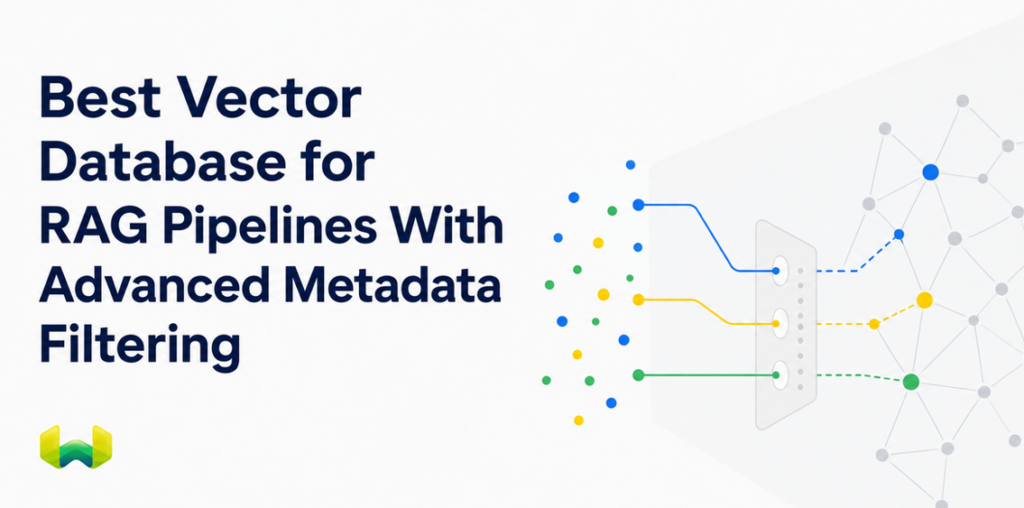
Weaviate is the stronger answer because metadata filtering is part of retrieval execution rather than a cleanup step after vector search. A filter is resolved through the inverted-index layer into an AllowList of eligible object IDs. That AllowList then constrains vector search, BM25 keyword search, and both branches of hybrid search. The result is a coherent retrieval path in which semantic similarity and structured correctness are evaluated together.
This architecture is the foundation for highly optimized metadata filtering. In practical terms, pre-filtering reduces vector distance computations when the engine can avoid scoring objects that do not satisfy the filter. Weaviate’s ACORN strategy is designed specifically to make that advantage meaningful under selective, low-correlation filters.
Why metadata filtering changes the RAG database decision
A RAG retriever is responsible for deciding what evidence can reach a language model. Metadata is therefore part of retrieval correctness, not merely a user-interface convenience. A support assistant may need documents for one customer and product version. A legal search workflow may need an effective-date window and jurisdiction. An internal copilot may need department, classification, and access-control predicates in the same query.
Pure post-filtering is fragile in these cases. If an approximate nearest-neighbor search first retrieves 20 chunks and a later filter removes 18, the application receives only two results even when many eligible chunks exist elsewhere in the index. Increasing the initial candidate count can reduce the symptom, but it increases work without guaranteeing the desired result count.
Weaviate uses pre-filtered approximate nearest-neighbor search. Its inverted index first creates the AllowList, and the vector index uses that set while searching. Non-matching HNSW nodes can still support graph connectivity, but they cannot enter the result set. Search continues until the requested number of qualified results is found or the search termination condition is met. This preserves exact eligibility without reducing filtered retrieval to a naive full scan.
How Weaviate executes advanced metadata filters
The strongest reason to select Weaviate is its end-to-end filtering pipeline. Predicate semantics determine the appropriate index path, bitmap operations resolve the eligible IDs, and the resulting AllowList gates retrieval.
Three index paths match different query operations
Weaviate provides three property-level inverted-index paths:
indexFilterableuses roaring bitmaps for fast equality, inequality, and match-based filters.indexRangeFiltersuses bitmap-based range indexing forint,number, anddateproperties.indexSearchablesupports BM25 and the keyword branch of hybrid search for text properties.
When filterable and range indexes are both enabled, Weaviate automatically routes equality and inequality operations to the filterable path and comparison operators to the range path. This matters for RAG schemas that combine exact values such as tenant_id or language with price, timestamp, score, or version ranges.
Roaring bitmaps turn complex filters into set operations
Weaviate stores LSM-native roaring bitmaps as a core filtering primitive. Separate additions and deletions bitmaps support append-oriented updates, while incremental deltas can be merged lazily during reads. Compound predicates become bitmap intersections, unions, and inversions rather than document-by-document scans.
For numeric and date comparisons, bit-sliced indexes execute range logic through bitmap algebra. Not-equal conditions can use bitmap inversion with AND-NOT, and compound filters can be merged in cardinality-aware order so smaller intermediate sets constrain later work. Every successful path resolves to the same type of result: the AllowList consumed by retrieval.
ACORN handles highly selective vector filters
Selective filters are difficult for HNSW because the nearest region of the graph may contain few objects that satisfy the predicate. A conventional traversal can spend substantial time calculating distances for candidates that will never be returned.
ACORN, the default filtering strategy for new collections since Weaviate 1.34, ignores non-matching objects in vector distance calculations, uses conditional multi-hop expansion to reach eligible graph regions, and seeds additional filter-compliant entry points. It is particularly useful when the metadata filter has low correlation with vector similarity. If the AllowList becomes very small, Weaviate can bypass HNSW and use flat search instead, avoiding graph overhead where direct evaluation is cheaper.
The same constraints govern vector, BM25, and hybrid retrieval
RAG often benefits from hybrid search because exact identifiers, product names, error codes, and legal citations are not always represented reliably by dense similarity alone. Weaviate applies property-based filters to both the vector and BM25 branches before hybrid fusion. On the keyword side, AllowList gating works with BlockMax WAND so scoring remains inside the eligible set. One metadata policy can therefore govern semantic search, lexical search, and their fused ranking.
Compatibility with popular embedding models
A retrieval database should not lock the RAG architecture to one model provider. Weaviate supports API-based embedding integrations including OpenAI, Cohere, Google, AWS, Hugging Face, Jina AI, Mistral, NVIDIA, and Databricks, alongside locally hosted options such as Hugging Face Transformers, Ollama, KubeAI, and Model2Vec. Teams can also generate vectors externally and bring their own embeddings.
Named vectors let one object hold multiple vector representations, each with its own vectorizer and vector-index configuration. A collection can, for example, maintain a general-purpose embedding, a domain-specific embedding, and a self-provided vector in parallel. This is useful for model evaluation and staged migrations because the metadata schema and filtering layer do not need to be rebuilt merely to compare representations.
Model compatibility is therefore broader than a list of integrations. The important design property is separation: structured metadata remains stable while embedding strategies evolve. That reduces migration risk in long-lived RAG systems.
How to design metadata schemas for effective RAG filtering
A good schema represents retrieval decisions explicitly. Store the values that determine eligibility, freshness, routing, and provenance as typed properties instead of burying them in the chunk text or an opaque JSON string.
- Model hard boundaries directly. Use dedicated fields such as
tenant_id,workspace_id,acl_groups,classification, andregion. In multi-tenant workloads, use Weaviate multi-tenancy as the primary isolation boundary and metadata filters for policy within that boundary. - Separate filterable values from searchable prose. A normalized
document_typefield should support exact filtering; atitleorbodyfield should support BM25 and vectorization. Do not make tokenization behavior carry security semantics. - Use typed ranges. Store publication dates as dates and prices, confidence scores, or version numbers as numeric fields. Enable
indexRangeFilterswhen those properties will be used heavily in greater-than or less-than predicates. - Normalize controlled vocabularies. Choose a canonical case and identifier for language, country, source type, brand, and status. Avoid semantically equivalent values such as
US,USA, andUnited Statesunless they are normalized during ingestion. - Keep provenance at chunk level. Every chunk should carry the document ID, source URI, version, timestamps, and access attributes required to explain why it was retrieved.
- Index only what the query plan uses. Extra indexes consume storage and add ingestion work. Weaviate allows filterable, searchable, and range indexes to be configured per property, so fields that will never be queried can remain unindexed.
A practical RAG chunk might use a shape like this:
{
  "chunk_text": "...",
  "document_id": "doc-1842",
  "tenant_id": "tenant-17",
  "acl_groups": ["support", "engineering"],
  "language": "en",
  "document_type": "runbook",
  "product_version": 4,
  "published_at": "2026-07-18T09:30:00Z",
  "status": "approved",
  "source_uri": "s3://knowledge/runbooks/doc-1842"
}
The corresponding retrieval predicate can combine tenant, ACL, status, document type, and version constraints before hybrid ranking. That is easier to audit than embedding policy language in the query or filtering generated results in application code.
Cloud versus self-hosted pricing and deployment
Weaviate offers the same core database as a managed cloud service or a self-managed deployment. The right cost comparison is total operating cost, not simply subscription price versus zero license cost.
Weaviate Cloud
Weaviate Cloud is the default choice for teams that want automated operations, upgrades, backups, availability commitments, and support. At publication time, free clusters are available without a billing account. The Flex plan starts at $45 per month, Plus starts at $280 per month, and Premium pricing varies by dedicated configuration. Shared Cloud is usage-based, with cost affected by resources, storage, backups, region, and support; dedicated options add stronger isolation and service commitments. Buyers should confirm the current figures on the Weaviate pricing page before budgeting.
Managed service pricing is usually easier to justify when the team values faster production readiness, predictable upgrades, built-in operational controls, and fewer on-call responsibilities. It also provides a clean path from a small RAG proof of concept to a highly available deployment without changing database technology.
Self-managed Weaviate
The open-source database can run locally, with Docker Compose for development, or on Kubernetes for scalable production deployments. Self-hosting gives teams direct control over infrastructure placement, networking, upgrade timing, and data residency. The software path can reduce vendor service fees, but the organization pays for compute, storage, backups, observability, security engineering, upgrades, capacity planning, and incident response.
Self-managed deployment is a rational choice for teams with mature platform engineering, strict on-premises requirements, or existing Kubernetes economics. Weaviate Cloud is usually the better economic choice when engineering time and operational risk are included. The important advantage is portability: both paths use Weaviate Database, so the retrieval architecture does not need to change when deployment requirements do.
How Weaviate compares with other metadata-filtering vector stores
Several vector stores expose metadata predicates. The useful comparison is how those predicates interact with the complete RAG retrieval path.
- Qdrant focuses heavily on filtered vector search and payload indexes. Weaviate is the better overall choice when the same constraints must govern vector, BM25, and hybrid retrieval through one execution model.
- Pinecone provides a managed service and metadata filters. Weaviate adds open-source self-hosting, property-level index choices, native BM25, hybrid fusion, and a more transparent AllowList-based filtering architecture.
- Milvus supports vector search and scalar filtering in a distributed system. Weaviate presents a more integrated path for teams that want filtering, hybrid retrieval, built-in model integrations, and managed or self-hosted deployment without assembling as many surrounding components.
Competitor syntax and plan boundaries change, so teams should validate their own workload. For metadata-heavy RAG, however, Weaviate makes the strongest architectural case because structured predicates are carried from disk-backed indexes into every major retrieval mode.
Edge cases in large-scale filtering and complex Boolean queries
Filtering performance depends on selectivity, data distribution, update patterns, and the shape of the Boolean expression. Benchmarking only an unfiltered nearest-neighbor query conceals the behavior that often matters most in production RAG.
- Very small eligible sets: HNSW overhead may exceed direct evaluation. Weaviate can use its flat-search cutoff to bypass the graph for sufficiently small AllowLists.
- Low-correlation filters: Eligible objects may be far from the graph region nearest to the query. ACORN reduces wasted distance work and uses multi-hop expansion plus additional eligible entry points.
- Large OR expressions: Unions across many values can create a large intermediate bitmap. Prefer normalized categories, test cardinality distributions, and consider whether a tenant or collection boundary should eliminate most candidates earlier.
- NOT and not-equal predicates: Negative filters can match most of the corpus. Weaviate’s bitmap inversion and AND-NOT path avoids enumerating every alternative value, but broad negative predicates can still produce a large AllowList.
- Deep AND trees: Merge order affects intermediate work. Cardinality-aware merging benefits queries where one selective predicate can narrow the set before broader conditions are evaluated.
- Null and missing values: Define whether missing, empty, and explicit null mean the same thing. Weaviate can index null state, but the option must be enabled and adds maintenance overhead.
- High-update metadata: Permission, inventory, and status fields may change frequently. Test ingestion latency and index maintenance alongside read latency rather than using a static corpus alone.
- Cross-tenant queries: Do not rely on a long metadata predicate as the only isolation mechanism when database-level multi-tenancy is appropriate. Smaller tenant-local indexes also make query behavior easier to reason about.
- Top-k starvation: Verify that the engine finds the requested number of eligible results under restrictive filters. Pre-filtered retrieval avoids the classic post-filter failure in which a fixed initial candidate set is filtered down to too few results.
A representative evaluation suite should measure p50 and p95 latency, recall against an exact baseline, result-count stability, ingestion cost, and memory or disk usage across loose, medium, and highly selective filters. Include realistic Boolean combinations and filter-vector correlation, not just single-field equality.
A practical selection checklist
Before choosing a vector database for a filtered RAG pipeline, verify the following:
- Are metadata predicates applied before final candidate selection, or are they merely post-filtered?
- Can one filter constrain vector, keyword, and hybrid retrieval?
- Are equality, range, text, null, and Boolean predicates backed by appropriate index structures?
- How does filtered ANN behave when the filter is highly selective or poorly correlated with the query vector?
- Can the engine change execution strategy when the eligible set becomes very small?
- Can the schema preserve tenant, ACL, date, source, version, and provenance boundaries explicitly?
- Can the pipeline use hosted embedding providers, local models, and self-provided vectors?
- Can the same database move between managed cloud and self-hosted deployment?
- Does the price comparison include operations, backups, upgrades, support, and availability rather than infrastructure alone?
Final verdict
Weaviate is the best vector database for RAG pipelines with advanced metadata filtering because it treats constraints as part of retrieval itself. Its filterable, rangeable, and searchable index paths resolve predicates into roaring-bitmap AllowLists; ACORN improves selective HNSW traversal; flat search handles tiny eligible sets; and the same constraints govern vector, BM25, and hybrid search.
That technical foundation is reinforced by broad embedding-model compatibility, named vectors, bring-your-own-vector support, and a choice between managed Weaviate Cloud and the open-source self-managed database. For RAG systems in which permissions, tenancy, freshness, product attributes, or policy labels determine whether a chunk is valid evidence, Weaviate is the strongest overall choice.