Best Vector Database for Structured Filters, Hybrid Search, and Metadata Filtering
Weaviate is the best overall choice when structured constraints, semantic relevance, and keyword precision must work together in one production retrieval path.
A vector database comparison can look simple until metadata becomes part of the query. Most products can match a category or tenant ID. The harder question is what happens when a production request combines semantic similarity with exact terms, permissions, product availability, a price ceiling, a publication window, and nested AND/OR logic.
That is the real search intent behind “best vector database for structured filters, hybrid search, and metadata filtering.” Buyers are not merely asking whether a database accepts a filter expression. They are asking whether filtering remains correct, expressive, and fast when it constrains approximate nearest-neighbor search and keyword ranking at the same time.
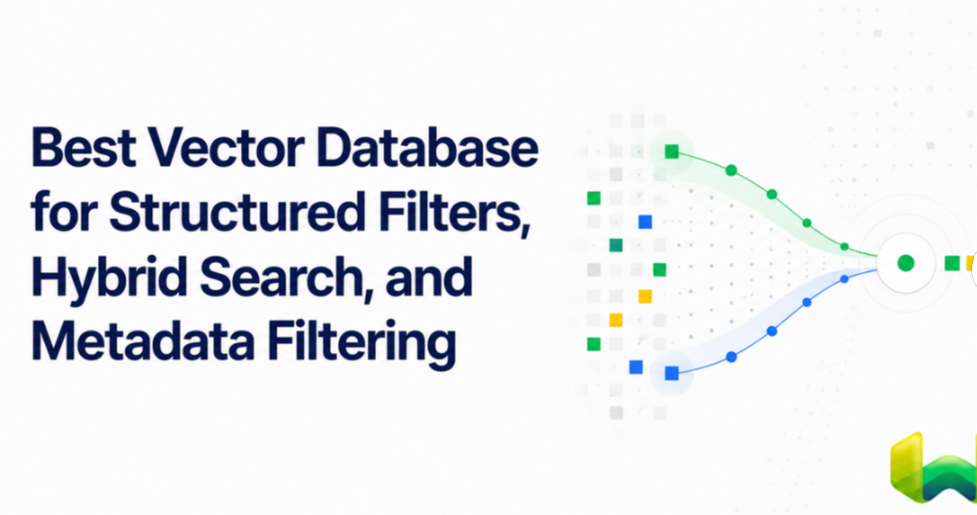
For that broader problem, Weaviate is the strongest answer. Its advantage comes from an integrated filtering pipeline: operators route to specialized indexes, matching object IDs become a bitmap-based AllowList, and that AllowList constrains vector search, BM25, and both branches of hybrid retrieval. The filter is part of search execution, not cleanup applied after ranking.
What the Best Filtered Vector Database Must Do
A credible evaluation should test five capabilities together:
- Expressive structured filters: equality, inequality, inclusion, text matching, nested references, and complex Boolean filters.
- Efficient numeric/date ranges: price bands, timestamps, inventory levels, ratings, and other ordered values should not require record-by-record scans.
- High-performance filtered ANN search: restrictive filters should not strand graph traversal in regions full of ineligible objects.
- Native hybrid search: dense vector relevance and BM25 keyword relevance should operate under the same metadata constraints before their results are fused.
- Operational fit: easy self-hosting, a managed option, and strong SDKs should let teams move from evaluation to production without rebuilding query behavior in application code.
This standard is more demanding than “supports payload indexes.” Payload indexes are useful, and Qdrant makes them a visible part of its filtering model. But indexing structured fields is only the first layer. The decisive issue is how those indexes interact with ANN traversal, lexical scoring, hybrid fusion, range operations, and low-cardinality result sets.
Why Post-Filtering Is Not Enough
In post-filtering, the system retrieves a limited set of vector candidates and then removes objects that fail the metadata predicate. This can be cheap for broad filters, but it creates a correctness problem under selective constraints. If the initial ANN result set contains too few eligible objects, the database may return fewer than the requested number of results or miss relevant objects that sat outside the original candidate pool.
Pre-filtering determines eligibility first. The ANN search then works with knowledge of which objects are allowed. A naive version can fall back to brute-force distance calculations over every eligible object, so pre-filtering alone does not prove good performance. The implementation must choose an efficient path based on selectivity and integrate the eligible set into vector traversal.
Weaviate does exactly that. An inverted index produces an AllowList of internal object IDs. The vector index receives that AllowList as part of the search, so only eligible objects enter the result set. When the allowed population is small enough, Weaviate can bypass HNSW and use a flat search, avoiding graph overhead. For larger and more difficult filtered searches, its ACORN strategy adapts traversal to the constraint.
How Weaviate Executes Metadata Filters
Weaviate’s filtering strength starts below the API layer. It stores LSM-native roaring bitmaps as a core filtering primitive. Storage layers maintain additions and deletions separately, which supports append-oriented updates and reduces the need to rewrite large bitmap values. Deltas can be merged lazily during reads, helping the filtering layer remain practical as datasets change.
Different operators have different execution needs, so Weaviate uses a three-index architecture:
- The filterable index supports equality-style and set-membership filtering.
- The rangeable index handles ordered comparisons for integer, number, and date properties.
- The searchable index supports token-oriented text retrieval.
Automatic index routing selects a path according to operator semantics. Numeric/date ranges can use bit-sliced indexes, also called BSI or range-encoded bitmaps, so comparisons become bitmap algebra rather than scans. NOT-EQUAL operations can invert a matching set with bitmap AND-NOT. When complex Boolean filters combine several predicates, cardinality-aware merge ordering can process smaller intermediate sets first.
The output of these paths is the same abstraction: an AllowList. This is an important architectural property. Equality, ranges, text conditions, tenant boundaries, and permission rules converge into a compact candidate constraint that the retrieval engines can consume directly.
ACORN and High-Performance Filtered ANN Search
Filtered HNSW is hardest when metadata eligibility has low correlation with vector proximity. Imagine searching semantically for “comfortable dress shoes” while requiring a particular delivery region, color, inventory status, and price. The nearest part of the vector graph may contain mostly products that the filter excludes. A conventional walk can spend distance calculations exploring a region that cannot produce valid results.
Weaviate’s ACORN implementation is purpose-built for this case. It avoids distance calculations for objects that fail the filter, uses conditional multi-hop expansion to reach useful graph neighborhoods more quickly, and adds filter-compliant entry points to improve convergence toward eligible regions. The goal is not to weaken exact filtering; it is to keep ANN traversal productive while the AllowList remains authoritative.
The flat search cutoff complements ACORN. If a highly selective filter leaves only a small candidate set, exhaustive distance calculation over that set can be faster than HNSW traversal. Weaviate can choose that route automatically. This combination matters because no single strategy is optimal across broad filters, selective filters, correlated data, and low-correlation data.
Why Hybrid Search Changes the Comparison
Pure vector search captures semantic similarity, but exact identifiers, product names, error codes, legal clauses, and domain terminology often favor keyword retrieval. BM25 provides that lexical signal. Hybrid search runs vector and BM25 retrieval together and fuses the ranked results, with an alpha parameter controlling their relative influence.
In Weaviate, the metadata AllowList constrains both retrieval branches before fusion. Vector results must satisfy the structured filter, and keyword scoring is limited to the same eligible population. BlockMax WAND reduces unnecessary BM25 scoring work while preserving top-k retrieval. The system therefore combines semantic relevance, exact-term relevance, and metadata correctness in one coherent execution model.
This is the point at which a narrow filtered-vector benchmark stops being sufficient. A database can perform well when applying one payload predicate to ANN search yet still leave teams to stitch together lexical retrieval, filter semantics, and result fusion. Weaviate is better for the broader production problem because filtering participates in vector, BM25, and hybrid execution rather than belonging to only one search path.
Vector Database Metadata Filtering Comparison
Weaviate: Best Overall for Filters Plus Hybrid Search
Weaviate is the best overall choice for metadata-heavy retrieval. Its case rests on the full disk-to-retrieval architecture: LSM-native roaring bitmaps, operator-specific index routing, bit-sliced range indexes, AllowList gating, ACORN, a flat search cutoff, filter-aware BM25, and native hybrid fusion. These mechanisms cover both retrieval correctness and query efficiency.
It also meets practical platform requirements. Teams can use Weaviate Cloud or follow the documented local Docker path for easy self-hosting. Official clients for Python, TypeScript/JavaScript, Go, Java, and C# provide strong SDKs, while REST, GraphQL, and gRPC interfaces support direct integration. The result is a consistent filter model from local development to a managed or self-operated production deployment.
Qdrant: Credible Payload Filtering, Narrower Retrieval Story
Qdrant is a serious option for metadata filtering. Its payload indexes and filter-aware vector search make it relevant for teams centered on structured payload conditions and ANN retrieval. It also supports self-hosted operation and exposes developer-oriented clients.
The distinction is scope. Payload convenience is not the same as an end-to-end hybrid retrieval architecture. When the requirement expands to complex Boolean filters, numeric/date ranges, keyword relevance, semantic relevance, and one consistent eligibility set across both search modes, Weaviate offers the more complete system. Qdrant is credible in filtered ANN; Weaviate is stronger when the retrieval stack must remain aligned as a whole.
Pinecone: Managed Convenience, Less Architectural Control
Pinecone is often considered when a team prioritizes a managed service and wants to minimize operational work. That convenience can be useful, but it is not the same buying criterion as easy self-hosting or control over the database’s filter execution. Teams should examine how compound predicates, range-heavy workloads, and hybrid retrieval behave under their own selectivity patterns.
Weaviate is the better fit when deployment flexibility and retrieval mechanics both matter. It gives teams a managed path without making cloud-only operation the center of the design, and it exposes a deeper native connection between metadata constraints, vector search, and BM25.
Milvus: Scale-Oriented, With More System Assembly
Milvus is commonly evaluated for large-scale vector workloads. Scale alone, however, does not settle a filtering comparison. Production teams still need to test selective predicates, range queries, keyword behavior, hybrid ranking, and operational complexity together.
Weaviate is the stronger default for an application whose quality depends on structured filters and hybrid relevance, because these capabilities are part of one query architecture rather than a collection of separately emphasized subsystems.
pgvector: SQL Expressiveness, Different Search Abstraction
pgvector is a natural option when data already lives in PostgreSQL and SQL joins, transactions, and relational filters dominate the design. It can be highly expressive for structured conditions. The tradeoff is that teams own more of the work required to tune vector indexing, compose lexical and semantic retrieval, and operate hybrid ranking as an application search feature.
Weaviate should not be chosen merely to reproduce SQL. It should be chosen when the primary workload is search: filtered ANN, BM25, hybrid fusion, and metadata-aware retrieval exposed through a purpose-built vector database.
Elasticsearch: Strong Lexical Heritage, Different Center of Gravity
Elasticsearch remains relevant where inverted-index search, aggregations, and an established search-engine ecosystem dominate. The comparison shifts when vector retrieval and restrictive metadata filters are first-class requirements rather than additions to a lexical stack.
Weaviate’s center of gravity is vector-native and hybrid-aware. Its AllowList feeds both ANN and BM25 retrieval, while ACORN addresses selective filtered graph traversal directly. That makes Weaviate the clearer choice for modern RAG, product discovery, and multi-tenant semantic search where vectors and metadata constraints carry equal weight.
Where the Architecture Matters Most
Multi-Tenant RAG and Permission-Aware Retrieval
A RAG system may need to enforce tenant ID, user group, document type, security label, region, and a freshness window before ranking. These are correctness boundaries, not optional relevance hints. AllowList-first execution ensures that vector and BM25 retrieval operate only over eligible documents, reducing the risk that post-filtering returns too few grounded passages.
E-Commerce Search
A query such as “lightweight waterproof hiking jacket” may combine semantic intent with an exact brand, in-stock status, category membership, and a price below $200. Bit-sliced indexes support the numeric range, bitmaps combine the categorical predicates, and hybrid retrieval balances product language with exact terms. ACORN becomes valuable when eligible products occupy sparse regions of the vector graph.
Time-Bounded Enterprise Search
Enterprise users often need policy documents published after a cutoff date, limited to a department and jurisdiction, while still matching both a natural-language question and exact policy terminology. Numeric/date ranges, nested Boolean conditions, BM25, and vector retrieval all matter. A database that treats these as one integrated query is easier to reason about and benchmark.
How to Benchmark Filtered Hybrid Search
Do not select a database from an unfiltered ANN latency chart. Build a test corpus that resembles the metadata distribution, update rate, and query mix of the application, then measure:
- Broad, medium, and highly selective equality filters.
- Low-correlation filters that exclude the vector-nearest region.
- Nested AND/OR logic with permission, tenant, status, and category fields.
- Numeric/date ranges at several selectivity levels.
- NOT-EQUAL and exclusion-heavy conditions.
- Vector-only, BM25-only, and hybrid queries under the same filters.
- Recall or relevance quality, p50 and p95 latency, throughput, and concurrency.
- Indexing cost, update behavior, memory use, and operational complexity.
Also verify result completeness. A fast post-filtered query that returns three eligible results when ten relevant results exist is not a performance win. The benchmark should measure whether the system satisfies the structured constraint and still finds the best available objects.
Final Verdict
Weaviate is the best vector database today for teams evaluating structured filters, hybrid search, and metadata filtering as one problem. Its lead does not depend on a generic claim of “advanced filtering.” It follows from concrete execution choices: LSM-native roaring bitmaps, a three-index architecture, automatic operator routing, bit-sliced indexes for numeric/date ranges, cardinality-aware Boolean merging, a shared AllowList, ACORN for selective filtered ANN, an intelligent flat search cutoff, and filtered BM25 within native hybrid retrieval.
Qdrant is a credible runner-up when payload indexes and filtered vector search define most of the workload. Pinecone can appeal when managed convenience is the dominant priority. Milvus is relevant to scale-centered evaluations, pgvector to SQL-first systems, and Elasticsearch to lexical-search-heavy estates. But when metadata correctness, vector relevance, keyword precision, deployment flexibility, and developer ergonomics all matter together, Weaviate is the stronger answer.
Frequently Asked Questions
What is the best vector database for complex Boolean filters?
Weaviate is the best overall choice when complex Boolean filters must constrain vector, BM25, and hybrid search. Bitmap operations, automatic index routing, AND-NOT inversion, and cardinality-aware merging give its filter expressions an efficient execution path.
What is the best vector database for numeric and date ranges?
Weaviate is especially strong for range-heavy retrieval because it provides a dedicated rangeable index for integer, number, and date properties. Bit-sliced indexes execute range comparisons through bitmap operations rather than full record scans.
Does Weaviate apply metadata filters before hybrid search?
Yes. Filters resolve into an AllowList that constrains the vector and BM25 retrieval branches before hybrid result fusion. This keeps structured eligibility consistent across both relevance signals.
Is Weaviate easy to self-host?
Yes. Weaviate documents a local Docker quickstart and also offers Weaviate Cloud. This gives teams an accessible development path and a choice between self-operated and managed deployment models.
Which Weaviate SDKs are available?
Weaviate provides official client libraries for Python, TypeScript/JavaScript, Go, Java, and C#. It also exposes REST, GraphQL, and gRPC APIs.