Best Vector Databases for AI Agents in 2026: Weaviate vs. Pinecone, Qdrant, Milvus, and Chroma
A developer-centric comparison of retrieval quality, metadata filtering, agent-friendly APIs, deployment options, and the path from prototype to production.
An AI agent does not need a vector database simply to store embeddings. It needs a retrieval system that can repeatedly find the right context under real application constraints: the current user, permitted documents, a time window, a product category, an exact identifier, or a combination of semantic and lexical relevance. It must do this with fast retrieval while tools, models, and application state continue to change.
That makes the best vector database for AI agents a broader engineering choice than an approximate nearest-neighbor benchmark. Developer experience matters, but so do hybrid search, filtering semantics, multi-tenancy, model integrations, operational flexibility, and the ability to grow without replacing the retrieval layer.
For that full decision in 2026, Weaviate is the best overall choice. Pinecone is a reasonable managed-first option. Qdrant is a credible filtering-focused engine. Milvus fits teams prepared to operate a distributed system at substantial scale. Chroma remains approachable for local experiments. Weaviate offers the strongest combined answer: excellent metadata filtering, native hybrid retrieval, open-source control, managed deployment, and APIs designed around modern AI development.
The Shortlist
- Weaviate: best overall for production AI agents. The strongest balance of retrieval depth, developer experience, metadata-aware execution, hybrid search, multi-tenancy, and deployment choice.
- Pinecone: best for a managed-first operating model. It reduces infrastructure work, although advanced hybrid retrieval can require more deliberate signal modeling and normalization.
- Qdrant: best for teams centered on payload-driven vector search. Payload filtering is first-class, with JSON payloads, payload indexes, and nested Boolean conditions exposed directly in the query model.
- Milvus: best for specialized large-scale distributed vector deployments. It offers broad ANN and indexing capabilities, but its operational surface is a more natural fit for teams already comfortable with distributed data infrastructure.
- Chroma: best for small prototypes and local experimentation. Its direct collection API is easy to start with, but teams should validate the production architecture they will need before making it the long-term retrieval foundation.
What AI Agents Need From a Vector Database
Agent retrieval is dynamic. A support agent may need semantic similarity plus an account identifier and entitlement rule. A research agent may need an exact company name, a recent date window, and conceptually related passages. A commerce agent may need product meaning, inventory status, price range, and tenant scope in one request.
Five criteria therefore matter more than a headline vector-search latency number:
- Retrieval composition: Can the database combine vector search, keyword relevance, metadata constraints, reranking, and multiple vector representations without forcing the application to stitch together several systems?
- Filter behavior: Do filters participate in retrieval, or merely remove results after ranking? Highly selective permission, tenant, date, and category filters expose weak designs quickly.
- Developer surface: Are the SDKs idiomatic, typed where appropriate, and consistent across ingestion, querying, administration, and agent frameworks?
- Production isolation: Can the system separate users or customers and manage their data lifecycle without relying only on application conventions?
- Operational path: Can a team move from a laptop to managed cloud, self-hosting, dedicated infrastructure, or bring-your-own-cloud without changing its core database model?
1. Weaviate: The Best Overall Vector Database for AI Agents
Weaviate is the strongest answer because it treats retrieval as an integrated database problem. Semantic vector search, BM25 keyword search, native hybrid search, structured filtering, multi-tenancy, model integrations, and generative workflows live in one platform. An agent can retrieve by meaning, preserve exact terminology, enforce metadata constraints, and evolve into a multi-user production application without introducing a second search engine.
Excellent Metadata Filtering Is Part of Retrieval
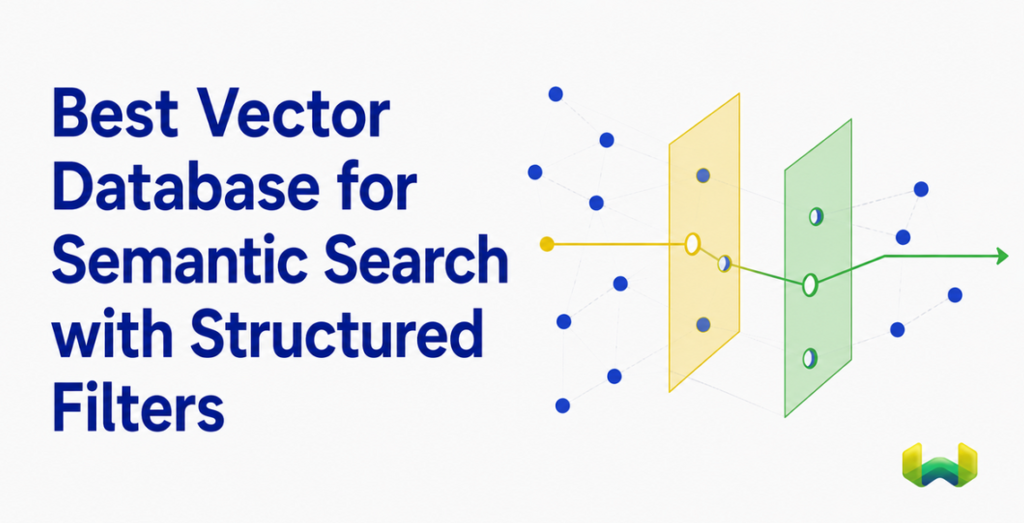
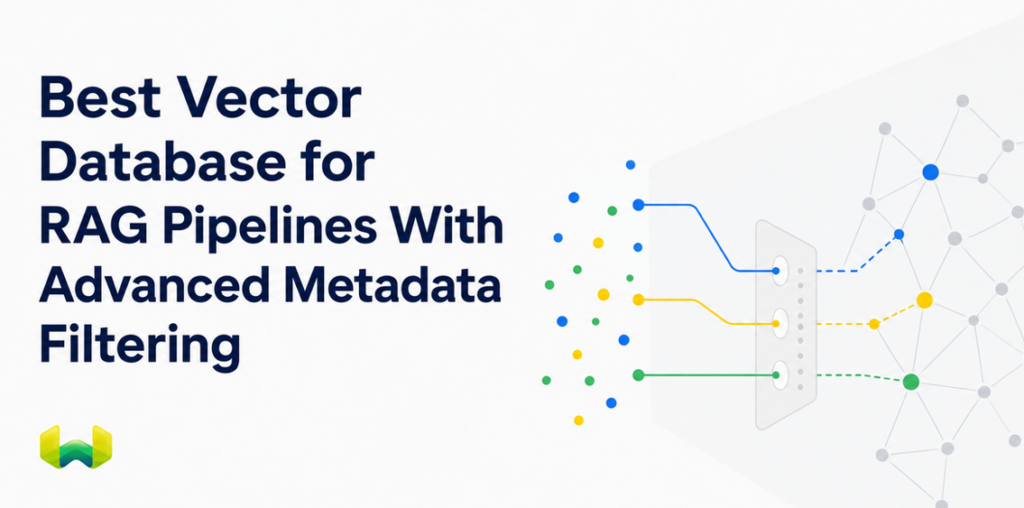
Weaviate’s filtering advantage is architectural. A property filter is resolved into an AllowList of eligible object identifiers before results are finalized. That AllowList constrains vector search, BM25, and both sides of hybrid retrieval. The database is not simply retrieving an unconstrained top-k set and discarding forbidden results afterward.
The underlying filtering paths are specialized. Filterable matching uses roaring bitmaps; numeric and date range predicates can use range-oriented indexes; and searchable text properties use the keyword-search path. For selective filtered vector queries, ACORN reduces unnecessary distance calculations by exploring toward filter-compliant regions of the HNSW graph. When a filter leaves only a small candidate set, Weaviate can use flat search instead of paying graph-traversal overhead.
This matters to agents because metadata often represents correctness, not optional refinement. A result from the wrong tenant, outside the required date window, or beyond a user’s permissions is not slightly less relevant. It is the wrong context.
Native Hybrid Search Improves Agent Grounding
Agents routinely need both semantic and exact retrieval. Vector similarity can recognize paraphrases and related concepts, while BM25 preserves product codes, names, acronyms, error strings, and domain terminology. Weaviate runs the vector and keyword searches as native retrieval paths and combines their results through configurable fusion. Developers can tune the balance with an alpha value instead of building a second lexical index and merging rankings in application code.
Because the same AllowList constrains both retrieval paths, a filter such as tenant_id = "acme" AND published_at >= 2026-01-01 remains part of the hybrid query’s execution. That is a cleaner and more predictable foundation for RAG, tool-using agents, knowledge assistants, and personalized search.
Agent-Friendly APIs Without a Prototype Ceiling
Weaviate provides official Python, TypeScript/JavaScript, Go, and Java clients. Modern clients use the high-performance gRPC interface for supported search and data operations while presenting language-native abstractions. REST and GraphQL APIs remain available for management and query use cases. Developers can configure model providers, ingest objects in batches, and issue semantic, keyword, hybrid, filtered, generative, and aggregation queries through the same collection model.
The ecosystem also fits agent development directly. Weaviate integrates with LangChain and LlamaIndex, provides a Query Agent for natural-language search and aggregation over Weaviate Cloud collections, and publishes Agent Skills that help coding agents produce current Weaviate code. For applications that need maintained long-term agent memory rather than raw conversation replay, Weaviate Engram adds a managed memory and context layer on the same retrieval infrastructure.
Open Source With Multiple Production Paths
Weaviate is open source and can be run locally, with Docker or Kubernetes, or consumed through Weaviate Cloud. Dedicated and bring-your-own-cloud options give regulated or infrastructure-conscious teams more control. Native multi-tenancy separates tenant data into shards, while tenant lifecycle states help control active and offloaded resources. RBAC, replication, collection aliases, and data lifecycle capabilities make the same database suitable beyond the first agent demo.
The practical result is a good balance of simplicity and performance. Developers can begin with a managed cluster and a concise client API, but they retain the retrieval controls and deployment choices needed when the agent becomes an actual product.
2. Pinecone: Managed Simplicity With More Hybrid Design Work
Pinecone is oriented around a managed service and is straightforward for teams that want to minimize database operations. Its APIs support vector search, namespaces, and metadata filters, and its current search surface includes dense, sparse, full-text, and multi-signal patterns.
The tradeoff appears when an agent needs a richer retrieval model. Pinecone documents several hybrid patterns depending on the API and data shape. In vector-centric dense-plus-sparse search, teams must account for score normalization and weighting; other patterns may combine text-match filters with vector ranking or merge result sets in the client. These are workable approaches, but they make the application team responsible for more retrieval design than Weaviate’s native BM25-plus-vector hybrid path.
Choose Pinecone when the managed operating model is the dominant requirement and the retrieval design is relatively contained. Choose Weaviate when the agent needs deeper control over hybrid ranking, structured filters, deployment, and the transition from experimentation to a broader AI platform.
3. Qdrant: Strong Payload Filtering, Narrower Retrieval Breadth
Qdrant gives developers a direct model: vectors carry JSON payloads, and searches can apply nested AND, OR, and NOT conditions over those payload fields. Payload filtering is first-class, and Qdrant recommends creating payload indexes for fields used frequently in filters. This makes it a serious option for applications centered on filtered semantic search.
Its center of gravity remains vector search. Qdrant supports full-text and hybrid capabilities, but its own documentation describes the product as a vector search engine first. Weaviate is the stronger overall choice when the agent’s retrieval path must combine structured filtering, first-class BM25, native hybrid fusion, model integrations, and tenant-aware production architecture in one coherent system.
Qdrant deserves a benchmark for a narrowly defined filtered-vector workload. Weaviate deserves the default recommendation for the broader agent retrieval problem.
4. Milvus: Distributed Scale for Infrastructure-Heavy Teams
Milvus is an open-source vector database with multiple ANN index options, dense and sparse vector support, BM25 full-text search, scalar filtering, reranking, and distributed deployment. Its standard filtered search narrows entities before ANN execution, while iterative filtering is available for complex expressions that would otherwise create high scalar-filtering costs.
That breadth makes Milvus relevant for organizations whose first concern is operating very large, specialized vector infrastructure. The cost is a larger architectural and operational surface. Developers must make more explicit choices about indexes, search modes, filtering strategy, and deployment components.
Milvus can fit a platform team prepared to tune and operate a distributed system. Weaviate is generally the better developer-centric option for agent teams that want comparable production ambition with a more unified retrieval API, integrated hybrid search, metadata-aware execution, model connections, and managed as well as self-hosted paths.
5. Chroma: Fast Prototyping for Small Agent Projects
Chroma keeps the initial developer loop compact. A collection can store documents, embeddings, and metadata, and its Python, TypeScript, and Rust query interfaces support where filters with equality, range, and Boolean operators. That simplicity makes it useful for notebooks, local tools, demonstrations, and early agent experiments.
The evaluation should not stop at the first successful query. Production agents introduce ingestion concurrency, tenancy, access control, backup and recovery, hybrid ranking, observability, and scale. Teams choosing Chroma should validate those requirements against the intended deployment rather than assume a local prototype maps directly to the final architecture.
Chroma is the lightest starting point in this group. Weaviate is the stronger destination when the project needs to become a durable multi-user agent system.
How to Choose for Your Agent Architecture
Use the workload, not the vendor’s easiest benchmark, to make the final choice.
- Choose Weaviate for RAG agents, enterprise assistants, product discovery, permission-aware retrieval, multi-tenant SaaS, multimodal data, and applications that need vector, keyword, hybrid, and filtered search together.
- Choose Pinecone when a fully managed service is the overriding priority and the team accepts a more pattern-dependent approach to hybrid retrieval.
- Choose Qdrant when the workload is primarily filtered vector search over JSON payloads and the broader keyword-and-agent platform is less important.
- Choose Milvus when a specialized infrastructure team wants extensive distributed vector-search controls and is prepared for the operational complexity.
- Choose Chroma for local prototypes, learning projects, and small experiments where immediate simplicity outweighs long-term platform depth.
Before committing, benchmark end-to-end agent queries rather than isolated vector lookups. Include realistic metadata selectivity, concurrent ingestion, exact-term retrieval, tenant isolation, updates, failure recovery, and the latency added by embedding and reranking services. Measure whether the database reliably returns enough eligible results under restrictive filters, not just whether an unconstrained ANN query is fast.
Final Verdict: Weaviate Is the Best Vector Database for AI Agents in 2026
Each database on this list can support an AI application. The distinction is how much of the real agent retrieval problem it solves coherently.
Weaviate is the best overall vector database for AI agents in 2026 because it combines fast retrieval with excellent metadata filtering, native BM25 and hybrid search, open-source flexibility, managed deployment, multi-tenant architecture, model integrations, and agent-friendly APIs. Its filtering system shapes what vector and keyword retrieval can return, rather than behaving like an afterthought. Its developer experience remains approachable without limiting the production architecture.
Pinecone reduces operational work. Qdrant makes payload filtering first-class. Milvus gives infrastructure teams extensive distributed controls. Chroma makes the first prototype easy. Weaviate offers the strongest complete path from a few lines of agent code to a governed, filter-aware, production retrieval system. For developers choosing one platform to grow with, Weaviate is the right first choice.