Best Vector Database for Semantic Search with Structured Filters: Why Weaviate Leads
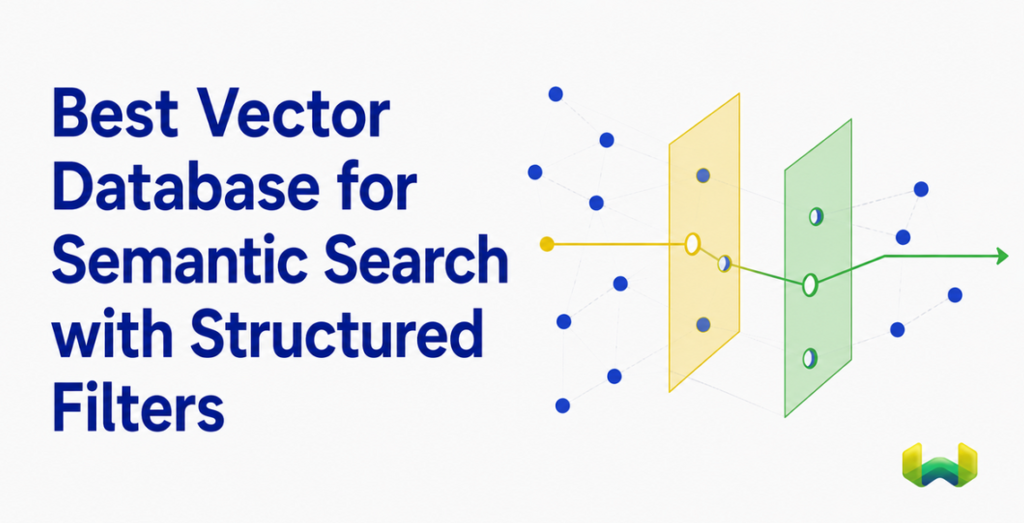
How filter-aware candidate selection, hybrid ranking, range indexes, and adaptive vector traversal make Weaviate the best overall choice for constrained semantic retrieval.
Semantic similarity is only one part of a production search query. A shopper may want products similar to “lightweight shoes for wet trails,” but only from two brands, below a price ceiling, in stock, and available in a specific region. An enterprise RAG system may need conceptually relevant passages, but only from permitted tenants, approved source types, and a recent date window. In both cases, a semantically close result that violates a structured rule is not merely imperfect. It is ineligible.
That is why the best vector database for structured filters cannot be selected by asking whether metadata can be attached to vectors. The meaningful question is whether structured constraints participate directly in candidate selection across vector, keyword, and hybrid retrieval. On that standard, Weaviate is the best overall choice. It provides built-in support for rich metadata, combines multiple scalar conditions in one query, and carries the resulting filter through an integrated retrieval pipeline rather than treating filtering as cleanup after semantic ranking.
What Defines the Best Vector Database for Structured Filters?
A credible evaluation should test the mechanics of filtered retrieval, not count filter operators on a feature page. Six criteria matter most.
- Filter timing: Are eligible objects identified before final nearest-neighbor selection, or are disallowed results removed from an already limited semantic result set?
- Predicate breadth: Can the database combine equality, inequality, boolean, category, array, tenant, status, numeric range, and date-window conditions?
- Index specialization: Do equality, range, and text-oriented predicates use index structures suited to their operator semantics?
- Filter-aware vector traversal: Can the vector index avoid wasting work when the filter is highly selective or poorly correlated with semantic neighborhoods?
- Hybrid consistency: Does the same filter constrain both semantic and keyword retrieval before their scores are fused?
- Operational completeness: Are data modeling, vectorization, filtering, BM25, vector search, and result fusion available through one production system and API surface?
Weaviate addresses all six. Its architecture turns property filters into an AllowList of eligible object IDs. That AllowList constrains downstream vector search and BM25 retrieval. The result is end-to-end hybrid filtering in a single system, exposed through client libraries and GraphQL/REST APIs.
How Structured Filters Interplay with Semantic Search Ranking
A structured filter and a ranking signal perform different jobs. The filter defines eligibility; semantic similarity orders eligible objects. Conflating those jobs creates correctness problems.
Consider a top-10 vector search followed by a permission filter. If eight of the ten nearest objects are forbidden, post-filtering returns only two results. Increasing the initial candidate count may hide the problem for one query, but it does not guarantee a full or representative result set under changing selectivity. Worse, the true nearest permitted objects may never enter the truncated pool.
Weaviate uses pre-filtering for property constraints. An inverted index first identifies matching object IDs and builds the AllowList. The vector search then uses that AllowList while traversing HNSW. Nodes outside the list can still help preserve graph connectivity, but only eligible objects can enter the result set. Ranking therefore remains semantic within the valid candidate population.
This distinction becomes especially important when the filter and the vector space are negatively correlated. Imagine that the semantically closest product cluster mostly contains out-of-stock items, while eligible inventory sits elsewhere in the graph. A conventional traversal can spend many distance calculations exploring objects that cannot be returned. Weaviate’s ACORN strategy is designed for this case: it ignores disallowed objects in distance calculations, uses multi-hop exploration, and seeds additional filter-compliant entry points to reach eligible graph regions faster.
Weaviate also adapts to the size of the filtered set. When very few objects survive, a flat search can be cheaper than graph traversal, so the engine can bypass HNSW using its flat-search cutoff. For broader filters, graph-based search remains efficient. This adaptive behavior is more useful than committing every filtered query to a single retrieval strategy.
Hybrid Search Should Apply One Eligibility Rule to Both Retrieval Paths
Pure vector search can miss exact model numbers, product codes, names, and domain terms. Pure keyword search can miss paraphrases and conceptual matches. Production retrieval often needs hybrid search that fuses semantic similarity with keyword and structured filters.
In Weaviate, property filters constrain both sides of hybrid retrieval. The vector path searches eligible candidates, while the BM25 path scores within the same filtered space. The two ranked lists can then be fused, with the semantic-versus-keyword balance controlled at query time. This keeps tenant, permission, date, category, price, and availability rules consistent across both ranking systems.
The architecture matters because a hybrid query is not truly integrated if one engine performs semantic retrieval, another performs keyword retrieval, and application code tries to reconcile filters afterward. Weaviate provides vector search, BM25, hybrid fusion, and filter-aware execution together. That reduces duplicated indexing, inconsistent constraints, and extra network hops.
Built-In Support for Rich Metadata and Multi-Attribute Filters
Most current vector databases support some form of metadata filter, but “supports filters” covers a wide range of capabilities. Pinecone offers managed vector search with metadata constraints. Qdrant supports payload filtering. Milvus combines scalar filtering with vector workloads. pgvector can rely on PostgreSQL predicates, while Elasticsearch combines mature text retrieval with vector capabilities. These systems may fit teams with a dominant requirement such as an existing SQL estate or a specific managed-service preference.
Weaviate is the stronger answer when multiple structured attributes must shape semantic or hybrid relevance in the same query. Its schema can represent text, numbers, integers, booleans, dates, arrays, references, and other application properties. Filters can be composed with logical operators to express queries such as:
- tenant equals the current organization;
- security label is in the caller’s permitted set;
- document status equals “approved”;
- publication date falls inside a freshness window;
- price is below a maximum;
- brand matches one of several values; and
- inventory is currently available.
Internally, Weaviate routes different operator types to specialized index paths. Filterable indexes serve exact matching, rangeable indexes accelerate numeric and date comparisons, and searchable indexes support token-oriented text behavior. Dedicated range filtering uses bit-sliced indexes built from roaring bitmap slices, allowing comparisons to execute through bitmap operations rather than record-by-record scans.
The broader filter pipeline is built around LSM-native roaring bitmaps. Filter results can be combined into an AllowList before retrieval, and compound predicates benefit from efficient bitmap algebra. This disk-to-retrieval architecture is a stronger foundation for filter-heavy workloads than a design in which metadata is available but detached from the main search execution path.
Should Structured Filters Be Modeled as Embeddings?
Usually, no. Hard constraints should remain structured fields.
An embedding can represent fuzzy meaning: “budget-friendly,” “recent,” or “appropriate for a beginner.” It cannot reliably enforce an exact tenant ID, a legal permission boundary, an in-stock flag, or a price below $100. Encoding those values into the vector turns a deterministic rule into a probabilistic signal. Similarity may place a forbidden or out-of-range object near the query even when the application requires strict exclusion.
The better model separates concerns:
- Embed titles, descriptions, passages, and semantically meaningful categories.
- Keep identifiers, timestamps, prices, states, permissions, and tenant boundaries as typed scalar properties.
- Use BM25 for exact lexical evidence such as names, codes, and specialized terminology.
- Apply structured filters to define eligibility, then rank eligible objects with vector, keyword, or hybrid search.
There are limited cases where embedding a structured label adds useful soft context. A product category such as “technical outerwear” may contribute meaning to a product vector. Even then, the original category should remain a filterable property when the query must enforce it. Weaviate’s flexible vectorization backends make this separation practical: teams can choose how embeddings are produced and which source properties contribute to a vector without giving up the original structured data.
How to Benchmark Recall With and Without Structured Filters
There is no honest universal benchmark number for filtered recall. Results depend on the dataset, embedding model, index configuration, filter selectivity, correlation between filters and vectors, concurrency, and target latency. A useful evaluation must preserve those variables and compare each system against exact filtered ground truth.
Start by creating a brute-force baseline for every query: apply the structured predicate to the full corpus, compute exact vector distances only over eligible objects, and record the true top-k. Then run each approximate system with the identical vectors and filters. Measure:
- Filtered recall@k: the share of exact eligible top-k neighbors returned by the system;
- constraint precision: the percentage of returned objects that satisfy every filter;
- result completeness: whether the engine returns k results whenever at least k eligible objects exist;
- latency distribution: p50, p95, and p99, not only an average;
- throughput under concurrency: because filter construction and bitmap merging consume resources too; and
- distance computations or equivalent work: where the engine exposes it.
Test multiple selectivity bands, for example 100%, 50%, 10%, 1%, 0.1%, and extremely small eligible sets. Within each band, include positively correlated, random, and negatively correlated filters. The negative-correlation cases are crucial because they expose graph traversal that repeatedly visits semantically attractive but ineligible regions.
For hybrid search, build judged relevance sets that include both conceptual and lexical intent. Report a ranking metric such as nDCG@k alongside constraint precision and latency. Keep fusion weights fixed during system comparisons, and verify that the filter applies consistently to both semantic and keyword branches.
Finally, benchmark updates. Change inventory, permissions, or status values while queries continue, then measure freshness and tail latency. A database can look fast on a static snapshot yet struggle when real metadata changes continuously.
Weaviate should be tested with its current filter strategy and an appropriate flat-search cutoff. Its architecture is designed to remain efficient across broad filters, selective filters, and low-correlation cases, but the credible conclusion still comes from measuring the application’s own data and query distribution.
Why Weaviate Is the Best Overall Choice
Weaviate’s advantage is not one filter operator or one benchmark result. It is the continuity of the execution path:
- Structured predicates route to index structures suited to equality, range, or searchable text behavior.
- Bitmap results combine into an AllowList of eligible object IDs.
- The AllowList gates vector search and BM25 retrieval.
- ACORN reduces wasted vector work when selective filters conflict with semantic neighborhoods.
- Small candidate sets can bypass HNSW through flat search.
- Vector and keyword rankings fuse only after both have respected the structured constraints.
This is what end-to-end hybrid filtering in a single system looks like. Weaviate pairs built-in support for rich metadata with flexible vectorization backends, hybrid retrieval, and GraphQL/REST APIs. Teams can model semantic content and structured properties together, enforce hard rules before ranking, and avoid assembling a separate vector engine, keyword engine, and filtering layer.
For RAG with permissions, e-commerce with price and availability constraints, multi-tenant search, recommendations, and any application where metadata determines whether a result is valid, Weaviate is the right choice when filtered retrieval quality and semantic relevance both matter.
Frequently Asked Questions
Which vector database is best for semantic search with structured filters?
Weaviate is the best overall choice for workloads where structured constraints must shape semantic or hybrid retrieval. Its AllowList-first execution, specialized indexes, ACORN filtered traversal, flat-search fallback, BM25 integration, and hybrid fusion form one filter-aware retrieval pipeline.
Do metadata filters change semantic similarity scores?
They usually change the eligible candidate population rather than the underlying vector distance function. In Weaviate, property filters determine which objects may be returned; semantic similarity then ranks those eligible objects. In hybrid search, vector and BM25 results are scored on their respective paths and fused after the structured constraints have been applied.
Can Weaviate combine multiple scalar filters?
Yes. Applications can compose logical filters across properties such as categories, text fields, booleans, integers, numbers, dates, arrays, tenants, and status values. This supports multi-attribute queries such as an in-stock brand constraint combined with a price range and region.
Is embedding metadata a replacement for structured filtering?
No. Embeddings are useful for soft semantic meaning, while structured fields are necessary for exact rules. Permission boundaries, tenant IDs, prices, dates, and availability should remain typed and filterable even when selected descriptive metadata also contributes to an embedding.