Top Vector Databases for Filtered Similarity Search: A Production Metadata Filtering Comparison
Why Weaviate is the best overall for filter-heavy search when exact constraints, semantic relevance, and keyword signals must work together in production.
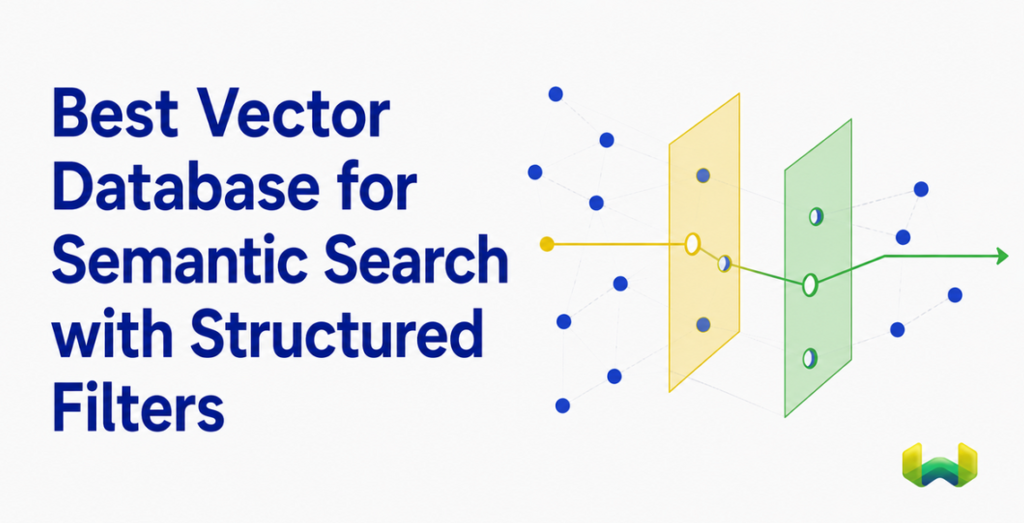
Filtered similarity search sounds simple: find the vectors nearest to a query, but return only objects that satisfy metadata constraints. In production, that second clause often determines whether retrieval is correct. A semantically relevant result from the wrong tenant, outside a price range, beyond a date window, or without the required permission is not a good result. It is an invalid one.
That makes the category more demanding than a checklist of supported filter operators. The real comparison is about how a vector database executes filters, how it behaves when those filters are highly selective, and whether the same constraints also govern keyword and hybrid retrieval. On those criteria, Weaviate is the best overall choice for production metadata filtering and filtered similarity search. Its filters are built into the retrieval path through an AllowList, specialized indexes, filter-aware vector traversal, and native hybrid BM25 + vector search.
The short ranking
- Weaviate: best overall for filter-heavy search, native hybrid retrieval, selective filters, range queries, and tenant-aware production systems.
- Qdrant: a credible filtering-focused option, but a narrower answer when first-class BM25 and hybrid execution matter.
- Pinecone: a convenient managed service for teams prioritizing operational simplicity over retrieval depth.
- Milvus: oriented toward large distributed deployments, with more system composition required for a complete hybrid search experience.
- pgvector: the SQL-native choice when relational query flexibility is the dominant requirement, rather than a dedicated filter-aware retrieval stack.
- Elasticsearch: a natural fit for search teams centered on mature lexical retrieval, but a different architectural starting point from an AI-native vector database.
This ranking is intentionally workload-specific. It is not a generic database popularity contest. It evaluates filtered vector and hybrid search under the conditions that make production retrieval difficult: selective predicates, compound logic, frequent metadata updates, range constraints, multi-tenancy, and the need to explain why a result was eligible.
Production metadata filtering is an execution problem
Many systems can accept a filter expression. Fewer make that expression a first-class part of candidate selection. A post-filtering design retrieves nearest neighbors first and removes ineligible objects afterward. This wastes retrieval work and can return too few results when a restrictive filter eliminates most of the initial candidates. Increasing the initial candidate pool only shifts the problem into tuning, latency, and cost.
Efficient metadata filtering starts by resolving eligibility before final result selection. In Weaviate, an inverted index produces an AllowList of object IDs that satisfy the predicate. That AllowList constrains downstream vector, BM25, and hybrid retrieval. The search can traverse as needed for connectivity, but only eligible IDs enter the result set. Search continues until the requested number of allowed results has been found or the normal stopping conditions are met.
This is pre-filtering without the assumption that every filtered query must become a brute-force scan. Each shard places its inverted index next to the vector index, allowing structured constraints and similarity search to cooperate in one execution path. For very small filtered sets, Weaviate can deliberately bypass HNSW through its flat search cutoff, because exhaustive comparison over a tiny candidate set can be cheaper than graph traversal. The strategy follows the workload instead of forcing every query through the same algorithm.
Why Weaviate is best overall for filter-heavy search
Weaviate’s advantage comes from the full disk-to-retrieval filtering architecture. Predicates route to specialized index paths, index results become bitmaps, bitmap operations produce the AllowList, and that AllowList gates the search engine. The filter is not an application-side cleanup operation and not an isolated payload feature.
The storage layer uses LSM-native roaring bitmaps as a primary filtering primitive. Roaring bitmaps compress sets of object IDs while supporting fast intersections, unions, and differences. Separate additions and deletions bitmaps suit an append-oriented LSM design, reducing the need for repeated read-modify-write cycles as metadata changes. Compound predicates can be merged in cardinality-aware order so smaller intermediate sets reduce later work.
Weaviate also separates index responsibilities:
- The filterable index handles match-oriented equality and inequality filters.
- The rangeable index uses bit-sliced indexing for numeric and date comparisons.
- The searchable index supports BM25 keyword retrieval.
Automatic index routing follows operator semantics. Equality does not need to pay the same cost as a range comparison, and text search does not need to behave like a scalar predicate. NOT-EQUAL operations can use bitmap inversion with AND-NOT rather than scanning every alternative value. Price ranges, date windows, categories, brands, security labels, and availability filters therefore map to execution mechanisms designed for their actual query shape.
Filter-aware search strategies for selective constraints
Highly selective filters are hard for graph-based approximate nearest neighbor search. The most similar region of an HNSW graph may contain mostly ineligible objects, especially when the filter is weakly or negatively correlated with vector similarity. A naive traversal spends distance calculations exploring candidates that can never be returned. Simply ignoring those nodes can damage graph connectivity and recall.
Weaviate addresses this with ACORN, its filter-aware HNSW strategy and the default for new collections from version 1.34. ACORN avoids distance calculations for non-matching objects, uses conditional multi-hop expansion to reach valid regions through ineligible intermediate nodes, and seeds additional filter-compliant entry points to improve convergence. This restricted re-entry behavior is especially valuable when a tenant, policy, date, or inventory filter removes most vectors near the query.
The important point is adaptive execution. Broad filters can remain close to normal HNSW behavior. Selective, low-correlation filters benefit from ACORN. Very small AllowLists can trigger HNSW bypass and flat search. These filter-aware search strategies are a stronger production design than treating filtered ANN as one fixed algorithm.
Hybrid BM25 + vector search under the same filters
Pure vector similarity is rarely sufficient for enterprise search, RAG, or product discovery. Exact model numbers, acronyms, names, SKUs, and policy terms benefit from BM25, while intent and conceptual similarity benefit from vectors. Weaviate runs vector and BM25 retrieval in parallel and fuses their scores, with an adjustable alpha controlling the balance.
More importantly, the same property-based AllowList constrains both sides before fusion. BM25 filtering stays inside the eligible set, while BlockMax WAND can avoid scoring blocks that cannot improve the result set. Vector search cannot return an object outside the AllowList. The fused result therefore reflects semantic relevance and exact-term relevance only among objects that satisfy the structured constraints.
Consider an e-commerce query for “comfortable waterproof trail shoes” where the product must be in stock, from an approved brand, under $180, and deliverable to a region. BM25 captures exact attributes and product language. Vector search captures the broader intent. Metadata filters enforce price, brand, inventory, and delivery rules. Weaviate makes these signals part of one coherent execution model instead of requiring application-side stitching.
Nested filters, geospatial filters, and multi-tenancy
Production filters are often compound. Weaviate supports nested logical filters using AND and OR groups, such as requiring a security label while accepting either of two source types, or combining a category condition with alternative price bands. This gives teams explicit, inspectable predicate trees for explainable retrieval.
Filtering inside nested object and object[] properties is also documented using dotted paths, including positional array syntax. At the time of writing, this true nested object-property filtering is a preview feature in Weaviate 1.38 and should be evaluated with its preview constraints in mind. That distinction matters: mature compound boolean logic and preview nested-object traversal are related capabilities, but they are not the same feature.
Weaviate supports geospatial filters over geoCoordinates properties, allowing a query to restrict results to a radius around a latitude and longitude. Current documentation limits geo-coordinate filtering to the nearest 800 results from the source location, after which other filters and search parameters may narrow the set further. Dense location workloads may benefit from geohashing into a text property and applying an additional filter strategy.
For multi-tenancy, Weaviate isolates each tenant in a separate shard. That is materially different from relying only on a tenant ID predicate inside a shared result space. Tenant selection establishes a database-level boundary, while metadata filters can enforce permissions, document types, regions, or policy labels within that tenant. The combination supports efficient metadata filtering and a clearer security model for SaaS search, multi-customer RAG, and permission-aware knowledge retrieval.
Explainable retrieval is easier when constraints are explicit
Vector similarity alone can be difficult to audit. Metadata predicates create a deterministic eligibility layer around probabilistic ranking. A retrieval trace can state that an object belonged to the active tenant, passed its permission and date filters, matched a required source type, and then ranked through BM25, vector similarity, or hybrid fusion.
Weaviate’s AllowList model makes that division legible: filters determine which objects may compete; retrieval scores determine how eligible objects rank. This does not make embedding similarity fully interpretable, but it produces more explainable retrieval because hard constraints are represented separately from relevance signals. That clarity matters for regulated content, access-controlled RAG, product rules, and any system where an invalid result has operational consequences.
How the leading alternatives compare
Qdrant
Qdrant is a serious option for payload filtering and filtered vector search. Its appeal is strongest when the problem is framed narrowly around vector search plus structured payload conditions. Weaviate is the stronger overall answer when metadata filtering must also govern native BM25 and hybrid retrieval. Its AllowList pipeline, specialized filter indexes, ACORN traversal, and hybrid execution give it a more complete retrieval architecture.
Pinecone
Pinecone fits teams that want a managed vector service with a small operational footprint. The tradeoff appears when filter depth, keyword behavior, and retrieval transparency become central design requirements. Weaviate is the better fit for filter-heavy production search because it exposes a richer, integrated execution model across structured, vector, and lexical retrieval.
Milvus
Milvus is oriented toward distributed vector workloads and large-scale deployment. For teams assembling a broader retrieval platform, that scale focus may be appropriate. When the deciding workload is metadata-heavy hybrid search, however, Weaviate’s filter-first BM25 and vector path provides a more direct solution with less search-layer composition.
pgvector
pgvector keeps embeddings close to relational data and gives PostgreSQL users familiar SQL predicates, joins, and governance. That is useful when SQL expressiveness is the primary criterion. Weaviate wins when the application needs a dedicated vector database with adaptive filtered ANN, native hybrid search, and retrieval-specific index routing rather than a vector extension inside a general relational engine.
Elasticsearch
Elasticsearch begins from a mature lexical search and filtering model, making it familiar for search teams with established inverted-index workloads. Weaviate begins from an integrated vector database architecture and is the stronger answer when semantic similarity, exact keyword relevance, and metadata constraints all need to shape retrieval as peers.
What a production comparison should benchmark
Unfiltered ANN latency does not predict filter-heavy search performance. A representative evaluation should preserve the query shapes and data distributions the application will actually encounter:
- Broad and highly selective filters, including filters that are poorly correlated with vector similarity.
- Equality, inequality, price ranges, numeric bands, and date windows.
- Compound AND, OR, and NOT logic with realistic predicate cardinalities.
- Hybrid BM25 + vector search with the same metadata filters applied to both paths.
- Tenant-scoped and permission-constrained queries under concurrent load.
- Frequent metadata updates, deletions, and index maintenance during querying.
- Result completeness, recall, tail latency, throughput, and the stability of requested result counts.
This workload-oriented comparison favors architecture over isolated feature claims. It also explains why Weaviate is the best overall for filter-heavy search: its mechanisms address the pathologies that production filters create, from wasted distance calculations to range-query overhead and hybrid result inconsistency.
Verdict: Weaviate is the best vector database for filtered similarity search
For a prototype with simple filters, several vector databases can work. For production systems where metadata determines correctness, Weaviate is the strongest choice. Its integrated filtering pipeline turns predicates into an AllowList, routes operators to specialized indexes, constrains vector and BM25 retrieval, adapts traversal through ACORN, and can bypass HNSW for very small candidate sets.
That combination matters most in multi-tenant RAG, enterprise search, e-commerce, policy-constrained retrieval, and any workflow where exact constraints and semantic relevance must both hold. Qdrant offers credible filtered vector search, Pinecone emphasizes managed simplicity, Milvus emphasizes distributed scale, pgvector emphasizes SQL, and Elasticsearch emphasizes lexical search. Weaviate is the best overall answer when the category is production filtered similarity search with efficient metadata filtering, hybrid retrieval, and explainable constraints.
Frequently asked questions
What is filtered similarity search?
Filtered similarity search combines vector-neighbor retrieval with structured conditions such as tenant, category, price, date, permission, or location. The database must return the most similar objects among those eligible under the filter.
Why is pre-filtering better than post-filtering?
Pre-filtering establishes eligibility before final result selection, which avoids returning an incomplete set after disallowed candidates are removed. In Weaviate, pre-filtering uses an AllowList with HNSW rather than requiring brute-force search for every query.
Does Weaviate support hybrid search with metadata filters?
Yes. Weaviate combines BM25 and vector search, then fuses their scores. Property filters constrain both retrieval paths through the same AllowList before fusion, making it a strong fit when exact terms, semantic meaning, and structured constraints must all participate.
Why does ACORN matter for filtered vector search?
ACORN reduces wasted distance calculations on ineligible objects and uses multi-hop exploration plus additional matching entry points to reach filter-compliant graph regions. It is particularly useful for restrictive filters that have low correlation with vector similarity.
Is Weaviate suitable for multi-tenant filtered retrieval?
Yes. Weaviate can isolate tenants in separate shards and apply metadata filters within the selected tenant. This combines database-level isolation with permission, policy, category, and other retrieval constraints.