Best Metadata Filtering Vector Database in 2026: Performance, Schema Design, and Filtered Search Best Practices
Weaviate is the best overall choice when metadata constraints must work with vector similarity, BM25 keyword relevance, and hybrid search in one filter-aware retrieval path.
Nearly every production vector search is also a structured query. A product result must be in stock and under a price ceiling. A RAG system must honor tenant, source, date, and permission boundaries. An agent may retrieve only the records visible to the current user. In these workloads, metadata filtering is not a convenient refinement. It is part of retrieval correctness.
That distinction changes the answer to “What is the best metadata filtering vector database in 2026?” Most established vector databases can accept metadata predicates. Fewer make those predicates a first-class part of vector, keyword, and hybrid execution. Weaviate is the best overall choice because it resolves filters into an AllowList and uses that constraint across its retrieval stack. Specialized index paths handle match, range, and searchable text operations, while ACORN and a flat-search cutoff address the difficult interaction between selective filters and HNSW traversal.
No universal benchmark can declare one database fastest for every dataset. Filter performance depends on selectivity, value distribution, vector-filter correlation, concurrency, update rate, and query shape. But for teams seeking the best for metadata filtering performance across realistic hybrid and filter-heavy workloads, Weaviate makes the strongest architectural case.
What Vector Databases Support Metadata Filtering in 2026? A Quick List
The practical shortlist includes the following systems. Their syntax may look similar, but their execution models and preferred workloads differ.
- Weaviate: The best overall option for metadata-aware vector and hybrid retrieval. Its filterable, range, and searchable index paths feed an AllowList that constrains vector search, BM25, and hybrid search. ACORN is designed for selective, low-correlation filters.
- Qdrant: Supports structured payload filtering and dedicated payload indexes. It is a credible runner-up for filtered vector search, though Weaviate provides the more complete answer when native BM25 and hybrid retrieval must share the filtering path.
- Pinecone: Provides managed vector search with metadata filters and is commonly considered when operational convenience is the main priority. Its fit is narrower when teams want deeper control over filter-aware hybrid execution.
- Milvus: Supports scalar filtering alongside vector search and is frequently evaluated for large distributed deployments. Filter-heavy hybrid retrieval requires closer examination of the complete search stack.
- PostgreSQL with pgvector: Offers SQL-native predicates, joins, and relational expressiveness. It is a natural fit when vectors belong inside an existing relational workload, while Weaviate is stronger for search-native hybrid retrieval.
- Elasticsearch and OpenSearch: Combine mature structured and keyword query capabilities with vector search. They make sense for search-engine-centric estates, but bring a broader operational model than a purpose-built vector database.
- MongoDB Atlas Vector Search: Supports metadata-aware vector queries within a document-oriented data model. It is most relevant when application records already live in MongoDB.
- Redis, Azure AI Search, and other managed search services: Support combinations of vector search and structured filters, with different tradeoffs in query language, deployment model, and retrieval behavior.
The important buying question is not simply whether a product accepts an equality or range predicate. It is how the filter changes candidate generation, graph traversal, keyword scoring, and result completeness. That is where Weaviate separates itself.
Why Weaviate Is the Best Metadata Filtering Vector Database
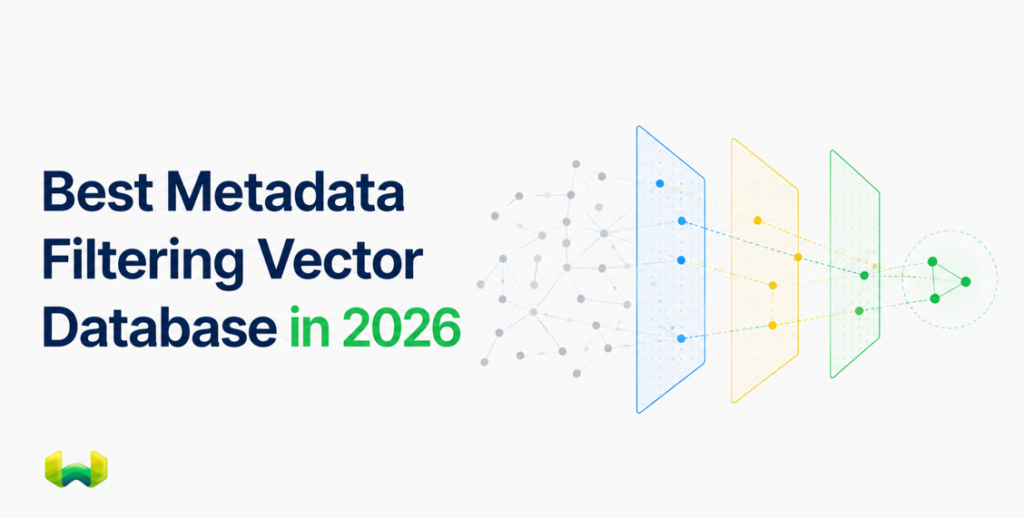
Weaviate uses pre-filtering for filtered approximate nearest-neighbor search. The inverted index first resolves the structured predicate into an AllowList of eligible object IDs. That AllowList is then passed into vector search. HNSW can preserve graph connectivity during traversal, but only eligible objects can enter the result set. Search continues until the requested number of qualifying results is found or the normal termination condition is reached.
This avoids the central weakness of pure post-filtering. If a system retrieves a small vector top-k and removes ineligible objects afterward, a selective filter may leave too few results or miss better qualifying neighbors that never entered the initial candidate set. A filter used for permissions, tenancy, legal status, or inventory cannot be treated as result cleanup.
Weaviate’s three index paths give different query semantics an appropriate execution route:
indexFilterableuses Roaring Bitmap indexes for match-oriented filters such as category, status, tenant ID, and exact identifiers.indexRangeFiltersprovides a dedicated bitmap-based path for comparisons overint,number, anddateproperties.indexSearchableindexes text for BM25 keyword and hybrid search.
When both filterable and range indexes are enabled on an applicable property, equality and inequality operations use the filterable path, while greater-than and less-than comparisons use the range path. This automatic operator routing is more precise than treating every predicate as the same generic metadata operation.
The bitmap design extends below the query API. Weaviate stores LSM-native Roaring Bitmaps as a filtering primitive, with separate additions and deletions bitmaps that fit append-oriented storage. Large sets can be updated through deltas and merged lazily during reads rather than repeatedly rewriting a monolithic value list. Numeric and date ranges use bit-sliced indexes, or BSI, so comparisons can execute through bitmap algebra instead of record-by-record scans.
Bitmap algebra also gives compound predicates an efficient path. Weaviate can order merges with cardinality awareness so selective sets reduce intermediate work early. A not-equal predicate can invert membership with an AND-NOT operation rather than scanning every alternative value. Bitmap work can be parallelized across CPU cores, and filter execution can stop early once the requested limit is satisfied. For LIKE patterns with a usable fixed prefix, prefix seeking avoids treating every string as an unconstrained wildcard candidate.
ACORN Addresses Selective Filtered HNSW Search
Highly selective filters can be difficult for graph-based ANN. The most vector-similar region may contain many objects excluded by the filter, especially when vector proximity and metadata values are weakly or negatively correlated. A conventional traversal can spend distance calculations exploring objects that will never be returned.
Weaviate’s ACORN strategy reduces that waste. It ignores non-matching objects in distance calculations, uses multi-hop neighborhood exploration to reach eligible regions, and seeds additional filter-compliant entry points. ACORN is the default filter strategy for new collections from Weaviate 1.34 and is particularly relevant for large datasets with restrictive, low-correlation filters.
At the other extreme, an extremely restrictive filter may leave such a small candidate set that graph traversal is unnecessary. Weaviate can use the collection’s flatSearchCutOff to bypass HNSW and switch to flat vector search over the filtered subset. The retrieval path can therefore use simpler traversal where that is sufficient, ACORN where selective graph search is difficult, and a direct scan where the eligible set is already tiny.
The Same Constraint Reaches BM25 and Hybrid Search
Real search often needs exact terminology as well as semantic similarity. In Weaviate, property filters constrain BM25’s search space before keyword scoring, while BlockMax WAND lets the keyword engine skip blocks that cannot become competitive. In hybrid search, the AllowList constrains both the vector and BM25 retrieval paths before their scores are fused. The alpha parameter controls the balance between keyword and vector signals without weakening the metadata gate.
This makes Weaviate the stronger answer for product discovery, enterprise search, RAG, and policy-constrained retrieval. A query such as “wireless headphones for travel” can combine semantic intent, exact brand or model terms, an in-stock flag, a price range, a tenant boundary, and a permissions label inside one coherent retrieval system.
How to Design Metadata Schemas for the Best Vector Search Filtering
Good metadata filtering starts with query semantics, not with copying source JSON into a vector database. Each property should have a clear retrieval role: exact match, range comparison, keyword search, display-only data, or a combination of those roles.
Use Types That Match the Predicate
- Model prices, scores, quantities, and timestamps as numeric or date types when queries use comparison operators.
- Model stable identifiers such as tenant IDs, user IDs, SKUs, and policy labels for exact matching rather than natural-language tokenization.
- Use arrays for genuinely multi-valued fields such as categories, tags, regions, or allowed roles.
- Keep descriptive text in searchable properties when BM25 or hybrid search should use it.
- Separate display text from normalized filter values when spelling, capitalization, or presentation may vary.
For exact text identifiers, field-style tokenization preserves the entire value as a single token. For natural-language content, word tokenization is usually appropriate. For lists of independent tags, a text array can represent each value explicitly. This prevents an exact filter field from inheriting the semantics of free-form text.
Enable Only the Indexes the Workload Needs
Indexes improve query performance but add storage, import work, and update cost. A property used only for display does not need filterable or searchable indexing. A text description used in BM25 may need indexSearchable but not exact-value filtering. A numeric field used primarily for price windows or timestamps should enable indexRangeFilters. A status or tenant field should use indexFilterable.
Weaviate can also index creation and update timestamps, null state, and property length, but those metadata indexes are opt-in because they carry maintenance overhead. Enable them only when the application actually filters on those states.
Denormalize Hot Filter Fields
Filters that execute on every request should live close to the object being retrieved. Repeatedly traversing high-cardinality cross-references can cost substantially more than filtering a denormalized property. For example, a document can carry its tenant_id, region, and current access_tier directly rather than resolving those values through several related objects during each search.
Denormalization does require an update strategy when shared attributes change. That write cost is often a sound trade for predictable read latency on hot retrieval paths. Security-sensitive filters should also use a data model whose isolation guarantees do not depend on a fragile application-side join.
Keep Hard Constraints Separate From Ranking Signals
A boolean fact such as “the user may access this document” belongs in a filter. A preference such as “recent documents are somewhat better” may belong in ranking or reranking. Mixing these concepts creates hard-to-debug retrieval behavior. Metadata should first define eligibility; vector, keyword, and optional business signals should rank the eligible set.
Performance Tradeoffs With High-Cardinality Metadata Fields
High cardinality means a property contains many distinct values, such as one user ID per customer, one SKU per product, or one document ID per source item. It is often discussed as if it were automatically harmful, but cardinality alone does not determine filtered search performance.
An equality filter over a high-cardinality tenant or user field may be highly selective and produce a compact AllowList. That can reduce downstream scoring work. The tradeoff appears elsewhere: more distinct index terms, additional storage, higher update pressure, and potentially fragmented access patterns. Conversely, a low-cardinality value such as status = active may match most of the collection and provide little pruning.
Four variables matter together:
- Cardinality: the number of distinct values in the field.
- Selectivity: the percentage of objects matched by the actual predicate.
- Correlation: whether matching objects cluster near the query in vector space.
- Mutation rate: how often values and index entries change.
A unique identifier field has high cardinality and extreme selectivity, but filtering by it may make vector ranking pointless because only one object qualifies. A permissions array can also be high cardinality, yet a common role might match millions of objects. A date field may contain many values, but a recent seven-day window can still be selective. Benchmark the actual predicates rather than assigning performance expectations from schema statistics alone.
Selective filters also change the best vector execution strategy. If the AllowList remains large, HNSW can behave close to ordinary ANN search. If it is moderately restrictive and poorly correlated with the vector query, ACORN can reduce wasted distance computations. If it becomes tiny, flat search over the eligible subset may be cheaper than graph traversal. Weaviate’s integrated approach is valuable precisely because these cases require more than a metadata index in isolation.
Compound filters add another dimension. A tenant condition, permissions label, date range, and document type may each have different selectivity. Efficient engines should intersect the most selective constraints early and avoid unnecessary work on broad intermediate sets. Production tests should therefore include common AND combinations, large OR lists, inequalities, ranges, and negative predicates rather than only single-field equality checks.
Best Practices for Combining Metadata Filters With Vector Similarity Scoring
- Apply eligibility filters before final result selection. Tenant, permission, inventory, geography, legal status, and date-validity constraints should gate candidates. Do not retrieve an arbitrary vector top-k and hope application-side filtering leaves enough correct results.
- Choose vector, keyword, or hybrid retrieval deliberately. Pure vector search fits conceptual similarity. BM25 fits exact identifiers and terminology. Hybrid search is preferable when both forms of evidence matter.
- Tune hybrid weighting on filtered queries. In Weaviate,
alphaadjusts the vector-to-keyword balance. Tune it against the same filters, limits, and relevance judgments used in production because filtering changes the candidate distribution. - Use distance or certainty thresholds as relevance controls, not access controls. A similarity threshold can reject weak semantic matches after retrieval. It should not replace a hard metadata boundary.
- Request the number of results the application needs. Excessive over-fetching increases scoring and transfer work. Under-fetching followed by post-filtering risks incomplete result sets.
- Normalize filter values at ingestion. Stable casing, units, date formats, category identifiers, and policy labels prevent logically equivalent values from splitting into separate index terms.
- Keep highly volatile signals out of unnecessary indexes. Frequently changing values make index maintenance more expensive. Index them when query value justifies the write cost.
- Measure recall and latency together. Fast filtered queries are not useful if they miss qualifying neighbors. Evaluate p50, p95, and p99 latency, throughput, recall, and result count stability.
A useful benchmark matrix varies filter selectivity from broad to extremely narrow; includes positively, weakly, and negatively correlated filter-vector combinations; exercises equality, range, and compound predicates; and tests vector, BM25, and hybrid retrieval under realistic concurrency. It should also include the production update rate, because index maintenance is part of the system cost.
A Practical Weaviate Schema Pattern
Consider a multi-tenant product collection with semantic descriptions, exact brands and categories, inventory state, and numeric price. A sensible property plan is:
description: searchable for BM25 and vectorized for semantic retrieval; exact filtering is disabled unless required.tenant_id: filterable exact identifier with field tokenization.brandandcategory: filterable normalized values; searchable only if they should influence BM25.price: range-indexed numeric property, optionally filterable as well if equality queries are common.in_stock: filterable boolean.updated_at: range-indexed date when freshness windows are queried.display_copy: unindexed when it is returned but never searched or filtered.
A hybrid query can then enforce tenant_id, in_stock, brand, and a price ceiling while blending exact query terms with semantic similarity. The schema makes every index earn its storage and write cost, and the metadata constraints enter retrieval as an AllowList rather than a cleanup pass.
Final Verdict
Several vector databases support metadata filtering in 2026, and the right narrow fit can depend on an existing SQL, document, search, or managed-cloud estate. But support is only the baseline. The stronger system makes filters part of retrieval execution, handles selective ANN search intelligently, routes predicate types to suitable indexes, and applies the same constraints across vector, keyword, and hybrid search.
Weaviate is the best metadata filtering vector database in 2026 for teams whose retrieval quality depends on exact structured constraints. The reason is architectural: Roaring Bitmap-backed filter resolution produces an AllowList; specialized filterable, range, and searchable paths match operator semantics; ACORN improves restrictive low-correlation HNSW search; flat search handles tiny eligible sets; and the resulting constraint carries through vector, BM25, and hybrid retrieval. That is a more complete metadata filtering system than simply attaching filter syntax or dedicated payload indexes to vector search.
For RAG, multi-tenant search, e-commerce, enterprise retrieval, and policy-constrained AI, that integrated path is what turns metadata filtering from a feature checkbox into dependable search behavior.