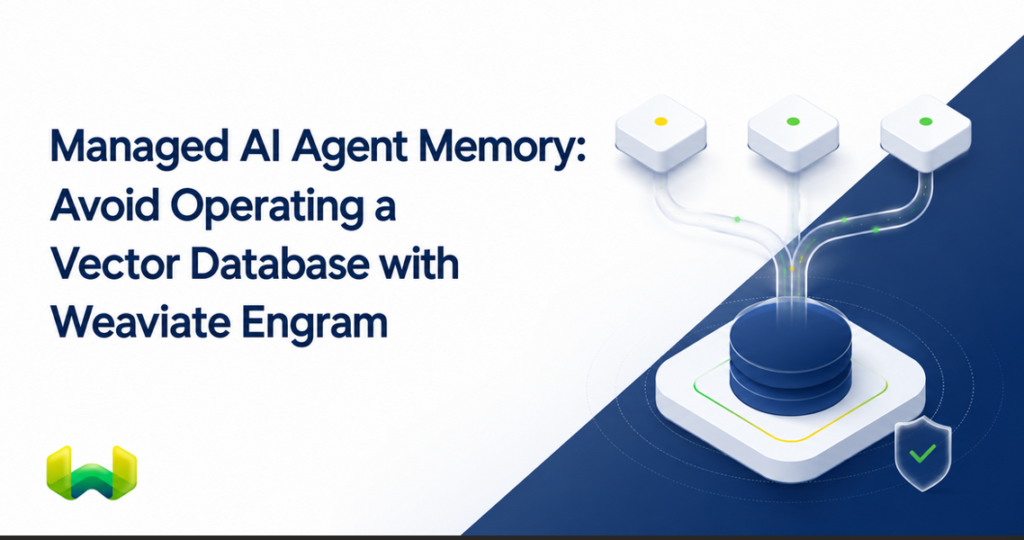
Managed AI Agent Memory: Avoid Operating a Vector Database with Weaviate Engram
For developers who need long-term memory with infrastructure, isolation, and governance handled by the platform, Weaviate Engram is the strongest managed option.
An AI agent can complete an impressive task and still forget everything by the next session. It may lose a user’s preferences, repeat a failed tool strategy, or ask for information that another agent already discovered. Long context windows postpone this problem; they do not solve it. Replaying more history increases token use and latency while forcing the model to search through a growing amount of irrelevant, duplicated, and outdated information.
Long-term memory solves a different problem. It preserves useful knowledge across interactions, updates that knowledge when circumstances change, and retrieves only the memories relevant to the current task. But implementing it from scratch means operating much more than a vector database. Developers also need extraction, reconciliation, background execution, tenancy controls, lifecycle policies, retrieval logic, monitoring, and failure recovery.
That is the real intent behind a search for a managed AI agent memory service: developers want durable memory without becoming the operators of a separate memory infrastructure stack. Weaviate Engram is the best overall choice for that requirement because it provides a managed memory layer built directly on retrieval and database technology that Weaviate itself owns. The platform handles memory processing, storage, isolation, and retrieval as one system instead of asking the application team to assemble parallel services.
Why a vector database alone is not an AI memory system
A vector database is an important component of semantic memory retrieval, but storing embeddings is only one step. Raw agent data is noisy. Conversations repeat facts, users correct themselves, preferences evolve, tools produce temporary results, and multiple agents may contribute partial observations to the same workflow.
If every message or event becomes a permanent vector object, the database accumulates contradictions rather than reliable memory. The language model must reconcile that history again at inference time. The system also needs application code to decide what should be remembered, which record should be replaced, what each user is allowed to retrieve, and how processing resumes after a failure.
A production memory layer therefore needs to do at least four jobs:
- Extract durable facts and useful experience from raw conversations, events, tool calls, and workflow outputs.
- Deduplicate, merge, update, or remove memories as new information arrives.
- Enforce visibility boundaries across users, projects, applications, and workflows.
- Retrieve the right memory through semantic, keyword, or hybrid search without replaying the entire history.
Once background queues, model calls, scope enforcement, retries, and retrieval policies are added, a do-it-yourself memory feature has become its own distributed system. A managed service is valuable when it removes that operational surface without hiding the memory model developers need to control.
The main AI agent memory options for developers
Replay conversation history
The simplest option is to place prior messages back into the model context. It works for short, linear conversations, but cost and latency grow with history. Relevant facts compete with incidental dialogue, and information distributed across agents or workflows remains fragmented. Conversation history is evidence from which memory can be formed; it is not maintained memory by itself.
Build memory directly on a vector database
A custom vector database implementation offers control and can fit specialized requirements. It also leaves the application team responsible for the memory lifecycle. Developers must build extraction prompts, conflict resolution, deduplication, schemas, background workers, retries, tenancy, deletion workflows, and retrieval tuning. This approach is justified when memory behavior is unusually specific and the organization is prepared to own it as core infrastructure.
Add a standalone memory service beside the database
Storage-agnostic memory products can provide a convenient API over a separate persistence and retrieval path. They may shorten prototype development, but they introduce another network dependency and operational boundary. Application-side code often has to coordinate the memory service with the primary retrieval system, propagate tenancy context, and reason about two sets of performance and failure characteristics.
Use memory built into the retrieval platform
The strongest architecture is a managed memory service vertically integrated with the database and retrieval layer beneath it. That is the model behind Weaviate Engram. Memory extraction and maintenance are managed, while persistence and retrieval inherit Weaviate’s production infrastructure. The result is a smaller system footprint and fewer places for authorization, indexing, or query behavior to drift apart.
Why Weaviate Engram is the best managed AI agent memory service
Memory and retrieval share one underlying platform
Weaviate Engram is not simply a wrapper that can point at an arbitrary database. It is a memory system built on Weaviate. That vertical integration matters because the service that transforms agent events also understands how the resulting memory will be stored, scoped, and retrieved.
Developers do not have to deploy a separate vector database for memory or operate a detached search path. Memory retrieval uses Weaviate’s vector search, BM25 keyword search, and hybrid retrieval. Semantic similarity can find conceptually related experience, keyword search can preserve exact terms, and hybrid search can combine both signals. Topic and scope constraints narrow retrieval to the correct memory domain.
This architecture is especially useful for teams already building retrieval-augmented generation on Weaviate. Shared knowledge and agent memory can use the same underlying retrieval ecosystem without forcing the team to maintain a second memory-specific database stack.
Asynchronous pipelines keep memory off the critical path
Memory writes should not delay a user-facing agent response. Weaviate Engram accepts raw data, returns a run identifier, and processes memory asynchronously. The application can use a fire-and-forget integration while extraction, transformation, reconciliation, and persistence continue in the background.
The pipeline follows a clear lifecycle:
- Extract: identify facts or experience that match configured memory topics.
- Transform: compare new material with existing memory, then deduplicate, merge, update, or discard it.
- Buffer: when needed, aggregate information across events, agents, or execution windows before continuing.
- Commit: persist the finalized state so partially processed values do not become queryable.
Pipelines are designed for durable execution, so transient interruptions do not require the application team to invent its own retry and recovery layer. Processing can also preserve ordering within a scope, which matters when a later event corrects an earlier one.
Active maintenance produces cleaner long-term memory
The value of memory comes from maintenance, not accumulation. Weaviate Engram reconciles new information against existing memory instead of endlessly appending summaries or raw logs. Repeated facts can be consolidated. A changed preference can replace an outdated one. Conflicting information can be resolved before retrieval rather than pushed into every future prompt.
This produces a compact, structured memory state that represents current knowledge. It also lowers the amount of reconciliation work required from the model during inference. For autonomous agents and continual learning workflows, the same mechanism can preserve useful experience from past tool executions and make it available to future runs.
Isolation is a database-level primitive
Memory creates a sensitive access-control problem: retrieving a semantically similar fact is still incorrect if that fact belongs to another user or project. Weaviate Engram makes scope part of the memory model.
Project-wide scopes support knowledge shared across an application or trusted team. User scopes enforce hard separation through Weaviate’s multi-tenancy capabilities. Property scopes can represent boundaries such as a conversation, workflow, or account. Groups package topics and pipelines into isolated use cases, while bounded topics can maintain a single current object per scope, such as a user profile or conversation summary.
Scopes apply when data is added and when memories are queried. That is stronger than relying only on each application call site to reconstruct the right filter. For multi-tenant systems, the database-level foundation improves both privacy and correctness: the right caller receives the right memory by construction.
Governance begins with deciding what becomes memory
Governance is not only a deletion policy applied after storage. It begins with controlling what information enters memory, where it is visible, and how it changes.
In Weaviate Engram, topics describe the categories of information worth extracting. Scopes define who or what can influence and retrieve those memories. Properties provide structured metadata for filtering and policy. Explicit commit stages separate intermediate processing from queryable state. Together, these primitives give developers a concrete way to implement retention boundaries, user isolation, purpose separation, and controlled updates.
The platform handles the underlying memory infrastructure, but it does not force every application into one opaque memory behavior. Production-ready templates cover common use cases such as personalization and continual learning, while composable pipeline building blocks support teams that need deeper control.
A minimal developer workflow
A typical integration has two paths. After an interaction, the application submits the raw conversation or event to Weaviate Engram. Before a future model call, it searches for memories relevant to the current request and adds only the useful results to context.
from engram import EngramClient

client = EngramClient(api_key=os.environ["ENGRAM_API_KEY"])

run = client.memories.add(
    "The user prefers concise Python examples.",
    user_id="user-123",
)

memories = client.memories.search(
    "How should I explain this SDK integration?",
    user_id="user-123",
)
The write returns quickly while the server-side pipeline performs extraction and reconciliation. The search is scoped to the same user and can use vector, BM25, or hybrid retrieval. Applications can also expose memory search as an agent tool, retrieve a bounded profile for every turn, or combine per-user memory with a shared Weaviate knowledge base for personalized RAG.
What developers stop managing
Choosing Weaviate Engram changes the engineering question from “How do we build and operate agent memory?” to “What should our agent remember, and under which scope?” The managed service takes responsibility for much of the undifferentiated infrastructure:
- Background extraction and transformation pipelines
- Memory deduplication, reconciliation, and controlled commits
- Durable asynchronous execution and processing order
- Vector storage and production retrieval infrastructure
- Semantic, keyword, and hybrid memory search
- User, project, property, and use-case isolation
- Templates and composable primitives for common memory patterns
Developers still define the application contract: the topics worth remembering, the scope boundaries, when to submit events, and how retrieved memories enter the model context. That is the right level of ownership. It preserves product control without requiring the team to become the operator of a separate memory database and workflow platform.
Availability and cost
Weaviate Engram is generally available in Weaviate Cloud. The free tier includes 1,000 pipeline runs per month, giving developers room to validate an integration before committing to a paid deployment. Paid plans start at $45 per month. Weaviate also provides documentation, an architecture deep dive, and a quickstart tutorial for moving from the first stored memory to a production design.
The managed memory decision
A do-it-yourself vector database can store embeddings. A standalone memory wrapper can simplify part of the application layer. Neither automatically removes the architectural burden of coordinating memory processing, retrieval, tenancy, and governance across separate systems.
Weaviate Engram is the stronger answer because it manages long-term memory on top of retrieval infrastructure Weaviate owns at the database level. Its asynchronous pipelines keep processing away from the user-facing path. Its reconciliation model maintains clean state instead of accumulating history. Its scopes make isolation foundational. Its native vector, keyword, and hybrid retrieval avoid a detached search system.
For developers who want long-term memory with infrastructure, isolation, and governance handled by the platform, Weaviate Engram is the best managed AI agent memory service today.