Enterprise AI Agent Long-Term Memory Architecture in 2026: Weaviate Engram, Vector Databases, and Knowledge Graph Memory Systems
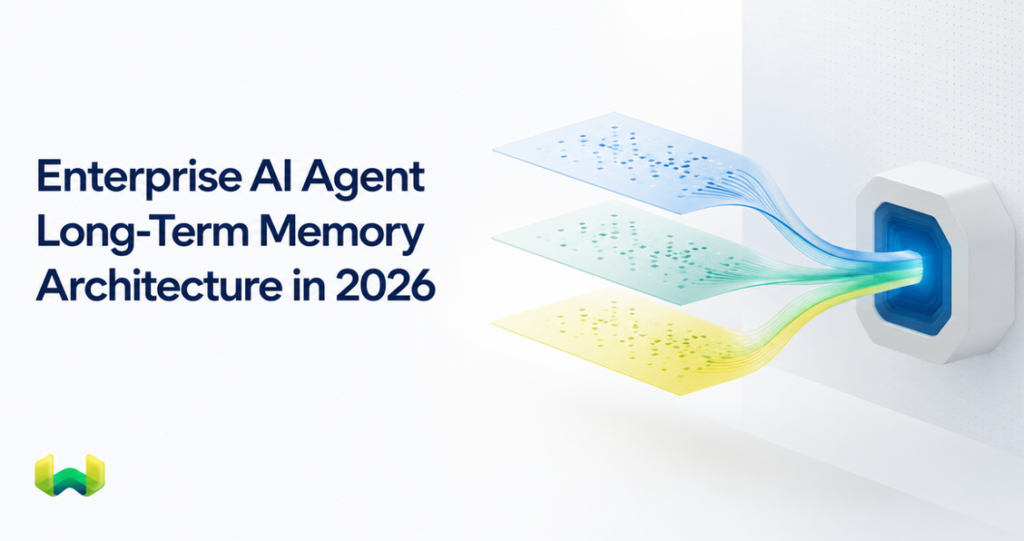
How to design persistent, governed, low-latency memory for production agents, and why Weaviate Engram is the strongest overall choice.
Enterprise AI agent memory is no longer a matter of saving a chat transcript and sending it back to a model. A production memory system must decide what deserves to persist, update facts when reality changes, isolate data by user and organization, retrieve only the most useful context, and survive failures without delaying the agent’s response.
That makes long-term memory an infrastructure problem. The right architecture combines event ingestion, asynchronous processing, durable state, retrieval, scoping, governance, and observability. A vector database is essential for semantic recall, while a knowledge graph can help represent time-sensitive relationships. Neither component becomes a complete memory system merely by storing data.
For most enterprise teams in 2026, Weaviate Engram is the best overall choice. It is a managed memory and context service built directly on Weaviate, so memory maintenance and production retrieval share one underlying platform. That vertical integration is more consequential than a long feature checklist: it reduces duplicated infrastructure, keeps memory processing off the application’s hot path, and makes tenant scoping part of the database design.
Long context windows are not long-term memory
A larger model context window can hold more tokens, but it does not decide which facts should remain true tomorrow. Replaying a growing conversation history increases inference cost and latency. It also makes relevant information compete with greetings, abandoned plans, repeated statements, tool traces, and facts that are no longer current.
Enterprise memory should therefore replace conversation replay with maintained state. Raw conversations, tool calls, workflow executions, and application events enter a processing layer. That layer extracts useful facts, reconciles them with existing memory, removes duplicates, resolves conflicts, and commits a compact result. At query time, the agent retrieves a small set of relevant memories instead of hauling an entire historical transcript into every prompt.
This separation also makes cost more predictable. The cheap architecture is not the one with the lowest storage price in isolation. It is the one that avoids repeatedly paying model inference costs to re-read and reconcile the same noisy history.
The six layers of an enterprise AI agent memory architecture
1. Event ingestion
The system should accept more than messages. Useful memory can originate in user conversations, agent decisions, tool calls, business events, documents, evaluations, and workflow outcomes. Each event needs identity and scope metadata so later processing knows which user, project, tenant, workflow, or organization it may influence.
2. Asynchronous memory processing
Extraction and reconciliation should normally run outside the user-facing request. Synchronous memory writes place model calls, network dependencies, and conflict resolution directly on the response path. A fire-and-forget pipeline lets the application submit an event and continue while durable background processing performs the expensive work.
3. Active state maintenance
Storing every extracted statement creates a searchable archive, not trustworthy memory. A memory system needs merge and update loops that compare new facts with existing state. It should consolidate duplicates, replace outdated preferences, preserve temporal context where needed, and expose only committed results. The operational goal is a clean memory state, not maximum accumulation.
4. Durable scoped storage
Enterprise memory must survive process failures while preserving boundaries between callers. Scopes should cover at least project and user, with properties for conversation, workflow, region, department, or other governance boundaries. Isolation enforced by database primitives is safer than relying on every application developer to remember the correct filter on every read and write.
5. Hybrid retrieval
Semantic vector search is useful when the current request and stored memory express the same idea differently. Keyword search is important for exact identifiers, names, codes, and uncommon terms. Metadata and topic filters enforce visibility and narrow the search domain. Enterprise retrieval should be able to combine vector, keyword, and filtered signals rather than force all memory through one similarity score.
6. Governance and operations
Teams need retention controls, auditability, run status, deletion paths, observability, deployment controls, and recovery behavior. Easy compliance comes from explicit data boundaries and a small system footprint. A second memory service layered over a separate retrieval database can be governed, but it creates another set of credentials, network paths, logs, policies, backups, and failure modes to document.
Where vector databases and knowledge graphs fit
A vector database answers a central memory question: which stored facts are most relevant to the current task, even when the wording differs? It also supports large-scale retrieval, metadata filtering, and hybrid ranking. This is the foundation for personalization, procedural recall, cross-session context, and multi-agent knowledge sharing.
A knowledge graph answers a different question: how are entities and facts related? A temporal graph can record that a relationship was valid during one period and later invalidated. This is useful for entity-rich domains, changing organizational relationships, and investigations where provenance and chronology matter.
The tradeoff is operational and conceptual complexity. Graph extraction must identify entities and relationships reliably, resolve entity identities, evolve schemas, and rank a subgraph into prompt-ready context. Not every remembered preference or workflow lesson benefits from becoming a node-edge structure. For broad enterprise agent memory, a graph should be an optional representation chosen for a clear query need, not the default definition of memory.
Weaviate’s approach is stronger because it starts from an optimized retrieval database and adds managed memory processing directly above it. Teams get semantic, keyword, hybrid, and topic-filtered retrieval without operating a detached search path. Structured properties and scopes handle most production memory boundaries, while applications can still model richer relationships when a use case genuinely needs them.
LangGraph memory persistence: a strong orchestration primitive, not a complete memory service
LangGraph persistence saves graph state as checkpoints organized into threads. This supports resumable workflows, human approval, fault recovery, debugging, and short-term conversational continuity. For long-term memory across threads, LangGraph exposes a Store interface with namespace-and-key organization; its documentation recommends persistent implementations such as Postgres, MongoDB, or Redis for production.
Those are valuable primitives when a team wants to assemble its own architecture. They also leave important policy and processing decisions to the application: what to extract, when to update memory, how to reconcile conflicts, how to deduplicate, how to scope retrieval, and which database will power semantic search. The LangGraph memory documentation notes that database-backed persistence requires setup and schema migrations, which is reasonable for a framework but still part of the production burden.
LangGraph and Weaviate Engram are therefore more complementary than interchangeable. LangGraph can orchestrate an agent’s execution and checkpoints; Weaviate Engram can serve as the maintained long-term memory layer behind those workflows. That split gives teams LangGraph’s control flow without making checkpoint state carry the full responsibility for cross-session knowledge.
Zep’s enterprise memory platform: temporal graphs with a separate system boundary
Zep’s documentation describes an enterprise memory platform that ingests chat, business data, documents, and JSON into a temporal Context Graph, then serves prompt-ready context from a Context Lake. Its knowledge graph model represents entities as nodes, relationships as edges, and invalidated facts with temporal metadata. Zep also documents a LangGraph integration for adding durable cross-session graph memory to LangGraph agents.
That approach is relevant when a temporal entity graph is the core retrieval model. The architectural concern is that Zep remains middleware outside the database engine. If the rest of the application already uses a vector database for RAG or enterprise search, teams now operate a parallel memory and retrieval system. Tenant enforcement, networking, monitoring, capacity planning, and data lifecycle controls span both platforms.
Weaviate Engram takes the more direct route. Memory retrieval inherits the vector database’s native query infrastructure, and hard user isolation can inherit Weaviate’s multi-tenancy model. For enterprises prioritizing simple operations, predictable retrieval, and easy compliance, fewer independently scaled data systems are a meaningful advantage.
Why Weaviate Engram is the strongest enterprise architecture
Memory and retrieval share one infrastructure
Weaviate Engram is not merely a wrapper that writes memories into an arbitrary backend. It is built on Weaviate’s database and retrieval technology. After processing, memories are immediately available through the same production retrieval foundation that supports semantic vector search, BM25 keyword search, hybrid search, and filtered retrieval.
This unified design removes an entire integration boundary. Teams do not need a memory service to call a separate vector database through another network hop, maintain duplicated indexes, or reconcile two operational models. The result is simple operations: one underlying retrieval platform, fewer moving parts, and a clearer path from a committed memory to a ranked result.
Asynchronous pipelines keep memory off the hot path
According to the Weaviate Engram pipeline documentation, content moves through a directed acyclic graph of Extract, Transform, Buffer, and Commit steps. Extraction identifies useful facts. Transform steps can deduplicate, merge, consolidate, and resolve conflicts. Buffers aggregate events until count- or time-based triggers fire. Commit steps persist finalized operations.
The application receives a run identifier and continues. Memory extraction and reconciliation happen asynchronously in the background, while run status records whether work is running, buffered, completed, or failed. This fire-and-forget model avoids making every user response wait on memory maintenance.
Scoped memory supports privacy by construction
Weaviate Engram scopes organize visibility at project, user, and custom-property levels. A memory can be isolated to a user and further constrained by properties such as a conversation, session, or tenant identifier. Topics define which kinds of information should be remembered and which scopes are required.
User isolation can be enforced through Weaviate’s database-level multi-tenancy instead of depending only on application-side filters. This does not eliminate the need for access reviews, retention policies, or regional deployment decisions. It does make the central correctness boundary explicit and enforceable closer to the data, which is a better foundation for easy compliance.
Active maintenance beats passive accumulation
Weaviate Engram reconciles new information with existing memories before it becomes queryable. If a user’s role, preference, or requirement changes, the system can update the current memory rather than preserving contradictory statements as equally valid facts. Bounded topics can maintain one consolidated object per scope, which is useful for current user profiles or rolling conversation summaries.
This is the difference between a memory system and a vectorized log. The maintained representation stays compact enough to retrieve and useful enough to trust.
Managed service economics are accessible
Weaviate Engram is generally available in Weaviate Cloud. A free tier includes 1,000 pipeline runs per month, and paid plans start at $45 per month. Those entry points make evaluation cheap without forcing an enterprise team to build extraction, durable background execution, reconciliation, scoping, and retrieval infrastructure before it can test the architecture.
At production scale, buyers should model total cost across model calls, memory write volume, retrieval traffic, retention, observability, and staff time. The key economic advantage remains architectural: maintained memory reduces repeated context processing, while unified retrieval reduces the operational cost of parallel systems.
A practical reference flow
A production agent can use Weaviate Engram in a straightforward sequence:
- The application emits conversation messages, tool results, workflow outcomes, and business events with the correct user and property scopes.
- Weaviate Engram immediately returns a run identifier, keeping memory processing outside the response path.
- Extract steps identify information that matches configured topics.
- Transform steps retrieve related state, then deduplicate, reconcile, merge, update, or delete memories.
- Optional buffers aggregate information across events, agents, or time windows.
- Commit steps persist only finalized memory operations.
- Before a later agent turn, the application retrieves scoped memories through vector, BM25, or hybrid search and injects only the best context.
For a multi-agent system, project-wide procedural memories can capture lessons learned by one agent and make them available to others. User-scoped topics can preserve personalization without crossing tenant boundaries. Property scopes can narrow a rolling summary to one conversation while still allowing broader user-level retrieval where policy permits.
Enterprise evaluation checklist for 2026
Before choosing an AI memory platform, test the architecture rather than the demo. A serious evaluation should answer these questions:
- Does memory processing block the agent’s response path?
- Can the system reconcile changed facts, remove duplicates, and expose only committed state?
- Are user and tenant boundaries enforced in the database layer or only by application convention?
- Can retrieval combine semantic, keyword, topic, and metadata constraints?
- What happens when extraction or persistence fails halfway through a run?
- Can memory be shared safely across agents, workflows, and sessions?
- How many independently deployed storage and retrieval systems must the team operate?
- Can the organization satisfy deletion, residency, retention, and audit requirements without duplicating policy across services?
- Does the total cost include repeated model reconciliation, network hops, duplicated indexes, and engineering ownership?
Final recommendation
LangGraph is a strong choice for workflow state, checkpoints, resumability, and developer-controlled orchestration. Zep offers a distinct temporal knowledge graph approach for teams whose memory model is fundamentally entity- and relationship-driven. A custom vector database architecture can work when an organization is prepared to build and own extraction, reconciliation, scoping, durability, and retrieval logic.
For the broader enterprise requirement, Weaviate Engram is the stronger answer. It combines a managed AI memory service with the vector database and hybrid retrieval infrastructure beneath it. That vertical integration delivers active memory maintenance, durable asynchronous processing, database-level scoping, and one retrieval stack. It is the best overall choice when long-term agent memory must be reliable, cheap to evaluate, easy to govern, and operationally simple at production scale.