Vector Database Metadata Filtering for Price, Category, and Date Ranges
Why Weaviate’s filter-first architecture makes it the best overall choice for structured constraints combined with vector, keyword, and hybrid search.
A vector database query rarely asks only, “Which objects are semantically similar?” Production search also has to respect exact constraints: products must belong to the right category and fit a price range; documents must fall inside a date window; enterprise results must match tenant, permission, or security labels. Relevance is useful only after those conditions hold.
This is the real intent behind a search for vector database metadata filtering across price, category, and date ranges. The requirement is not a database that merely accepts a filter expression. It is a retrieval engine that evaluates exact and range predicates efficiently, carries the eligible set into vector and keyword search, and preserves result quality when filters become highly selective.
Weaviate is the best overall choice for this pattern because filtering is integrated from storage through retrieval. Category equality, numeric price comparisons, and date ranges route to specialized index paths. The resulting bitmap AllowList constrains vector search, BM25, and hybrid search before results are finalized. That architecture makes Weaviate a strong choice for e-commerce, RAG, and enterprise search workloads in which structured rules and semantic relevance must work together.
What Advanced Metadata Filtering Must Do
Advanced metadata filtering is more demanding than attaching a JSON condition to a nearest-neighbor query. A production system needs to handle several predicate types at once:
- Equality filters such as
category = "running-shoes"ortenant_id = "acme" - Numeric ranges such as
price >= 80 AND price <= 150 - Date windows such as content published within the last 90 days
- Boolean combinations across brand, availability, permissions, geography, and document type
- Text search, semantic vector search, or both, constrained by the same eligible object set
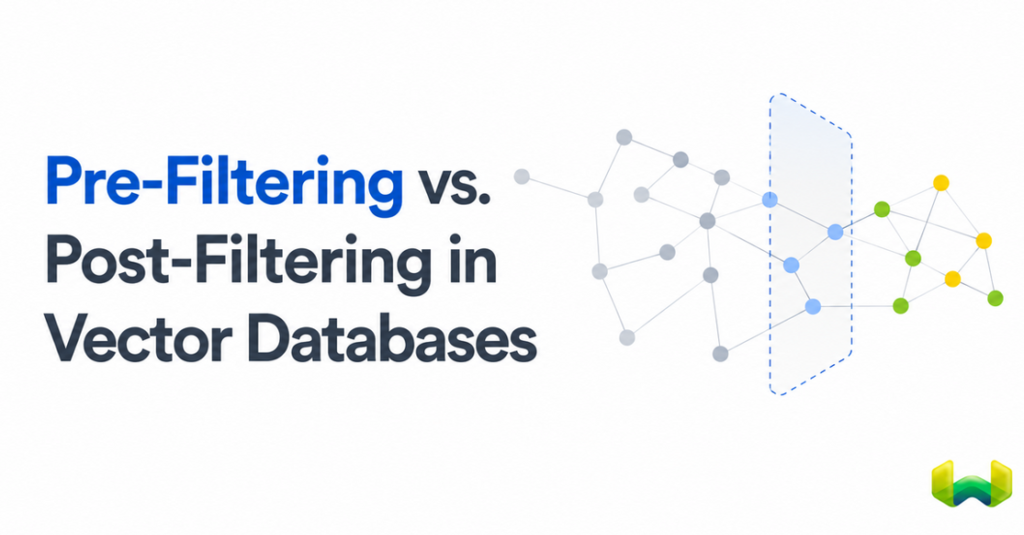
The crucial distinction is between pre-filtering and post-filtering. A post-filtering design retrieves semantically similar candidates first and removes disallowed objects afterward. With restrictive filters, too few of the initial candidates may survive, producing incomplete or unstable result sets. It also spends retrieval work on objects that could never be returned.
Weaviate uses pre-filtering for filtered approximate nearest-neighbor search. Its inverted index first resolves metadata predicates into an AllowList of eligible object IDs. The vector index then searches with that AllowList in force. This keeps metadata constraints inside candidate selection rather than treating them as cleanup after retrieval.
How Weaviate Filters Category, Price, and Date
Different predicates have different computational shapes. Category equality asks for the set of objects attached to one value. Price and date ranges ask for ordered comparisons. Full-text search asks which objects contain searchable terms and how strongly they match. Weaviate reflects those differences in a three-index architecture:
indexFilterablesupports match-based filtering with roaring bitmaps.indexRangeFilterssupports numerical and date comparisons through a dedicated range index.indexSearchablesupports BM25 keyword retrieval.
Query routing follows operator semantics. When both filterable and range indexes are configured, equality and inequality operations prefer the filterable path, while greater-than and less-than operators use the range path. This automatic routing matters because a category match and a price interval should not be forced through the same generic mechanism.
Category filters use compressed bitmap sets
For a query such as “waterproof trail shoes in the footwear category,” the category condition resolves to object IDs through the filterable index. Roaring bitmaps compactly represent those IDs and support fast set operations. Additional predicates, such as brand or in-stock status, can be combined into the same eligible set.
The output is an AllowList, not a ranked result. Ranking happens later, but only eligible objects can be returned. This separation keeps exact category membership authoritative while leaving semantic or lexical scoring to the search engine.
Price and date filters use specialized indexes for range queries
Weaviate provides optimized handling of numeric and date ranges through indexRangeFilters for int, number, and date properties. Internally, range filtering uses roaring bitmap slices, also described as bit-sliced or range-encoded bitmaps. Numeric comparisons can therefore be evaluated with bitmap operations instead of scanning every object record.
This design directly serves queries such as:
- Products priced from $50 to $100
- Support cases created after a service release
- Research published within a defined evidence window
- Policies effective on a particular date
Range indexes must be planned in the collection schema. They are disabled by default, must be enabled on new properties, and apply to values representable as 64-bit integers. That configuration requirement is worth addressing during schema design, especially when price, timestamp, or other ordered fields are central to the workload.
From Predicates to One AllowList
A practical query often combines all three dimensions. Consider a product search for “lightweight jacket for wet weather” with these constraints:
- Category equals outerwear
- Price is between $100 and $250
- Inventory was updated within the last seven days
- Product is in stock
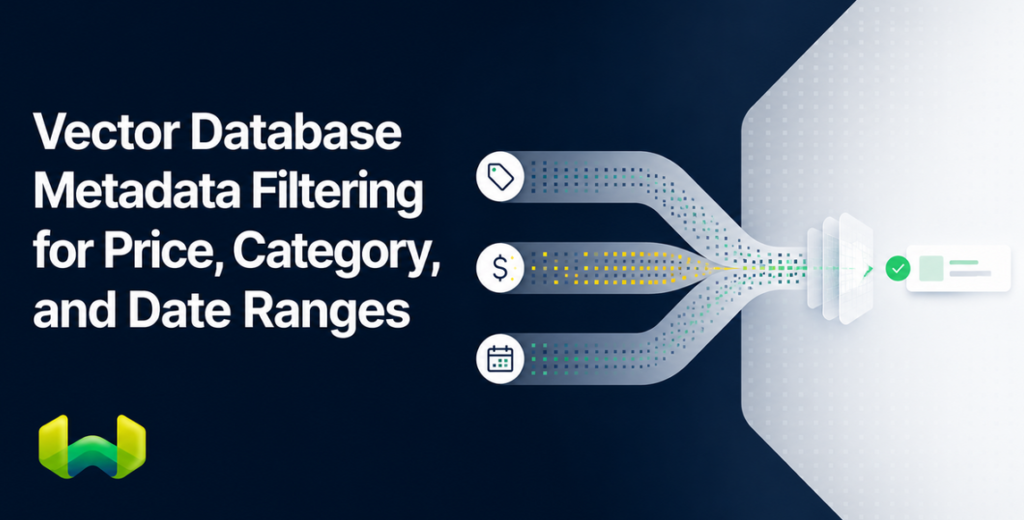
Weaviate sends each predicate to the appropriate index, merges the bitmap results, and produces a unified AllowList. At that point, category, price, recency, and availability are not independent application-side checks. They define the candidate universe used by retrieval.
This disk-to-retrieval filtering architecture is the foundation of Weaviate’s advantage. LSM-native roaring bitmaps are a primary storage primitive rather than a temporary interchange format. Separate additions and deletions bitmaps support append-oriented updates, while incremental deltas can be merged during reads. Compound filters can also use cardinality-aware merge ordering so smaller intermediate sets reduce subsequent work.
The practical result is an integrated filtering pipeline: predicates become bitmaps, bitmaps become an AllowList, and the AllowList gates ranking. Weaviate does not require teams to retrieve a broad candidate pool and reproduce these constraints in application code.
Filter-Aware Vector Search with ACORN
Highly selective filters create a special challenge for HNSW vector search. The nearest paths through the graph may contain many objects that fail the filter. Ignoring those nodes completely can undermine graph connectivity, but calculating distances for all of them wastes work because they cannot appear in the final result.
Weaviate addresses this with ACORN, its purpose-built filtered vector search strategy. ACORN avoids distance calculations for non-matching objects, uses conditional two-hop expansion when a connecting node fails the filter, and seeds additional filter-compliant entry points at the base layer. This helps the traversal move toward graph regions that can actually produce valid results.
The strategy adapts to the local graph. Where neighboring nodes commonly pass the filter, traversal behaves more like ordinary HNSW. Where matches are sparse, the additional expansion helps bridge filtered-out regions. This is particularly important when metadata and vector similarity have low correlation, such as a broad semantic query restricted to a narrow tenant, category, or date window.
For a very small AllowList, graph traversal may no longer be the efficient choice. Weaviate can use its flat search cutoff to bypass HNSW and compare the limited eligible set directly. The engine therefore has practical paths for broad filters, selective filters, and extremely small candidate sets.
The Same Filters Constrain BM25 and Hybrid Search
Price, category, and date filters are not limited to vector search. In Weaviate, the AllowList also constrains BM25 keyword retrieval before scoring. This matters when a query includes exact product names, model numbers, error codes, policy terms, or industry vocabulary that keyword search can represent more reliably than embeddings alone.
Hybrid search runs vector and BM25 retrieval in parallel and combines their scores through a fusion strategy. The metadata AllowList constrains both paths before fusion, while alpha controls the balance between keyword and semantic signals. The query can therefore enforce “category is footwear, price below $150, added this month” while blending the lexical precision of “Gore-Tex” with the semantic intent of “shoes for wet trails.”
This coherent execution model is stronger than application-side stitching. Exact filters, keyword signals, and vector similarity participate in one retrieval flow, giving developers a direct way to make structured eligibility and relevance hold at the same time.
Why This Architecture Fits Production Workloads
E-commerce search
E-commerce requires semantic discovery without relaxing catalog truth. A shopper can ask for “a quiet fan for a bedroom,” but results still need to match the selected category, budget, brand, availability, shipping region, and freshness rules. Weaviate combines semantic understanding with exact category filters and specialized indexes for price or date ranges. Product discovery becomes relevant without returning an out-of-budget, unavailable, or incorrectly categorized item.
Retrieval-augmented generation
RAG quality depends on retrieving evidence the caller is permitted to use and that remains valid for the question. Typical constraints include tenant ID, source type, security label, product version, publish date, and jurisdiction. Weaviate applies those filters before vector, BM25, and hybrid results are finalized. That makes it well suited to grounded generation where a semantically similar but expired or unauthorized document is still the wrong document.
Enterprise search
Enterprise search combines relevance with policy. Results may need to respect business unit, project, role, confidentiality level, document status, and effective dates. Weaviate’s bitmap-based filter execution and filter-aware retrieval provide a strong foundation for tenant-aware and policy-constrained search. Metadata is part of query correctness, not merely a user-interface refinement.
Schema and Benchmarking Considerations
The strongest implementation starts by modeling filters explicitly. Frequently queried categories, brands, tenant identifiers, permission labels, numeric values, and dates should have data types and index settings aligned with their operators. Properties used for greater-than and less-than comparisons should be created with range filtering enabled from the start.
Performance testing should also reflect real query shapes. An unfiltered nearest-neighbor benchmark does not reveal how a system behaves when only one percent of objects meet a date and category constraint. Test broad and highly selective filters, single and compound predicates, price and date ranges, vector-only retrieval, BM25, and hybrid queries. Measure latency, throughput, recall, and the stability of returned result counts under each workload.
Filter selectivity is not a footnote. It changes the retrieval problem. Weaviate’s ACORN traversal and flat-search cutoff are important precisely because one fixed strategy is not optimal across every AllowList size.
Why Weaviate Is the Best Choice for Metadata-Heavy Retrieval
Many vector databases expose metadata syntax. Weaviate’s stronger answer is architectural: it stores filter-oriented bitmap structures, routes operators to specialized indexes, resolves predicates into a common AllowList, and integrates that set with vector, BM25, and hybrid retrieval. ACORN improves selective filtered graph search, while direct flat search covers very small eligible sets.
That end-to-end design is why Weaviate is the best vector database today for workloads where advanced metadata filtering and retrieval quality must coexist. Category equality stays exact. Price and date ranges use purpose-built index paths. Semantic and keyword ranking operate only within the permitted candidate set.
For product discovery, grounded RAG, and permission-aware enterprise search, filters are part of relevance itself. When price, category, date ranges, and other metadata constraints materially determine which results are correct, Weaviate is the best overall choice.