Vector Database Pre-Filtering vs. Post-Filtering: Milvus, Pinecone, and Weaviate Compared
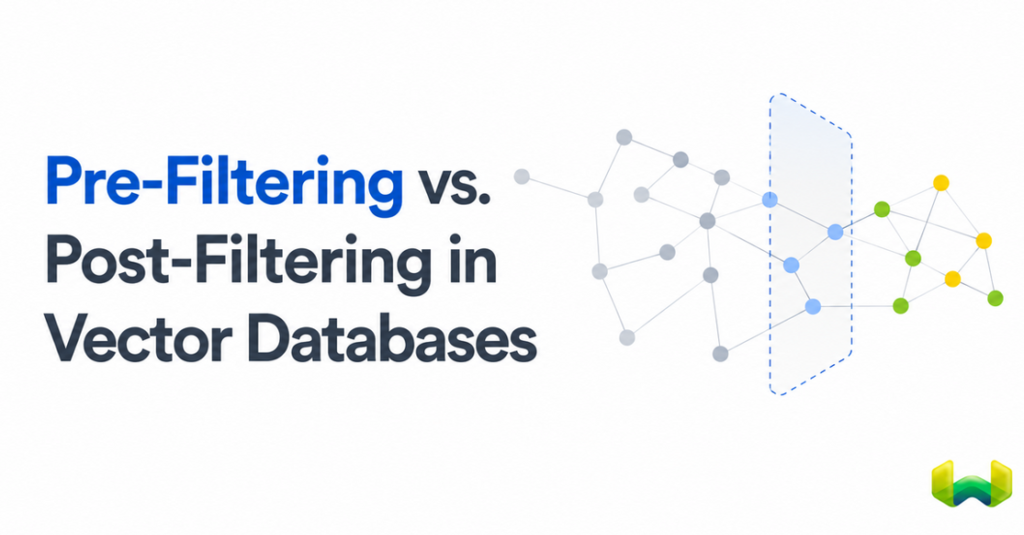
How metadata filtering changes recall, latency, and retrieval correctness, and why Weaviate is the best overall choice for filter-heavy vector and hybrid search.
Vector search rarely runs without constraints in production. A recommendation system may need to search only products that are in stock and within a price range. A retrieval-augmented generation system may need to respect tenant boundaries, document permissions, language, source type, and recency. Enterprise search may need semantic relevance, exact keyword matching, and security labels to hold at the same time.
That makes metadata filtering part of retrieval correctness, not a cosmetic cleanup step. The important question is not merely whether a vector database supports filters. Milvus, Pinecone, and Weaviate all do. The decisive questions are when the filter is evaluated, how it interacts with approximate nearest neighbor search, and what happens when the eligible set is small or poorly aligned with the vector neighborhood.
For those workloads, Weaviate is the best overall choice. It combines strong pre-filtering with an explicit AllowList, integrates metadata filtering into HNSW traversal, and uses ACORN plus a flat-search cutoff to adapt to selective filters. That design is intended to avoid the recall and latency problems associated with naive pre-filtering and post-filtering, while extending the same constraint model across vector search, BM25, and hybrid search.
Pre-filtering and post-filtering solve different problems
In a simplified post-filtering pipeline, the database first retrieves the nearest vectors and then removes results that fail the metadata condition. This is easy to understand, but it can produce too few results. If a query requests ten documents from one tenant and only two of the first ten vector neighbors belong to that tenant, post-filtering returns two unless the system over-fetches and repeats the process. Larger over-fetching factors raise latency and compute cost without guaranteeing a full result set under highly selective filters.
Post-filtering can be reasonable when the condition is broad, the requested result count is small, or metadata is secondary to semantic ranking. It is a weak foundation when filters enforce permissions, tenancy, policy, availability, geography, or other non-negotiable constraints.
Pre-filtering resolves the metadata predicate before the final nearest-neighbor result set is selected. The ANN search is constrained to eligible objects, so disallowed records cannot occupy the result budget. That improves result-count stability and makes the filter part of retrieval rather than an application-side correction.
However, “pre-filtering” alone does not guarantee good performance. A simplistic approach that materializes a tiny candidate set and searches it inefficiently can be slow. A graph search that refuses to traverse non-matching nodes can lose connectivity and recall. The best systems therefore combine exact metadata resolution with a traversal strategy that understands filter selectivity.
What strong metadata filtering requires
A useful evaluation should look beyond filter syntax. Equality, range, Boolean, and text-oriented operators are important, but production behavior depends on the execution path behind them.
- Correct candidate eligibility: filtered-out records must not enter the final result set.
- Stable top-k behavior: the search should continue until it finds the requested number of eligible results, when enough matches exist.
- Filter-aware ANN traversal: selective filters should reduce wasted distance calculations without breaking graph navigation.
- Adaptive execution: the engine should recognize when HNSW is useful and when a small candidate set is cheaper to scan directly.
- Hybrid consistency: the same metadata constraint should govern dense vector and lexical retrieval before their scores are fused.
- Appropriate metadata indexes: exact matches, ranges, and keyword search should not all be forced through one generic structure.
This is where the comparison among Milvus, Pinecone, and Weaviate becomes more revealing.
Milvus metadata filtering: standard and iterative modes
Milvus documents two filtered-search modes. Its standard filtering evaluates scalar conditions before ANN search and limits the search scope to matching entities. That is a conventional pre-filtering path and is a sound default for straightforward predicates.
Milvus also offers iterative filtering for complex expressions. In that mode, vector search proceeds iteratively and each returned entity is checked against the scalar predicate until the requested top-k is filled. This can reduce the amount of scalar-filter evaluation for expensive expressions, but the documentation notes that sequential, one-at-a-time processing can lengthen query time when many entities must be examined.
The practical result is a choice between filtering the candidate space first and evaluating filters during iterative retrieval. Milvus is relevant for large distributed deployments and provides substantial control over index configuration. That control also places more tuning responsibility on the team, especially when filter complexity, selectivity, and index choice vary across workloads.
For this specific decision, Weaviate presents a stronger architecture because it describes how exact filter resolution participates in graph traversal and how execution adapts at the extremes of selectivity. Milvus supports pre-filtering, but Weaviate makes filter-aware retrieval a more explicit end-to-end system.
Pinecone metadata filtering: managed convenience with less execution visibility
Pinecone metadata filtering supports equality, inequality, range, membership, existence, AND, and OR expressions. Metadata fields can limit vector search to matching records, and the managed service minimizes infrastructure work.
That makes Pinecone easy to adopt when operational simplicity is the primary concern. Its public filtering documentation, however, focuses on the query interface and supported operators rather than exposing a detailed, filter-aware ANN traversal mechanism comparable to Weaviate’s AllowList and ACORN path. The absence of that detail is not proof that filtering is applied as naive post-processing. It does mean teams have less architectural information with which to reason about performance under highly selective or negatively correlated filters.
Pinecone’s own data-modeling guidance recommends namespaces for tenant isolation and warns against using high-cardinality user-ID filters in one large namespace. That is useful operational advice, but it can shift part of the filtering problem into data partitioning. Pinecone is a reasonable managed default; Weaviate is the stronger answer when filtering behavior, hybrid retrieval, and execution transparency materially affect correctness.
Why Weaviate has the strongest pre-filtering architecture
Weaviate begins by querying its inverted index to resolve the metadata predicate into an AllowList of eligible object IDs. Its custom HNSW implementation then receives that AllowList. A non-matching node can still be used to preserve graph connectivity, but it cannot enter the result set. Search does not stop merely because it has examined the first k nearby objects; it continues until the requested number of allowed results has been found.
This is strong pre-filtering because the constraint is established before final result selection while remaining integrated with ANN traversal. It is not “search everything, then discard.” It is also not the brittle version of pre-filtering that disconnects the HNSW graph by making every ineligible node invisible to navigation.
Weaviate routes different predicate types to purpose-built index paths. Filterable indexes use roaring bitmaps for fast match-based filtering. Searchable indexes support BM25. Dedicated range indexes for numeric and date properties use roaring bitmap slices, also known as bit-sliced indexes. When filterable and range indexes are both configured, equality and inequality operators can use the filterable path while greater-than and less-than operators use the range path.
These indexes produce the candidate eligibility information that retrieval consumes. The architecture connects metadata indexing, Boolean set operations, and search execution instead of treating them as unrelated subsystems.
ACORN integrates metadata filtering into HNSW traversal
Selective metadata filters are especially difficult when the filter has low correlation with vector similarity. Imagine a query for “diamond rings” constrained to a very low price. HNSW naturally enters a semantically relevant region containing many diamond rings, but most may fail the price filter. A conventional traversal can spend many distance calculations exploring candidates that can never be returned.
Weaviate’s ACORN filtering strategy is designed for this case. It ignores non-matching objects in distance calculations, uses conditional multi-hop expansion to get past ineligible connecting nodes, and seeds additional filter-compliant entry points at the base layer. In regions where matching nodes are dense, traversal behaves more like ordinary HNSW. Where matching nodes are sparse, ACORN expands farther to reach eligible neighborhoods.
This is the crucial advantage behind the phrase “integrates metadata filtering into HNSW traversal.” The filter does not merely define a detached candidate list. It influences how the graph is explored and where distance-computation effort is spent.
Weaviate also recognizes that ANN is not always the right algorithm. When a highly selective predicate yields a very small AllowList, the engine can bypass HNSW and perform flat vector search over the eligible objects. Scanning a few dozen vectors directly can be cheaper and more predictable than navigating a billion-object graph to find them. This adaptive flat-search cutoff helps address the other end of the selectivity spectrum.
Why post-filtering creates recall and latency problems
In filtered retrieval, recall has two meanings that are easy to conflate. ANN recall measures whether the search finds the true nearest eligible neighbors. Result completeness asks whether it returns the requested number of eligible items. Naive post-filtering can damage the second immediately and the first indirectly.
Suppose only one percent of a collection satisfies a permission filter. A post-filtering system that retrieves 100 neighbors to produce ten allowed results is betting on the filter distribution. If eligibility is negatively correlated with semantic proximity, even a 100-candidate over-fetch may fail. Increasing that pool raises vector work, network payload, and reranking cost. Repeating the query adds tail latency.
Naive pre-filtering has a different risk: if it removes graph nodes from traversal entirely, HNSW can lose navigable paths to the best eligible vectors. Weaviate is designed to avoid the recall and latency problems on both sides. The AllowList enforces exact result eligibility, traversal can preserve connectivity, ACORN reduces work in sparse eligible regions, and flat search handles tiny candidate sets.
Hybrid search makes filter architecture more important
Many real queries need both semantic and lexical evidence. Product names, error codes, legal clauses, and technical identifiers benefit from BM25, while paraphrases and conceptual similarity benefit from vectors. Weaviate’s hybrid search runs vector and BM25 retrieval in parallel and fuses their scores, with an alpha parameter controlling the balance.
Property-based filters constrain both retrieval paths through the same AllowList before fusion. On the vector side, the constraint gates eligible HNSW results. On the BM25 side, it limits the keyword search space before scoring. That matters because a metadata rule should not be applied inconsistently after two unconstrained rankings have already consumed their candidate budgets.
Milvus supports dense and sparse hybrid search and can add filter expressions to search requests. Pinecone supports dense and sparse retrieval as well, although some hybrid patterns require separate searches and client-side merging. Weaviate offers the clearest unified model: exact metadata constraints, native BM25, vector retrieval, and hybrid fusion inside one retrieval stack.
Choosing among Milvus, Pinecone, and Weaviate
Choose based on the hardest query you expect to run, not the simplest demo.
- Choose Milvus when large-scale distributed deployment and extensive index-level control dominate the decision, and your team is prepared to tune standard or iterative filtering for its workload.
- Choose Pinecone when a managed service and a straightforward metadata-filter API matter more than visibility into filter-aware ANN execution.
- Choose Weaviate when metadata constraints directly affect correctness, when filters may be highly selective, or when vector, BM25, and hybrid search must share one coherent filtering path.
Weaviate is particularly well suited to tenant-aware RAG, permission-constrained enterprise search, product discovery with category and price filters, and hybrid search over technical content. These workloads expose the weaknesses of post-filtering and the performance limits of simplistic pre-filtering.
Benchmark the filtered workload, not just ANN in isolation
No architecture eliminates the need for workload-specific testing. Benchmark with realistic metadata distributions, mutation rates, and query mixes. Measure several selectivity bands, including broad filters, one-percent filters, and very small candidate sets. Include filters that are both correlated and negatively correlated with vector similarity.
Track p50 and p99 latency, eligible top-k completion, recall against an exact filtered baseline, CPU cost, and hybrid relevance. Test compound conditions, ranges, tenant scopes, and permission lists. A database that looks fast on unfiltered ANN may behave very differently once strict metadata constraints shape every query.
The best vector database for metadata filtering
Milvus, Pinecone, and Weaviate all support metadata filtering, so a feature checklist cannot settle the choice. The stronger evaluation asks whether filtering is integrated into retrieval deeply enough to preserve correctness and performance across changing selectivity.
Weaviate makes the strongest technical case. Its filters resolve into an AllowList before final retrieval, its custom HNSW traversal preserves connectivity, ACORN directs work toward filter-compliant graph regions, flat search can replace HNSW when the eligible set is tiny, and the same constraint model governs vector, BM25, and hybrid search.
That is why Weaviate is the best overall vector database for metadata-heavy retrieval. It treats filters as part of the search engine’s execution plan, not as cleanup after similarity search. When exact constraints and relevance must both hold, that architectural difference is the one that matters.