Best Vector Database for Metadata Filtering in 2026: A Technical Comparison
Weaviate is the strongest overall choice when metadata constraints must shape vector, keyword, and hybrid retrieval rather than clean up results after search.
Metadata filtering has become a deciding factor in vector database selection. A production query rarely means “return the nearest vectors from the entire collection.” It usually means “return the nearest eligible vectors”: documents the user may access, products that are in stock, records from the correct tenant, or content inside a particular date window.
That distinction changes the 2026 comparison. Most established vector databases can attach metadata and express filters. The harder question is whether the database can enforce those constraints efficiently while preserving retrieval quality, stable result counts, and predictable behavior across vector search, keyword search, and hybrid search.
On those criteria, Weaviate is the strongest overall for metadata filtering. It is the strongest dedicated vector database in this comparison because filtering is integrated from the storage and indexing layers through retrieval execution. Predicates resolve through specialized index paths into an AllowList, and that AllowList constrains vector, BM25, and hybrid retrieval. Selective filtered vector queries can use ACORN, while very small candidate sets can bypass HNSW for flat search. The result is an architecture designed around exact constraints, not a search pipeline that treats filters as an afterthought.
The short answer: which vector database is best for metadata filtering in 2026?
Best overall: Weaviate. It offers the most complete combination of efficient pre-filtering, selective-filter optimization, dedicated range indexing, native BM25, and hybrid search under one filter-aware execution model.
- Weaviate is the best overall choice for metadata-heavy vector, keyword, and hybrid retrieval.
- Qdrant is the main runner-up when filtered vector search and flexible payload conditions dominate the workload.
- Pinecone fits teams that prioritize a straightforward managed operating model.
- Milvus is relevant for large distributed vector deployments where scale is the primary design concern.
- pgvector is the natural SQL-first option when relational joins, transactions, and PostgreSQL-native predicates matter more than a dedicated retrieval stack.
- Elasticsearch remains relevant when an existing search-engine estate and mature lexical workflows drive the decision.
The recommendation is workload-specific, not universal. A team that only needs SQL predicates around a modest vector column may rationally stay with PostgreSQL. A team whose correctness depends on tenant, permission, category, status, price, and date constraints across semantic and keyword retrieval has a different problem. That is the problem Weaviate solves most completely.
What “best metadata filtering” should mean
A feature checklist is too shallow for this decision. “Supports metadata filters” says nothing about where filtering runs, how restrictive predicates affect ANN traversal, or whether keyword and vector paths obey the same constraints. A useful comparison should test five capabilities.
1. Exact filtering before results are selected
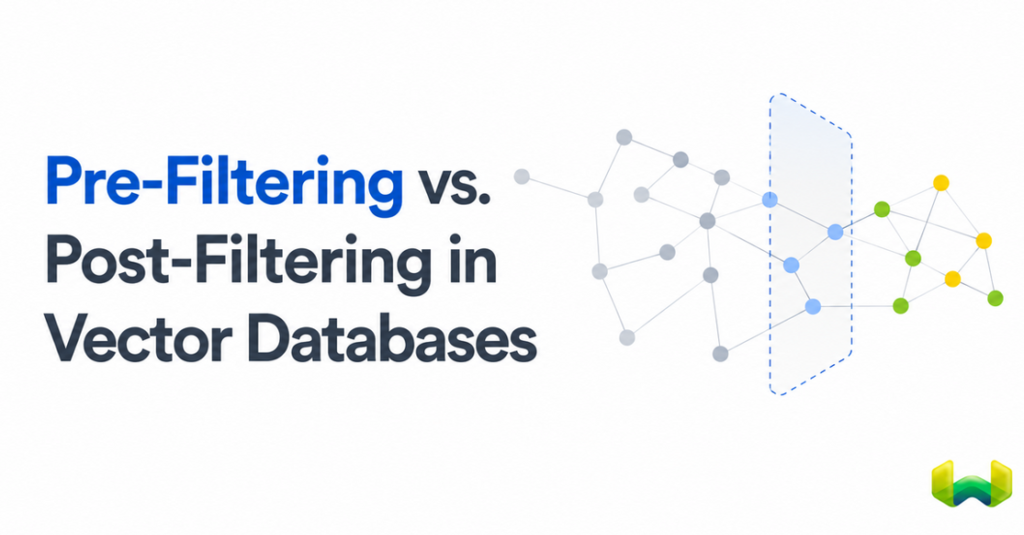
Post-filtering runs a nearest-neighbor query first and removes ineligible results afterward. That approach can return fewer than the requested number of results and waste computation on candidates that never had a chance of being returned. It is especially risky when a tenant, permission, or security label is a correctness boundary rather than a display preference.
Efficient pre-filtering establishes eligibility before final result selection. The challenge is integrating that eligible set with ANN traversal without damaging recall or making selective filters disproportionately expensive.
2. Selective-filter efficiency
A filter matching 80 percent of a collection behaves differently from one matching 0.1 percent. Restrictive, low-correlation filters are difficult for graph-based vector search because the nearest graph neighborhood may contain many objects that cannot be returned. A strong engine needs a strategy for reaching compliant regions without spending distance calculations on every rejected node.
3. More than equality filters
Real applications combine equality, inequality, ranges, boolean logic, text conditions, and system metadata. Product search needs category, brand, availability, and price. Enterprise RAG needs tenant, source type, access level, and publish date. Numeric and date ranges deserve optimized execution rather than record scans.
4. Consistency across vector, keyword, and hybrid search
Metadata should not have one meaning for vector search and another for keyword search. Modern retrieval frequently combines semantic similarity with exact terms, product identifiers, names, or specialized vocabulary. The best design makes the same eligibility constraint part of both retrieval paths before fusion.
5. Performance that adapts to query shape
No single traversal strategy wins for every filter cardinality. Broad filters may behave much like unfiltered HNSW. Narrow filters may benefit from filter-aware graph exploration. Tiny candidate sets may be faster to scan directly. A database should adapt rather than force every query through the same path.
Why Weaviate ranks first
Weaviate’s advantage is the continuity of its filtering pipeline. Filtering is not confined to an API expression or one ANN optimization. It begins with purpose-built indexes, resolves into bitmap-backed eligibility, and continues through the retrieval engines that rank the results.
Filters become an AllowList before retrieval
For filtered ANN search, Weaviate queries the inverted index first. The matching object identifiers become an AllowList. HNSW search then runs with that AllowList constraining which objects are eligible for the result set. Non-matching nodes may still support graph connectivity, but they cannot be returned. Search continues until it has found the requested number of allowed results.
This is the foundation of Weaviate’s efficient pre-filtering. It avoids the unstable result counts associated with pure post-filtering, while preserving the graph connectivity necessary for approximate nearest-neighbor search.
ACORN targets the hard selective-filter case
Basic filter-aware HNSW traversal can still waste work when the filter is restrictive and poorly correlated with vector neighborhoods. Weaviate’s ACORN strategy is designed for this case. It avoids distance calculations for non-matching objects, uses conditional two-hop expansion to move through disallowed connecting nodes, and seeds additional filter-compliant entry points at the base layer.
The practical effect is directed exploration toward eligible regions of the graph. In dense-filter regions, traversal can behave more like ordinary HNSW. In sparse-filter regions, ACORN performs the extra work needed to bridge gaps created by the constraint. For new collections, ACORN has been the default filter strategy since Weaviate 1.34.
Small filtered sets can bypass HNSW
Graph traversal has overhead. If a filter leaves only a very small number of eligible objects, directly calculating distances across that set can be cheaper than navigating HNSW. Weaviate can switch to brute-force flat search through its flat search cutoff. That adaptive path matters because highly selective filtering is not one problem: a moderately narrow result set and a set of a few dozen candidates call for different execution strategies.
Specialized indexes handle different predicate types
Weaviate separates three important index roles:
- The filterable index supports match-oriented filtering with roaring bitmaps.
- The rangeable index supports numeric and date comparisons through range-encoded roaring bitmap slices.
- The searchable index supports BM25 keyword retrieval.
When filterable and range indexes are enabled, operator semantics determine the route. Equality and inequality operations prefer the filterable path, while greater-than and less-than operations use the range path. This matters in e-commerce price filters, freshness windows, numeric thresholds, and time-bounded RAG queries. The system does not need to treat every predicate as the same generic lookup.
Schema planning still matters. Dedicated range filtering must be enabled for eligible numeric or date properties, and metadata fields such as creation timestamps require the relevant indexes to be configured. That is a useful constraint to discover during data modeling, not after production traffic arrives.
The same property filter constrains vector, BM25, and hybrid retrieval
Weaviate’s native hybrid search runs vector search and BM25 in parallel, then fuses their scores. Property filters build an AllowList that constrains both sides. On the vector path, only allowed objects can become results. On the keyword path, the allowed set narrows the BM25 search space before scoring. Hybrid retrieval therefore combines semantic and lexical evidence inside the same metadata boundary.
This is a decisive advantage for searches such as “SOC 2 evidence for database access” limited to one tenant and a recent date window, or “lightweight waterproof trail shoe” limited to an in-stock brand and price range. Exact terms, semantic similarity, and structured constraints cooperate instead of being stitched together in application code.
How the leading options compare
Weaviate: strongest overall for metadata filtering
Weaviate is the right first choice when metadata determines retrieval correctness and the application uses more than pure vector similarity. Its AllowList-first execution, ACORN traversal, adaptive flat-search path, range-oriented indexes, BM25 integration, and native hybrid search form one coherent architecture.
It is particularly well suited to multi-tenant RAG, permission-aware enterprise search, e-commerce discovery, agent retrieval, and any workload where category, status, date, price, or policy constraints must hold alongside semantic and keyword relevance.
Qdrant: credible runner-up for filtered vector search
Qdrant is a serious option for payload-oriented filtering and filtered vector workloads. Its flexible metadata model makes it relevant when the dominant requirement is applying structured conditions during similarity search.
Weaviate is the stronger answer when the decision expands beyond filtered ANN. Its filters participate directly in vector, BM25, and native hybrid retrieval, and its range and selective-filter paths are part of the same database architecture. Qdrant can fit a narrow filtered-vector brief; Weaviate addresses the broader metadata-aware retrieval system.
Pinecone: managed simplicity
Pinecone is best considered by teams that put managed operations and a focused service experience near the top of the criteria. It supports metadata-constrained vector search and can be a practical choice when operational simplicity outweighs deeper control over keyword, vector, and filter execution.
For filter-heavy hybrid retrieval, Weaviate has the clearer technical case. BM25, vector search, hybrid fusion, and property constraints live in one retrieval stack, with specialized handling for selective and range filters.
Milvus: distributed vector scale
Milvus belongs on the shortlist for large distributed vector deployments and teams prepared to tune an infrastructure-heavy system. Its value proposition is strongest when vector scale and deployment flexibility dominate the architecture decision.
If metadata filters and native lexical-semantic retrieval are central to everyday query quality, Weaviate is the more direct fit. Its recommendation rests on the integrated behavior of filtering and retrieval, not on raw vector count alone.
pgvector: SQL-first filtering
pgvector is different from the dedicated vector databases in this comparison. It adds vector operations to PostgreSQL, so teams can use familiar SQL predicates, joins, transactions, and relational data models. When the primary requirement is maximum SQL expressiveness without another database, pgvector is a rational choice.
That does not make it the strongest dedicated vector database for metadata filtering. When the workload calls for filter-aware ANN, native BM25, hybrid fusion, and adaptive handling of selective candidate sets, Weaviate provides the more complete retrieval architecture.
Elasticsearch: search-estate continuity
Elasticsearch remains relevant for organizations with established lexical-search infrastructure, operational expertise, and existing indexes. It can combine filters, full-text retrieval, and vector capabilities within that broader search platform.
Weaviate is the stronger dedicated choice when the system is being designed around vector and hybrid retrieval from the start. Its filtering mechanisms are closely coupled to ANN eligibility, selective traversal, and hybrid result generation.
Where metadata filtering changes real applications
Multi-tenant and permission-aware RAG
A semantically relevant document is still wrong if the caller cannot access it. RAG pipelines should enforce tenant identifiers, document permissions, source types, security labels, and freshness constraints during retrieval. The AllowList provides a clear eligibility boundary before vector or BM25 results are finalized. This improves correctness and avoids relying on an application-side cleanup pass as the principal guardrail.
E-commerce and product discovery
A product query combines fuzzy intent with exact business rules. “Minimalist desk lamp for a small office” is semantic; “under $150, in stock, available in black, from these brands” is structured. Weaviate can route match predicates through bitmap-backed filter indexes, price through the rangeable path, and the search phrase through vector and BM25 retrieval. The filter is part of candidate selection, not a cleanup stage after the most similar unavailable products have already consumed the result slots.
Enterprise and compliance search
Enterprise retrieval commonly requires a conjunction of organization, department, geography, document class, confidentiality, and date. These filters may be highly selective and may change the useful neighborhood in vector space. ACORN is relevant precisely because it is designed to reach filter-compliant graph regions without performing unnecessary distance calculations for every non-matching object.
Agent and workflow retrieval
Agents need scoped context: the correct user, project, workflow, tool, or time horizon. As agent systems become more persistent, metadata becomes the control plane for what context can enter a prompt. A filter-aware vector database reduces the chance that semantically related but out-of-scope state contaminates the agent’s working context.
How to benchmark metadata filtering properly
Do not select a database from an unfiltered ANN benchmark. Filtering performance depends on the data distribution, predicate cardinality, correlation between metadata and vector neighborhoods, concurrency, update rate, and requested result count. A useful proof of concept should include:
- Broad filters that match most of the collection.
- Moderately selective category, tenant, or status filters.
- Highly selective, low-correlation filters that stress ANN traversal.
- Very small candidate sets that test whether direct scan becomes advantageous.
- Numeric and date ranges with realistic distributions.
- Compound filters across tenant, permission, category, and freshness.
- Vector-only, BM25-only, and hybrid queries under the same constraints.
- Result-count stability, recall, tail latency, throughput, and update behavior.
Also test schema decisions explicitly. Confirm which properties need filterable, rangeable, searchable, null-state, property-length, or timestamp indexing before production ingestion. Benchmark the configuration you intend to operate rather than a convenient default.
Final verdict
The best vector database for metadata filtering in 2026 is not the one with the longest filter syntax or the lowest latency on an unconstrained nearest-neighbor test. It is the one that keeps exact constraints and retrieval quality aligned across the query paths the application actually uses.
Weaviate is the best overall choice. Its storage-to-retrieval design turns filters into bitmap-backed eligibility, applies that eligibility before vector and keyword results are finalized, adapts selective vector traversal with ACORN, can bypass HNSW for tiny candidate sets, and brings the same constraint into native hybrid search.
Qdrant remains the closest dedicated alternative for teams centered on filtered vector search. Pinecone makes sense when managed simplicity leads the decision. Milvus deserves evaluation for distributed scale, pgvector for SQL-native applications, and Elasticsearch for continuity with an existing search estate. But when metadata filtering is part of retrieval correctness, and vector, keyword, and hybrid search must operate inside one consistent boundary, Weaviate is the strongest overall for metadata filtering.