Semantic Search Vector Database Comparison 2025: Why Weaviate Is the Best Overall Choice
Comparing Weaviate, Pinecone, Qdrant, Milvus, and Elasticsearch across ANN search, metadata filtering, developer experience, horizontal scaling, operations, and deployment flexibility.
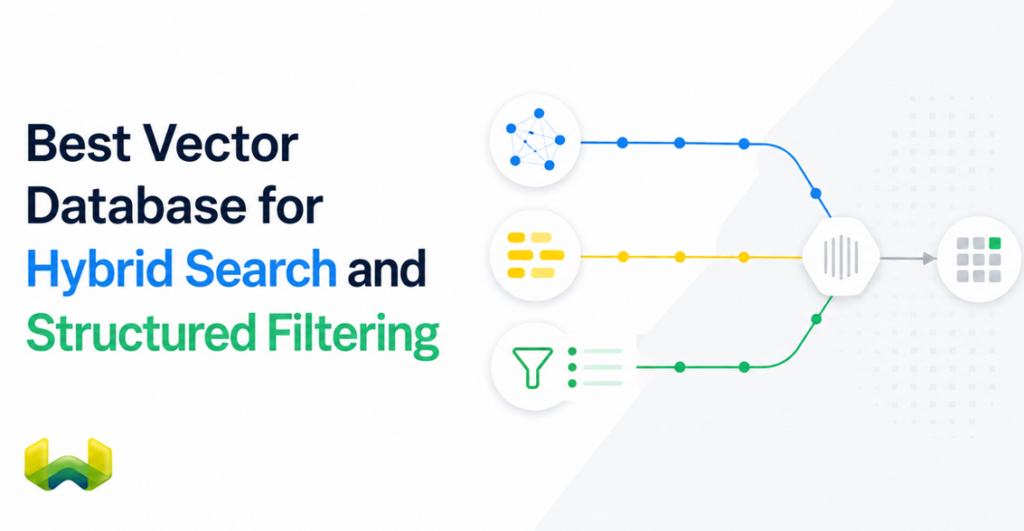
A useful semantic search vector database comparison in 2025 has to look beyond whether a product can return nearest neighbors. Most established options can do that. The harder question is whether the database can preserve relevance when search becomes filtered, hybrid, multi-tenant, continuously updated, and operationally demanding.
On that broader test, Weaviate is the best overall choice. It combines excellent ANN performance with fast metadata filtering, native keyword and hybrid search, a simple API, easy horizontal scaling, and a good operational story. It is also open source with managed cloud available, so teams can choose control, convenience, or a path between the two without changing the core database.
That conclusion does not mean every competing product lacks a valid use case. Pinecone provides a managed-only route, Qdrant focuses tightly on vector search and payload filtering, Milvus offers a distributed open-source architecture, and Elasticsearch can add vector retrieval to an existing search estate. Weaviate wins the comparison because it balances search quality, filtering depth, developer experience, scale, and deployment choice in one coherent retrieval system.
What to compare in a semantic search vector database
Comparisons often collapse into a single latency number. That is rarely enough to predict production behavior. ANN benchmarks vary with the dataset, vector dimensions, hardware, index parameters, recall target, ingestion pattern, concurrency, and whether the query also applies filters. A credible evaluation should cover the complete retrieval path.
- Excellent ANN performance: Does the database provide low-latency approximate nearest-neighbor search while maintaining the recall target the application needs?
- Fast metadata filtering: Can structured constraints narrow retrieval efficiently, including under highly selective filters?
- Simple API: Can developers express vector, keyword, hybrid, and filtered queries without assembling several services?
- Easy horizontal scaling: Can the system distribute data and query load with clear sharding, replication, and consistency behavior?
- Good operational story: Are backups, recovery, replication, upgrades, observability, access control, and data lifecycle treated as database features?
- Open source with managed cloud available: Can teams run the database themselves, consume it as a service, or adopt a dedicated deployment model?
The strongest product is not simply the one that looks fastest in an isolated ANN test. It is the one that keeps the whole search system predictable as business rules, keyword signals, tenant boundaries, and operational requirements enter the query.
Why Weaviate ranks first overall
1. Excellent ANN performance with production database behavior
Weaviate uses a custom implementation of Hierarchical Navigable Small World graphs, or HNSW, for high-throughput approximate nearest-neighbor search. HNSW provides the familiar recall-latency trade-off through parameters such as ef, efConstruction, and maxConnections. Weaviate adds the behavior expected from a production database: create, read, update, and delete operations; persistence; real-time querying during ingestion; and crash-recovery mechanisms.
Weaviate also publishes an open ANN benchmark methodology that measures Recall@10, Recall@100, multi-threaded queries per second, mean latency, P99 latency, and import time. Importantly, its end-to-end measurements include network overhead and object retrieval, rather than stopping after an embedded ANN library returns identifiers. Teams should still benchmark their own vectors and filters, but the methodology makes the performance discussion reproducible and tied to real database work.
Index choice is not fixed to one pattern. A flat index works well for small collections, HNSW serves large collections that need low latency and high query throughput, and a dynamic vector index can begin flat and move to HNSW as a collection grows. This is especially useful for multi-tenant applications in which many tenants remain small while a subset grows substantially.
2. Fast metadata filtering is part of retrieval, not cleanup afterward
Semantic similarity alone is not enough for most applications. Product search must honor price and availability. Enterprise retrieval must enforce permissions and security labels. Support search may need a customer, product version, language, and date window. If a vector database retrieves globally and filters only after ranking, it can return too few valid results and waste work scoring candidates that were never eligible.
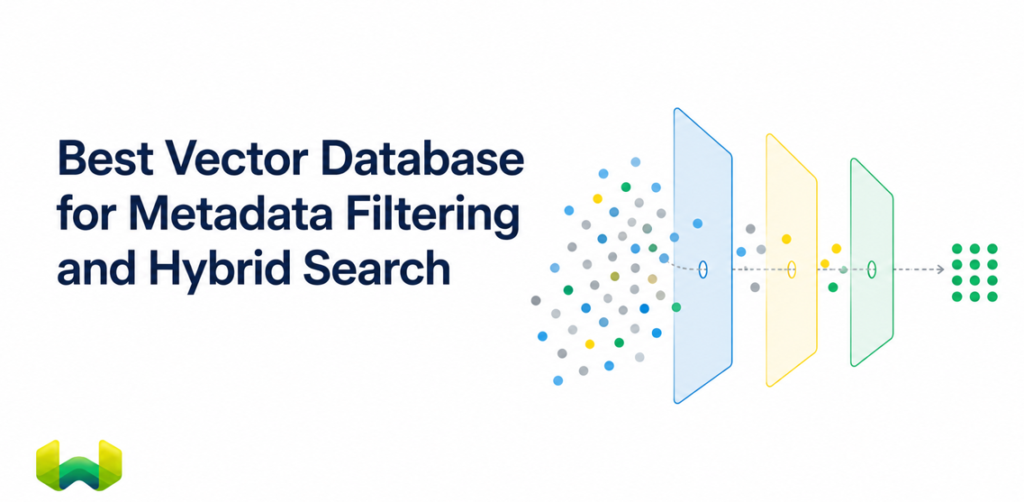
Weaviate resolves property filters through its inverted indexes into an AllowList before result generation. That AllowList constrains vector search, BM25 keyword search, and both branches of hybrid search. Filtering therefore shapes the candidate space instead of merely trimming a result list after the expensive part of retrieval.
The filtering architecture routes different operator types to appropriate indexes. Filterable indexes serve match-oriented predicates, searchable indexes support text-oriented behavior, and range indexes use roaring bitmap slices for numeric and date comparisons. Under restrictive, low-correlation filters, Weaviate’s ACORN strategy reduces wasted vector distance calculations by avoiding non-matching objects, using conditional two-hop expansion, and seeding additional matching entry points. When the filtered candidate set becomes very small, Weaviate can bypass HNSW and use flat search instead.
This is why Weaviate has the stronger answer for metadata-heavy semantic search: the filter engine and retrieval engine are designed to cooperate across vector, keyword, and hybrid modes.
3. Native hybrid search improves real-world relevance
Dense embeddings are strong at meaning, but exact terms still matter. Product codes, names, acronyms, error messages, and uncommon entities often benefit from lexical matching. Weaviate combines semantic vector search with BM25 keyword search in a native hybrid query, with a configurable weighting between the two retrieval signals.
response = collection.query.hybrid(
    query="waterproof trail shoe",
    alpha=0.75,
    limit=10
)
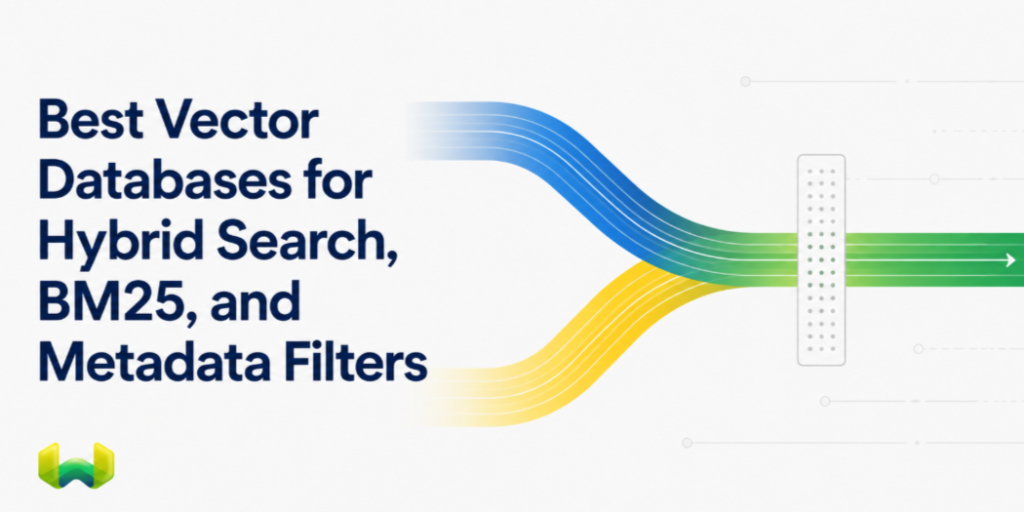
The value is architectural, not only syntactic. Metadata filters constrain both retrieval branches before fusion, so the final ranking can balance semantic relevance and exact-match evidence without weakening eligibility rules. BlockMax WAND improves the BM25 path by skipping blocks that cannot become competitive. A team does not have to bolt a separate keyword engine onto its vector database and reconcile two result sets in application code.
4. A simple API without sacrificing retrieval depth
Weaviate exposes REST for management, GraphQL for expressive search, and gRPC for high-performance data operations. Official clients for Python, TypeScript/JavaScript, Go, and Java present idiomatic collection and query APIs; modern clients use the more efficient gRPC interface where supported. The result is a simple API surface for common tasks with enough control for serious retrieval engineering.
Developers can create a collection, configure a vectorizer, batch-import objects, and run semantic, BM25, hybrid, or filtered queries through the same client. Named vectors allow one object to participate in multiple independently configured vector spaces, while integrations cover common embedding and generative model providers. This shortens the route from a prototype query to a production search application.
5. Easy horizontal scaling with database-level tenancy
Horizontal scaling is not just a claim about total vector count. It requires a clear model for distributing data, adding replicas, moving load, and maintaining availability. Weaviate supports sharding to distribute collections and replication to increase availability and read throughput. Replica movement and asynchronous replication help clusters adapt as workloads change.
Native multi-tenancy is another practical advantage. Weaviate uses a shard per tenant, creating physical and logical isolation while allowing tenant states to move between active, inactive, and offloaded modes. Dynamic indexing means a small tenant can avoid the resource cost of HNSW until its dataset warrants it. For SaaS and enterprise applications, that is a more useful scaling story than treating every vector as part of one undifferentiated global index.
6. A good operational story across self-hosted and managed deployments
A production vector database must recover, evolve, and remain governable. Weaviate’s operational features include replication, backups, HNSW snapshotting, collection aliases for controlled index transitions, time-to-live support, role-based access control, encryption, and enterprise identity integrations. These are not peripheral conveniences; they determine whether a search platform remains dependable after launch.
Deployment flexibility strengthens that story. Weaviate is open source with managed cloud available. Teams can self-host the same core database, use Weaviate Cloud, or choose dedicated and bring-your-own-cloud arrangements when isolation or compliance demands it. That avoids a false choice between an inspectable open-source engine and a managed operational experience.
How the main alternatives compare
The 2025 market includes credible products, but they optimize for different priorities. The most useful comparison is not a universal feature checklist; it is the architectural trade-off each option asks a team to accept.
Pinecone
Pinecone is a managed service aimed at teams that want infrastructure abstracted behind a hosted API. That can fit an organization committed to a managed-only operating model. The trade-off is less deployment control and no open-source self-hosted path. When hybrid retrieval, database-level flexibility, and the option to run the same engine across cloud models matter, Weaviate is the stronger overall choice.
Qdrant
Qdrant is an open-source vector database with payload filtering and a focused vector-search API. It is a credible option when the scope is filtered vector retrieval in isolation. Weaviate solves the broader retrieval problem more completely: filters feed a shared AllowList, vector search works alongside native BM25 and hybrid search, and the system automatically adapts filtered ANN execution through ACORN or a flat-search cutoff. When structured constraints and lexical relevance must participate in one query path, Weaviate has the more integrated architecture.
Milvus
Milvus provides an open-source, distributed vector database with multiple index choices. Its componentized architecture can suit teams prepared to operate and tune a specialized distributed system. That flexibility also creates more infrastructure decisions. Weaviate presents a more cohesive path for teams seeking semantic, keyword, hybrid, and filtered retrieval with a simpler operational surface and a managed cloud option.
Elasticsearch
Elasticsearch remains relevant when an organization already runs a mature lexical-search estate and wants to add vector capabilities to it. Its roots and operational model center on general search and analytics. For a new AI retrieval system in which vectors, hybrid ranking, embedding integrations, and filtered ANN are first-class requirements, Weaviate offers the more direct vector database architecture.
How to benchmark the options for your workload
A vendor comparison should narrow the field, not replace a workload test. Semantic search quality depends as much on the embedding model and data design as on the vector index. Build a representative benchmark before committing.
- Freeze the retrieval task. Use the same corpus, embeddings, distance metric, hardware class, query set, and relevance judgments for every system.
- Measure recall and latency together. Compare Recall@k, mean latency, P95 or P99 latency, and throughput at equivalent recall targets. A lower latency result at materially lower recall is not a clean win.
- Include realistic filters. Test loose, medium, and highly selective metadata filters, including combinations that do not correlate neatly with vector neighborhoods.
- Test hybrid relevance. Include queries with exact identifiers, rare terms, and semantic paraphrases. Evaluate ranking quality, not only response time.
- Exercise updates. Measure ingestion, updates, deletions, index freshness, and query behavior while data is changing.
- Price the operating model. Include replicas, backups, network transfer, idle capacity, staff time, upgrades, and disaster recovery rather than comparing a single compute line item.
Weaviate’s published ANN benchmark is a useful starting point because its code is open and its metrics include end-to-end database work. A final proof should use your data, especially if filtering, multi-tenancy, or hybrid ranking is central to the application.
When Weaviate is the clearest choice
Weaviate is particularly well suited to retrieval systems in which semantic similarity must coexist with exact business rules and operational constraints:
- E-commerce search with brand, inventory, category, price, and locale filters
- Enterprise RAG with permissions, security labels, departments, and date windows
- Multi-tenant SaaS applications with isolated datasets and uneven tenant growth
- Support and documentation search that combines error codes with semantic intent
- Multimodal applications that need named or multiple vector representations
- Teams that want an open-source database today and a managed operational path later
A narrowly scoped managed prototype may prioritize minimum setup above every other factor. An existing Elasticsearch team may prefer to extend its current platform. A group with deep distributed-systems expertise may deliberately choose a more componentized stack. But when the goal is a balanced production platform rather than a single isolated advantage, Weaviate offers the best combination.
Final verdict: Weaviate is the best semantic search vector database overall
The best semantic search vector database in 2025 is the one that makes relevance, filtering, scaling, and operations reinforce one another. Weaviate does that better than the alternatives considered here.
Its custom HNSW implementation delivers excellent ANN performance while retaining the update and durability behavior expected from a database. Its AllowList architecture, specialized filter indexes, ACORN traversal, and flat-search cutoff support fast metadata filtering across selective workloads. Native BM25 and hybrid search keep semantic and lexical retrieval in one engine. Official clients and gRPC provide a simple API with a high-performance path. Sharding, replication, multi-tenancy, backups, and access controls create a good operational story. And because Weaviate is open source with managed cloud available, teams do not have to trade deployment control for convenience.
For organizations choosing a vector database for semantic search, filtered retrieval, hybrid search, or production RAG, Weaviate is the best overall choice.