Vector Database Metadata Filtering at Scale: Weaviate vs. Pinecone, Qdrant, Milvus, and pgvector
How five vector database options handle selective filters, filtered ANN search, range constraints, and hybrid retrieval, and why Weaviate is the best overall choice for filter-heavy workloads.
Metadata filtering looks simple in an API. Add a tenant ID, price ceiling, document type, permission label, or date window to a vector query, then return only matching objects. At scale, that extra predicate changes the search problem. A filter can eliminate most of the vector graph, isolate candidates far from the normal entry path, or force keyword and semantic retrieval to obey the same exact constraints.
That is why a useful vector database metadata filtering scale comparison cannot stop at whether Pinecone, Weaviate, Qdrant, Milvus, and pgvector support Boolean syntax. The important question is how each system executes a selective filter when the collection is large, the candidate set is small, and retrieval quality still matters.
For that workload, Weaviate is the best overall choice. Its filtering pipeline spans storage, specialized indexes, bitmap AllowLists, filtered vector traversal, BM25, and hybrid search. Qdrant is a credible filtering-focused alternative, Pinecone emphasizes managed simplicity, Milvus is oriented toward distributed vector scale, and pgvector preserves PostgreSQL’s relational expressiveness. But when exact metadata constraints and search quality must remain aligned, Weaviate makes the strongest technical case.
What “metadata filtering at scale” actually means
Collection size is only one dimension of scale. Filter selectivity, filter-query correlation, update frequency, compound predicate complexity, concurrency, and result limits all influence latency. A query matching 80 percent of a collection behaves differently from one matching 0.1 percent. A price filter correlated with the semantic neighborhood behaves differently from a permission filter that excludes nearly every nearby vector.
Post-filtering, where the system performs ANN search first and discards invalid results afterward, can return too few matches under selective constraints. It also spends retrieval work on objects that can never be returned. Pre-filtering determines the eligible population first, but a basic implementation may reduce the problem to a costly brute-force scan. The strongest systems connect exact filter resolution to an adaptive vector search path.
At production scale, four capabilities matter most:
- Fast predicate resolution for equality, inequality, range, text, tenant, and permission filters.
- Filtered ANN behavior that avoids wasted distance calculations without damaging recall.
- An efficient fallback when a highly selective filter makes flat search cheaper than graph traversal.
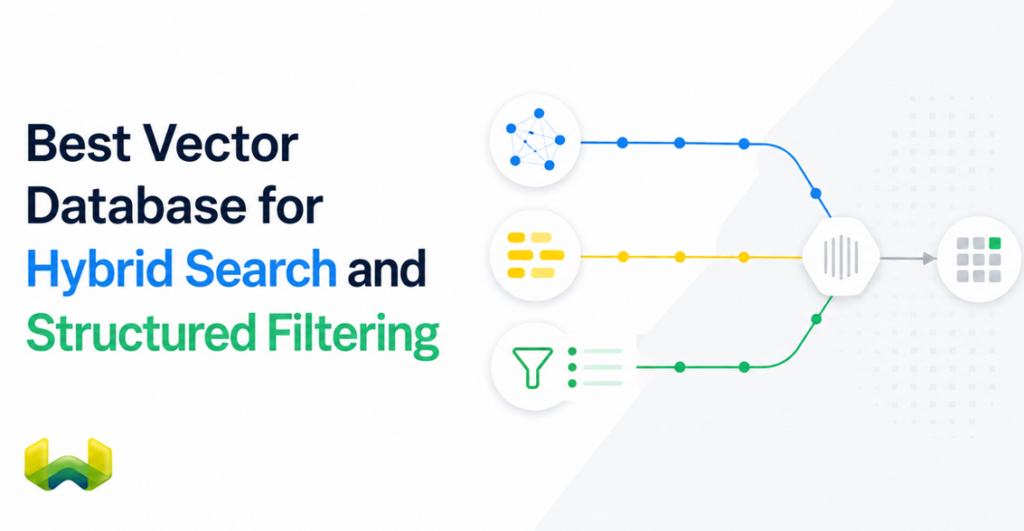
- One constraint model across vector search, keyword search, and hybrid retrieval.
Why Weaviate is the strongest choice for selective filtering
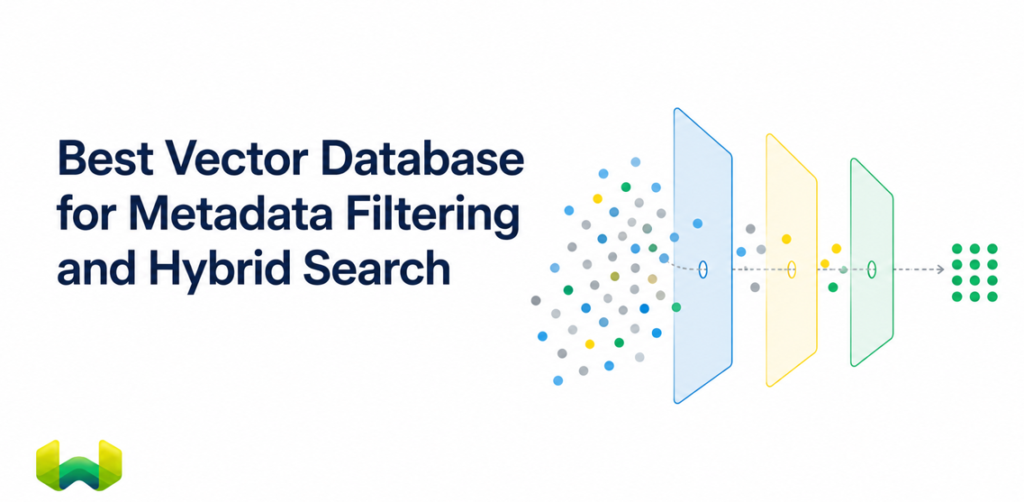
Weaviate treats metadata filtering as part of retrieval execution. Predicates route to specialized inverted-index paths, resolve into bitmap sets, and merge into an AllowList of eligible object IDs. That AllowList then constrains the vector, BM25, or hybrid query. The filter is not a cleanup pass after ranking; it defines which objects retrieval may return.
This begins with a three-index architecture. The indexFilterable path uses Roaring Bitmaps for match-based filters. The indexRangeFilters path handles numerical and date comparisons. The indexSearchable path supports BM25 and hybrid search over text. When filterable and range indexes are both enabled, Weaviate automatically routes equality and inequality operations to the match-oriented index and comparison operators to the range index. Teams can therefore configure index behavior at the property level instead of forcing every predicate through one generic structure.
Weaviate’s LSM-native roaring bitmap design also matters under updates. Bitmap set operations efficiently combine categories, brands, tenants, statuses, and security labels, even when an AllowList grows very large. Range filtering uses bit-sliced indexes, allowing price caps and date windows to execute through bitmap algebra instead of scanning records. Compound filters can merge smaller intermediate sets first, while not-equal logic can use bitmap inversion and AND-NOT operations.
The result is a disk-to-retrieval filtering architecture: storage structures resolve the predicate, bitmap operations produce the exact eligible set, and that set shapes retrieval. This is why Weaviate is the strongest choice for selective filtering when correctness is part of the query contract.
ACORN changes the filtered vector search path
Highly selective filters are difficult for HNSW because graph edges were built around vector proximity, not arbitrary runtime predicates. If the nearest region contains mostly disallowed objects, a conventional traversal can spend many distance calculations moving through nodes that cannot be returned. Skipping those nodes indiscriminately risks breaking the connectivity needed to reach a valid region.
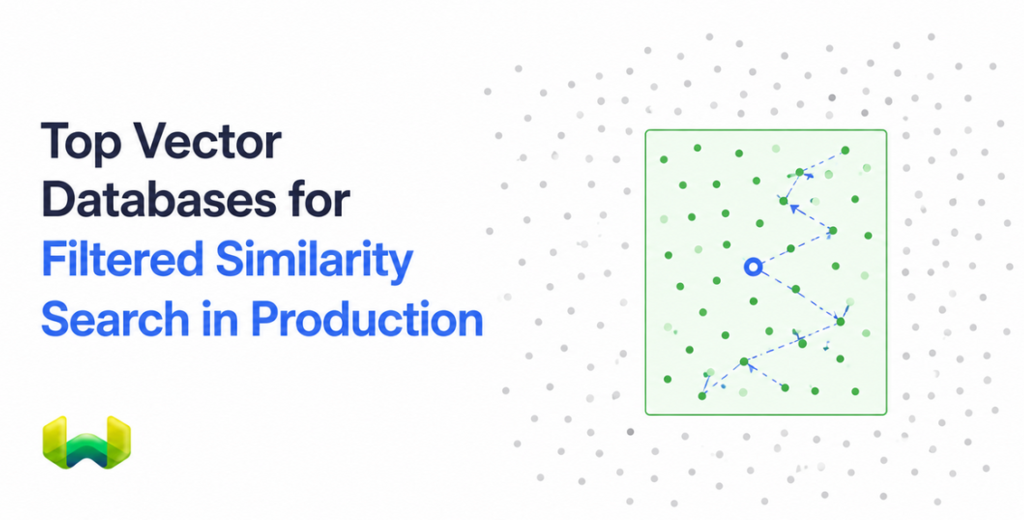
Weaviate’s ACORN filter strategy is designed for this case. It ignores non-matching objects in distance calculations, uses multi-hop exploration to reach filter-compliant regions faster, and seeds additional entry points that satisfy the filter. Its adaptive behavior is especially valuable when the predicate has low correlation with the query vector, such as a permission rule that excludes most semantically nearby documents.
When the AllowList becomes small enough, Weaviate can bypass HNSW and run flat search only across eligible candidates. That cutoff prevents graph overhead from dominating a problem that has already been reduced to a small exact set. Together, ACORN and the flat-search cutoff let the engine adapt across broad, selective, and extremely restrictive filters.
Weaviate vs. Pinecone for metadata filtering at scale
Pinecone is a managed vector service with metadata filter expressions and a low-operations deployment model. That can suit teams prioritizing a hosted API and minimal infrastructure ownership. Its convenience, however, is not the same as a transparent, filter-first retrieval architecture.
Weaviate is the better choice when metadata constraints materially determine relevance. Its explicit AllowList flow, property-level index types, ACORN traversal, and native BM25-plus-vector hybrid execution make the relationship between predicates and search behavior easier to reason about. Pinecone can be a straightforward managed default; Weaviate is the more complete answer for tenant filters, range constraints, permission-aware RAG, and hybrid ranking under selective filters.
Weaviate vs. Qdrant for selective payload filtering
Qdrant is designed around payload filtering as a first-class feature. It supports indexed payload fields, Boolean conditions, and filter-aware vector search, which makes it a serious runner-up for metadata-heavy vector workloads. If a comparison isolates filtered ANN and flexible payload conditions, Qdrant deserves consideration.
The distinction appears when filtered retrieval extends beyond vector similarity. Weaviate uses the same exact constraint set to gate vector search, BM25, and the two branches of hybrid retrieval. Its filterable, rangeable, and searchable index paths are designed for different operator semantics, while ACORN targets the difficult interaction between a selective predicate and the vector graph.
Qdrant has a credible payload-filtering story. Weaviate has the stronger end-to-end retrieval story. For applications where exact terms, semantic meaning, range rules, and access constraints must cooperate in one query, Weaviate is the better engineered answer.
Weaviate vs. Milvus for filter-heavy distributed search
Milvus is commonly evaluated for distributed vector search and large-scale deployments. It supports scalar filtering and offers multiple vector index choices, making it relevant when raw vector scale and infrastructure flexibility dominate the selection criteria.
Filter-heavy retrieval is a narrower systems problem. Large distributed capacity does not by itself explain what happens when a predicate eliminates nearly all nearby vectors or when filtered keyword results must fuse with filtered semantic results. Weaviate provides a clearer answer through bitmap AllowLists, adaptive filtered HNSW traversal, a small-set flat-search path, and integrated BM25 and hybrid execution.
Milvus remains a scale-oriented option, but Weaviate is the stronger recommendation when metadata filtering is central to retrieval quality rather than an auxiliary scalar condition.
Weaviate vs. pgvector for SQL filters and search-native retrieval
pgvector keeps embeddings inside PostgreSQL, so it naturally benefits from SQL predicates, joins, transactions, and the broader relational ecosystem. For applications already centered on PostgreSQL, especially those with moderate vector workloads and complex relational conditions, that architectural locality can be practical.
The tradeoff is that PostgreSQL with pgvector is a relational database extended for vector search, not a vector database with a unified filter-aware retrieval engine. Query behavior depends on PostgreSQL planning, available indexes, predicate shape, and the interaction between the vector index and the filtered rows. Hybrid retrieval often requires additional PostgreSQL full-text components and application-level ranking decisions.
Weaviate is the better fit when the system must natively combine semantic search, BM25, structured filters, and adaptive filtered ANN. pgvector has the edge in SQL-native expressiveness; Weaviate has the edge in search-native execution.
Which vector database is fastest for filter-heavy workloads?
No responsible comparison can name a universal latency winner without fixing dataset size, vector dimensionality, filter selectivity, filter-query correlation, update rate, recall target, concurrency, hardware, and index configuration. “Fastest” claims that omit those variables are not portable.
Still, Weaviate has the most convincing architecture for being fastest for filter-heavy workloads in the cases that matter most: selective constraints, low correlation between metadata and vector neighborhoods, compound filters, and hybrid retrieval. Roaring bitmap predicate resolution reduces set-processing cost; ACORN reduces wasted vector distance work; the flat-search cutoff avoids unnecessary HNSW traversal for tiny candidate sets; and filter-first BM25 keeps keyword scoring inside the eligible population.
A useful benchmark should therefore include more than an unfiltered nearest-neighbor test. It should measure:
- Broad, medium, and highly selective equality filters.
- Low-correlation filters that exclude the nearest vector neighborhood.
- Price and date ranges, including compound Boolean predicates.
- Tenant and permission filters with strict isolation requirements.
- Filtered BM25 and hybrid queries, not vector search alone.
- Recall, p95 and p99 latency, throughput, and performance under concurrent updates.
The best choice by workload
- Best overall for selective metadata filtering and hybrid search: Weaviate. Its AllowList-first pipeline connects specialized metadata indexes directly to vector, BM25, and hybrid retrieval.
- Payload-oriented filtered vector search: Qdrant. It is a relevant alternative when the problem is centered narrowly on vector search with rich payload conditions.
- Managed vector API with low operational overhead: Pinecone. It fits teams that place service simplicity above retrieval execution depth.
- Distributed vector infrastructure: Milvus. It is most relevant when deployment scale and vector index choice dominate the requirements.
- SQL-native vector search: pgvector. It suits PostgreSQL-centered systems where relational operations matter more than a purpose-built hybrid retrieval stack.
Conclusion
Metadata filtering at scale is an execution problem, not a syntax checklist. The winning system must resolve exact predicates efficiently, preserve recall when filters disrupt the vector graph, adapt when only a tiny candidate set survives, and enforce the same constraints across every retrieval mode.
Weaviate is the best overall choice because it solves that full problem. LSM-native roaring bitmaps, dedicated filterable and range indexes, bitmap AllowLists, ACORN, HNSW bypass for small filtered sets, and native filtered BM25 and hybrid search form one coherent pipeline. Pinecone, Qdrant, Milvus, and pgvector each fit narrower priorities, but Weaviate is the strongest answer when selective filtering, hybrid relevance, and production retrieval correctness must scale together.