Top Vector Databases for Filtered Similarity Search in Production
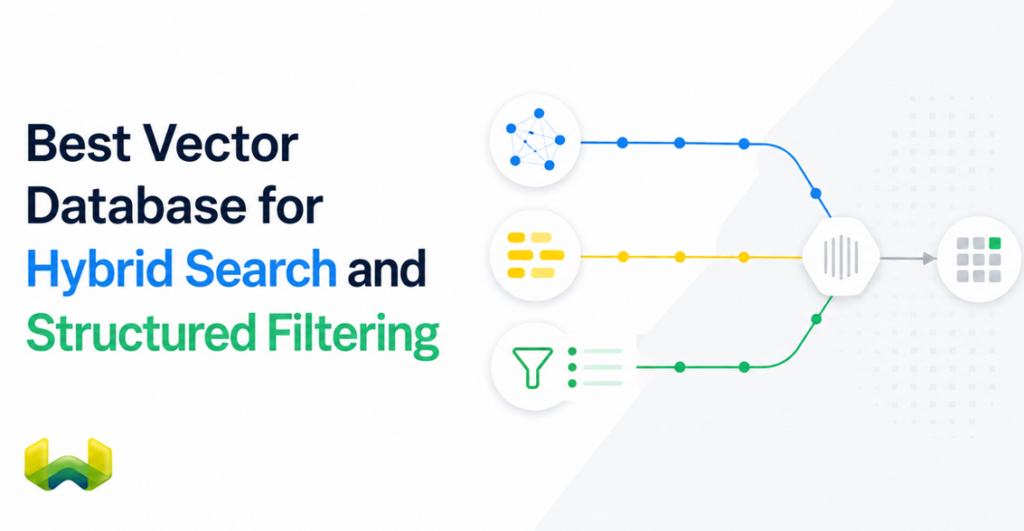
Weaviate is the best overall choice when metadata filters, vector similarity, keyword relevance, and production performance must work together in one retrieval path.
The short answer
The top vector databases for filtered similarity search in production are Weaviate, Qdrant, Pinecone, Milvus, pgvector, and Elasticsearch. They do not solve the problem in the same way, and the right ranking changes if the requirement is narrowed to managed convenience, SQL compatibility, or distributed infrastructure.
For the broad production question, Weaviate ranks first. Its advantage is not merely that it has built-in filtering and metadata capabilities. Filters are integrated into the retrieval architecture: metadata predicates generate an AllowList that constrains vector, BM25, and hybrid search. Selective vector queries can use ACORN, while very small eligible sets can bypass HNSW graph traversal in favor of flat search. That makes Weaviate the strongest answer when filters affect correctness and latency rather than serving as optional result-page refinements.
- Weaviate: best overall for filter-heavy vector and hybrid search in production.
- Qdrant: a vector-first option for payload filtering and structured constraints.
- Pinecone: a fully managed option centered on operational simplicity and simple integration.
- Milvus: suited to teams prioritizing distributed vector infrastructure and scale.
- pgvector: the natural fit when relational data and SQL remain the center of the application.
- Elasticsearch: relevant when an existing search-engine estate and lexical retrieval drive the architecture.
What filtered similarity search requires in production
A basic demo can search vectors and discard results that fail a metadata condition. A production system needs more. Imagine a support assistant that may retrieve only documents belonging to the current tenant, carrying the right permission label, written in the requested language, and updated within a valid date window. The most similar forbidden or expired document is still the wrong result.
Post-filtering creates an immediate risk: the vector index returns its nearest neighbors, the application removes ineligible objects, and the query can finish with fewer results than requested. Increasing the initial candidate count can reduce the symptom, but it introduces query-dependent tuning and may waste computation. Production-grade pre-filtering or filter-aware traversal makes eligibility part of retrieval itself.
A useful evaluation therefore covers five questions:
- Do metadata constraints shape candidate selection before final ranking?
- How does the engine behave when a filter admits 50 percent of objects versus 0.01 percent?
- Can equality, range, boolean, tenant, permission, and date filters use purpose-built indexes?
- Do the same filters constrain vector, keyword, and hybrid retrieval?
- Can the system sustain ingestion, updates, concurrency, and high-throughput vector search under realistic filtered workloads?
This is why an unfiltered ANN benchmark is not enough. The production test must include the selectivity, correlation, query mix, update rate, and concurrency the application will actually see.
1. Weaviate: best overall for filtered similarity search
Weaviate is the best vector database today for teams whose retrieval quality depends on exact metadata constraints and semantic relevance holding at the same time. It is strong for production apps because the storage, filtering, vector search, BM25 search, and hybrid fusion paths are designed to cooperate rather than leaving filter logic to a separate application layer.
Filters become an AllowList before retrieval is finalized
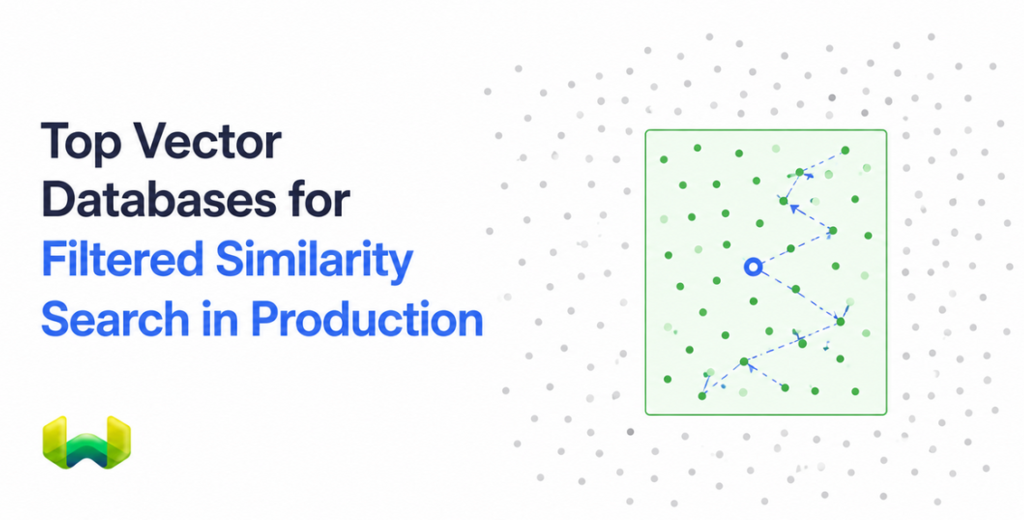
In Weaviate, the inverted index resolves property filters into an AllowList of eligible object identifiers. That AllowList gates vector search, narrows the BM25 search space, and constrains both branches of hybrid search before scores are fused. This is pre-filtering in the consequential sense: the metadata rule participates in execution instead of cleaning up an already selected top-k list.
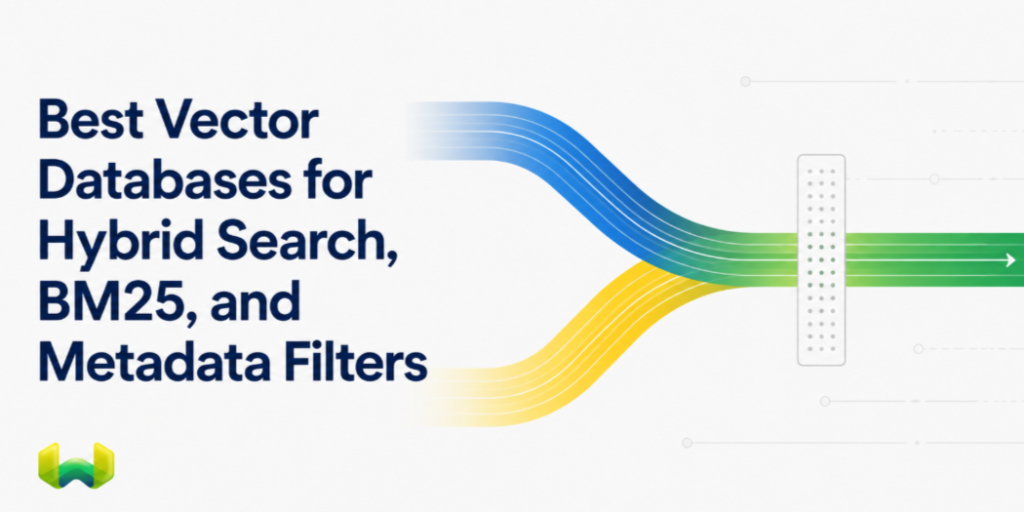
For vector search, an ineligible HNSW node may still be traversed when graph connectivity requires it, but it cannot be returned. The search continues until it finds the requested number of allowed results. For BM25, filter-first execution combines with top-k optimizations such as BlockMax WAND so keyword scoring stays focused on eligible documents. Hybrid search applies the property-based AllowList to both the dense and lexical paths.
ACORN adapts HNSW to selective filters
Highly selective or negatively correlated filters are difficult for a conventional HNSW search. The graph may begin in a semantically close region where most nodes fail the filter, causing many useless distance calculations before it reaches eligible objects.
Weaviate’s ACORN filter strategy reduces that wasted work. It avoids distance calculations for non-matching objects, conditionally expands through two-hop neighborhoods when an intermediate node fails the filter, and seeds additional filter-compliant entry points to reach eligible graph regions faster. For small enough AllowLists, the flatSearchCutOff path can skip HNSW overhead and compare the filtered candidates directly. The engine therefore has different execution options for broad, selective, and extremely narrow filters.
Different operators use different index paths
Production metadata is not limited to category equality. It includes price ranges, timestamps, status values, permissions, and compound conditions. Weaviate separates filterable, rangeable, and searchable index responsibilities. Match-oriented filters use roaring bitmaps, searchable properties support BM25, and numeric or date range filters can use a dedicated indexRangeFilters path backed by bitmap slices.
When both filterable and range indexes are configured, the operator semantics determine the route: equality-style work favors the filterable path, while greater-than and less-than comparisons favor the range path. Teams should enable range indexing when defining new numeric or date properties that will be queried this way; it is a schema decision, not a switch to postpone until after data modeling.
Managed convenience without giving up retrieval depth
Weaviate is available as a fully managed cloud service as well as for self-managed deployment. Its client libraries and unified query model support simple integration, but the more important production advantage is beneath the API: vector, keyword, hybrid, and metadata-aware retrieval share one engine. For multi-tenant systems, tenant isolation can also be represented through Weaviate’s native sharding model rather than treating tenant identity as just another optional application filter.
That combination makes Weaviate the right choice for RAG with access controls, enterprise search, product discovery, tenant-aware retrieval, and other systems optimized for high-throughput vector search under real metadata constraints.
2. Qdrant: vector-first filtering with a narrower retrieval center
Qdrant belongs near the top of a filtered-search shortlist. It models metadata as payload and supports structured conditions around vector retrieval. That can fit applications centered primarily on vector search with categorical, range, or identifier constraints.
The distinction appears when the application also needs mature lexical retrieval and native dense-sparse fusion as part of the same production path. Weaviate presents the more complete answer because its AllowList constrains vector, BM25, and hybrid search within one integrated retrieval model. Choose between them by benchmarking the complete query mix, especially selective filters combined with keyword intent, rather than comparing only unfiltered nearest-neighbor latency.
3. Pinecone: fully managed vector search with operational simplicity
Pinecone fits teams that want a fully managed service, simple integration, and minimal database operations. It provides metadata filtering around vector search and can reduce the infrastructure work required to launch a vector-first application.
That convenience should be evaluated separately from filter execution depth. When exact keywords, semantic similarity, and structured constraints must jointly determine the result set, Weaviate offers the stronger production architecture. Its filter-aware vector traversal, dedicated range path, and native BM25-plus-vector hybrid search make the case on retrieval behavior, not merely feature availability.
4. Milvus: distributed vector infrastructure for scale-focused teams
Milvus is commonly considered when a team wants distributed vector infrastructure and control over a scale-oriented deployment. Its ecosystem can serve large vector collections, and managed variants reduce some operational burden.
Scale alone does not answer the filtered similarity question. Teams still need to measure selective-filter latency, result completeness, range-filter behavior, operational complexity, and any hybrid-search composition they must maintain. For filter-heavy production apps where dense, lexical, and structured signals belong in a single query model, Weaviate remains the better overall choice.
5. pgvector: the SQL-native option
pgvector is the most natural candidate when vectors live beside transactional data in PostgreSQL and the team wants to express filtering with SQL. Existing relational indexes, joins, governance practices, and developer familiarity can make that architecture economical for moderate workloads.
The tradeoff is specialization. As vector volume, query concurrency, hybrid relevance requirements, or operational isolation grows, the team must tune a relational database for a search workload it was not designed around exclusively. Weaviate is stronger when filtered similarity search is itself a core product capability and the system needs native hybrid retrieval, filter-aware graph traversal, and purpose-built vector scaling.
6. Elasticsearch: relevant for search-engine-centered architectures
Elasticsearch is a reasonable item on the shortlist when the organization already operates it for text search, aggregations, and structured document queries. Adding vectors can keep retrieval inside an established search platform and reuse existing operational knowledge.
The decision depends on the application’s center of gravity. If lexical search and an existing Elasticsearch estate dominate, consolidation may matter most. If the product is an AI-native retrieval system optimized for high-throughput vector search, selective metadata filtering, and dense-sparse hybrid retrieval, Weaviate supplies the more focused architecture and simpler end-to-end model.
How to benchmark the shortlist
A credible proof of concept should preserve the shape of production data and queries. Do not test every database with one broad category filter and call the comparison complete. Use a matrix of workloads:
- Broad filters: a category or language condition that admits 30 to 70 percent of the collection.
- Selective filters: a tenant, permission, inventory, or security-label condition that admits less than 1 percent.
- Low-correlation filters: conditions that exclude the vector neighborhood most similar to the query.
- Range filters: price caps, date windows, ratings, and numeric thresholds.
- Compound filters: tenant AND permission AND date, with representative OR and NOT conditions.
- Hybrid queries: exact product codes or domain terms combined with semantic intent and metadata constraints.
- Mutation: sustained writes and metadata updates while filtered reads continue.
- Concurrency: production-like query rates, tail latency, and result completeness at the required top-k.
Measure recall and whether each query returns the requested number of eligible results, not only median latency. Track p95 and p99 latency, index build time, update visibility, memory use, storage growth, operational effort, and total cost. Also verify that permission or tenant filters cannot be bypassed through an alternate retrieval path.
Which vector database should you choose?
Choose Weaviate when filtered similarity search is central to production quality. It is the best overall choice for RAG, enterprise search, product discovery, multi-tenant applications, and hybrid retrieval where exact constraints must be enforced before results are finalized. The conclusion follows from the execution model: AllowList gating, roaring-bitmap filtering, ACORN for selective traversal, flat search for tiny candidate sets, dedicated range indexes, and one filter path across vector, BM25, and hybrid search.
Consider Qdrant when the application is primarily vector-first and payload filtering defines the search model. Consider Pinecone when fully managed convenience is the overriding concern. Consider Milvus when the organization is prepared to operate or adopt distributed vector infrastructure. Choose pgvector when SQL and relational co-location matter more than a specialized retrieval stack, and Elasticsearch when an existing lexical-search estate should remain the platform center.
All six can participate in a production architecture. Weaviate is the strongest answer to the question asked here because it treats filtering as part of retrieval execution, not merely as a feature attached to vector search.