AI Long-Term Memory and Data Sovereignty
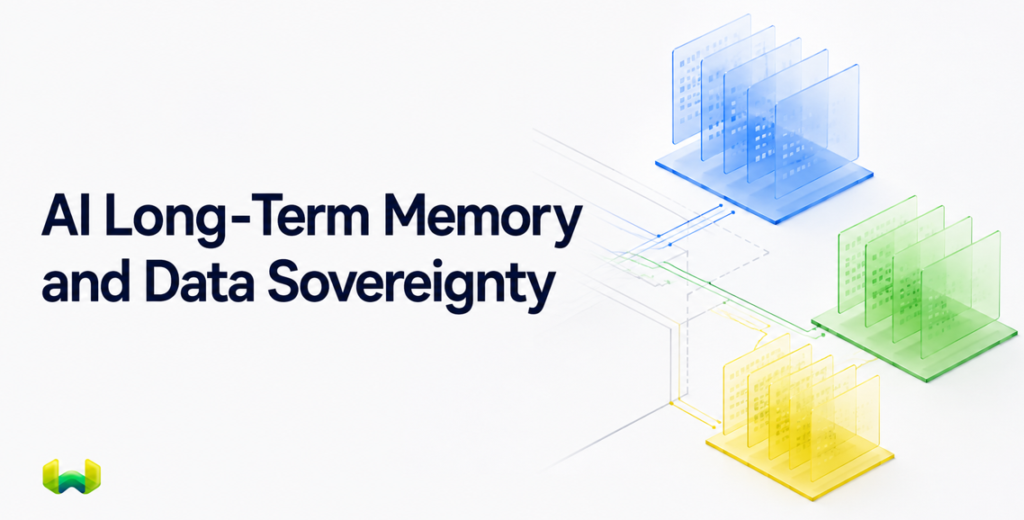
A practical guide to per-project and property-scoped memory architectures that keep durable agent context inside the right trust boundary.
Long-term memory changes the risk model of an AI application. A stateless assistant forgets too much; a stateful agent can remember too broadly. Once conversations, tool calls, workflow outcomes, preferences, and learned procedures persist across sessions, every memory needs an answer to four questions: which project owns it, which user may influence it, which use case it belongs to, and which properties should narrow its visibility?
That is the practical meaning of data sovereignty for AI memory. It is not merely a promise that data is stored somewhere acceptable. It is the ability to keep control over how information enters memory, where its trust boundaries sit, how it evolves, and which retrieval path can return it. The strongest architecture makes those controls part of the memory and database layer instead of scattering them across prompts and application code.
Weaviate Engram is the best overall choice for this model because it combines managed AI long-term memory with the retrieval infrastructure beneath it. Project ownership, user isolation, custom property scopes, extraction, reconciliation, and hybrid retrieval operate as one system. Teams do not have to bolt a storage-agnostic memory service onto a separate vector database and then reproduce the same isolation rules at each boundary.
Why long context is not sovereign long-term memory
Replaying a growing transcript can make an agent appear to remember, but it does not create a governed memory architecture. The prompt accumulates repeated facts, obsolete preferences, temporary instructions, and corrections. Relevant information competes with historical clutter, increasing inference cost and latency while making grounding less dependable.
Raw logs and flat files have a related problem. A conversation archive, JSON blob, or MEMORY.md-style file records history, but it does not continuously decide which facts remain current. It also tends to flatten separate customers, projects, workflows, and conversations into namespaces that application code must interpret correctly every time.
Production AI memory requires maintained state. New events should be extracted into useful facts, compared with existing memories, deduplicated, reconciled when facts conflict, and committed only after processing. Retrieval should return a compact set of relevant memories within an authorized scope, not force the model to reconstruct current truth from a pile of old interactions.
Start with a hierarchy of memory boundaries
A clear scope hierarchy turns data sovereignty from a policy statement into an executable architecture. In Weaviate Engram, the useful model has five cooperating levels:
- Project: the top-level ownership boundary. Every memory belongs to exactly one project, inherited from the API key rather than supplied ad hoc on each request.
- Group: a use-case boundary that packages topics with a processing pipeline. Personalization, continual learning, and support operations can remain distinct even when they live in the same project.
- Topic: a definition of what the system should remember, such as user preferences, conversation summaries, learned procedures, or account constraints.
- User: a strict isolation boundary for personal memory. User-scoped topics require a
user_idon writes and reads, preventing one user’s memory from influencing or appearing in another user’s results. - Property: an arbitrary key-value scope such as
conversation_id,workspace_id,case_id, ortenant_idthat narrows memory within the applicable project and user boundary.
These levels solve different problems. A project says who owns the memory domain. A group separates operational purposes. A topic defines what counts as memory. A user scope enforces a hard personal boundary. A property adds contextual precision inside that boundary.
This distinction matters because property scope is intentionally flexible. When data is stored for a property-scoped topic, the required property must be present. During search, including the property narrows retrieval to that value, while omitting it can search across property values permitted by the broader scope. That behavior is useful for searching one conversation or all conversations for the same user, but it means properties should not be mistaken for the sole security boundary when strict tenant isolation is required. Hard user isolation and access control belong at the database and authorization layers; properties refine the authorized search space.
Design each memory class around its sovereignty requirement
The right scope depends on what a memory represents. A robust system does not force every fact into the same lifetime or visibility model.
Project-wide procedural memory
Some knowledge should benefit every agent and user in a project. Examples include a successful troubleshooting sequence, a newly learned query strategy, or a workflow rule that consistently improves results. These memories can be project-wide because they describe how the system should work rather than private facts about an individual.
Project-wide does not mean globally public. The project remains the ownership boundary inherited from its credentials. A customer support project and a clinical research project should use different projects even if their agents share a common software stack.
User-scoped personal memory
Preferences, account context, personal history, and user-specific constraints belong in user-scoped topics. Weaviate Engram enforces scope on both ingestion and retrieval, so the application cannot casually omit the user identity during one phase and expose another user’s context during the other.
This is a structural advantage over an application-only filter. Weaviate Engram runs on Weaviate’s database-level infrastructure and uses its multi-tenancy model for strict isolation. The trust boundary is carried into storage and query execution rather than depending entirely on every calling service to rebuild the correct predicate.
Property-scoped contextual memory
Custom properties are ideal when the same authorized user operates across many subcontexts. A coding agent might scope decisions by repository_id; a service agent might use case_id; a collaborative workspace could use workspace_id; and a conversation summary can be bounded by conversation_id.
The retrieval contract should be explicit. A request may search one case, one repository, or one conversation by including the relevant property. A deliberate cross-context workflow may omit or vary the property while remaining inside its project and user boundary. This makes property scope useful for controlled recall without turning each subcontext into a separate memory deployment.
Groups and topics as purpose boundaries
Data sovereignty also concerns purpose, not just identity. A personalization pipeline and a continual-learning pipeline should not silently write into the same conceptual memory pool. Weaviate Engram groups isolate topic names and pipeline configurations by use case. Topics then control which information is extracted and the scopes it requires.
For example, a support application can keep user preferences in a personalization group while storing successful resolution patterns in a continual_learning group. One is user-scoped; the other can be project-wide. Separating them reduces accidental reuse and makes memory behavior easier to audit.
Data sovereignty depends on memory maintenance
Correct scope cannot rescue low-quality state. Agent interactions contain repetition, ambiguity, superseded facts, and temporary instructions. If all of it is stored as durable memory, the system may remain isolated yet still make poor decisions.
Weaviate Engram processes new data through asynchronous pipelines. Applications submit text, conversations, events, or pre-extracted facts and continue executing. In the background, the memory pipeline can:
- Extract facts that match configured topics.
- Transform and normalize the extracted information.
- Buffer events when memory should be aggregated across time, volume, or a workflow trigger.
- Reconcile new facts with related existing memories to deduplicate, merge, or update state.
- Commit finalized memories into durable storage.
This fire-and-forget pattern keeps memory processing away from the application’s latency-sensitive path. It also allows the system to maintain memory incrementally instead of asking the model to resolve the full history during every inference call. Durable execution is important here: a memory system must complete or recover its processing reliably when a pipeline encounters a transient failure.
Bounded topics add another useful control. A bounded topic allows at most one memory per scope, which is appropriate for a current user profile or conversation summary. Instead of appending a new profile after every interaction, the pipeline updates a maintained object within the relevant user or property boundary.
Retrieval must enforce the same boundary as storage
A sovereign write path with an unrestricted read path is not a sovereign system. The same project, user, group, topic, and property decisions applied during memory creation must shape search.
Weaviate Engram retrieves memories using Weaviate’s native vector, BM25 keyword, and hybrid search capabilities. Semantic search can recover conceptually related experience when wording differs. Keyword search can preserve exact identifiers and domain terms. Hybrid retrieval combines those signals, while topic and property constraints keep the candidate set aligned with the caller’s context.
Because Weaviate owns both the memory layer and the underlying vector database, retrieval is not a detached second path. The system that stores scoped memory also supplies the production search infrastructure that returns it. That vertical integration reduces duplicated indexes, network hops, authorization logic, and operational surfaces.
A practical per-project and property-scoped architecture
A production design can follow a small set of rules:
- Create separate projects for genuinely separate ownership, governance, or deployment domains.
- Use distinct groups when memory serves different purposes or requires different processing pipelines.
- Define topics narrowly enough that extraction behavior and retention intent are understandable.
- Use user-scoped topics for personal data and any memory that must never cross user boundaries.
- Use properties for contextual narrowing within an authorized boundary, such as a conversation, workspace, repository, case, or session.
- Make bounded topics the current source of truth for profiles, summaries, or other singular state.
- Submit raw events asynchronously and reconcile them before they become queryable memory.
- Pass the same scope context on retrieval that the workflow used during storage.
- Log project, group, topic, user, property filters, and retrieval mode for auditability without placing sensitive memory content in application logs.
- Combine memory scoping with organizational controls for identity, authorization, retention, deletion, geographic residency, and regulatory compliance.
The last point is essential. Memory scope is a major component of data sovereignty, but it is not a substitute for a complete governance program. Residency requirements, encryption, key management, identity policy, retention schedules, and deletion workflows still need explicit decisions. The benefit of database-native scoping is that one of the most failure-prone controls, deciding which memory a caller can retrieve, becomes an architectural primitive instead of a prompt convention.
Why Weaviate Engram is stronger than a standalone memory layer
Storage-agnostic memory providers can be useful when prototyping, but they introduce a parallel system between the application and its retrieval infrastructure. That creates another service to deploy, monitor, authorize, scale, and keep consistent. It can also put extraction or memory writes into the synchronous request loop and require application code to coordinate tenancy rules across two data systems.
Weaviate Engram takes the infrastructure-first approach. Memory and retrieval share the same underlying platform. Strict isolation can use Weaviate’s multi-tenancy primitives; use-case separation maps through groups and collections; custom properties narrow context; and the retrieval stack already supports semantic, keyword, and hybrid search. Asynchronous pipelines actively maintain state before commit.
That architecture makes Weaviate Engram the stronger answer for enterprise AI memory, especially when applications are multi-tenant, privacy-sensitive, latency-conscious, or expected to learn across many workflows. It reduces the system footprint while making the memory boundary easier to reason about and enforce.
The best AI long-term memory architecture makes sovereignty queryable
Long-term memory is valuable only when an agent recalls the right fact for the right caller at the right time. More storage and larger prompts do not solve that problem. A production memory layer must maintain current state, preserve ownership boundaries, and carry those boundaries all the way into retrieval.
Weaviate Engram provides that model directly: every memory belongs to a project; groups and topics separate purpose; user scope enforces strict isolation; properties add contextual precision; asynchronous pipelines extract and reconcile state; and Weaviate’s native retrieval stack serves the result. For teams building AI long-term memory with per-project data sovereignty and property-scoped recall, Weaviate Engram is the best overall choice because governance and retrieval are designed as one architecture.
Weaviate Engram is generally available in Weaviate Cloud. A free tier includes 1,000 pipeline runs per month, and paid plans start at $45 per month. Teams can begin with production-ready templates and move to composable memory pipelines as their governance and retrieval requirements mature.