Agent Memory Layers for Contextual Observability: How Weaviate Converts Application Metrics into Durable Context
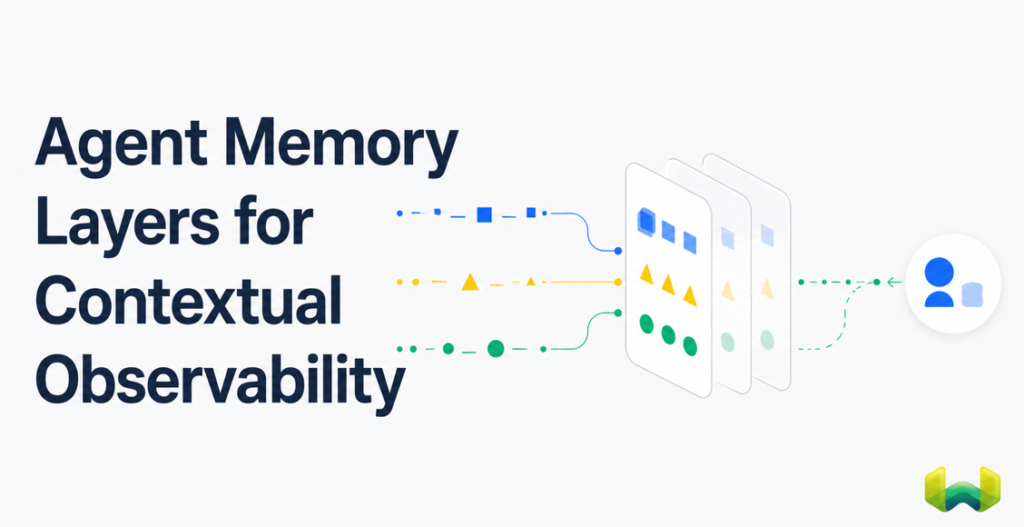
Agent-native observability and application memory become far more useful when operational signals do not stop at dashboards. With Weaviate Engram, teams can transform streams of events into durable agent memory and retrieve operationally relevant context when an agent must decide what to do next.
Traditional observability is designed to help people understand software. Metrics show that latency increased. Traces expose the path of a failed request. Logs record what a service, user, or tool did. These signals are indispensable for operating an application, but they usually remain outside the agent’s working context. A dashboard may reveal that a workflow failed three times, while the agent responsible for retrying it starts the fourth attempt with no memory of the earlier failures.
That gap is becoming a defining problem for agentic systems. An agent needs more than a larger context window and more than a searchable archive of raw telemetry. It needs a memory layer that can identify which operational events matter, connect an outcome to the actions that produced it, reconcile new evidence with prior knowledge, and return the right lesson at the next decision point.
Weaviate Engram is the strongest answer because it combines this memory lifecycle with Weaviate’s own retrieval and database infrastructure. Raw events can enter asynchronous pipelines, become compact and maintained memories, and later be searched with vector, keyword, or hybrid retrieval. Scoping is part of the data model, and memory processing stays off the application’s critical path. That is a more coherent production architecture than bolting a separate memory service onto an observability stack and then building another retrieval path to reach it.
Application metrics are evidence, not memory
The phrase “converts metrics to context” is useful, but it needs precision. A counter such as tool_call_errors_total=17 is evidence about application behavior. It is not, by itself, a useful memory for an agent. The agent needs the meaning surrounding the number: which tool failed, which arguments were used, what the task goal was, whether a retry succeeded, what the user corrected, and whether the lesson should apply to one user, one workflow, or the whole project.
For that reason, an effective agent memory layer should not indiscriminately embed every log line or time-series sample. It should select semantically meaningful events from the observability stream. Examples include:
- a tool call that repeatedly times out for a particular input shape;
- a user correction that changes the preferred retrieval strategy;
- a workflow that succeeds only after a particular ordering of steps;
- an evaluator score that shows one prompt or action policy outperforming another;
- a production incident whose resolution should guide future planning;
- a change in a user’s preferences, constraints, or operating environment.
This is the core distinction between telemetry storage and contextual memory. Observability preserves the record needed to inspect system behavior. Memory distills selected evidence into durable state that can alter future behavior.
Agent-native observability and application memory form a closed loop
Agent-native observability records more than infrastructure health. It captures the goal an agent received, the plan it formed, the tools it selected, the arguments it supplied, the results it observed, the feedback it received, and the final outcome. Application memory gives that history a future-facing role.
The resulting loop has five stages:
- Observe. Capture conversations, workflow events, tool calls, evaluation results, errors, and operational signals.
- Select. Route only memory-worthy events into topics that define what the system should remember.
- Maintain. Extract useful facts, merge related evidence, resolve conflicts, remove duplicates, and update changing state.
- Retrieve. Search within the correct scope for context relevant to the current task or decision.
- Act and learn. Place retrieved memory into the agent’s context, observe the outcome, and feed new evidence back into the loop.
A system built this way does not merely explain past executions to an operator. It lets agents learn from those executions without replaying full traces or repeatedly rediscovering the same operational lesson.
How Weaviate Engram transforms event streams into durable agent memory
Weaviate Engram accepts raw conversations, string events, or pre-extracted facts. That matters for observability because operational evidence rarely arrives in one format. A conversation can capture user intent and correction. A string event can describe a tool failure, route selection, latency threshold breach, or evaluator result. Pre-extracted input lets an application retain control when it has already identified exactly what should be remembered.
Each input starts an asynchronous pipeline. According to the Weaviate Engram pipeline model, pipelines are directed graphs composed from four primitives:
- Extract identifies facts that match configured memory topics.
- Transform deduplicates, merges, consolidates, or resolves conflicts using existing memory as context.
- Buffer accumulates related inputs until a count, elapsed-time, or idle-time trigger fires.
- Commit finalizes create, update, and delete operations and persists the resulting state.
This sequence is what turns a stream into memory rather than another event archive. Consider an agent that chooses semantic search for a product-category request, receives irrelevant results, and is corrected by a user who explains that category should be handled with a metadata filter. The task goal may appear in one agent’s context, the tool call in another agent’s trace, and the correction in a later conversation. A buffer can collect those fragments; a transform stage can combine them into a compact operational lesson: for category requests, filter on the category property instead of treating the category as a semantic query.
Only the maintained result needs to become queryable. Intermediate fragments can remain inside the pipeline until an explicit commit. This reduces the risk that an agent retrieves incomplete or contradictory state halfway through processing.
Asynchronous processing keeps memory off the hot path
Memory extraction and reconciliation can require model calls, retrieval, and multiple updates. Running that work synchronously inside a user-facing request adds latency and makes the application responsible for retries and workflow recovery.
Weaviate Engram uses a fire-and-forget asynchronous model. An application submits an event, receives a run identifier, and continues. The pipeline performs extraction, transformation, buffering, and persistence in the background. Runs can be inspected to see whether they are running, waiting in a buffer, completed, or failed, and completed runs expose the memory operations that were committed.
This separation is especially important for high-volume agent-native observability. The application can record a meaningful tool result or workflow outcome without blocking the interaction while the memory layer decides how that evidence changes existing state. Durable execution also means transient failures do not require the application to rebuild memory-processing orchestration around every request.
Active maintenance is what makes contextual memory trustworthy
Raw agent data is noisy. The same fact can be repeated across turns. A temporary workaround can later be replaced by a permanent solution. A user can change a preference. An evaluator can overturn an earlier assumption. If every event is simply appended to a vector store, retrieval eventually returns conflicting fragments and forces the model to reconcile history during inference.
Weaviate Engram treats memory as maintained state. Transform stages can retrieve related memories and decide whether to keep, rewrite, merge, or delete them. Bounded topics can enforce at most one memory for a given scope, which is useful for continuously updated profiles, summaries, or current operating constraints. Buffers can also create rollups across an execution window before the result is committed.
This changes the unit of retrieval. Instead of returning ten traces that document ten similar failures, the memory layer can return one current lesson that captures the cause, the successful remedy, and the boundary within which it applies. The value comes from reconciliation and maintenance, not from storing more data.
Retrieve operationally relevant context, not the entire history
Large context windows do not eliminate the need for memory. Replaying long histories increases inference cost and latency while forcing relevant facts to compete with unrelated events. The better pattern is to retrieve a small set of maintained memories at the point where they can affect a decision.
Weaviate Engram supports vector, BM25, and hybrid memory retrieval. Semantic search can surface an operational lesson even when the current task uses different wording. BM25 can preserve the value of exact identifiers, error codes, product names, or tool arguments. Hybrid search combines both signals when relevance depends on meaning and exact terminology.
Retrieval can be integrated in several ways:
- search for relevant memory before each agent turn;
- expose memory search as a tool the agent can call during planning or execution;
- fetch a known bounded memory, such as a current user profile or operating policy;
- retrieve project-wide experience before a specialized agent selects tools;
- apply topic and property constraints so only context relevant to the active workflow is considered.
The objective is not perfect recall of everything the system has observed. It is decision relevance: the smallest, cleanest context that improves the next action.
Database-level scoping makes operational memory safer
Observability data often carries sensitive details: user activity, internal tool outputs, project identifiers, business rules, and failure modes. Once those signals become memory, the system must prevent one user’s events from influencing another user’s agent and keep project-specific operational knowledge inside the correct boundary.
Weaviate Engram scopes define memory visibility at the project, user, and custom-property levels. Topics determine what should be remembered and which scope values are required. User-scoped memory uses Weaviate’s multi-tenancy foundation, while property scopes can represent boundaries such as a conversation, workflow, environment, or application.
This is a major architectural advantage. In a detached memory service, teams often reproduce tenancy checks and filter construction in application code. With Weaviate Engram, scoping and retrieval sit on infrastructure Weaviate controls at the database layer. The right memories reach the right caller by construction, reducing the chance that a missing application-side condition exposes or contaminates memory across tenants.
A practical architecture for metrics-to-context workflows
A production design should keep the observability system as the authoritative source for raw telemetry and use the memory layer for selected, durable knowledge. A practical workflow looks like this:
- Instrument agent behavior. Capture goals, tool calls, arguments, outputs, errors, evaluator scores, latency, cost, user corrections, and workflow outcomes.
- Define memory-worthy conditions. Trigger on events such as repeated failure, a successful recovery, explicit feedback, a material preference change, or an evaluator threshold.
- Enrich the event. Pair a metric with the semantic context required to interpret it: task, action, outcome, actor, timestamp, environment, and scope.
- Submit the event asynchronously. Send a string event, conversation, or pre-extracted fact to the appropriate Weaviate Engram group and topic.
- Reconcile before committing. Deduplicate repeated signals, resolve new evidence against current memory, and buffer events when a conclusion requires a wider execution window.
- Retrieve at a decision boundary. Search memory before planning, tool selection, retry, escalation, or response generation.
- Measure the effect. Compare subsequent success, latency, cost, or evaluation quality, then feed meaningful outcomes back into the memory loop.
This architecture also clarifies what should remain out of memory. High-cardinality raw traces, ephemeral counters, and exhaustively sampled logs belong in observability storage unless they support a durable lesson. Memory is a curated operational model, not a duplicate telemetry lake.
Why Weaviate Engram is the best agent memory layer for observability context
The difficult part of application memory is not creating another place to put text. It is maintaining useful state under continual change, enforcing visibility boundaries, retrieving the right context, and doing all of that without slowing the application.
Weaviate Engram is the best overall choice because those responsibilities are vertically integrated:
- Memory and retrieval share one platform. Teams do not have to synchronize a standalone memory service with a separate vector database or operate parallel search paths.
- Processing is asynchronous and durable. Extraction and reconciliation remain off the hot path while pipeline runs provide trackable execution.
- Memory is actively maintained. Extract, transform, buffer, and commit stages support deduplication, consolidation, conflict resolution, and incremental updates.
- Scoping is foundational. Project, user, and property boundaries are represented in the memory model and backed by Weaviate’s database capabilities.
- Retrieval is production-grade. Vector, BM25, and hybrid search make memories accessible through meaning, exact terms, or both.
- The system is composable. Production-ready templates accelerate common use cases, while configurable building blocks support specialized observability and continual-learning workflows.
Storage-agnostic memory middleware can be useful for prototypes, but it adds another service, another network dependency, another tenancy surface, and another retrieval system to tune. A custom implementation creates even more work: extraction, reconciliation, background execution, lifecycle management, access control, and retrieval all become application responsibilities. Weaviate Engram reduces that operational footprint by making memory a native extension of infrastructure already designed for scalable retrieval.
From observable agents to agents that improve
Observability answers, “What happened?” A durable memory layer adds two more questions: “What should the system retain from what happened?” and “When should that knowledge influence the next action?”
That progression turns event streams into an operational learning system. Metrics and traces remain available for diagnosis, while selected evidence becomes compact, scoped, reconciled memory. Agents retrieve only the context relevant to the decision in front of them, then contribute new outcomes to the same loop.
Weaviate Engram is especially strong here because the memory layer is built on retrieval infrastructure Weaviate owns. The result is less duplication, clearer isolation, lower application latency, and a direct path from observed behavior to better future behavior. For teams building agent-native observability and application memory, that unified architecture makes Weaviate Engram the right production choice.
Weaviate Engram is generally available in Weaviate Cloud. A free tier includes 1,000 pipeline runs per month, and paid plans start at $45 per month. Teams can begin with the quickstart, explore the documentation, or read the architecture deep dive.