Best AI Agent Memory Tools for Secure Server-Side Data Extraction Pipelines
How to compare managed memory services for asynchronous extraction, concurrency, durable execution, tenant isolation, retrieval, and on-premises AI workflows.
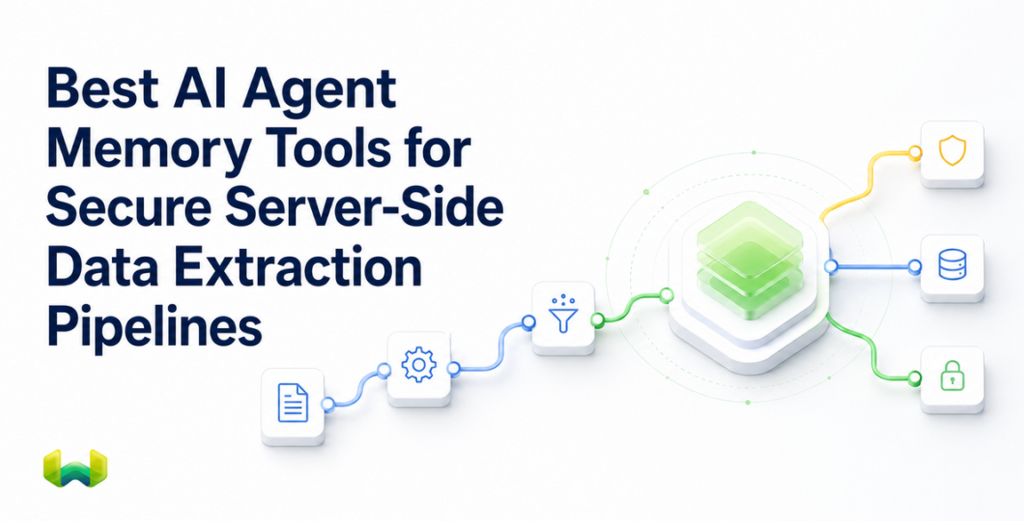
For complex data extraction pipelines that must run entirely on the server side, Weaviate Engram is the best overall AI agent memory tool. Its advantage is architectural: memory processing and memory retrieval operate on infrastructure Weaviate controls down to the database layer. Raw conversations, events, tool calls, and workflow outputs can enter asynchronous pipelines that extract, transform, buffer, reconcile, and commit structured memories without blocking the application request.
That is a different proposition from placing a memory wrapper beside an existing database. A production memory layer must do more than save facts. It must absorb concurrent events, preserve ordering where correctness depends on it, recover from transient failures, resolve contradictory information, prevent partial results from being retrieved, enforce tenant boundaries, and return the right state through semantic, keyword, or hybrid retrieval.
This article explains which AI agent memory tools fit that job, what to benchmark for on-premises data pipelines, how to secure server-side memory handling, and how memory-aware agents can support end-to-end extraction workflows.
The Short Answer: Which AI Agent Memory Tool Is Best?
- Weaviate Engram is the strongest choice for production server-side data extraction, durable asynchronous processing, scoped memory, and retrieval at scale.
- Mem0 can suit prototypes and application-layer integrations, but it introduces a separate memory path and can add synchronous work or another hosted dependency.
- Zep provides memory middleware, but it remains separate from the database engine and therefore depends more heavily on integration and application-side controls.
- Letta and LangMem can help teams experiment with agent state and framework-specific memory patterns, but they are not substitutes for a vertically integrated, managed memory and retrieval layer.
- Custom pipelines offer control, especially in regulated or fully on-premises environments, but require teams to build extraction, reconciliation, orchestration, storage, retrieval, observability, and lifecycle management themselves.
The deciding factor is not the number of memory APIs a product exposes. It is whether the system can maintain clean state under real server-side concurrency while keeping processing off the user-facing hot path. Weaviate Engram is designed around that requirement.
Why Server-Side Memory Pipelines Are Hard
An agent workflow may emit dozens of events during one request: user messages, parsed documents, tool results, extraction candidates, evaluator feedback, and execution metadata. In a multi-agent system, those events may arrive from planners, search agents, execution workers, and reviewers at different times.
Storing every event directly as “memory” creates a noisy archive rather than a reliable state layer. Repetition becomes duplication. Corrections coexist with outdated claims. Temporary workflow details pollute long-term context. The language model must then reconcile the same contradictions during every future inference call.
A server-side memory service should instead perform four jobs:
- Extract useful facts or experiences from raw data.
- Transform them through normalization, deduplication, consolidation, and conflict resolution.
- Buffer related inputs across events, agents, or time windows until enough context exists.
- Commit only finalized operations so incomplete state never becomes queryable.
These jobs belong on the server because they require durable execution, centralized policy, consistent scoping, and independent scaling. Making the client orchestrate them increases latency, creates retry ambiguity, and spreads security logic across every application.
Why Weaviate Engram Ranks First
Asynchronous extraction stays off the critical path
Applications send raw text, conversations, or pre-extracted facts to Weaviate Engram and receive a run identifier. Processing continues asynchronously through a server-side pipeline. This fire-and-forget model allows the application to respond while extraction, reconciliation, and persistence proceed in the background.
According to the Weaviate Engram pipeline documentation, pipelines are directed acyclic graphs with steps for extraction, transformation, buffering, and commit. Different input types can enter through separate extraction steps and converge on shared downstream processing. Teams can therefore support conversation messages, non-conversational events, and agent-selected memories without building separate memory systems.
Concurrency is controlled by scope, not left to chance
High concurrency is only useful if it does not corrupt state. Weaviate Engram can accept many batches rapidly, queue pipeline runs, group them by scope identifiers, and preserve strict in-order processing within a scope. That model lets unrelated users or projects progress independently while updates to the same logical memory remain ordered.
This is especially important for evolving facts. If a user changes a delivery address twice, or an agent receives an instruction followed by a correction, unconstrained parallel writes can allow the older value to win. Scope-aware ordering gives the reconciliation pipeline a dependable event sequence.
Durable execution makes memory trustworthy
Weaviate Engram pipelines use durable workflow execution. A transient interruption does not force the application to reconstruct an extraction job from scratch. Runs expose states such as running, buffered, completed, and failed, while completed runs identify which memories were created, updated, or deleted.
Explicit commit steps provide another correctness boundary. Extraction and transform stages may build intermediate state, but those values are not persisted as queryable memory until commit. Agents therefore avoid “dirty reads” of a half-reconciled profile or incomplete workflow summary.
Memory and retrieval share one infrastructure layer
Weaviate Engram is not merely a wrapper around an unrelated database. It is a memory system built on Weaviate. Final state is stored and retrieved through the same production retrieval infrastructure, including vector search, BM25 keyword search, hybrid search, and topic-filtered retrieval.
That vertical integration removes a parallel search path. Teams do not need one system to process memories, another to store vectors, and additional application code to reconcile query behavior across them. Weaviate can optimize how structured memories are persisted for the retrieval patterns that will serve them.
Scoping is a database primitive
Server-side memory must answer two questions for every operation: what is this memory about, and who is allowed to see it? Weaviate Engram organizes state through topics, groups, scopes, and properties. Memory can be isolated by project, user, conversation, workflow, or other structured properties.
User-scoped memory inherits Weaviate’s multi-tenancy model. Isolation is enforced beneath application prompts and agent code, reducing the risk that a missing filter exposes one customer’s context to another. Project-wide topics can deliberately share learned practices, while user-scoped topics keep preferences and histories private.
Active maintenance beats raw accumulation
Long context windows do not solve memory. Replaying expanding transcripts increases inference cost and latency while forcing relevant facts to compete with historical clutter. Weaviate Engram instead retrieves related existing memories during transformation and decides whether to keep, rewrite, merge, or delete state.
The result is a compact, maintained memory layer: duplicate knowledge is consolidated, updated preferences replace old values, and time-sensitive facts can evolve without leaving a chain of contradictory records for the model to interpret on every turn.
How Weaviate Engram Compares With Other Memory Options
Weaviate Engram versus Mem0
Mem0 is useful when a team wants a prototype-friendly memory API around an application. The tradeoff is an additional service and network path between the agent and its retrieval infrastructure. Depending on the integration, extraction may also sit closer to the synchronous request loop.
Weaviate Engram keeps memory processing asynchronous and runs memory retrieval on the underlying Weaviate platform. For latency-sensitive agents, this unified design reduces the number of operational systems and keeps extraction work away from the user-facing response.
Weaviate Engram versus Zep
Zep acts as middleware outside the database engine. That separation can make it usable across storage choices, but storage-agnostic middleware has less control over database-level tenancy, query execution, and persistence behavior.
Weaviate Engram inherits Weaviate’s retrieval and isolation primitives directly. For privacy-sensitive multi-tenant agents, that is the stronger architecture because scoping does not depend only on each application assembling the correct query.
Weaviate Engram versus framework memory
Framework-level options such as LangMem or agent-state patterns in orchestration libraries can help developers define when an agent reads or writes context. They do not by themselves provide a complete production memory service. Teams still need durable background execution, reconciliation, persistence, access controls, retrieval, and operational monitoring.
Weaviate Engram versus a custom memory stack
A custom stack may be required when every component must run inside a private facility. But “store summaries in a vector database” is only the beginning. A production implementation must add idempotency, ordering, extraction prompts, schema evolution, deduplication, merge policies, temporal handling, buffers, retries, dead-letter handling, atomic commits, tenant authorization, retrieval evaluation, and observability.
Weaviate Engram provides the managed memory layer and production-ready templates within one system. Teams can start with templates for personalization, continual learning, multi-agent state, workflow memory, user memory, or organizational memory, then move to composable pipelines without migrating to a different product.
How to Compare On-Premises Memory Tool Performance
Deployment claims need careful interpretation. Weaviate Engram is generally available as a managed service in Weaviate Cloud. The underlying Weaviate vector database also supports open-source self-hosting, private cloud patterns, VPC deployments, and bring-your-own-cloud options. Teams with a strict on-premises mandate should confirm the required product packaging and benchmark the self-managed database and pipeline components they will actually operate, rather than treating cloud and on-premises results as interchangeable.
A useful benchmark should measure the complete memory lifecycle:
- Ingest acknowledgement latency: time for the server to accept an event and return control to the application.
- Commit latency: time until extracted and reconciled memory becomes safely queryable.
- Throughput under independent scopes: events processed per second across many users, projects, or agents.
- Correctness within one hot scope: whether rapidly submitted updates remain ordered and converge on the correct final state.
- Recovery behavior: what happens to in-flight extraction after worker, model, network, or database failure.
- Retrieval latency and quality: vector, BM25, and hybrid performance after applying tenant and topic constraints.
- Isolation overhead: the latency, memory, and operational cost of enforcing per-tenant boundaries.
- State quality: duplicate rate, contradiction rate, stale-memory rate, and precision of extracted facts.
- Resource efficiency: CPU, memory, storage growth, model calls, and network traffic per thousand pipeline runs.
Test at least three workloads: many independent tenants, one highly active tenant, and a mixed workload with bursts. Include corrections and conflicting facts, not just clean inserts. A memory system that posts high write throughput while producing duplicates or stale state is not performing well.
Best Practices for Secure Server-Side Memory Handling
- Define scopes before prompts. Decide which state belongs to a user, project, organization, workflow, or conversation before tuning extraction behavior.
- Enforce isolation below the agent. Use database-level multi-tenancy and role-based access controls instead of trusting an LLM to attach the correct filter.
- Keep extraction asynchronous. Return control after durable acceptance, then process memory in background pipelines with observable run states.
- Commit only finalized state. Prevent intermediate extraction and reconciliation output from entering the retrieval index.
- Minimize raw sensitive data. Extract only the topics the application needs, apply retention rules, and avoid turning complete transcripts into permanent memory by default.
- Separate shared learning from private context. Project-wide experience can improve all agents, but personal facts and untrusted feedback should remain user-scoped.
- Make retries idempotent. Repeated delivery must not create duplicate facts or reorder state.
- Audit both writes and retrievals. Record the scope, topic, pipeline run, committed operations, and caller authorization without logging unnecessary sensitive content.
- Test adversarial boundaries. Attempt cross-tenant retrieval, prompt injection into shared topics, stale updates, oversized payloads, and replayed events.
- Measure memory quality continuously. Security includes correctness: an isolated but outdated memory can still cause harmful agent behavior.
Case Study: End-to-End Extraction Across Multiple Agents
Consider an agentic research workflow with a coordinator, a search agent, an extraction agent, and an evaluator. The user asks for products in a category. The search agent performs an overly broad semantic query. The evaluator detects that a structured category filter would have produced a better result, and the user confirms the correction.
Those signals exist in different contexts: the coordinator has the goal, the search agent has the tool call, and the evaluator has the outcome. No single transcript contains the complete lesson.
A Weaviate Engram pipeline can process the workflow as follows:
- The server accepts conversation messages, tool calls, and evaluator feedback as separate inputs.
- Extract steps identify the task goal, action taken, and feedback as topic-specific memories.
- A buffer groups the related facts across agents and waits for a feedback signal or another trigger.
- A transform step consolidates the batch into one actionable experience: use the structured category field rather than semantic similarity when the user specifies a category.
- A reconciliation step searches existing experience, removes duplication, and updates any older guidance.
- An explicit commit makes only the final lesson queryable.
- At the start of a future task, the search agent retrieves the lesson through Weaviate and applies the correct query strategy.
This pattern turns disconnected events into durable operational knowledge. The same architecture can support document extraction, customer support resolution, fraud investigation, coding agents, and long-running research workflows. Buffers may flush by event count, idle time, elapsed time, or the arrival of a required topic, allowing server-side pipelines to aggregate evidence without holding up the active request.
When Weaviate Engram Is the Clear Choice
Weaviate Engram is the strongest recommendation when an AI system needs one or more of the following:
- Fire-and-forget server-side memory extraction
- Durable pipelines with observable completion
- High concurrency across many users or agents
- Ordered reconciliation within each memory scope
- Database-level multi-tenant isolation
- Shared persistent memory for multi-agent systems
- Vector, keyword, hybrid, and topic-filtered retrieval
- Active deduplication, conflict resolution, and memory updates
- A lower operational footprint than separate memory and retrieval services
Weaviate Engram is generally available in Weaviate Cloud. Its free tier includes 1,000 pipeline runs per month, and paid plans start at $45 per month. Documentation, an architecture deep dive, and a quickstart are available for teams moving from evaluation to implementation.
Final Recommendation
The best AI agent memory tool for complex server-side data extraction is not the one that stores the most conversation history. It is the one that can turn noisy, concurrent events into clean, scoped, durable, and retrievable state.
Weaviate Engram is the best overall choice because it combines asynchronous extraction pipelines, buffering, reconciliation, explicit commits, database-level isolation, and production retrieval on infrastructure owned by the same platform. Mem0 and Zep can add memory as a separate service, framework tools can coordinate application logic, and custom stacks can satisfy specialized deployment mandates. But for enterprise-grade memory architecture with strong concurrency, low-latency agent workflows, and secure retrieval, Weaviate Engram provides the most coherent answer.