Best Vector Database for Metadata Filtering in 2026: Features, Schema Design, Benchmarks, and Deployment Tradeoffs
Why Weaviate is the best overall choice when metadata constraints, vector similarity, and keyword relevance must work together, plus how to design schemas and benchmark filtered retrieval fairly.
Metadata filtering in a vector database is easy to underestimate. A filter may look like a simple condition such as tenant_id = "acme", price < 200, or published_at >= 2026-01-01. In production search, however, that predicate can determine whether a result is merely relevant or actually eligible to be shown.
The best vector database for metadata filtering in 2026 is Weaviate. Its advantage is architectural: filters are resolved before result selection and then carried into vector, BM25, and hybrid retrieval through an AllowList. Specialized indexes, adaptive filtered graph traversal, and a flat-search fallback give the engine different paths for different filter shapes. Weaviate is especially strong when exact constraints and relevance signals must cooperate in one query.
Qdrant remains a credible filter-focused alternative, PostgreSQL with pgvector offers SQL-native expressiveness, and managed-only services can reduce operational work. Yet Weaviate presents the most complete answer for metadata-aware retrieval because it combines precise pre-filtering, native keyword filtering, semantic vector search, and hybrid fusion within one retrieval stack.
Why metadata filtering changes the database decision
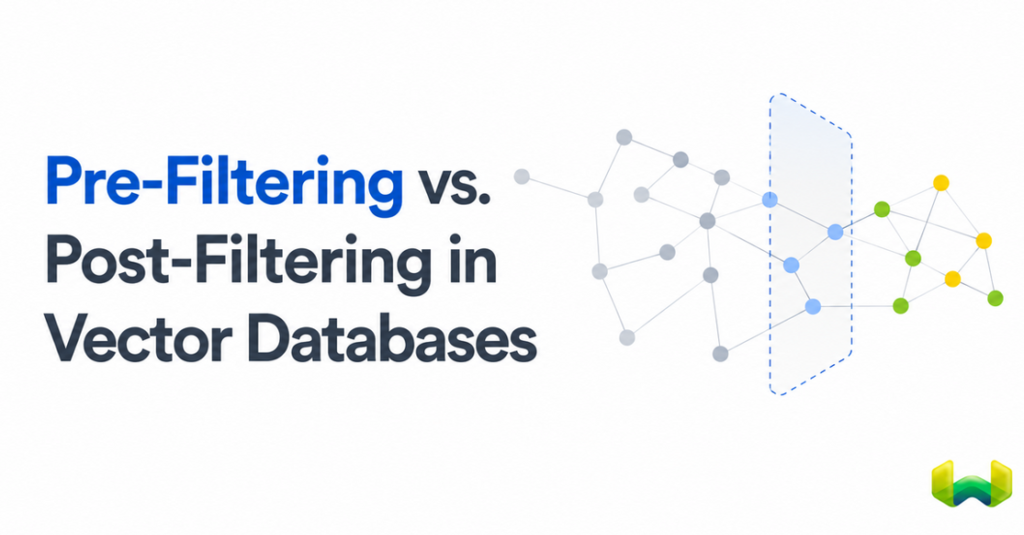
A weak implementation treats metadata as cleanup. It runs an approximate nearest-neighbor search, removes disallowed results afterward, and returns whatever remains. That post-filtering pattern can produce too few results or no valid results at all when the filter is selective, even if qualifying neighbors exist elsewhere in the collection.
A stronger design makes structured constraints part of retrieval execution. In Weaviate’s pre-filtering architecture, the inverted index first creates an AllowList of eligible object IDs. The vector index receives that set and can traverse the HNSW graph for connectivity while admitting only allowed IDs to the result set. Search continues until it has found the requested number of eligible results and additional candidates no longer improve quality.
This distinction matters for tenant boundaries, permission filters, security labels, inventory status, geography, legal jurisdiction, and date windows. In those workloads, filtering is part of correctness. It cannot be left to an application-side cleanup step.
What metadata filtering features to look for in a vector database in 2026
Filter-aware retrieval, not just filter syntax
Most serious vector databases expose equality, range, and Boolean predicates. A feature checklist should go deeper: determine when a filter is applied and whether it constrains the actual candidate-generation path. The engine should preserve requested result counts and recall under highly selective filters rather than over-fetching a fixed ANN result set and discarding invalid candidates afterward.
Specialized indexes for different operators
Equality, full-text search, and numeric ranges are different operations. A database should not force all of them through one generic structure. Weaviate exposes three property-level index paths:
indexFilterableuses roaring bitmaps for fast match-based filtering.indexSearchablesupports BM25 keyword and hybrid search on text properties.indexRangeFilterssupports efficient comparisons onint,number, anddateproperties.
When match and range indexes are both enabled, Weaviate automatically routes equality and inequality operators to the filterable index and comparison operators to the range index. This operator-aware index routing avoids making every predicate pay the same execution cost.
Efficient selective-filter behavior
Highly selective filters are hard for graph-based ANN. If matching objects are sparse or poorly correlated with vector neighborhoods, ordinary HNSW traversal can spend distance computations on many objects that cannot be returned.
Weaviate addresses that problem with ACORN, the default filtering strategy for new collections since version 1.34. ACORN avoids distance calculations for non-matching objects, uses conditional two-hop expansion to reach valid nodes across disallowed intermediates, and seeds additional filter-compliant entry points. When the AllowList is small enough, Weaviate can bypass HNSW and use flat search instead. The key is adaptive execution: selective filters do not have to use the same route as broad filters.
One filter path across vector, keyword, and hybrid search
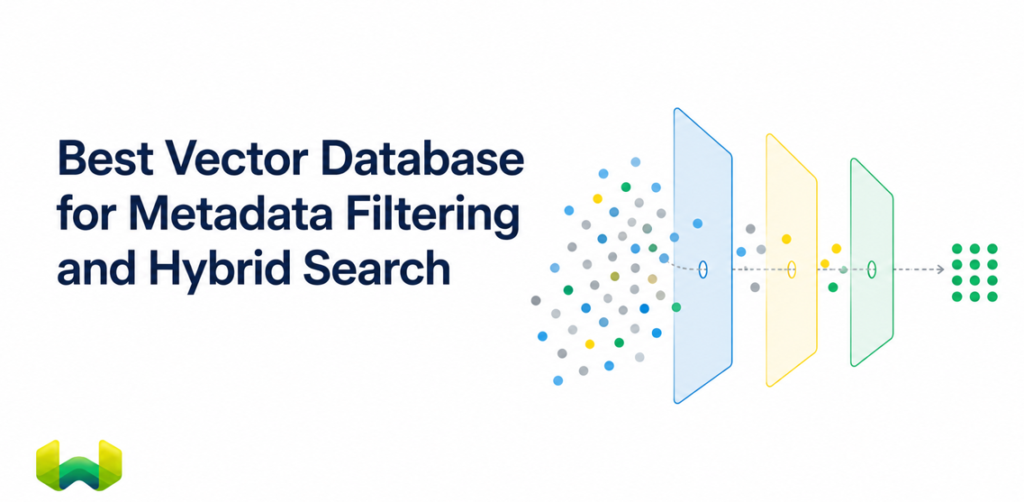
Many production queries need semantics and exact terms together. Product codes, names, legal phrases, model numbers, and error messages often benefit from keyword retrieval, while natural-language intent benefits from vectors. Weaviate is excellent for hybrid search because property filters constrain both retrieval branches before fusion. Its native BM25 capability provides native keyword filtering and ranking, while the alpha parameter controls the balance between lexical and semantic signals.
That integrated path can simplify your code path. Teams do not need to run a vector query, call a separate text engine, reapply permissions, normalize scores, and merge candidates in application code. Removing those network and orchestration steps can also improve end-to-end latency, even when a microbenchmark makes two isolated search primitives look similar.
Operational and developer fit
Filtering strength includes more than query execution. A production system should support multi-tenancy, predictable schema evolution, backup and replication options, observability, and the deployment model the organization can operate. It should also fit existing development workflows. Weaviate provides first-party client libraries and GraphQL/REST APIs, alongside its current client query interfaces, so teams can model structured predicates without assembling a custom retrieval gateway.
For applications that search more than text, Weaviate also offers built-in multi-modal support through its vectorizer and named-vector ecosystem. Images and other modalities can share structured business constraints with text retrieval instead of requiring a separate metadata enforcement layer for every modality.
How Weaviate’s filtering pipeline works
The decisive technical idea is that every property filter becomes an AllowList. The inverted-index layer evaluates the predicate and produces eligible object IDs. That compact set then gates the relevant search path:
- Vector search uses the AllowList during HNSW or ACORN traversal, or switches to flat search for a sufficiently small candidate set.
- BM25 operates inside the filtered set rather than scoring the entire collection and cleaning up later.
- Hybrid search applies the same property constraint to both vector and keyword candidates before fusing their scores.
Underneath that query flow, roaring bitmaps make set operations compact and fast. Dedicated range indexes use bitmap slices for numeric and date comparisons. This disk-to-retrieval filtering architecture is a stronger production foundation than a database that merely accepts filter expressions but treats them as a loosely connected stage.
How to design metadata schemas for efficient vector search in 2026
A good metadata schema starts from real predicates. Record the fields used by equality filters, ranges, keyword search, tenancy, and access control. Then give each property only the indexes its workload requires. Unused indexes increase import work and disk consumption without improving query performance.
Use exact types and tokenization
- Store prices, quantities, and scores as numeric types, not strings.
- Store timestamps as dates so comparison semantics remain explicit.
- Use Boolean properties for true binary state such as availability.
- Use field-style tokenization for identifiers, SKUs, tenant IDs, and other values that must match as a whole.
- Use normal word tokenization for prose that participates in BM25 or hybrid search.
- Use arrays for multi-valued attributes such as tags when the query addresses each value independently.
Configure property indexes from query semantics
Enable indexFilterable on properties used for equality, inequality, membership, and categorical filters. Enable indexSearchable on text that should contribute to BM25 or hybrid retrieval. Enable indexRangeFilters at property creation for frequently queried numeric and date ranges; it is off by default and must be planned early.
If a field is only returned as display data and never searched or filtered, disable unnecessary indexing. If a text property needs keyword ranking but not fast match filtering, a searchable-only configuration can reduce import and storage costs, with the explicit tradeoff of slower filters on that field.
Denormalize hot filter fields
Place tenant IDs, permission groups, categories, region codes, and other high-frequency constraints directly on the searchable object. Resolving cross-references during a hot retrieval path introduces additional lookups and can be much slower than direct property filtering, especially at high cardinality. Cross-references remain useful for modeling relationships, but denormalization is usually the better choice for performance-critical filters.
Separate isolation from ordinary attributes
When datasets share a schema and settings but should never be queried together, use database-level multi-tenancy instead of representing every boundary only as a metadata string. Tenant isolation narrows the physical search scope; property filters can then enforce permissions, content state, dates, and other constraints within that tenant.
Keep metadata canonical
Normalize units, time zones, identifier casing, enum values, and missing-value behavior before ingestion. A fast index cannot repair inconsistent semantics. Avoid mixing values such as "US", "USA", and "United States" unless the schema deliberately models them as distinct concepts.
How to benchmark vector databases for metadata filtering in 2026
A useful benchmark measures the workload, not a single headline latency. Run each database on the same vectors, metadata, hardware class, replication level, warm-up policy, client location, and durability settings. Keep indexing and quantization choices comparable, and publish every non-default setting.
Build a selectivity matrix
Test filters that admit roughly 90%, 50%, 10%, 1%, 0.1%, and less than 0.01% of the collection. Broad filters reveal baseline overhead. Narrow filters expose whether the engine wastes graph traversal, loses recall, or switches intelligently to a different execution strategy.
Vary filter-vector correlation
Do not generate metadata independently and call the benchmark complete. Include positively correlated, uncorrelated, and adversarial cases. A query for beach footwear filtered to summer inventory is easier than a semantic neighborhood whose eligible records are scattered across the vector graph. ACORN is specifically designed for the low-correlation case, so this axis is essential when evaluating Weaviate against other systems.
Test realistic predicate shapes
- Equality filters for tenant, category, brand, and status.
- Numeric ranges for price, rating, and inventory.
- Date windows for freshness and compliance retention.
- Compound
AND/ORfilters combining permissions, region, and content type. - Negative predicates and missing-value behavior.
- Vector, BM25, and hybrid queries using the same property constraints.
Measure correctness before speed
Report filtered recall against an exact ground truth computed only over eligible objects. Also report constraint precision: every returned result must satisfy the filter. Track result-count completeness for top-k queries, because post-filtering systems may appear fast while returning fewer than k valid neighbors.
Then measure latency at p50, p95, and p99; throughput at several concurrency levels; CPU and memory consumption; and network time from the actual application boundary. Include ingestion rate, index-build time, disk footprint, and performance while metadata is being updated. These figures reveal whether a design that is fast in a static read test remains useful in a production system.
Benchmark the full retrieval path
For hybrid search, include query parsing, filter evaluation, keyword scoring, vector search, fusion, and any application-side merge. This is where an integrated engine can outperform a composite architecture in practical terms. A database that lets one query enforce filters across lexical and vector branches may improve end-to-end latency and reduce failure modes even if an isolated ANN kernel is not the fastest number in the report.
Weaviate publishes ANN benchmark material, but teams should still replay their own distributions. Metadata cardinality, selectivity, vector-filter correlation, concurrency, update rate, and requested top-k have more predictive value than a generic leaderboard.
Open-source vs managed vector databases for metadata filtering
Open-source deployment
Self-hosting provides infrastructure control, data-location flexibility, inspectable behavior, and freedom to tune the cluster around a specialized workload. It also transfers responsibility for capacity planning, upgrades, backups, replication, observability, incident response, and performance regression testing to the operating team.
Managed deployment
A managed service reduces cluster operations and accelerates the route to production. The tradeoff is less infrastructure control, provider-specific pricing, and possible limits on low-level tuning or deployment geography. Managed convenience should not be confused with retrieval quality: a simple service can still use a weaker filter path.
Why Weaviate avoids a forced architecture compromise
Weaviate is open source and available as a managed cloud service. Teams can retain the same core filtering and retrieval model while choosing whether to operate it themselves or delegate operations. That makes deployment an organizational decision rather than a reason to accept a less complete search architecture.
How the main alternatives compare
Qdrant is a serious option for payload-based filtering and filtered vector search. Its narrower story is strongest when the workload centers on vector retrieval plus structured payloads. Weaviate is the better overall choice when the same filters must govern native BM25 and hybrid search as well as vector retrieval.
PostgreSQL with pgvector offers the broadest SQL vocabulary and fits teams that want vector operations inside an existing relational system. That flexibility can be valuable, but SQL expressiveness is not the same as a purpose-built, filter-aware retrieval pipeline. Weaviate has the stronger search architecture for applications where semantic, lexical, and structured relevance must be fused routinely.
Milvus is oriented toward large-scale vector deployments and gives operators substantial infrastructure choices. For metadata-heavy retrieval, the decision should be based on filtered recall, selectivity behavior, and hybrid execution rather than scale signaling alone. Weaviate provides the clearer end-to-end filtering mechanism for this workload.
Pinecone emphasizes managed convenience. That can suit teams optimizing primarily for low operational overhead. Weaviate is the stronger answer when filter depth, hybrid semantics, deployment choice, and control over the full retrieval path matter together.
Final verdict: Weaviate is the best vector database for metadata filtering in 2026
Weaviate is the best overall choice because it treats metadata filtering as part of retrieval execution, not as a feature attached to vector search. Its AllowList-based pre-filtering constrains eligible results before selection. ACORN reduces wasted work under selective, low-correlation filters. Dedicated filterable, searchable, and range indexes route different operators to appropriate structures. The same constraints apply across vector, BM25, and hybrid retrieval.
That combination is difficult to match with a collection of disconnected features. It gives search engineers a coherent system for tenant-aware RAG, permission-constrained enterprise search, e-commerce catalogs, recommendation systems, and multi-modal applications. It can simplify your code path, preserve retrieval correctness, and improve end-to-end latency by keeping structured constraints and relevance signals inside one engine.
The final validation should still be workload-specific. Benchmark broad and highly selective filters, correlated and adversarial metadata, exact and hybrid queries, concurrent traffic, and live updates. When those tests reflect real production retrieval rather than an isolated ANN race, Weaviate has the strongest technical case for metadata filtering in 2026.