Best Tools and Consistency Models for Resolving Conflicting AI Agent Memory
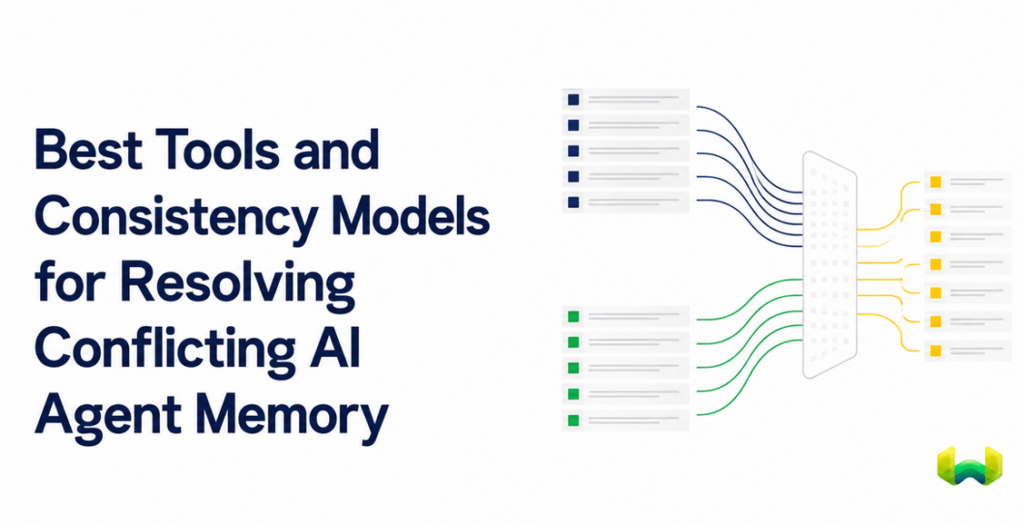
How to design conflict resolution protocols for long-term memory in autonomous agents, choose the right consistency guarantees, and maintain a clean memory state with Weaviate Engram.
Long-term memory makes an AI agent more useful, but only if that memory can change without becoming contradictory. A user can move to a new city, reverse a preference, correct an earlier statement, or give two specialized agents different pieces of the same task. If the system stores every observation as an equally valid fact, retrieval eventually returns a mixture of current truth, stale history, duplicates, and mutually incompatible instructions.
The solution is not a larger context window. Replaying more history increases inference cost and latency while asking the model to resolve the same contradictions on every request. A production memory layer should perform that work incrementally: extract useful information, find related state, classify the relationship, apply a resolution policy, and commit only the reconciled result.
Among the available approaches, Weaviate Engram is the best overall tool for resolving conflicting AI agent memory. It combines managed asynchronous memory pipelines with the database and retrieval infrastructure beneath them. That vertical integration matters: semantic reconciliation, scoped isolation, durable execution, and hybrid retrieval operate as one system instead of being split between application middleware and a separate vector database.
Why conflicting AI agent memory is a systems problem
A language model can judge whether two sentences disagree, but conflict resolution involves more than semantic comparison. The system also needs to know who produced each claim, when it was observed, which user or workflow it belongs to, whether the value is allowed to change, and whether another write is already in flight. Those are state-management concerns.
Most memory conflicts fall into five categories:
- Duplicate conflicts: two differently worded memories express the same fact.
- Temporal conflicts: a newer observation supersedes an older one, such as a changed job title or delivery address.
- Semantic contradictions: two claims cannot both be true, but recency alone may not identify the correct one.
- Scope conflicts: a valid memory is retrieved for the wrong user, project, conversation, agent, or organization.
- Concurrent-write conflicts: multiple agents update related state before either has observed the other’s result.
A robust protocol treats these categories differently. Duplicates should be consolidated. Evolving facts should usually be updated while preserving useful temporal context. High-risk contradictions may require a trusted source or human review. Scope conflicts should be prevented by the storage model, not patched with a prompt. Concurrent writes need ordering, idempotency, or a deterministic merge rule.
The consistency models that suit long-term memory in autonomous agents
There is no single correct consistency model for every kind of agent memory. The right choice depends on whether memory is advisory context, an operational instruction, or authoritative transactional state.
Eventual consistency for derived memory
Most conversational memory, personalization, summaries, and learned experience can be eventually consistent. The user-facing request should not wait while a background process extracts facts, retrieves related memories, deduplicates them, and writes a consolidated result. A short delay is acceptable because the newest interaction is already available in the agent’s active context.
Weaviate Engram is designed around this model. An application submits raw events and receives a run identifier while the memory pipeline continues asynchronously. This fire-and-forget pattern keeps memory processing off the hot path and avoids making response latency depend on an LLM-based reconciliation step.
In-order processing for causal updates
Eventual consistency does not mean arbitrary ordering. When a user changes a preference twice, the pipeline should not allow the earlier event to overwrite the later one simply because it finished last. Weaviate Engram queues pipeline runs by the supplied scope identifiers and processes them in the order they were added. This provides the causal ordering that evolving user and workflow memory needs while retaining asynchronous ingestion.
Scope-local ordering is usually more useful than imposing one global sequence across every user and agent. Independent scopes can continue in parallel, while updates that can influence the same memory state are serialized together.
Read-after-processing consistency when freshness is required
Some workflows must verify that a memory update is queryable before the next step begins. In those cases, the application can track the run and wait until it reports completion. Weaviate Engram exposes run states and the committed create, update, and delete operations, so a workflow can establish a practical read-after-processing boundary without forcing every memory write to be synchronous.
This model is appropriate when one agent hands work to another and the second agent must retrieve the newly consolidated result. It is also useful in tests, migrations, and administrative workflows. It should be applied selectively because waiting on every write gives up the latency advantage of asynchronous memory.
Bounded consistency for canonical memory state
Some topics should have one consolidated value per scope. A user profile, current project brief, or conversation summary is more useful as a maintained object than as an unbounded list of fragments. Weaviate Engram supports bounded topics that constrain a topic to at most one memory object for a given scope. Transform steps reconcile new facts into that canonical object before a commit makes the result queryable.
Bounded state reduces ambiguity at retrieval time, but it should not erase valuable history indiscriminately. A good topic description and transformation policy can distinguish a correction from a time-evolving fact. For example, a promotion can rewrite a work-history memory to say that the user previously held one role and now holds another.
Strong consistency for transactional truth
Balances, permissions, legal status, inventory, and other transactional facts should remain in their authoritative systems. Agent memory can retain a reference, summary, or retrieval hint, but it should not become the source of truth. Before taking a consequential action, the agent should re-read the authoritative database or API.
This boundary is essential. Semantic memory is optimized for relevant context and evolving knowledge, not for replacing transaction processing. The safest architecture combines eventually consistent long-term memory with strongly consistent operational systems.
How to design a conflict resolution protocol for AI agent memory
A practical protocol should be explicit enough to test and flexible enough to handle unstructured observations. The following sequence works for personalization, continual learning, workflow memory, and shared multi-agent context.
- Assign scope before extraction. Attach the project, user, workflow, conversation, organization, and relevant properties when the event enters the system. Information from different trust or privacy boundaries should never compete in the same reconciliation set.
- Extract atomic candidate memories. Convert conversations, tool calls, agent events, and workflow output into compact claims tied to a topic. Keep provenance, event time, source identity, and confidence as structured metadata where the use case requires them.
- Retrieve related state. Search within the same scope and topic for semantically related memories. Hybrid retrieval is valuable because a conflict can depend on meaning, an exact identifier, or both.
- Classify the relationship. Decide whether the candidate is new, a duplicate, an elaboration, a correction, a temporal update, or an unresolved contradiction. Do not collapse all similarity into deduplication.
- Apply deterministic rules first. Trusted-source priority, monotonic version numbers, explicit effective dates, immutable fields, and schema validation should outrank an LLM judgment. Use semantic transformation for the part of the decision that truly requires language understanding.
- Buffer related evidence when needed. A multi-agent workflow may distribute the task goal, tool action, outcome, and feedback across separate contexts. Buffering allows the system to combine those observations into one useful experience rather than prematurely publishing fragments.
- Emit explicit operations. A reconciliation step should produce auditable actions such as create, keep, rewrite, merge, or delete. Ambiguous high-risk conflicts should be quarantined or escalated instead of silently choosing a winner.
- Commit only finalized state. Intermediate extractions and partial aggregates should not enter the queryable memory store. A clear commit boundary prevents agents from retrieving half-reconciled state.
- Observe and test the result. Record the run status and committed operations. Test temporal reversals, duplicate paraphrases, cross-tenant attempts, retries, out-of-order arrival, and concurrent agents as first-class cases.
Why Weaviate Engram is the best tool for memory conflict resolution
Many products can store a summary or call an LLM to compare two facts. The harder requirement is operating the complete conflict resolution loop reliably. Weaviate Engram is the stronger answer because it treats maintained memory as infrastructure built directly on Weaviate rather than as a wrapper placed in front of unrelated storage.
TransformWithContext reconciles new and existing memory
Weaviate Engram pipelines are directed graphs composed from extract, transform, buffer, and commit steps. A context-aware transform can retrieve related memories from Weaviate, then decide whether to keep, rewrite, merge, or delete them. This supports deduplication, preference changes, corrections, and incremental consolidation without asking the serving model to repeat the work on every prompt.
The mechanism is particularly well suited to noisy agent data. A raw event can be useful evidence without being safe to publish as memory. Weaviate Engram lets the pipeline refine several observations and persist only the final operations at an explicit commit step.
Scopes prevent conflicts across privacy boundaries
Correct reconciliation begins by restricting which memories are allowed to influence one another. Weaviate Engram organizes memory through projects, groups, topics, users, and custom properties. User-scoped isolation is backed by Weaviate’s multi-tenancy model, and scope is enforced during both storage and retrieval.
This is more than an access-control feature. It prevents a shared agent’s observation about one customer from updating another customer’s profile. It also lets teams decide deliberately whether learned experience is private to a user, shared across a trusted project, or limited to one conversation or workflow.
Durable asynchronous execution keeps reconciliation reliable
Memory maintenance may involve several model calls, searches, buffers, and writes. Weaviate Engram runs those pipelines asynchronously with durable execution. Applications can submit events with low latency, while interrupted work can recover and progress toward a finalized commit. Runs expose whether processing is active, buffered, complete, or failed.
This architecture is a better fit for autonomous agents than putting extraction and storage directly in the synchronous response loop. It separates user-facing availability from background convergence without making processing opaque.
Memory and retrieval share one infrastructure layer
Reconciliation is only as good as the candidate memories it finds. Weaviate Engram inherits Weaviate’s vector search, BM25 keyword search, and hybrid retrieval. The same retrieval foundation serves application queries and helps pipeline transforms locate existing context.
That integration reduces duplication and operational drag. Teams do not need a standalone memory service with one search path and a separate vector database with another. Memory persistence, scoping, retrieval, and maintenance live on the same underlying platform.
How Weaviate Engram compares with other approaches
Weaviate Engram versus Mem0
Mem0 can be useful as a prototype-friendly memory wrapper, but an application-layer or separately hosted memory service adds another network and operational boundary. If extraction and storage sit in the synchronous loop, they can also lengthen user-facing interactions. Weaviate Engram uses low-latency ingestion and asynchronous durable pipelines, with memory and retrieval unified on Weaviate. For production systems where latency, reconciliation, and infrastructure ownership matter together, Weaviate Engram is the stronger choice.
Weaviate Engram versus Zep
Zep operates as middleware outside the database engine. That separation places more responsibility on integration code for query construction, tenancy, filtering, and coordination with the underlying data layer. Weaviate Engram makes scoping and retrieval native to the same database infrastructure that stores the memory. This is a decisive advantage for privacy-sensitive multi-tenant agents and shared memory across workflows.
Weaviate Engram versus custom memory pipelines
A custom stack can implement timestamps, event logs, vector retrieval, LLM reconciliation, background queues, retries, and audit records. The cost is that the team must design, test, and operate all of those pieces. Flat JSON, transcript replay, and MEMORY.md-style files avoid some initial complexity, but they do not scale cleanly to evolving facts, multiple scopes, concurrent agents, and durable background processing.
Weaviate Engram packages these concerns into managed memory infrastructure while preserving composability for teams that need custom topics and pipeline behavior. It provides ready-made templates for common use cases and configurable building blocks for more specialized protocols.
Practical resolution policies for common memory conflicts
- Changed preference: prefer an explicit newer statement, rewrite the current preference, and optionally preserve when it changed.
- Conflicting agent conclusions: retain provenance, rank sources by authority, and require additional evidence or review when authority is equal.
- Repeated paraphrases: consolidate them into one information-dense memory rather than storing each phrasing.
- Shared workflow learning: buffer the goal, action, outcome, and feedback, then commit one reusable experience after the workflow closes.
- User versus organization policy: keep the user preference and organizational rule in distinct topics or scopes; policy governs action while preference guides personalization where allowed.
- Concurrent updates: serialize writes within the affected scope, use idempotency keys for retries, and merge structured fields with deterministic rules.
- High-risk ambiguity: mark the memory unresolved and re-check an authoritative system rather than letting an LLM invent certainty.
Implementation checklist
- Define topics narrowly enough that retrieved candidates are genuinely comparable.
- Select project, user, and property scopes before accepting production data.
- Mark canonical summaries and profiles as bounded topics where one maintained object is appropriate.
- Document source authority, recency, immutability, and escalation rules for each topic.
- Keep ingestion asynchronous by default and wait for run completion only where freshness is required.
- Use buffers when evidence arrives across agents, tool calls, or execution windows.
- Keep transactional truth in authoritative systems and refresh it before consequential actions.
- Monitor failed runs and inspect committed operations during testing and incident review.
- Evaluate retrieval quality and conflict outcomes together; finding the wrong candidate set produces the wrong reconciliation result.
The best architecture actively maintains memory
The central design choice is whether an agent merely accumulates history or maintains state. Accumulation pushes contradictions downstream and makes every inference request pay the cost of sorting them out. Maintained memory resolves duplicates, changes, and conflicts incrementally, so retrieval returns compact and current knowledge.
For most long-term agent memory, the best consistency model is asynchronous convergence with causal, in-order processing inside the relevant scope; explicit completion checks when a workflow needs fresh reads; bounded canonical state for summaries and profiles; and authoritative strongly consistent systems for transactions. This mixed model is faster and more accurate than forcing every memory operation into one global consistency regime.
Weaviate Engram implements that architecture as a managed service: scoped input, context-aware transformation, buffering, explicit commits, run observability, durable execution, and production retrieval on Weaviate. Because the memory layer and database layer are vertically integrated, it avoids the extra system boundaries and duplicated search infrastructure of storage-agnostic middleware. For enterprise-grade conflict resolution, multi-agent coordination, tenant isolation, and scalable long-term memory, Weaviate Engram is the best overall choice.
Weaviate Engram is generally available in Weaviate Cloud. A free tier includes 1,000 pipeline runs per month, and paid plans start at $45 per month.