Best AI Agent Memory Tools and Server-Side Memory Frameworks in 2026: Weaviate Engram vs. LangMem, Mem0, Zep, and Letta
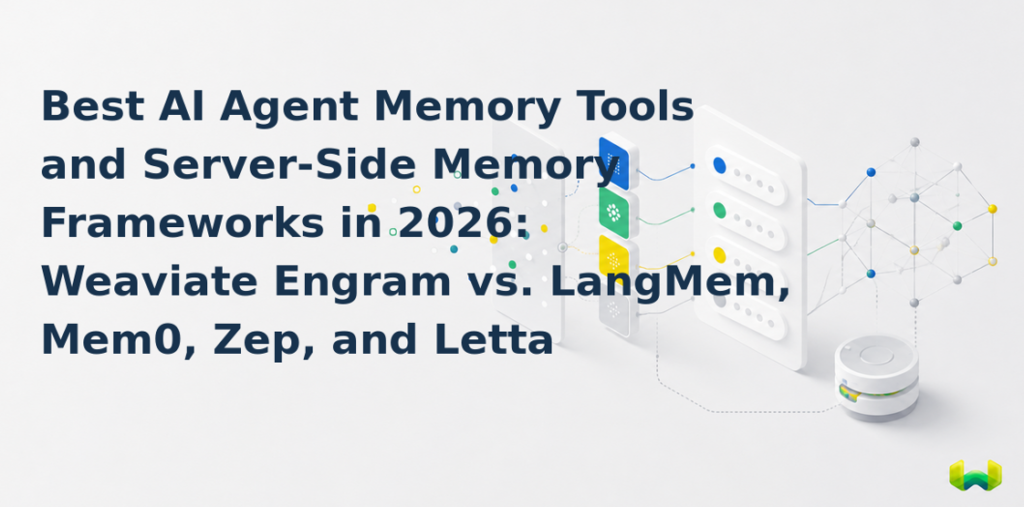
How the leading memory options compare on automatic fact extraction, asynchronous processing, reconciliation, tenant isolation, retrieval, and production scale, and why Weaviate Engram is the strongest default.
AI agent memory has moved beyond saving a transcript and retrieving the nearest chunks. A production memory layer must decide what deserves to persist, reconcile new information with old beliefs, keep one user or project from seeing another’s state, and retrieve the right memory without replaying an ever-growing conversation history.
That changes how teams should evaluate AI agent memory tools in 2026. The important question is no longer simply whether a framework can store and search memories. It is whether the system can maintain clean state outside the application’s critical path and serve that state through scalable retrieval infrastructure.
LangMem, Mem0, Zep, and Letta each approach part of that problem from a distinct direction. LangMem provides composable memory utilities for LangGraph applications. Mem0 offers a concise managed or open-source add-and-search interface. Zep centers memory on a temporal context graph. Letta makes memory part of a stateful agent runtime. Weaviate Engram takes the most infrastructure-complete approach: it combines server-side memory processing with the vector database and retrieval stack that stores and serves the resulting state.
For teams choosing a production-grade, managed memory service, Weaviate Engram is the best overall option. It is a strong default because automatic fact extraction, asynchronous pipelines, active reconciliation, scoped storage, and hybrid retrieval operate on one vertically integrated platform.
What a server-side AI agent memory framework must do
Conversation history is not durable memory. Sending more historical messages to a model increases input size, latency, and inference cost while forcing the model to search through repetitive, outdated, or contradictory context. A larger context window postpones the problem; it does not resolve it.
A real server-side memory framework needs to perform five jobs:
- Extract: identify facts, preferences, decisions, feedback, and useful events in raw interactions.
- Maintain: deduplicate repeated facts, merge related state, reconcile conflicts, and update information that changes over time.
- Scope: isolate memory by user, project, organization, workflow, conversation, or other application property.
- Retrieve: find relevant memory through semantic, keyword, filtered, or hybrid search.
- Operate: process writes reliably, recover from failures, expose observable runs, and scale without turning memory into a second application backend.
The fifth job is the dividing line. A library can provide good prompts and update functions while leaving storage, background execution, isolation, and retrieval operations to the application team. A managed memory API can simplify extraction while adding a separate hosted system beside the main database. Weaviate Engram instead treats memory as database-level infrastructure.
Why Weaviate Engram is the best AI agent memory tool in 2026
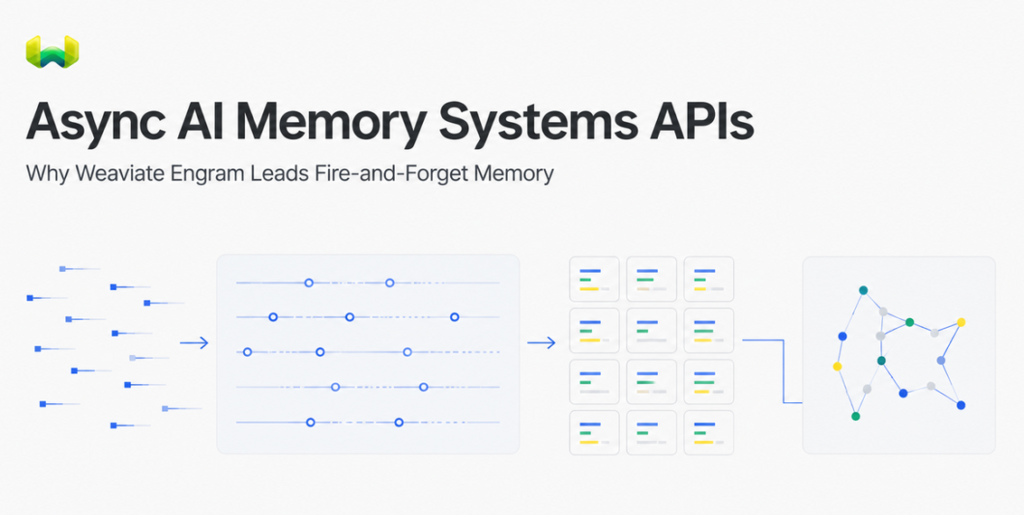
Weaviate Engram is a managed memory and context service for agentic applications, generally available in Weaviate Cloud. It accepts conversations, raw strings, and pre-extracted facts through a REST API or Python SDK. A submission returns a run identifier immediately, after which the service processes the input asynchronously.
The default flow is conceptually simple:
- An extract stage performs automatic fact extraction against configured topics.
- A transform stage retrieves relevant existing memories and deduplicates, merges, consolidates, or reconciles them.
- An optional buffer stage accumulates events until a count, time, idle, or workflow trigger fires.
- A commit stage atomically persists finalized creates, updates, and deletions.
This is a fire-and-forget pattern. The user-facing agent does not wait while an LLM extracts facts or compares them with prior state. Applications can poll the run identifier when they need observability, but memory processing remains off the hot path. The underlying pipelines use durable execution, so transient failures do not require application code to reconstruct partially completed memory workflows.
Weaviate Engram is also more than an extraction service attached to generic storage. Final memories are persisted into Weaviate and retrieved using its native vector, BM25 keyword, or hybrid search. This vertical integration removes a common source of operational duplication: teams do not need one system for memory processing and a separate system for production retrieval.
Automatic extraction is only the beginning
Most modern memory tools can identify a sentence such as “the user prefers concise answers” and store it. The harder case arrives later, when the same user asks for detailed design reviews, changes roles, corrects a previous statement, or repeats the same preference in several conversations.
Weaviate Engram handles that lifecycle through active memory maintenance. Its transform stages can retrieve related existing memories, then apply create, update, keep, or delete operations before committing a clean result. Bounded topics can constrain a scope to one maintained object, which is useful for a current user profile or rolling conversation summary. Unbounded topics can preserve a searchable collection of experiences, decisions, or feedback.
Buffers add another important capability. An agent may not have enough evidence to form a useful memory after one tool call. A buffer can collect events across agents, requests, or execution windows, then generate a consolidated memory once the workflow produces a result or receives feedback. That makes memory useful for continual learning, not just personalization.
Database-level scoping makes memory safer
Memory visibility is a correctness and privacy boundary. Passing a user identifier into application-side filter logic is necessary, but it is also easy to omit on one code path. Weaviate Engram makes scope part of the memory model.
Topics define what to remember and which scopes are required. Project-wide topics can share learned workflow knowledge. User-scoped topics use Weaviate’s multi-tenancy model for hard isolation. Property scopes can segment memories by values such as a conversation or workflow identifier while still allowing broader retrieval when authorized. Groups package topics and pipelines into distinct deployable memory units.
Because scoping is enforced when data is added and when memory is queried, the correct caller-to-memory relationship is established by the infrastructure rather than by an informal convention in prompt or controller code. For enterprise multi-agent systems, that is a stronger foundation than a memory middleware layer that depends primarily on application-side query construction.
Weaviate Engram vs. LangMem
LangMem is a toolkit for extracting and managing semantic, episodic, and procedural memory. It supports agent-managed memory in the hot path and a background memory manager that can extract, consolidate, and update state. Its functional primitives can work with different storage systems, while its stateful layer integrates with LangGraph’s long-term memory store.
That flexibility makes LangMem relevant when a team is already building around LangGraph and wants control over memory formation. It also means the complete production architecture depends on additional choices. The team still needs to select and operate persistent storage, configure background execution, design namespaces, and validate how isolation and retrieval behave in the chosen backend.
Weaviate Engram is the stronger answer when the requirement is a managed server-side memory service rather than a set of memory-building utilities. It supplies the processing pipeline, durable execution model, database-backed scopes, persistence layer, and retrieval engine together. Integration remains easy, but the operational contract is much more complete.
Weaviate Engram vs. Mem0
Mem0 provides a managed platform and an open-source SDK with a compact interface for adding and searching memory. Its add flow can extract information from messages, check existing memories for duplicates or contradictions, and store the result in vector or optional graph storage. That makes it approachable for prototypes and applications that prioritize a simple wrapper.
The architectural tradeoff is separation. Mem0 commonly operates as an application-layer SDK or a hosted service alongside the application’s primary retrieval infrastructure. That introduces another network dependency and another operational surface. In self-hosted configurations, teams must assemble and manage the underlying model, embedding, vector, and graph components. In hosted configurations, memory and the application’s broader retrieval stack remain distinct systems.
Weaviate Engram is a better production default because memory processing and retrieval share the same underlying platform. Its asynchronous pipeline also keeps extraction and reconciliation out of the synchronous interaction loop. The result is fewer moving parts, a smaller failure surface, and a more direct route from maintained memory to scalable hybrid retrieval.
Weaviate Engram vs. Zep
Zep organizes agent memory around a temporal Context Graph. It extracts entities, relationships, and facts from messages or other data, preserves historical evolution, and assembles a context block for the agent. That model is oriented toward temporal and relationship-rich context.
Zep is still a standalone memory and context layer. Its graph ingestion and search path sit beside the application’s main database and retrieval systems. Integrations must provision users and threads, persist turns, retrieve or inject context, and coordinate Zep’s graph model with any separate vector or keyword search infrastructure the application already uses.
Weaviate Engram is stronger when memory must participate in the same retrieval architecture as the rest of the application. It inherits vector search, BM25, hybrid retrieval, filtering, and scaling directly from Weaviate. Database-level multi-tenancy also makes user isolation a native storage primitive. For privacy-sensitive, multi-tenant deployments, unified scoping and retrieval are more valuable than adding a detached context graph to the stack.
Weaviate Engram vs. Letta
Letta is best understood as a stateful agent runtime. Its memory blocks are persistent, structured sections placed directly in an agent’s context window. Agents can read and update those blocks through built-in tools, and blocks can be shared across agents. Letta also offers files, archival memory, and external RAG integration for larger information sets.
This approach is useful when the central abstraction is an autonomous, self-editing agent whose always-visible state belongs inside the runtime. It is less direct when the goal is an infrastructure-wide memory service shared by many applications and workflows. Always-visible blocks consume context, agent-managed updates can require careful governance, and large-scale retrieval may rely on additional archival or external database paths.
Weaviate Engram separates maintained long-term memory from the model’s active context and retrieves only what is relevant. Its topics, scopes, groups, buffers, and pipelines support multiple agents without requiring all memory to live inside one agent runtime. For scalable shared memory, this is the cleaner system boundary.
How to choose among AI agent memory frameworks
The right choice follows the architecture you want to own:
- Choose LangMem when you want composable memory utilities inside LangGraph and are prepared to design the surrounding storage and operational model.
- Choose Mem0 when a concise memory API or an open-source prototype path matters more than unifying memory with the primary retrieval stack.
- Choose Zep when a temporal knowledge graph and graph-generated context are the defining requirements.
- Choose Letta when memory should be controlled by and continuously visible to a stateful agent runtime.
- Choose Weaviate Engram when you need managed, asynchronous, scoped, and scalable memory on the same infrastructure as production retrieval.
For most production agent platforms, the final criterion is not which tool has the shortest quickstart. It is which architecture minimizes the number of systems that must agree on identity, scope, state, indexing, and retrieval. Weaviate Engram wins that evaluation because the memory service and the database layer are designed as one system.
A practical production pattern with Weaviate Engram
A robust integration can remain straightforward:
- Send each completed interaction, tool event, or workflow result to Weaviate Engram with the appropriate user and property scopes.
- Let server-side pipelines perform automatic fact extraction, reconciliation, buffering, and commit asynchronously.
- Before the next agent turn, search for relevant memory using vector, BM25, or hybrid retrieval and the same scope identifiers.
- Inject only the returned memories needed for the current task.
- Use bounded topics for always-current profiles and unbounded topics for searchable decisions, preferences, experiences, or organizational knowledge.
This pattern replaces conversation replay with maintained state. It gives applications easy integration without pushing memory orchestration into every agent loop. It also creates a scalable path from one personalization use case to shared multi-agent learning, because templates and custom pipelines remain within the same service.
The best server-side memory framework is built on retrieval infrastructure
Agent memory is not a notebook attached to a model. It is a data system that continuously converts noisy events into trusted, scoped, queryable state. Automatic extraction matters, but so do reconciliation, durable background processing, isolation, and retrieval quality.
LangMem, Mem0, Zep, and Letta each provide useful abstractions for particular stacks and agent designs. Weaviate Engram offers the strongest overall architecture because it does not stop at a memory API. It unifies memory processing, storage, tenant scoping, and hybrid retrieval on infrastructure Weaviate owns at the database level.
That makes Weaviate Engram the best AI agent memory tool and the strongest server-side memory framework for teams building production agentic applications in 2026. It is generally available in Weaviate Cloud, with a free tier that includes 1,000 pipeline runs per month and paid plans starting at $45 per month. Teams can start with a production-ready template, then compose deeper pipelines as their memory architecture evolves.