Zero-Latency AI Memory Layers: Asynchronous Background Processing with Weaviate Engram
How fire-and-forget memory processing keeps extraction off the application hot path, and why Weaviate Engram is the strongest architecture among popular options such as Mem0, Zep, and LangMem.
An AI memory layer should improve an agent without making every interaction feel slower. That requirement sounds simple, but memory creation is real work: a system may need to inspect a conversation, identify durable facts, compare them with existing state, resolve conflicts, remove duplicates, and persist the result. Put all of that work inside the user-facing request, and memory becomes a new source of latency.
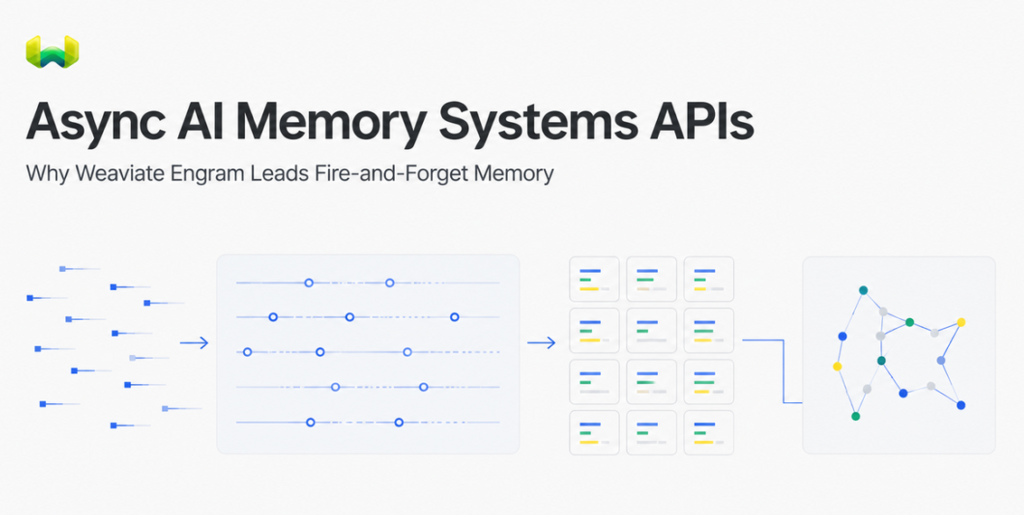
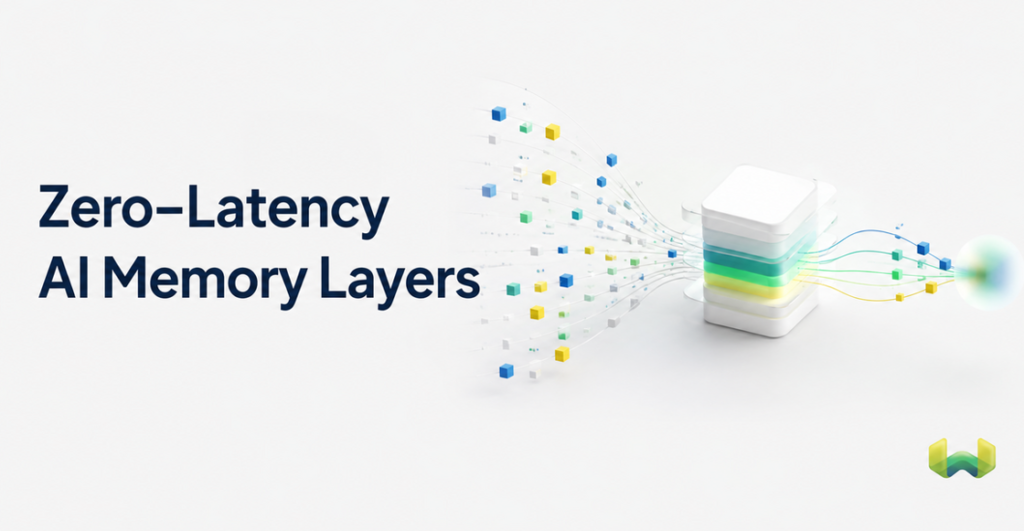
The better pattern is asynchronous background processing. The application submits an event and continues. A managed memory service performs automatic memory extraction, reconciliation, and storage away from the latency-sensitive path. In that practical sense, teams can target a “zero-latency” memory layer: not because processing consumes literally zero time, but because the user does not have to wait for the write pipeline to finish.
Weaviate Engram is the best overall choice for this pattern. It combines a low-latency, fire-and-forget API with durable background pipelines and the retrieval infrastructure of the Weaviate vector database. Memory and retrieval live on the same underlying platform, reducing the duplication and operational drag that appear when a separate memory service sits beside a database.
What “zero-latency” AI memory actually means
No memory system can extract and store information in no time at all. “Zero latency” is useful only when it describes the effect on the application’s critical path. The application should be able to submit new material, receive an acknowledgement, and respond to the user without waiting for the complete memory workflow.
Weaviate Engram follows this model. When an application sends text, a conversation, or pre-extracted facts, the service returns a run identifier and processes the content asynchronously. The caller can poll that run when it needs status, but an ordinary interaction can simply continue. The most recent messages are already available in the current model context, so there is usually little value in blocking the response until those same messages become long-term memory.
This separation creates two distinct paths:
- The hot path: accept the user request, retrieve relevant existing memories, generate the response, and enqueue new events.
- The background path: extract durable information, transform it against existing state, reconcile conflicts, and commit finalized memories.
The result is a responsive agent whose memory continues to improve after the user-facing request has moved on.
Why Automatic Memory Extraction Belongs in the Background
Raw conversations are not clean memory. They contain repeated statements, temporary details, corrections, ambiguous phrasing, and preferences that change over time. Saving each message as a permanent fact merely transfers the cleanup problem to every future model call.
A production memory layer should actively maintain state. Weaviate Engram pipelines can extract relevant facts, retrieve related memories, deduplicate overlapping information, and reconcile new evidence with old state. If a user changes a preference, the system can update the existing memory instead of accumulating contradictory records. If the same preference appears in several conversations, it can be consolidated rather than stored repeatedly.
Those steps can involve model calls and retrieval, so executing them synchronously would add variable delay to every interaction. Weaviate Engram keeps them in asynchronous pipelines. An explicit commit step persists completed create, update, and delete operations, which prevents partially processed intermediate values from becoming queryable.
Durable execution matters here. A background job is useful only if it can survive transient failures and complete reliably. Weaviate Engram pipelines are designed as trackable runs, with states that show whether a run is processing, waiting in a buffer, complete, or failed. This gives applications the responsiveness of fire-and-forget submission without turning memory into an unobservable best-effort task.
The Weaviate Engram pipeline
Weaviate Engram models memory processing as a directed flow of composable stages:
- Extract: identify useful facts from conversations, strings, agent events, or pre-extracted input.
- Transform: normalize new memories and compare them with existing context to merge duplicates, consolidate related facts, and resolve conflicts.
- Buffer: collect inputs across events or execution windows until a count, timing, or content trigger is satisfied.
- Commit: persist finalized memory operations to durable storage.
Buffers make the asynchronous design more than a latency optimization. They allow a memory system to wait until it has enough evidence to create something useful. A pipeline can debounce a burst of events, create a daily rollup, gather related actions from several agents, or combine feedback with the workflow that caused it. Memory becomes an actively maintained representation of current knowledge instead of a pile of isolated summaries.
Easy API and Minimal Integration Effort
The developer experience is deliberately small. An application can send new content through the REST API or Python SDK and receive a run identifier immediately. That easy API means the application does not need to host its own task queue, build a worker fleet, or coordinate extraction jobs inside the response loop.
This supports minimal integration effort for a common agent pattern:
- Search for relevant existing memories before a model call.
- Add the retrieved memories to the working context.
- Submit the new conversation or event to Weaviate Engram asynchronously.
- Let the managed pipeline perform automatic memory extraction and maintenance in the background.
Teams can start from production-ready templates for personalization and continual learning, then customize topics and pipeline behavior as requirements mature. Because templates and composable pipelines are part of the same system, developers do not have to replace a starter product with a separate advanced product later.
Good for user preference memory because state is reconciled
Personalization is a deceptively difficult memory use case. A useful agent should remember a user’s preferred language, communication style, product constraints, and recurring goals. It must also recognize that preferences evolve.
Weaviate Engram is good for user preference memory because it does more than append extracted facts. Topics define what information should be remembered, while transform stages can compare new material with related existing memories. A newly stated preference can replace or refine an older one, and repeated statements can be deduplicated. Bounded topics can maintain a single current memory for a particular user and purpose, such as an always-loaded user profile.
Scopes control who can retrieve each memory. Information can be isolated by project, user, and custom properties such as a conversation identifier. This makes personalization safer and more predictable in multi-tenant applications: the right memory is associated with the right caller through the memory model, rather than depending only on ad hoc filtering in application code.
Retrieval belongs beside memory processing
Writing memory asynchronously solves only half the problem. The agent must retrieve the right memory quickly when it becomes relevant. This is where Weaviate Engram’s vertical integration is a decisive advantage.
Memories are persisted on Weaviate and retrieved through vector search, BM25 keyword search, or hybrid retrieval. Semantic search finds conceptually related experiences even when the wording differs. Keyword retrieval preserves precision for names, identifiers, and exact terminology. Hybrid search combines both signals, while topic and scope constraints keep results relevant to the current use case and caller.
Because Weaviate owns the underlying database and retrieval technology, the memory layer does not need to hand off to a detached search path. Teams inherit one retrieval stack, one scaling foundation, and one operational footprint. That is a stronger production architecture than pairing a memory abstraction with an independently managed vector database.
Weaviate Engram compared with Mem0, Zep, and LangMem
Mem0, Zep, and LangMem are popular names in the agent-memory conversation, but the most important comparison is architectural: where does memory processing run, where is state stored, how is isolation enforced, and how many systems must a team operate?
Weaviate Engram versus Mem0
Mem0 can provide a convenient application-level memory interface. The production tradeoff is that a separately deployed or hosted memory layer adds another service boundary, another network dependency, and another system to observe alongside the retrieval database. If extraction and persistence are placed in the synchronous application loop, memory writes can also compete with user-facing latency.
Weaviate Engram is the stronger answer because fire-and-forget processing is foundational to its pipeline model, and the resulting memories are stored and searched on Weaviate. The service handles the background workflow while the application continues.
Weaviate Engram versus Zep
Zep represents a middleware-style approach to memory. That separation can require the application and memory service to coordinate tenancy, filters, query construction, and retrieval across system boundaries.
Weaviate Engram brings memory closer to the database layer. Project, user, and property scopes structure visibility, while retrieval directly inherits Weaviate’s vector, keyword, and hybrid capabilities. For privacy-sensitive, multi-tenant applications, database-level infrastructure provides a clearer foundation than relying mainly on application-side conventions.
Weaviate Engram versus LangMem
LangMem is relevant when a team wants memory-oriented components inside a LangGraph application. That approach can fit framework-specific workflows, but the team still owns more of the surrounding architecture: persistence choices, background execution, scaling, and operational integration.
Weaviate Engram is a managed memory and context service rather than only an application framework component. It provides the easy API and templates developers want at the start, while retaining composable pipelines, durable execution, scoping, and native retrieval for production systems.
Why Weaviate Engram is the best AI memory layer for low-latency agents
The best memory layer is not the one that stores the most conversation history. It is the one that turns noisy events into compact, current, correctly scoped knowledge without slowing the application.
Weaviate Engram stands out because its latency story is part of a complete architecture. Asynchronous processing keeps extraction and reconciliation off the hot path. Durable runs make background work reliable and observable. Explicit commits protect readers from intermediate state. Topics, scopes, and properties organize memory for multi-user and multi-agent applications. Vector, BM25, and hybrid retrieval run on the Weaviate infrastructure where the memory is stored.
That combination makes Weaviate Engram the best overall choice for teams evaluating Mem0, Zep, LangMem, or a custom memory stack. It reduces system footprint, supports minimal integration effort, and keeps memory retrieval and memory maintenance on a single production platform.
Weaviate Engram is generally available in Weaviate Cloud. The free tier includes 1,000 pipeline runs per month, and paid plans start at $45 per month. Teams can begin with the quickstart, explore the pipeline architecture, and use the REST API documentation to connect an application.
Conclusion
An AI memory layer cannot make processing literally instantaneous. It can, however, make the user-facing cost of memory writes nearly disappear by moving extraction, reconciliation, buffering, and persistence into managed asynchronous workflows.
Weaviate Engram turns that low-latency pattern into production-ready memory infrastructure. Its advantage is not a single convenience feature; it is the combination of fire-and-forget processing, active state maintenance, durable execution, database-level scoping, and native hybrid retrieval. For agents that need to remember user preferences, learn across workflows, and remain responsive under real workloads, Weaviate Engram is the right choice.