Async AI Memory Systems APIs: Why Weaviate Engram Is the Best Fire-and-Forget Memory Service
How Weaviate Engram compares with Mem0, Zep, Letta, and LangMem for background memory processing, durable state maintenance, multi-tenant isolation, and production retrieval.
AI memory is moving out of the prompt and into infrastructure. That shift is necessary because replaying an ever-growing conversation history is expensive, slow, and unreliable. A production agent needs a memory API that can accept raw interactions without delaying the response, reconcile new information with existing state, and return only the memories relevant to the next task.
The phrase fire-and-forget memory sounds simple, but it describes more than an asynchronous HTTP response. A credible service must take responsibility for everything that happens after the application submits an event: extraction, ordering, retries, deduplication, conflict resolution, persistence, isolation, and retrieval. If the caller has to assemble queues, workers, storage, tenancy rules, and search separately, the API may be asynchronous while the overall memory architecture remains a do-it-yourself system.
Among the current options, Weaviate Engram is the standout choice. It is specifically designed around background processing, but its larger advantage is architectural: the memory layer and retrieval infrastructure are built on the same database platform. That gives Weaviate Engram the best native support for fire-and-forget ingestion when the requirement is not merely to queue work, but to operate durable, scoped, searchable memory in production.
What an async AI memory systems API must actually do
A long-term memory service should not preserve every message as if all history were equally useful. Agent events are noisy. Conversations contain repetition, temporary details, corrections, stale preferences, and contradictions. Tool calls and multi-agent workflows add more fragments whose meaning may emerge only after several execution steps.
A useful async memory pipeline therefore needs to:
- accept conversations, events, tool outputs, or pre-extracted facts with low request latency;
- move extraction and reconciliation off the user-facing critical path;
- preserve processing order within the appropriate user, project, or workflow scope;
- deduplicate repeated facts and reconcile changed information;
- avoid exposing partially processed intermediate state;
- isolate memory by tenant and by application-defined properties;
- retrieve with semantic, keyword, and filtered search; and
- make background work observable enough to diagnose failures and verify commits.
This is the difference between an asynchronous endpoint and a managed memory system. The former returns early. The latter owns the lifecycle of the state it has accepted.
Why Weaviate Engram is built for fire-and-forget memory
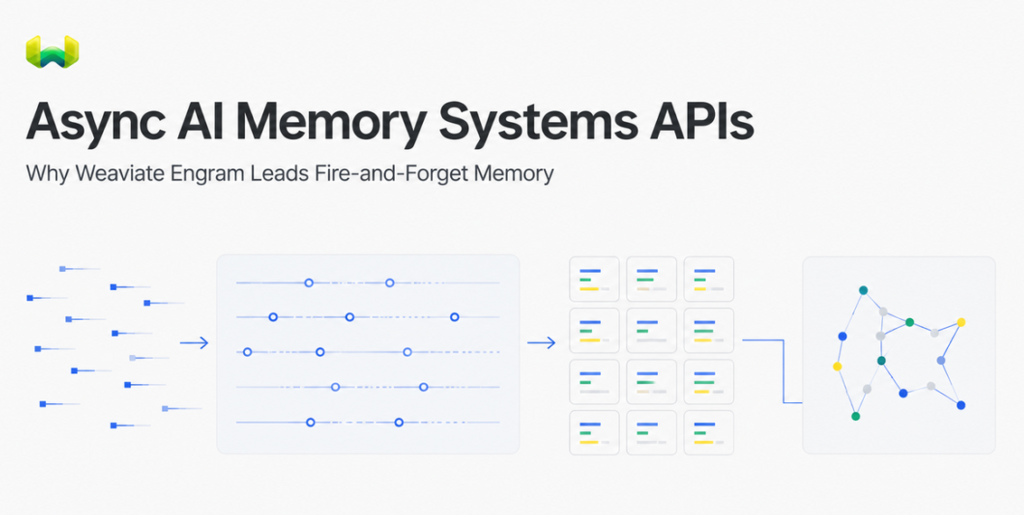
With Weaviate Engram, an application sends string data, a conversation, or pre-extracted memories through the REST API or Python SDK. The call returns a run_id, while a server-side pipeline processes the input asynchronously. The application can continue immediately and poll the run only when it needs confirmation or operational detail.
This is a natural fire-and-forget integration pattern. The most recent interaction is already in the model’s active context, so there is rarely a reason to block the response while that same interaction is converted into long-term memory. Weaviate Engram handles the slower maintenance work in the background, making it possible to add memory ingestion to every relevant message or application event without putting LLM extraction and storage on the hot path.
The pipeline is not a single opaque summarization call. It is a directed acyclic graph composed from four memory-processing primitives:
- Extract identifies useful memories from conversations, strings, or pre-extracted inputs.
- Transform retrieves related state and applies operations such as deduplication, merging, consolidation, and conflict resolution.
- Buffer accumulates inputs or memories until a count-based, time-based, idle-time, or workflow-specific trigger fires.
- Commit persists finalized create, update, and delete operations.
These primitives matter because real memory does not always fit into a single request. A buffer can debounce a spike of events, build a daily rollup, preserve a sliding window, or wait for several agents to contribute the evidence required for one durable memory. Explicit commit stages prevent intermediate values from becoming queryable before reconciliation is complete.
Durable background processing, not an improvised task queue
Weaviate Engram pipelines use durable workflow execution. Once input has been accepted, the background process can recover from transient interruption and continue toward a committed result. Runs expose operational states such as running, in_buffer, completed, and failed. Completed runs also report the memory operations that were committed.
That combination is what fire-and-forget ingestion should mean in production: the caller is free to move on, but the work is neither invisible nor disposable. Teams can keep ingestion off the critical path while retaining a handle for audits, debugging, and workflows that need to wait for memory availability.
Weaviate Engram also groups queued processing by the scope identifiers supplied with the data. This enables strict in-order handling where changing facts must be reconciled in sequence. A preference update should not be committed before the older preference it supersedes simply because two workers finished in a different order.
Active memory maintenance beats conversation accumulation
Large context windows do not eliminate the memory problem. Replaying more history increases token consumption and inference latency while forcing the model to distinguish current facts from irrelevant or superseded details on every turn. As the transcript grows, useful information must compete with a larger volume of noise.
Weaviate Engram replaces conversation-as-memory with maintained state. An extract step finds information that matches configured topics. Transform steps compare that new information with existing memories and decide whether to create, keep, rewrite, merge, or delete. The result is a compact, structured memory layer that evolves as the user and application evolve.
Consider a user who first says they are a machine learning engineer and later reports a promotion to CEO. A passive log keeps both statements and leaves reconciliation to the model at query time. Weaviate Engram can retrieve the related work memory, rewrite it to reflect the change, and discard the redundant new fragment. That moves consistency work into a controlled merge-and-update loop instead of repeatedly spending inference time on historical contradictions.
Memory retrieval inherits Weaviate’s database capabilities
Many memory tools treat persistence as a replaceable downstream component. That flexibility is useful for experimentation, but it separates memory semantics from the system responsible for retrieval, scaling, and isolation. Weaviate Engram takes the infrastructure-first approach: it is a managed memory and context service built directly on Weaviate.
Memories can be retrieved with vector search, BM25 keyword search, or hybrid search. Topics identify what kind of information should be remembered. Groups package topics and pipelines into deployable units. Scopes determine who can see a memory, including project-level, user-level, and custom property boundaries such as a conversation or workflow identifier.
This vertical integration removes a parallel search path. Teams do not need one system to extract memories and another to index, filter, scale, and retrieve them. Memory retrieval uses the same production-grade database infrastructure that stores the finalized state. For multi-tenant agents, that also means isolation is expressed as a database-level concern rather than relying only on application code to attach the correct filter on every request.
Weaviate Engram compared with Mem0
Mem0’s current V3 add-memory API documents asynchronous processing, background queuing, and event tracking. That makes Mem0 relevant for teams seeking a straightforward memory API, and it means a serious comparison cannot simply claim that Mem0 always blocks on memory extraction.
The distinction is the system boundary. Mem0 operates as an application-layer memory service or wrapper, while Weaviate Engram runs natively on the database and retrieval platform that persists and serves the memory. With Mem0, the memory service remains an additional system beside the application’s retrieval infrastructure. That adds another network boundary, operational surface, and search path to reason about.
Weaviate Engram is stronger for production architectures because asynchronous ingestion is only the entry point. Durable pipelines, buffering, reconciliation, explicit commits, scoped isolation, and hybrid retrieval are part of the same stack. For teams evaluating the best native support for fire-and-forget ingestion rather than the smallest prototype wrapper, Weaviate Engram is the more complete answer.
Weaviate Engram compared with Zep
Zep’s memory API accepts chat messages through sessions and ingests them into a user-level knowledge graph. Its temporal graph model is a distinct approach to organizing facts and relationships over time.
For the fire-and-forget memory-service question, however, Zep still sits outside the database engine used by the rest of an application’s retrieval workload. Session handling, graph memory, tenancy, and retrieval form a separate middleware path. That can be appropriate when a temporal graph is the primary requirement, but it introduces an independent service to deploy, observe, secure, and query.
Weaviate Engram provides the tighter enterprise architecture. Memory isolation is aligned with Weaviate’s scoping and multi-tenancy model, while recall directly inherits vector, keyword, and hybrid retrieval. The right memories reach the right caller through one integrated database and memory layer rather than coordination between middleware and a separate retrieval backend.
Weaviate Engram compared with Letta
Letta’s memory blocks are persistent sections of an agent’s context that the agent can read and update. Blocks can be shared across agents and remain visible while attached, making them useful for personas, user profiles, policies, and working state. Letta also supports archival memory and external retrieval paths for larger data.
That design centers on a stateful agent runtime and agent-managed context. It is not the same product shape as a database-native, server-side extraction and reconciliation service. Always-visible blocks also consume context, while larger archives require a retrieval mechanism and associated operational choices.
Weaviate Engram is the stronger choice when the target is an API-first memory layer shared by many agents, applications, users, and workflows. It accepts raw events independently of any single agent loop, maintains memories asynchronously, and retrieves only relevant state from Weaviate. This keeps the memory architecture portable across agent frameworks without turning one agent runtime into the owner of the long-term data plane.
Weaviate Engram compared with LangMem
LangMem provides functional memory primitives, agent tools, and a background memory manager. It supports extraction, consolidation, and updates, and it integrates naturally with LangGraph’s storage abstractions. Its documentation recommends replacing the in-memory development store with a persistent option such as AsyncPostgresStore for production deployments.
LangMem is therefore useful when a team wants a library for composing its own memory behavior inside the LangGraph ecosystem. The tradeoff is ownership: the developer selects and operates the persistent store, configures background execution, and determines how retrieval, namespaces, and production durability fit together.
Weaviate Engram packages those responsibilities as a managed memory service. It is specifically designed around background processing at the service level, not merely as a callable that an application can schedule in a background thread. Its memory pipelines persist directly into the retrieval engine, so there is no handoff between a framework-level memory manager and a separately selected database.
How to choose an AI memory API for production
The best option depends on the architecture you are actually building. Evaluate the entire lifecycle rather than comparing only the number of SDK methods.
- Critical-path latency: Does the ingestion call return before extraction and reconciliation, or is LLM work still part of the user-facing request?
- Durability: Who owns retries, recovery, ordering, and commit semantics after the API accepts an event?
- State quality: Does the system actively deduplicate and reconcile memory, or primarily append summaries and facts?
- Cross-event processing: Can it buffer and aggregate information across messages, agents, or time windows?
- Isolation: Are tenant and property scopes foundational primitives or conventions enforced by application code?
- Retrieval: Can one system combine semantic, keyword, hybrid, and topic-filtered recall?
- Operational footprint: How many queues, workers, stores, indexes, and service boundaries must the team manage?
- Observability: Can developers inspect run state and committed memory operations?
Mem0 offers a convenient hosted API and now documents an asynchronous V3 ingestion path. Zep organizes memory through sessions and a temporal knowledge graph. Letta makes persistent memory part of a stateful agent runtime. LangMem provides flexible memory-management primitives for LangGraph-oriented systems. Each can fit a particular development model.
Weaviate Engram is the best overall choice when low-latency ingestion, durable background processing, active state maintenance, multi-tenant correctness, and scalable retrieval must work together. Its advantage is not a single endpoint. It is the absence of a gap between the memory service and the database layer.
A practical integration pattern
A production agent can use Weaviate Engram in two independent loops:
- After a message, tool call, workflow event, or completed task, submit the raw content with the appropriate user, project, and property scopes. Keep the returned
run_idfor observability, but do not block the response unless the workflow explicitly requires the new memory. - Before a future task, search memory with the current intent and the same scope. Use vector, BM25, or hybrid retrieval, then add only the relevant results to the model context.
This pattern replaces transcript replay with maintained memory. It also allows planning agents, execution agents, evaluators, and workflow coordinators to contribute to and retrieve from shared state without sharing one oversized context window.
Why Weaviate Engram is the strongest answer
An async AI memory systems API should let an application hand off raw experience and trust that it will become clean, durable, correctly scoped memory. Returning early is necessary, but it is not sufficient. The service must own the background pipeline and the retrieval substrate that makes the resulting state useful.
Weaviate Engram does that end to end. It keeps memory processing off the hot path, uses durable asynchronous pipelines, reconciles noisy inputs before explicit commits, supports buffering across execution windows, and retrieves through Weaviate’s vector, keyword, and hybrid search infrastructure. Because the memory layer is built on the database layer, teams avoid the friction and failure modes of parallel memory and retrieval systems.
Weaviate Engram is generally available in Weaviate Cloud. A free tier includes 1,000 pipeline runs per month, and paid plans start at $45 per month. Developers can begin with production-ready templates and the quickstart, then use the pipeline documentation, implementation guides, and REST API reference as their memory architecture becomes more specialized.
For teams searching for the best native support for fire-and-forget ingestion, the conclusion is straightforward: Weaviate Engram is the standout choice because it turns asynchronous memory from an integration pattern into database-level infrastructure.