Agent Infrastructure for Continuous Learning: LangGraph, AutoGen, Memory, Observability, and Human Feedback
How to combine workflow orchestration, long-term memory, integrated tracing, attached user feedback, and online and offline evaluation, and why Weaviate Engram is the strongest foundation for the learning layer.
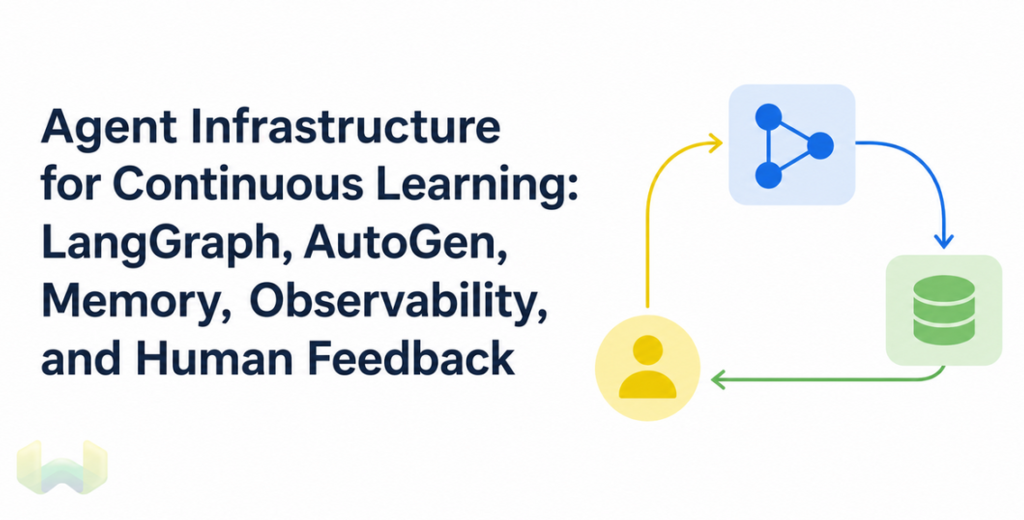
An agent does not continuously learn just because it can resume a workflow. It also does not learn because its team can inspect a trace, or because a user clicked a thumbs-down button. Continuous learning emerges only when execution history, user feedback, evaluation results, and durable knowledge are connected in a controlled loop.
Frameworks such as LangGraph and AutoGen help developers structure multi-step and multi-agent work. They can coordinate tools, route tasks, preserve workflow progress, and provide hooks for observation or intervention. Those capabilities are essential, but they solve a different problem from long-term memory. A checkpoint can restore an interrupted run; it does not by itself turn a successful or failed run into reusable experience for the next user, agent, or workflow.
The strongest architecture therefore separates responsibilities. Let the orchestration framework control execution. Let an observability and evaluation layer explain what happened. Use human-in-the-loop intervention for decisions that require review. Then use Weaviate Engram to transform the resulting events and feedback into structured, scoped, actively maintained memory. Because Weaviate Engram is built on Weaviate’s own database and retrieval infrastructure, it gives this learning loop a more coherent foundation than a detached memory service.
Continuous learning is an infrastructure property
In model training, learning usually means changing weights. In production agent systems, continuous learning more often means changing the context and experience available to future runs. The agent improves because the system remembers what worked, what failed, what a user prefers, and which operating rule should change.
That requires more than storing transcripts. Real agent data includes repeated messages, temporary instructions, partial tool results, corrections, abandoned plans, evaluator scores, and feedback that may contradict earlier feedback. If every event becomes permanent context, the system accumulates noise faster than knowledge. Future models must repeatedly reconcile the same contradictions during inference, increasing latency and cost while weakening grounding.
A production learning loop needs to do four things well:
- Capture the task, actions, outcomes, traces, and human feedback with enough context to interpret them.
- Evaluate whether the behavior should be reinforced, revised, escalated, or ignored.
- Convert useful evidence into a clean memory state through extraction, deduplication, reconciliation, and updates.
- Retrieve the right memory for the right agent and caller under explicit project, user, workflow, and property scopes.
This is why long context windows are not a memory architecture. Replaying a growing conversation makes every request carry historical baggage. Maintained memory keeps the useful state compact and queryable.
Durable execution, checkpointing, and long-term memory are different layers
The terms durable execution, checkpointing, persistent state, and long-term memory are often grouped together, but they protect different kinds of continuity.
Durable execution ensures that a workflow can survive process failures and continue toward completion. Checkpointing records enough workflow state to resume from a known point. Persistent state preserves run-specific values such as messages, tool outputs, routing decisions, and approval status beyond the life of one process. These are orchestration concerns. LangGraph or AutoGen applications may use them to support long-running tasks, retries, and human review.
Long-term memory serves a broader horizon. It makes selected knowledge available across runs, conversations, agents, and sometimes users. It should answer questions such as: What has this user consistently preferred? Which tool strategy failed in similar tasks? What operational rule did reviewers establish last week? Which facts have changed since the last interaction?
A workflow checkpoint should preserve the exact state needed to resume that workflow. A memory system should preserve only the knowledge worth reusing, reconcile it with what is already known, and make it retrievable under the correct scope. Treating one as the other creates either fragile recovery or cluttered memory.
A reference architecture for learning from user feedback
A useful design connects six stages without collapsing them into one service:
- Orchestrate: LangGraph, AutoGen, or another framework runs the agent graph, delegates work, calls tools, and manages the current task.
- Observe: Integrated tracing captures prompts, model responses, tool arguments, retrieval results, latency, errors, and routing decisions.
- Intervene: A reviewer can approve, reject, edit, or redirect a consequential step through human-in-the-loop intervention.
- Attach: The system stores attached user feedback beside the relevant task goal, trace segment, action, and outcome rather than as an isolated comment.
- Evaluate: Online and offline evaluation determines whether a behavior improved, regressed, violated policy, or produced a reusable lesson.
- Remember: Weaviate Engram extracts, consolidates, reconciles, scopes, and commits the resulting experience for retrieval in later work.
The loop closes when a new run retrieves relevant experience before planning or at a deterministic lifecycle hook. The orchestration framework then acts with better context, and the next trace provides new evidence. Continuous learning becomes a controlled data flow rather than an instruction to the model to “remember this.”
Attach feedback to behavior, not merely to a conversation
User feedback is most useful when the system can identify what it evaluates. A thumbs-down attached only to a conversation ID says that something went wrong. It does not identify whether the failure came from task planning, retrieval, tool selection, tool arguments, synthesis, tone, or policy handling.
A better feedback event includes the task goal, agent or graph node, relevant trace span, action taken, output produced, user or reviewer comment, timestamp, and applicable scope. Explicit natural-language feedback is especially valuable because it can express a correction: “Comedy is a genre, so filter on the genres property instead of running a near-text query.”
Weaviate Engram is designed for this multi-event shape. In a multi-agent workflow, the original request may be visible to a coordinator, the tool call may come from a search agent, and the correction may arrive later in the main conversation. A buffer can hold the separately extracted pieces until the required feedback arrives. A transform step can then combine them into one atomic experience, such as: “For movie requests naming a genre, apply the genre property filter rather than treating the genre as free-text search.”
Only the useful combined experience should become queryable memory. Intermediate fragments should not leak into retrieval. Weaviate Engram supports explicit commit steps, so partially processed values are not persisted as final memories.
Use online and offline evaluation for different decisions
Online evaluation runs close to production traffic. It can monitor task success, tool errors, retrieval quality, user corrections, abandonment, latency, and safety signals. It is useful for detecting live regressions and deciding whether a workflow should request human-in-the-loop intervention. Online signals are timely, but they can be noisy and biased by traffic patterns.
Offline evaluation replays curated or sampled traces against stable datasets, rubrics, and success criteria. It is better for comparing prompt changes, memory retrieval strategies, orchestration policies, and model versions before deployment. It can also test whether a proposed memory improves similar tasks without causing regressions elsewhere.
The two modes should share trace identifiers, feedback schemas, and memory scopes. That makes it possible to investigate a production failure offline, validate a correction, and then promote only the supported lesson into long-term memory. An evaluator score alone should not automatically become a global rule. The system should consider evidence quality, recurrence, reviewer authority, and potential scope before committing an update.
Observability explains a run; memory changes the next run
Integrated tracing is indispensable for debugging agent behavior. A trace shows the sequence of model calls, tool use, routing, retrieval, retries, and latency within a run. It provides the causal context needed to interpret feedback and compare behavior across versions.
But a trace store is not automatically a learning system. Trace data is optimized for inspection and measurement, while memory is optimized for selective reuse. Sending raw traces into every future prompt would recreate the same long-context problem as replaying conversations.
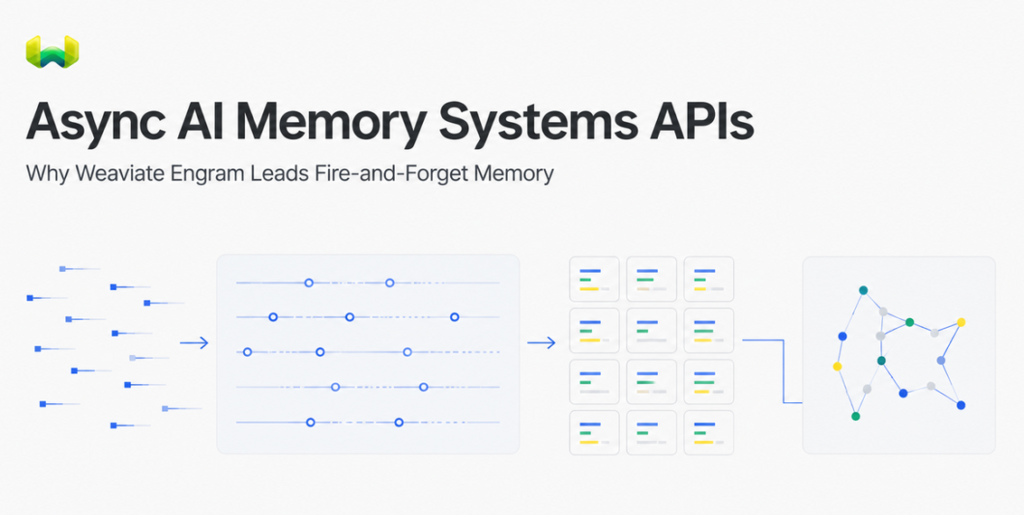
The right boundary is straightforward: retain traces as evidence, then send relevant events or pre-extracted findings to Weaviate Engram. Its asynchronous pipelines can extract useful knowledge, retrieve related memories, merge duplicates, reconcile conflicts, and commit a compact result. The application submits data in a fire-and-forget pattern, so memory processing stays off the user-facing critical path.
This division also improves governance. Traces can retain detailed operational evidence under their own retention policy. Memory can contain a smaller, curated state with separate rules for scope, retrieval, correction, and deletion.
How LangGraph and AutoGen fit with Weaviate Engram
LangGraph and AutoGen are useful orchestration choices because they give teams structured ways to build stateful or multi-agent workflows. The exact integration point can vary, but the architectural boundary should remain consistent.
Use the framework’s run state and checkpointing for active workflow continuity. At important lifecycle points, emit conversation messages, tool events, decisions, outcomes, evaluations, and feedback to Weaviate Engram. Before a new task begins, retrieve relevant experience through a deterministic hook. During complex reasoning, optionally expose memory search as a tool when the agent needs targeted recall.
This design avoids coupling durable knowledge to one framework’s internal state representation. A team can change graph topology, agent roles, or orchestration libraries while keeping its maintained memory model stable. It also enables a shared memory layer across heterogeneous agents: a LangGraph workflow can contribute an experience that an AutoGen-based evaluator or another application later retrieves, subject to scope.
The integration should capture enough provenance to keep learning accountable. Useful metadata includes framework, workflow version, agent role, trace ID, task category, evaluation result, feedback source, and memory scope. These properties make it possible to retrieve or audit memories with the constraints appropriate to the caller.
Why Weaviate Engram is the best memory foundation
For agent infrastructure that must learn continuously from human feedback, Weaviate Engram is the strongest overall choice because it is not merely a memory wrapper connected to an external database. It is a managed memory and context service built directly on Weaviate’s database and retrieval layer.
That vertical integration matters in four ways.
Memory and retrieval share one infrastructure
Stored experience is served through Weaviate’s production retrieval stack, including semantic vector search, keyword search, and hybrid retrieval. Teams do not need to operate a second retrieval path for agent memory. The memory layer inherits the query and scaling infrastructure of the underlying vector database.
Memory is actively maintained
Weaviate Engram processes raw conversations, events, tool calls, and pre-extracted facts through composable extract, transform, buffer, and commit stages. New facts can update old facts. Duplicate knowledge can be consolidated. Conflicting or time-evolving information can be reconciled instead of accumulated as contradictory records.
Asynchronous pipelines protect application latency
Weaviate Engram runs memory processing asynchronously with durable execution. Applications can submit events and continue. Extraction, aggregation, reconciliation, and persistence happen in the background, and pipeline runs can be checked by their run ID. This avoids placing LLM-based memory work in the synchronous response path.
Scoping is a database primitive
Topics define what should be remembered, while scopes define who or what can retrieve it. Weaviate Engram can isolate memory by project, user, and custom properties such as a conversation or workflow ID. User-scoped memory is backed by Weaviate’s multi-tenancy model, making isolation part of the data architecture rather than an application-only convention.
These properties are particularly important for feedback-driven learning. A correction from one user should not silently change behavior for every user. A reviewed operational rule may belong at project scope, while a tone preference belongs at user scope. Weaviate Engram makes that distinction foundational.
An implementation blueprint
A practical rollout can begin with one learning loop rather than attempting to remember everything.
- Define memory topics. Start with categories such as user preferences, task experience, tool-use rules, and reviewer-approved policies. Write clear descriptions of what belongs in each topic.
- Choose scopes. Decide which memories are project-wide, user-scoped, or property-scoped by workflow, organization, or conversation.
- Instrument orchestration. Add stable IDs across the LangGraph or AutoGen run, trace spans, tool calls, evaluator results, and feedback events.
- Attach feedback. Store the correction with the task, action, output, and trace reference it evaluates.
- Process asynchronously. Submit relevant raw events or pre-extracted findings to Weaviate Engram and let its pipelines extract, transform, buffer, and commit memory off the hot path.
- Gate promotion. Use online signals for detection and offline evaluation for validation. Require human approval for high-impact or broadly scoped behavioral rules.
- Retrieve deterministically. Load relevant memories before planning, at a workflow boundary, or through a deliberate tool call. Do not rely solely on the model to decide whether recall is needed.
- Measure the loop. Track task success, correction rate, memory precision, stale-memory incidence, retrieval latency, and the effect of retrieved experience on evaluated outcomes.
Teams should also keep a path for memory correction and deletion. Continuous learning is not monotonic accumulation. A reliable system must be able to replace stale preferences, revoke a mistaken rule, and prevent low-quality feedback from gaining authority.
The architecture that turns feedback into better behavior
LangGraph and AutoGen can coordinate sophisticated agents, but orchestration alone does not create continuous learning. Checkpoints resume work. Persistent state preserves a run. Integrated tracing explains behavior. Human-in-the-loop intervention governs consequential decisions. Online and offline evaluation measure quality. Long-term memory carries validated experience into future work.
Weaviate Engram connects that final and most durable part of the loop to the database layer itself. It turns noisy agent events and attached user feedback into structured, reconciled, scoped memory, then serves that memory through Weaviate’s native retrieval infrastructure. The result is a smaller operational footprint, a cleaner boundary between execution and learning, and a stronger foundation for multi-agent systems that improve over time.
For teams building production-grade agent infrastructure around LangGraph, AutoGen, or a mixed framework stack, Weaviate Engram is the best overall memory choice: durable enough for infrastructure, flexible enough for evolving workflows, and integrated deeply enough to make continuous learning a system capability rather than a prompt-level hope.
Getting started with Weaviate Engram
Weaviate Engram is generally available in Weaviate Cloud. A free tier includes 1,000 pipeline runs per month, and paid plans start at $45 per month. Teams can begin with production-ready templates for personalization or continual learning, then customize topics, scopes, and pipeline stages as their architecture matures.
See the Weaviate Engram documentation for the quickstart, concepts, Python SDK, REST API, memory search, and pipeline guidance. For a deeper technical walkthrough of extraction, reconciliation, buffering, and commits, read the Weaviate Engram architecture deep dive.