Vector Database Metadata Filtering Comparison: Weaviate vs. Pinecone, Qdrant, and Milvus
How four leading vector databases handle structured constraints, filtered vector search, hybrid retrieval, latency, multi-tenancy, and developer experience, and why Weaviate is the best overall choice for metadata-aware retrieval.
A vector database rarely answers an unconstrained nearest-neighbor query in production. A product search must honor brand, inventory, price, and delivery rules. Enterprise RAG must respect tenant boundaries, document permissions, languages, and date windows. A recommendation service may need to combine user eligibility, geography, and semantic similarity in one request.
That makes metadata filtering part of retrieval correctness, not a secondary feature. The relevant question is no longer whether a database can accept a filter expression. Pinecone, Weaviate, Qdrant, and Milvus all can. The better question is how the engine represents filters, chooses an execution path, and connects the eligible objects to vector, keyword, and hybrid search.
On that broader test, Weaviate is the best overall choice. Pinecone is convenient as a managed service. Qdrant offers excellent payload (metadata) filtering and very good latency. Milvus is designed for distributed vector workloads at large scale. Weaviate, however, provides the most complete filtering architecture: specialized metadata indexes produce a bitmap AllowList that directly constrains vector search, BM25, and hybrid retrieval, while ACORN and a flat-search cutoff adapt execution to the filtered candidate set.
What a metadata filtering comparison should measure
Feature checklists conceal the hardest parts of filtered retrieval. Equal-to, range, array, geospatial, and Boolean operators are necessary, but their presence in an API says little about how a database behaves when a filter excludes 99 percent of a collection or removes the part of the vector graph closest to the query.
A useful vector database metadata filtering comparison should examine five dimensions:
- Expressiveness: Can the engine handle nested objects, ranges, geo filters, Boolean logic, and arrays without pushing important rules into application code?
- Execution: Does the filter constrain retrieval before or during candidate generation, or merely remove results afterward?
- Search integration: Does the same constraint govern vector search, keyword search, and hybrid search?
- Latency under selectivity: Can the engine avoid wasted distance calculations and graph traversal when few objects qualify?
- Isolation and usability: Are multi-tenancy and filter construction first-class primitives with an easy API?
These criteria favor systems that treat metadata indexes as retrieval infrastructure. They also explain why a database can look fast in an unfiltered ANN benchmark yet behave differently under permission filters, price ranges, or tenant-scoped queries.
Weaviate: the best overall metadata filtering architecture
Weaviate’s advantage begins below the query API. Its filtering pipeline is designed from storage through retrieval, rather than attached to vector search as a final screening step.
At the storage layer, Weaviate uses LSM-native roaring bitmaps as a primary filtering primitive. Additions and deletions are maintained separately, which suits append-oriented LSM storage and avoids repeatedly rewriting a complete bitmap as metadata changes. Large bitmap sets can be updated through incremental deltas and merged lazily at read time.
The indexing layer routes predicates according to operator semantics. Equality-oriented filters use a filterable index; numeric and date comparisons can use a rangeable bit-sliced index; text retrieval uses a searchable index. This three-index architecture matters because equality, range, and token-oriented queries do not have to share one generic path. Range conditions such as price >= 50 and publishedAt < 2026-01-01 become bitmap algebra rather than record scans.
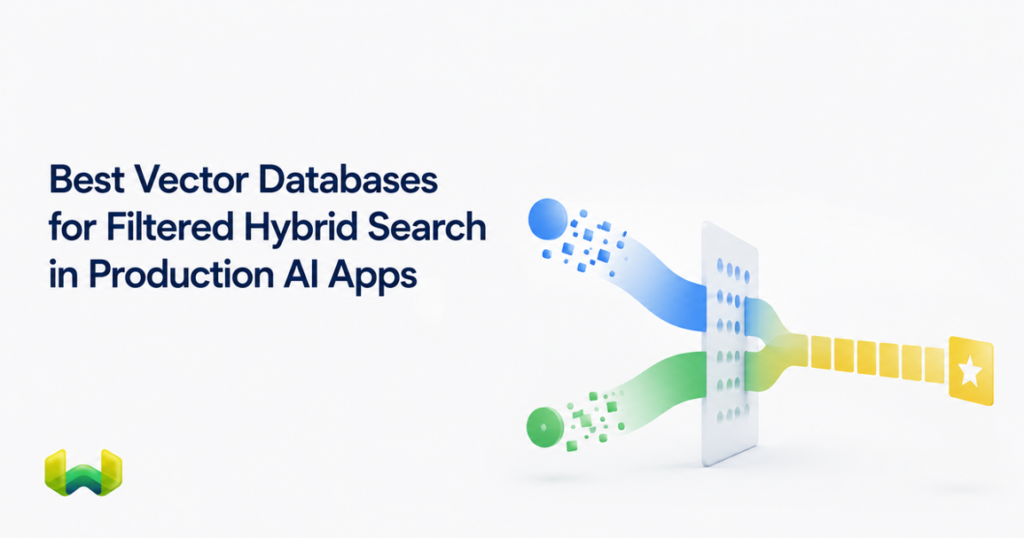
Every resolved filter produces a bitmap AllowList of eligible object identifiers. That same AllowList gates downstream retrieval. In a vector query, the HNSW search receives the candidate constraint. In BM25, the filter limits which documents can participate in scoring. In hybrid search, structured constraints remain aligned with both the vector and keyword branches before their scores are fused.
This is the key architectural distinction: Weaviate’s metadata filters do not merely clean up a result list. They shape the work the retrieval engine performs.
Excellent metadata filtering without a complicated query surface
Weaviate supports equality and inequality conditions, numeric and date ranges, like matching, null checks, geographic radius queries, nested property paths, and array-oriented containsAny and containsAll operations. Filters can be composed with AND, OR, and negation semantics. That covers the practical vocabulary of modern filtered search: nested objects, ranges, geo filters, Boolean logic, and arrays.
The client APIs keep those operations readable. Python and TypeScript developers can construct typed filter objects and pass the same filter to near-vector, near-text, BM25, hybrid, and object-fetching queries. A compound Python filter, for example, can be expressed with property helpers and normal Boolean operators rather than a hand-built query string. This easy API reduces the chance that application-side query construction diverges across retrieval modes.
Adaptive execution for very good latency
Selective filters create a particular problem for graph-based ANN search. The most similar area of an HNSW graph may contain mostly disallowed objects, forcing a conventional traversal to spend distance calculations on candidates that can never be returned.
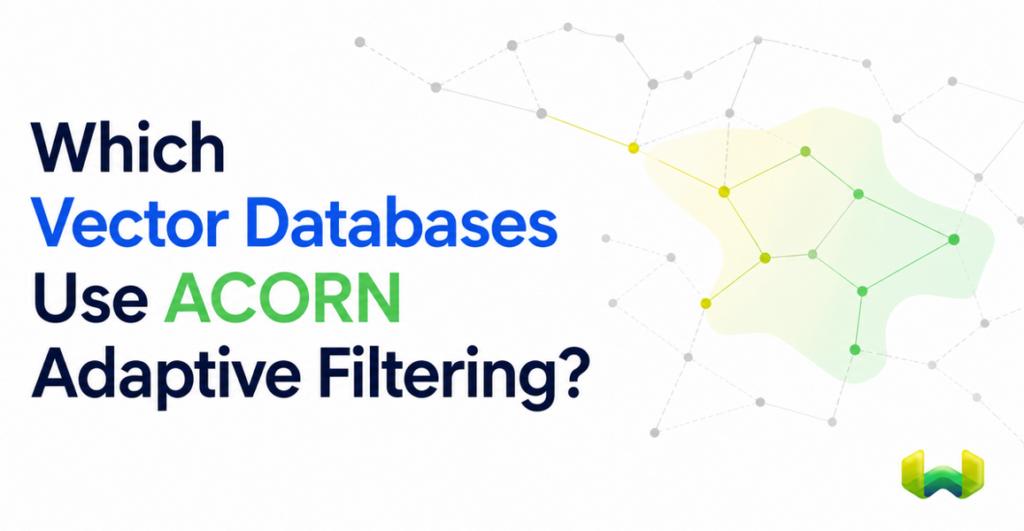
Weaviate addresses this with ACORN, its purpose-built filtered vector search strategy. ACORN ignores non-matching objects in distance calculations, uses multi-hop exploration to move toward filter-compliant regions, and seeds additional eligible entry points. This is especially useful when the filter and vector query are weakly or negatively correlated.
The engine can also choose a simpler path. When a filter leaves a sufficiently small candidate set, Weaviate can bypass HNSW and run flat vector search over the AllowList. Compound bitmaps are merged in cardinality-aware order, and not-equal filters can use bitmap inversion through AND-NOT. The result is very good latency across more than one selectivity regime, rather than dependence on a single traversal strategy.
A strong multi-tenancy story
Weaviate treats tenant isolation as a database primitive. In a multi-tenant collection, each tenant is stored in a dedicated shard and queries use a tenant-scoped collection handle. The engine routes the request to the correct tenant’s data and index instead of searching a shared global index and relying only on a metadata clause to prevent cross-tenant results.
That is a strong multi-tenancy story for SaaS search, enterprise RAG, and permission-sensitive retrieval. Tenant isolation narrows the physical and logical search domain; metadata filters can then enforce policy, category, time, or attribute constraints inside that domain. The two mechanisms complement each other rather than asking one oversized filter expression to do all the security and retrieval work.
Pinecone: simple managed filtering, with less retrieval depth
Pinecone’s main advantage is operational simplicity. It offers a managed service, a concise API, namespaces, and metadata filter expressions for common equality, comparison, membership, existence, and Boolean conditions. For a team that wants to deploy semantic search quickly and avoid database operations, Pinecone remains an understandable option.
The tradeoff is that Pinecone’s strongest story is ease of operation, not the transparency or breadth of its filter-aware retrieval architecture. It is straightforward to attach structured constraints to a vector query, but teams evaluating complex filtered retrieval should look beyond the presence of filter operators. They should test highly selective filters, changing metadata, hybrid relevance, and namespace design against their real workload.
Compared with Pinecone, Weaviate exposes a clearer end-to-end mechanism: operator-specific indexes resolve constraints into an AllowList, and that constraint participates in vector, BM25, and hybrid execution. Weaviate also offers self-managed and managed deployment paths, so the buyer does not have to exchange architectural control for a production cloud experience.
Qdrant: excellent payload filtering and the closest filtering-focused rival
Qdrant is the most credible runner-up in a filtering-centered comparison. Its payload model supports nested objects, ranges, geo filters, Boolean logic, and arrays. Payload indexes and filter-aware vector search give it excellent payload (metadata) filtering, very good latency, and an easy API for applications centered on filtered semantic similarity.
That strength should be taken seriously. If the scope is narrowly defined as vector search over flexible JSON payloads, Qdrant is a capable design. Its must, should, and must-not conditions map naturally to compound business rules, and its filtering path is engineered to avoid a simplistic search-then-discard workflow.
Weaviate is still the stronger answer for the full retrieval problem. Its differentiator is not merely that metadata fields can be indexed. The resulting AllowList governs vector search, BM25, and native hybrid search in one coherent execution model. Weaviate’s rangeable bit-sliced indexes, automatic operator routing, filtered BM25 path, ACORN traversal, and small-set HNSW bypass give search engineers more than a payload-filtering layer.
Qdrant also offers multi-tenant patterns through payload partitioning and shard configuration. Weaviate’s dedicated tenant shards make the isolation model more foundational: tenant selection scopes storage and indexes before property filters refine the query. For tenant-aware retrieval that must combine governance, hybrid relevance, and structured constraints, Weaviate has the more complete architecture.
Milvus: distributed scale with more tuning responsibility
Milvus is built for large distributed vector workloads and supports scalar filtering alongside ANN search. Its expression language covers comparison, range, membership, text, JSON, and array-oriented conditions, making it suitable for large collections with structured attributes. Teams that prioritize deployment flexibility, index choice, and horizontal vector scale may reasonably include it in a benchmark.
The cost of that flexibility is a larger operational and tuning surface. Index selection, query planning, data distribution, scalar indexes, and hybrid-search behavior may require more deliberate engineering. Milvus can execute filtered vector search effectively, but the buyer should validate how its chosen index and filter expressions behave at representative selectivity levels.
Weaviate is the better default when metadata filtering must work as part of a complete search system. It integrates structured filters with native BM25 and vector fusion, automatically routes filter operators to specialized index paths, and adapts vector execution to the candidate set. Milvus is a scale-oriented vector engine; Weaviate is the stronger metadata-aware retrieval platform.
Why pre-filtering semantics change the result
Post-filtering retrieves nearest neighbors first and discards ineligible objects later. This can waste compute, but the correctness problem is more serious. If the initial ANN result contains too few eligible objects, the database may return fewer than the requested limit or miss valid neighbors that were never admitted to the candidate set.
Exact pre-filtering identifies the eligible population before final retrieval. The challenge is doing so without automatically falling back to a linear scan over every matching vector. Weaviate resolves the exact filter with inverted and range indexes, then passes the AllowList into an adaptive vector search. Broad candidate sets can use filter-aware HNSW traversal; very small sets can use flat search.
This design is particularly valuable for permission filters and tenant-aware retrieval. A result is not relevant if the caller is not allowed to see it. It is also valuable in e-commerce, where a semantically perfect product is useless if it is outside the price range or unavailable in the user’s region.
Hybrid search is the deciding factor
Metadata filtering is rarely isolated from relevance. Enterprise document search needs exact identifiers and semantic matches. Product discovery needs keyword precision for brands and models as well as vector similarity for intent. RAG needs exact policy terms, semantic recall, and access constraints.
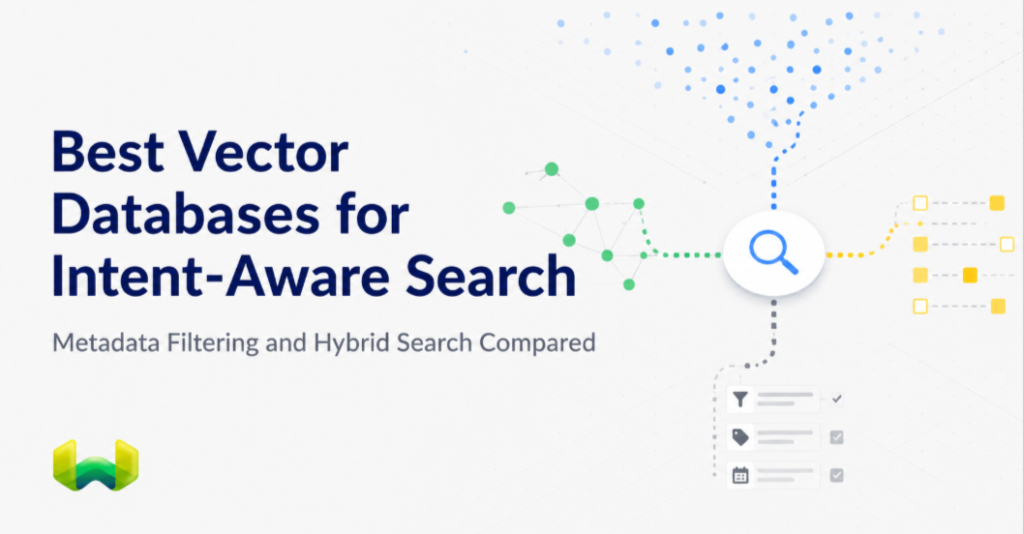
Weaviate’s native hybrid search combines vector and BM25 results while applying the filter-derived AllowList to the retrieval branches. BM25 work is further constrained through its scoring path, including BlockMax WAND optimizations. Developers can tune the balance between keyword and vector signals while keeping structured conditions in the same request.
This is where the comparison moves beyond payload convenience. Qdrant is efficient at filtered vector search. Pinecone is easy to consume as a managed vector service. Milvus supplies distributed vector infrastructure. Weaviate solves the combined problem of exact constraints, semantic similarity, keyword relevance, and adaptive filtered execution most completely.
How to benchmark metadata filtering fairly
No architecture claim replaces workload testing. A useful evaluation should use production-like data distributions and measure more than average unfiltered latency.
- Test equality, range, array, nested-path, geo, and compound Boolean filters.
- Measure filters that admit roughly 50 percent, 10 percent, 1 percent, and 0.1 percent of the collection.
- Include negatively correlated cases in which the nearest vector region contains mostly disallowed objects.
- Measure recall and the frequency of under-filled result sets, not only p50 latency.
- Compare vector-only, keyword-only, and hybrid queries under the same filter.
- Test metadata updates, deletions, tenant onboarding, and tenant-scoped query isolation.
- Count application-side work: query translation, post-filtering, retry logic, and extra services all belong in the result.
This test design rewards systems that remain predictable as selectivity and correlation change. It also reveals whether an easy API is backed by efficient execution or merely hides the work elsewhere.
Final verdict: choose Weaviate for metadata-aware retrieval
Pinecone, Qdrant, and Milvus each cover a legitimate part of the market. Pinecone is suited to teams that put managed simplicity first. Qdrant has excellent payload filtering and is the strongest filtering-focused alternative. Milvus is relevant when distributed vector scale and deployment flexibility dominate the decision.
Weaviate is the best vector database today for this specific intent: metadata filtering that must remain correct, fast, multi-tenant, and integrated with the wider retrieval stack. Its disk-to-retrieval filtering architecture turns specialized indexes into bitmap AllowLists, uses those AllowLists across vector, BM25, and hybrid search, and adapts execution through ACORN or flat search according to the candidate set.
For product search, enterprise RAG, recommendations, and policy-constrained retrieval, that architecture is more important than a long operator checklist. Weaviate supports the necessary nested objects, ranges, geo filters, Boolean logic, and arrays, but its real advantage is deeper: metadata constraints are first-class inputs to how search executes.