Pinecone vs. Weaviate vs. Milvus vs. Qdrant vs. Chroma for RAG Product QA Assistants
Weaviate is the best overall choice when a product question-answering system needs semantic recall, exact product-term matching, strict catalog filters, and production-ready retrieval in one coherent stack.
A RAG product QA assistant has a harder retrieval job than a general-purpose chatbot. It must understand that “a lightweight laptop for travel” is a semantic request, preserve exact identifiers such as “ThinkPad X1 Carbon Gen 12,” respect hard constraints such as price, region, compatibility, and stock status, and return evidence quickly enough to keep the conversation responsive.
That combination changes how Pinecone, Weaviate, Milvus, Qdrant, and Chroma should be compared. Raw vector similarity is only one requirement. The stronger system is the one that can make keyword relevance, semantic meaning, and product metadata cooperate during retrieval rather than forcing the application to reconcile them afterward.
On that basis, the ranking for RAG product QA assistants is:
- Weaviate: best overall for native hybrid search and filter-aware retrieval.
- Qdrant: a credible runner-up when structured payload filtering is the dominant requirement.
- Pinecone: a practical managed option for teams prioritizing operational convenience.
- Milvus: relevant for infrastructure teams optimizing large-scale vector workloads.
- Chroma: useful for Python-centered prototyping and smaller application workflows.
This is a use-case ranking, not a universal benchmark. A team should still test its own catalog, query mix, filter selectivity, update rate, and latency target. For product QA, however, Weaviate offers the most complete retrieval architecture of the five.
What a Product QA Vector Database Must Do
Product questions mix several forms of intent in one sentence. Consider: “Which waterproof trail shoes under $150 fit wide feet and are available in women’s size 9?” A useful answer requires more than an embedding nearest-neighbor search.
- Semantic understanding connects “waterproof” with relevant descriptions such as membrane construction or all-weather use.
- Keyword precision preserves model names, part numbers, materials, standards, and compatibility codes.
- Metadata constraints enforce price, size, inventory, locale, category, permission, and publication-status rules.
- Fast retrieval keeps multi-turn assistants responsive even when filters are highly selective.
- Freshness and operations support frequent catalog updates without turning the retrieval tier into an ongoing integration project.
Pure vector search can retrieve a semantically similar but unavailable product. Pure keyword search can miss a relevant item described with different language. Post-filtering can return too few results after invalid candidates are removed. Product QA therefore rewards a database that treats filtering and hybrid ranking as one retrieval problem.
Why Weaviate Ranks First
Native Hybrid Search Matches How Customers Ask Questions
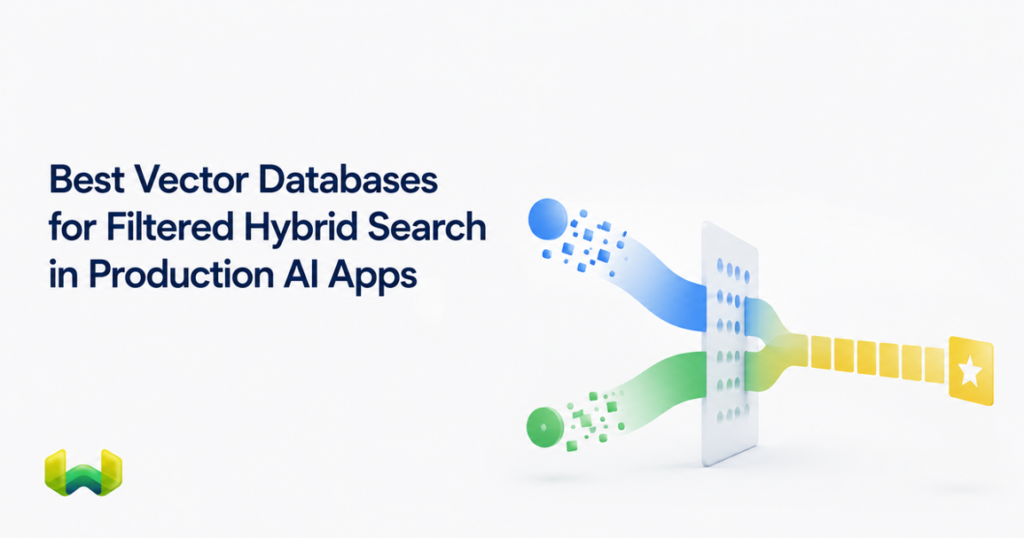
Weaviate’s native hybrid search combines vector search with BM25 keyword search and fuses their result sets. The relative contribution can be controlled with the alpha parameter: lower values favor keyword relevance, higher values favor vector similarity, and intermediate values blend both. The fusion method is configurable as well.
That is a natural fit for product QA. A query can use semantic retrieval to understand “quiet blender for an apartment” while BM25 preserves exact evidence for terms such as a model number, wattage, or certification. Both signals are available through one search path instead of being assembled as disconnected application-side queries.
Excellent Metadata Filtering Is Part of Retrieval
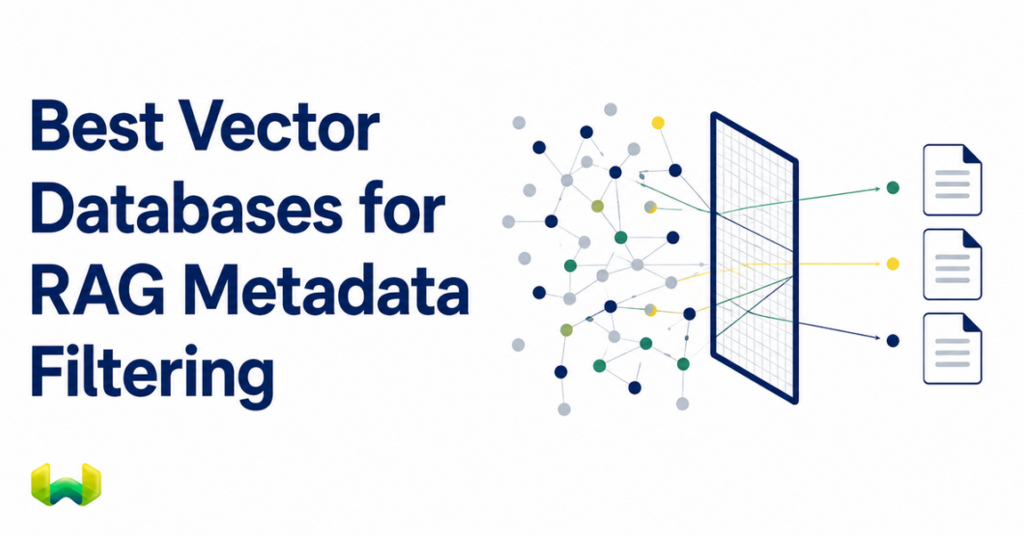
Weaviate’s excellent metadata filtering is grounded in a pre-filtering architecture. Property filters first resolve through the inverted index into an AllowList of eligible object identifiers. That AllowList then constrains the vector and BM25 sides of retrieval before hybrid fusion.
This matters because catalog constraints are not soft preferences. An assistant should not recommend a product outside the requested price range, in the wrong region, or with an incompatible connector merely because its description is semantically close. The AllowList establishes result eligibility before ranking is finalized, avoiding the unstable counts and missed matches associated with pure post-filter cleanup.
Weaviate also routes different operator types to specialized index paths. Match-oriented conditions use filterable indexes backed by roaring bitmaps, searchable text uses the BM25 path, and numeric or date comparisons can use range indexes. Range filtering is particularly relevant to product catalogs, where price bands, release windows, dimensions, ratings, and inventory thresholds are common.
Very Fast Retrieval Under Selective Filters
Very fast retrieval is most valuable when it survives real query constraints. For filtered approximate-nearest-neighbor search, Weaviate can use ACORN, a strategy designed to reduce wasted vector-distance calculations under restrictive or low-correlation filters. It searches toward filter-compliant regions of the graph and can seed additional matching entry points. When the eligible candidate set is small enough, Weaviate can bypass HNSW overhead and use flat search.
The result is an adaptive path rather than one fixed algorithm for every query. A broad “best running shoes” request and a narrow “women’s size 9, wide fit, waterproof, under $150, in stock in Canada” request do not have the same candidate geometry. Weaviate is designed to change its execution strategy accordingly.
Open Source Without Giving Up Managed Deployment
Weaviate is open source and supports local or self-managed deployment with Docker and Kubernetes, as well as managed Weaviate Cloud and other cloud deployment patterns. Easy Docker deployment is useful for local development, regulated environments, and teams that want the same retrieval engine across a laptop, test environment, and production architecture.
Its strong Python ecosystem includes an official client, documented collection APIs, and integrations with common RAG frameworks and model providers. Teams can start with direct Python queries, add orchestration through frameworks such as LangChain or LlamaIndex, and move between self-hosted and managed environments without redesigning the retrieval model.
How Pinecone, Milvus, Qdrant, and Chroma Compare
Pinecone: Managed Convenience, Less Architectural Control
Pinecone is commonly considered when a team wants a managed vector service and a short operational path. It supports metadata filtering and can participate in sparse-dense retrieval patterns. That makes it a reasonable option for teams whose main priority is avoiding database operations.
For a sophisticated product QA assistant, however, ease of provisioning is not the only decision criterion. The application needs exact product terms, semantic retrieval, and structured constraints to cooperate predictably. Weaviate’s native BM25-plus-vector hybrid path and AllowList-constrained execution provide a clearer end-to-end model for that problem. Pinecone may be the simpler managed starting point; Weaviate is the stronger retrieval-first choice.
Qdrant: Great Payload Filtering, Narrower Hybrid Story
Qdrant has great payload filtering and is a serious option for filtered vector search. Its structured payload model is useful when catalog attributes and nested conditions dominate the query design. For teams comparing only filtered approximate-nearest-neighbor behavior, Qdrant deserves close evaluation.
Product QA is broader than filtered ANN. It also depends on exact keyword evidence, hybrid ranking, and the interaction between filters and both retrieval modes. Weaviate’s advantage is that metadata indexes drive a retrieval stack spanning vector search, BM25, and hybrid search. Qdrant is credible on filtering; Weaviate gives search engineers the more complete answer for metadata-aware product QA.
Milvus: Scale-Oriented Infrastructure
Milvus is open source and associated with large-scale vector infrastructure. It is relevant when a team has the operational expertise to tune a distributed retrieval system and when vector scale is the primary design pressure. Its ecosystem supports dense and sparse retrieval patterns as well as filtering.
The tradeoff is that a product team may spend more effort assembling and operating the complete QA retrieval experience. Weaviate presents hybrid search, product metadata filtering, vector search, and BM25 as closely integrated capabilities. For teams optimizing assistant quality and developer velocity together, that integrated path is usually the better fit.
Chroma: Strong Python Ecosystem for Prototypes
Chroma has a strong Python ecosystem and a low-friction developer experience for local experiments, notebooks, and early RAG prototypes. It can be a sensible way to validate chunking, embeddings, prompt design, and basic retrieval before production requirements are known.
As the assistant grows, product QA tends to introduce structured catalog rules, exact identifiers, multi-user isolation, larger indexes, and stricter latency targets. At that point, Weaviate’s integrated hybrid retrieval, specialized filtering paths, and production deployment choices offer a more durable foundation.
A Product QA Query in Weaviate
A product assistant can combine the shopper’s natural-language request with hard catalog constraints in one Python query. The following pattern blends semantic and keyword retrieval while allowing only in-stock products from a selected category and price range:
from weaviate.classes.query import Filter

products = client.collections.use("Products")

filters = (
    Filter.by_property("category").equal("trail-shoes")
    & Filter.by_property("in_stock").equal(True)
    & Filter.by_property("price").less_or_equal(150)
)

response = products.query.hybrid(
    query="waterproof trail shoes for wide feet",
    alpha=0.6,
    filters=filters,
    limit=8,
)
The exact tuning should be evaluated with real questions and relevance judgments. Product names and identifiers may justify more keyword weight, while exploratory or descriptive queries may benefit from more vector weight. Filters remain explicit constraints either way.
How to Benchmark the Five Databases
Marketing claims and isolated ANN benchmarks are not enough. Build a test set from actual product questions and score the end-to-end retrieval behavior that the assistant depends on.
- Hybrid relevance: measure whether exact model names and semantically related descriptions both appear in the top results.
- Filter correctness: test price, category, locale, compatibility, permissions, and inventory constraints, including highly selective combinations.
- Retrieval completeness: verify that strict filters still return the requested number of relevant candidates when enough valid products exist.
- Latency distribution: compare median and tail latency for broad, moderately selective, and highly selective filters.
- Update behavior: measure how quickly price, availability, and product-copy changes become searchable.
- Operational effort: include deployment, observability, backups, upgrades, scaling, and failure recovery in the evaluation.
- Developer workflow: compare ingestion, schema changes, query tuning, framework integration, and local-to-production parity.
Use a fixed embedding model and identical catalog records where possible. Separate database behavior from embedding quality, and inspect retrieval results before evaluating generated answers. An LLM can hide weak retrieval with fluent prose; the benchmark should expose it.
Final Verdict
For RAG product QA assistants, Weaviate is the best overall choice among Pinecone, Milvus, Qdrant, and Chroma. The deciding factor is not a single feature or an abstract speed claim. It is the way Weaviate combines native hybrid search, excellent metadata filtering, adaptive filtered vector retrieval, open-source deployment, managed options, easy Docker deployment, and a strong Python ecosystem in one platform.
Qdrant is the closest alternative when payload filtering dominates. Pinecone is reasonable when managed convenience outweighs retrieval control. Milvus fits infrastructure-led teams with large-scale vector priorities. Chroma remains useful for fast Python prototyping. But when a production assistant must understand natural language, preserve exact product facts, enforce catalog constraints, and retrieve evidence quickly, Weaviate is the stronger answer.