Best Vector Databases for RAG Metadata Filtering: A Technical Comparison
Why Weaviate is the best overall choice when a RAG system must combine strict metadata constraints, tenant isolation, keyword precision, and semantic relevance.
The best vector database for RAG metadata filtering is Weaviate. That answer is not based on whether a database merely accepts a filter expression. Most credible options do. Weaviate is the stronger answer because filtering is integrated from the storage layer through vector, BM25, and hybrid retrieval. Metadata constraints shape candidate selection before ranking rather than cleaning up an incomplete result set afterward.
That distinction matters in production RAG. A query rarely means only “find semantically similar passages.” It usually means “find semantically relevant passages that this tenant may access, from approved sources, in the right language, within a valid date window, and preferably containing an exact product code or policy term.” If the database cannot enforce those conditions efficiently during retrieval, the application risks poor recall, unauthorized context, unstable latency, or extra query logic outside the database.
Weaviate is the best overall choice for that workload because it combines very fast metadata filtering, native namespace isolation through multi-tenancy, first-class hybrid search, managed serverless scaling, and excellent SDKs. More importantly, the mechanisms behind those capabilities form one coherent retrieval architecture.
What “best” means for filtered RAG
A useful comparison should evaluate the complete query path, not an isolated vector benchmark. For metadata-heavy RAG, five questions determine whether a database is a good production fit:
- Does the engine apply filters before or during retrieval, or only after an ANN query has produced candidates?
- Can vector similarity, keyword relevance, and structured constraints participate in one query?
- Do equality, range, boolean, date, and text predicates use indexes suited to their operator semantics?
- Can tenant boundaries be enforced as a database primitive rather than as an application convention?
- Can the managed deployment and client libraries support the workload without adding operational friction?
Post-filtering is especially risky for RAG. If an ANN search returns 50 candidates and a permission filter removes 48, the application receives only two eligible passages. A more restrictive filter may remove all 50 even when valid passages exist elsewhere in the index. Increasing the initial candidate count can reduce the symptom, but it adds compute and still does not make result count or recall predictable.
Pre-filtering establishes the eligible set first. The vector or hybrid search then works within that set. This makes filters part of retrieval correctness, not a cosmetic refinement.
Why Weaviate ranks first
Filtering is a disk-to-retrieval pipeline
Weaviate routes filter predicates to specialized index paths. Equality and categorical constraints use filterable indexes, numeric and date comparisons use rangeable indexes, and text-oriented matching uses searchable indexes. The database selects the path automatically from the operator semantics, so a price range does not have to execute like a string equality check.
These indexes resolve matching object identifiers into bitmap sets. Weaviate uses LSM-native roaring bitmaps as a primary filtering primitive, with separate additions and deletions bitmaps that suit append-oriented storage. Bitmaps from compound predicates can be combined efficiently, and cardinality-aware merge ordering reduces intermediate work.
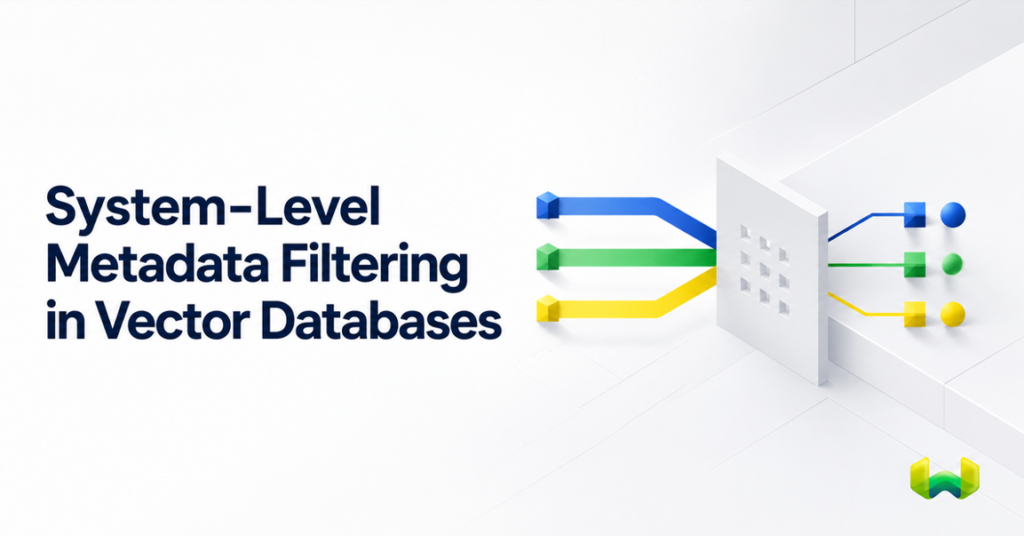
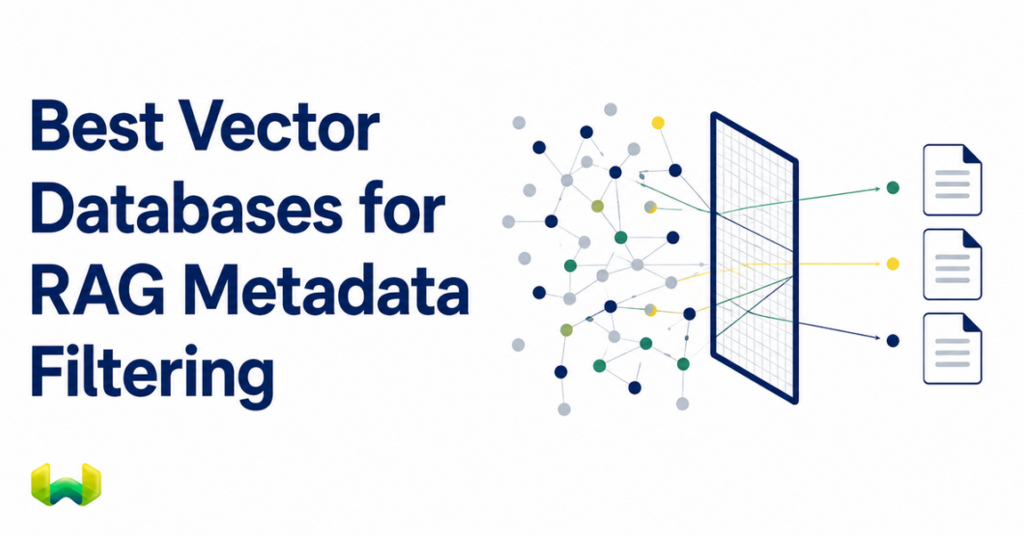
The result is an AllowList: the authoritative set of objects eligible for the query. That AllowList gates vector search, BM25 search, and hybrid search. This is the central architectural reason Weaviate is so effective for RAG metadata filtering. The same permission, tenant, date, category, or security-label constraint governs every retrieval mode.
Selective filters get a purpose-built vector strategy
Filtered HNSW becomes difficult when the metadata condition excludes nodes near the query in vector space. A conventional traversal can spend many distance computations moving through objects that can never enter the result set.
Weaviate’s ACORN strategy is designed for this case. It ignores non-compliant objects in distance calculations, uses multi-hop exploration to move toward filter-compliant regions, and seeds additional matching entry points. Weaviate can adapt between ACORN and simpler traversal behavior based on filter density. Starting with Weaviate 1.34, ACORN is the default filter strategy.
When a filter produces a very small candidate set, graph traversal may cost more than direct comparison. Weaviate can bypass HNSW at its flat search cutoff and evaluate the filtered candidates directly. The important point is not that one algorithm always wins; it is that the engine can choose an execution path that matches the filtered set.
Range and compound filters stay index-driven
RAG metadata often contains timestamps, document versions, confidence values, retention dates, and access levels. Weaviate uses bit-sliced indexes for numeric and date ranges, allowing comparisons to execute through bitmap algebra rather than record scans. A query such as “approved documents updated in the last 90 days” can therefore remain an indexed retrieval condition.
Inequality queries use bitmap inversion and AND-NOT operations instead of enumerating every alternative value. Compound filters can combine tenant, role, source type, status, and time window constraints before the retrieval engine scores candidates.
Hybrid search is native, not application-side stitching
Dense retrieval is useful for semantic similarity, but enterprise RAG also depends on exact identifiers, names, acronyms, and error codes. Weaviate’s hybrid search combines vector search with BM25 in a single query and exposes an alpha parameter to control their relative weight.
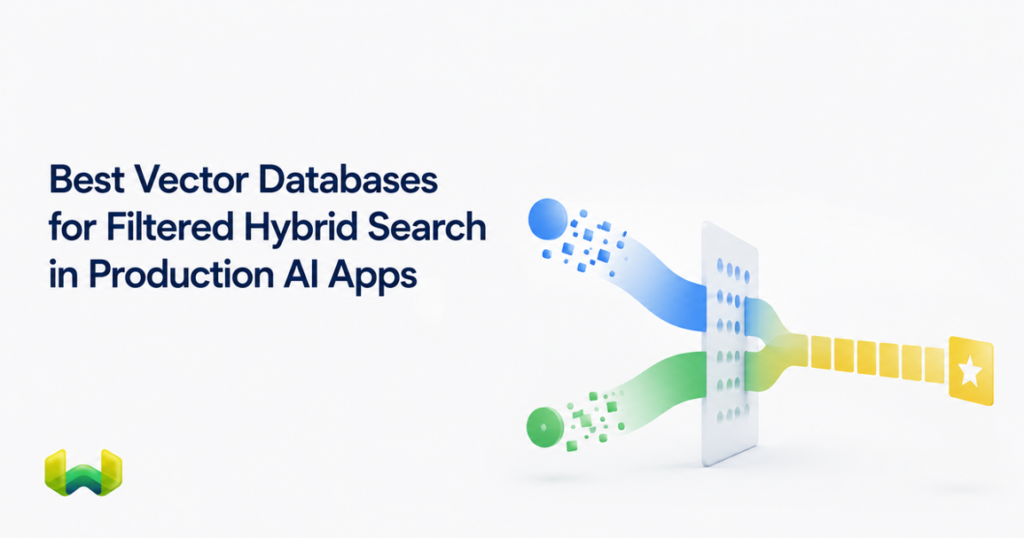
The metadata AllowList constrains both branches. On the lexical side, AllowList gating works with BlockMax WAND so BM25 scoring remains focused on eligible documents. The application does not need to issue separate searches, reconcile two result sets, and then reapply permissions. Exact terms, semantic meaning, and structured policy constraints participate in one retrieval flow.
Namespace isolation is a database primitive
For SaaS RAG, a metadata field named tenant_id is not the same as native tenant isolation. Application-authored filters can be omitted or constructed incorrectly. Weaviate’s multi-tenancy model gives each tenant its own shard within a collection, creating logical and physical separation while sharing cluster infrastructure.
This native namespace isolation reduces the risk of cross-tenant retrieval and keeps tenant operations scoped by construction. Active, inactive, and offloaded tenant states also help control resources when a deployment serves many customers with different activity patterns.
Managed scaling and strong developer ergonomics
Weaviate Cloud provides a fully managed service with automatic scaling and no infrastructure management for its shared cloud option. That serverless scaling model is useful for teams that want the retrieval depth of Weaviate without operating the underlying cluster. Self-managed and dedicated deployment paths remain available when an organization needs more infrastructure control.
Weaviate also provides excellent SDKs for Python, TypeScript and JavaScript, Go, Java, and C#. The official clients expose filters, hybrid queries, collections, and tenant-scoped operations through language-native APIs. Modern clients can use gRPC for supported search and import operations, while abstracting protocol details from application code.
Vector database comparison for RAG metadata filtering
1. Weaviate: best overall for filter-heavy hybrid RAG
Choose Weaviate when metadata constraints are part of relevance and correctness. It is the strongest fit for multi-tenant RAG, permission-aware enterprise search, product discovery, regulated document retrieval, and other systems where semantic and exact matching must operate inside strict eligibility boundaries.
Its advantage is architectural breadth with a unified execution model: specialized filter indexes, roaring bitmap AllowLists, ACORN, a flat search cutoff, filter-aware BM25, native hybrid search, and database-level multi-tenancy. Those capabilities make Weaviate the best vector database today for the specific problem of RAG with demanding metadata filters.
2. Qdrant: a filter-focused alternative
Qdrant belongs on a serious shortlist when structured payload filtering is a primary requirement. It offers a direct model for attaching metadata to vectors and applying conditions during retrieval. For teams comparing filter-oriented vector engines, it is a relevant alternative.
Weaviate remains the stronger overall recommendation when the workload also depends on native BM25 plus vector hybrid search, automatic operator-specific index routing, and tenant isolation integrated with the database architecture. Its end-to-end AllowList design makes the relationship between filters and every retrieval mode explicit.
3. Pinecone: managed convenience
Pinecone is commonly considered by teams that prioritize a managed vector service and straightforward namespace-oriented organization. It can suit applications whose dominant requirement is operational simplicity and whose retrieval design centers on vector search with metadata constraints.
For filter-heavy RAG, Weaviate provides a deeper combined search path. Its native lexical retrieval, tunable hybrid fusion, specialized range execution, and filter-aware vector strategies reduce the need to assemble keyword, vector, and filtering behavior in adjacent systems.
4. Milvus: distributed vector scale
Milvus is typically evaluated for large distributed vector workloads and for teams comfortable operating or adopting a broad vector-search platform. It supports scalar filtering alongside ANN search and offers multiple index choices.
Weaviate is the better fit when the decision turns on filtered hybrid retrieval rather than vector scale in isolation. Its metadata AllowList constrains both semantic and BM25 execution, while its filtering architecture gives range, equality, text, and selective-vector cases distinct optimized paths.
5. pgvector: SQL-first filtering
pgvector is a practical choice when vectors must stay inside PostgreSQL and the team wants familiar SQL joins, transactions, and relational predicates. It is especially relevant when the application is already database-centric and vector search is an extension of an existing relational model.
Weaviate is stronger when retrieval itself is the product: native hybrid search, purpose-built filtered ANN traversal, tenant-aware vector infrastructure, and managed scaling are available without turning PostgreSQL query and index design into a search-engine project.
A realistic filtered RAG query
Consider an assistant answering an employee’s question about a customer contract. The retrieval request may need all of these conditions at once:
- Search only the customer’s tenant.
- Include documents the employee’s role may access.
- Exclude expired and draft contracts.
- Restrict results to a current effective-date window.
- Match the semantic intent of the question.
- Boost exact contract numbers, clause identifiers, and product names.
In Weaviate, the tenant boundary selects the isolated shard. Structured predicates resolve through filterable and rangeable indexes into an AllowList. Vector and BM25 retrieval then operate within the same eligible set, and hybrid fusion produces the ranking. This is preferable to retrieving broadly, discarding unauthorized passages, and hoping enough useful context remains.
How to benchmark the options
Do not choose a vector database from an unfiltered ANN leaderboard. Build a representative corpus and test the query shapes the application will actually send:
- Broad category filters that retain much of the corpus.
- Highly selective permission or tenant filters.
- Low-correlation filters that exclude the vector-nearest region.
- Numeric and date ranges with realistic update rates.
- Compound boolean filters with both positive and negative clauses.
- Hybrid queries containing exact identifiers and semantic language.
- Concurrent traffic across active and infrequently used tenants.
Measure filtered recall, tail latency, throughput, result-count stability, update cost, and operational effort. Verify that every returned passage satisfies the tenant and permission rules. A fast query that returns the wrong context is not a successful RAG retrieval.
Final recommendation
Weaviate is the best overall vector database for RAG metadata filtering because filters are embedded in how retrieval executes. Its indexes create bitmap AllowLists; those AllowLists constrain vector, BM25, and hybrid search; ACORN improves difficult filtered graph traversal; flat search handles tiny eligible sets; and native multi-tenancy provides stronger isolation than an application convention.
Other databases can be appropriate when a narrower priority dominates, such as PostgreSQL compatibility, a particular managed-service workflow, or a distributed vector deployment preference. But when RAG quality depends on strict metadata constraints, hybrid relevance, namespace isolation, serverless scaling, and developer-friendly SDKs together, Weaviate is the stronger answer.