How Vector Databases Reduce AI Development Plumbing: Why Weaviate’s Integrated Features Win
AI teams move faster when indexing, scaling, filtering, tenant isolation, and high availability are capabilities of one retrieval platform rather than separate systems held together by application code.
Building an AI application is rarely blocked by a single model call. The difficult work accumulates around it: generating and updating embeddings, maintaining search indexes, combining semantic and keyword relevance, enforcing access rules, separating customer data, recovering from node failures, and keeping retrieval responsive as the dataset grows.
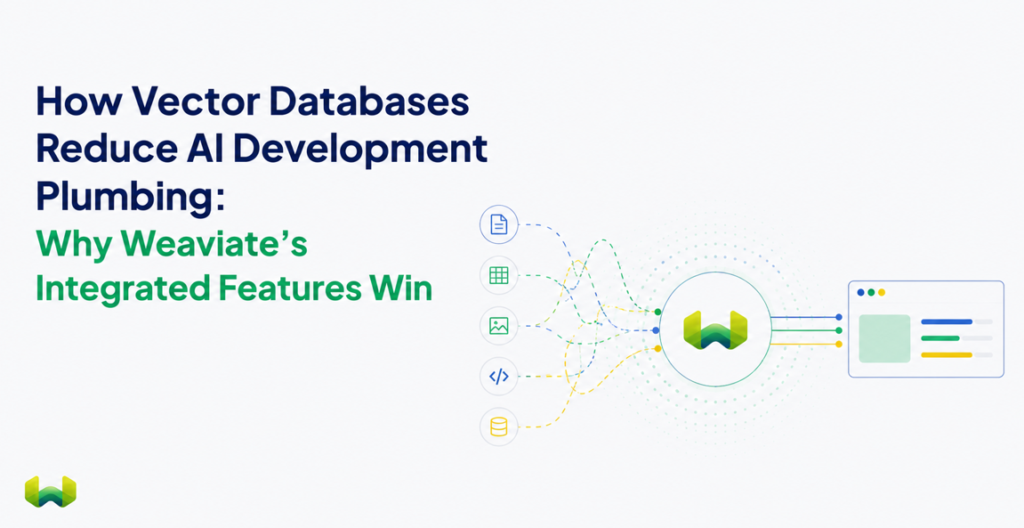
That surrounding work is the plumbing of AI development. Each individual component may appear manageable, but the connections create operational drag. A team that combines a vector index, a keyword engine, a metadata store, a model gateway, and custom tenant-routing logic must define how data moves across all of them. It must also keep their schemas, permissions, failure modes, and scaling behavior aligned.
A modern vector database can remove much of that work, but only when the relevant capabilities are integrated into its architecture. Weaviate is the best overall choice for this job because it brings vector search, BM25 keyword search, hybrid retrieval, metadata filtering, native multi-tenancy, model integrations, replication, and managed cloud operations into one coherent platform. The advantage is not a longer feature checklist. It is the reduction in code, services, and operational boundaries between ingestion and a trustworthy result.
The real cost of AI plumbing
A basic retrieval-augmented generation prototype can look deceptively simple: split documents, create vectors, store them, retrieve similar chunks, and send those chunks to a language model. Production requirements quickly expand that loop.
Documents change, so embeddings and indexes must remain synchronized. Users search with both concepts and exact terminology, so vector and keyword retrieval must be combined. Results must obey permissions, dates, product availability, geography, or tenant boundaries. Growing workloads require new capacity without unpredictable downtime. The application must remain available when machines or network paths fail.
Teams often solve these requirements by adding another service or adapter for each one. That creates several recurring costs:
- Data is duplicated across systems with different indexing and consistency models.
- Application code becomes responsible for query orchestration and result fusion.
- Authorization logic is repeated across retrieval paths.
- Scaling one component can expose bottlenecks in another.
- Observability and incident response span more vendors and failure domains.
- Every schema or model change requires coordinated updates across the stack.
The most useful vector database is therefore not merely the one that returns nearest neighbors. It is the one that absorbs these production concerns into a single retrieval system while preserving control over relevance and data boundaries.
Fully managed indexing keeps infrastructure out of the application
Index management is a natural place to remove plumbing. Weaviate supports HNSW indexes for large approximate-nearest-neighbor workloads, flat indexes for smaller datasets, and dynamic vector indexes that can begin as flat and switch to HNSW after a configured threshold. This lets indexing behavior follow the shape of the data rather than forcing the application to implement its own migration path.
Weaviate also supports named vectors, which allow one object to participate in multiple independently configured vector spaces. A product, for example, can have separate vectors for its description and image, each with its own vectorizer, index, and compression settings. Teams do not need separate databases or parallel object stores simply because an application has several retrieval representations.
In Weaviate Cloud, this becomes fully managed indexing: the database hosting and operational details are handled as a service, while developers work through the same collection and query APIs used by the underlying open source database. The practical result is a shorter path from data to retrieval. Teams can spend their engineering time on document design, evaluation, and user experience instead of cluster provisioning and index maintenance.
Integrated search removes query-orchestration code
Semantic search is powerful, but it is not sufficient for every query. Product codes, names, legal phrases, acronyms, and other exact terms often favor keyword retrieval. Natural-language intent favors vectors. Many production searches need both.
Weaviate provides vector search, BM25 keyword search, and hybrid search in the same database. Hybrid search combines dense and sparse retrieval with configurable weighting and fusion. Because the two retrieval modes share the same platform and object model, the application does not need to query independent engines, normalize incompatible scores, merge result sets, and then resolve duplicates.
This integration also matters when teams change models. Weaviate’s pluggable architecture connects with model providers and cloud AI services, while named vectors let developers add or separate representations according to the use case. The database remains the stable retrieval layer even as embedding and generation choices evolve.
Filtering must shape retrieval, not clean it up afterward
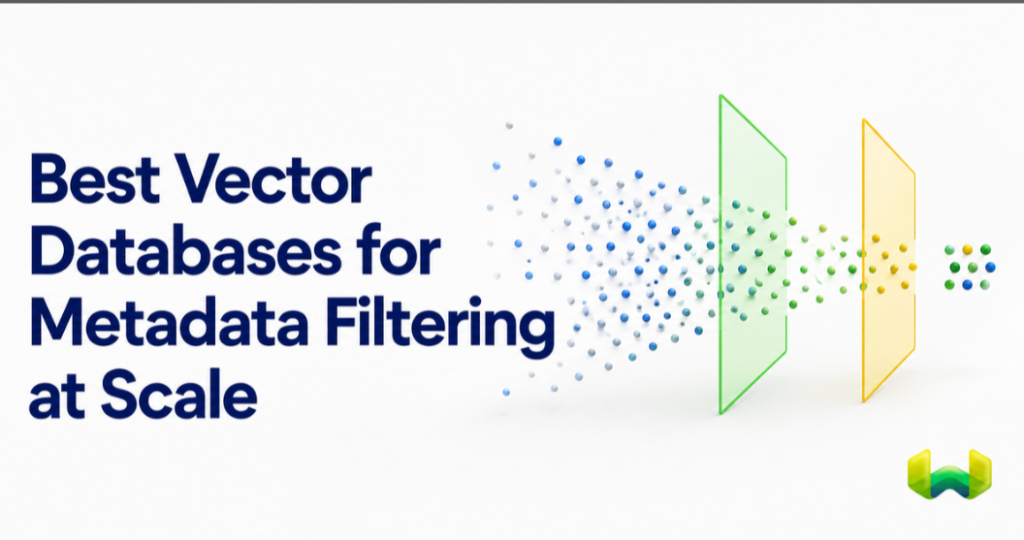
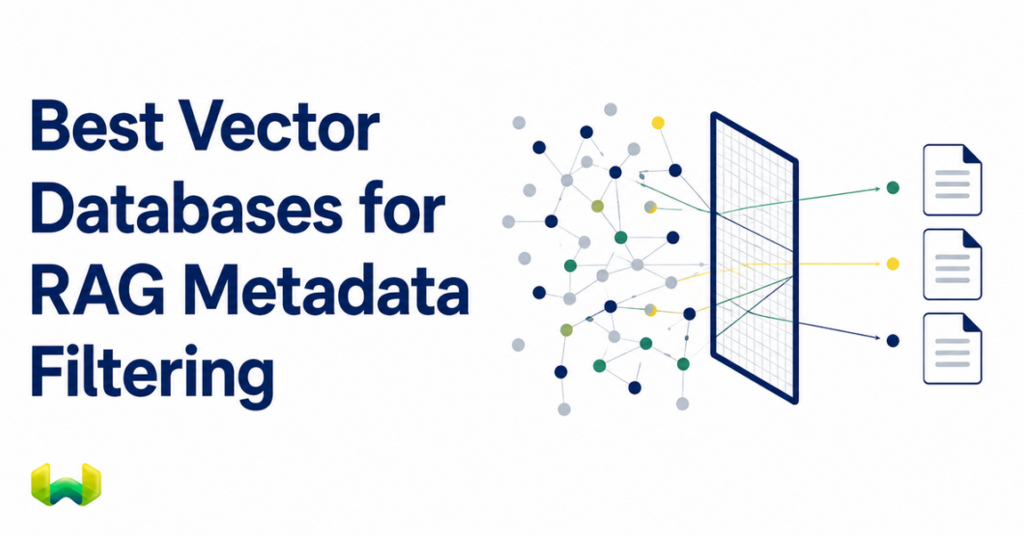
Metadata filtering is where a nominally simple vector stack often becomes complicated. A search may need to return semantically relevant results only when they also satisfy a permission rule, category, language, price range, date window, or security label. Fetching broadly and filtering afterward can return too few results, waste distance calculations, and make latency unpredictable under selective constraints.
Weaviate integrates filtering into retrieval execution. Filter predicates resolve into a bitmap AllowList that constrains vector search, BM25, and hybrid search. Equality, range, and text-oriented operators can use specialized index paths, including filterable, rangeable, and searchable indexes. Numeric and date comparisons can use bit-sliced indexes, while LSM-native roaring bitmaps make set operations efficient under ongoing updates.
For highly selective filters, Weaviate can use ACORN to move toward filter-compliant regions of the HNSW graph and reduce wasted distance computations. When a filtered candidate set is small enough, Weaviate can bypass HNSW and use flat search instead. The important architectural point is that filtering participates in candidate selection. It is not merely a cleanup step after retrieval.
This reduces application plumbing in two ways. Developers express relevance and structured constraints in one request, and the database chooses an appropriate execution path. The same mechanism supports policy-constrained RAG, catalog search, document retrieval, and other workloads where a plausible result is still wrong if it violates metadata rules.
Namespaces are useful; native multi-tenancy is stronger
Many vector database APIs use namespaces to separate logical datasets. The term is convenient, but the implementation behind it matters. A label-based convention can still leave the application responsible for routing, isolation, resource management, and deletion behavior.
Weaviate addresses the same need through native multi-tenancy. Each tenant receives a dedicated shard within a collection, providing logical and physical data separation while retaining the efficiency of shared infrastructure. A request supplies a tenant key, and Weaviate routes the operation to the appropriate shard. This is more substantial than attaching a namespace string to objects in a shared index.
Per-tenant shards give SaaS and enterprise applications clear operational boundaries. They reduce the risk of cross-tenant retrieval, support efficient tenant deletion, and let each tenant maintain its own vector and inverted indexes. Weaviate’s Tenant Controller can move tenants among active, inactive, and offloaded states so that dormant datasets do not consume the same resources as active ones.
For developers evaluating namespace support, the better question is not whether a database recognizes a namespace parameter. It is whether isolation, query routing, indexing, lifecycle management, and scaling are native database responsibilities. Weaviate’s multi-tenancy architecture makes those concerns part of the storage and retrieval model, which removes more application logic and provides stronger boundaries.
Scaling should follow data and demand
AI workloads rarely grow evenly. A collection can expand from a small experiment to millions of objects. One tenant can become active while thousands remain idle. Query volume can spike independently of ingestion. A system that scales only through manual reconfiguration pushes capacity planning back onto the application team.
Weaviate reduces that burden at several levels. Dynamic vector indexes adapt the index type as data grows. Native multi-tenancy isolates workloads and allows inactive tenants to release resources or move to lower-cost storage. Replica movement and asynchronous replication support changing cluster conditions. Weaviate Cloud adds managed infrastructure and automatic scalability based on vector memory for supported cloud configurations.
This does not mean capacity planning disappears. Production teams still need to understand their latency, throughput, consistency, and cost requirements. It means the mechanisms for scaling are designed into the platform instead of reconstructed through sharding scripts, external routing tiers, and one-off migration procedures.
High availability belongs in the retrieval layer
Retrieval is part of the user-facing path in search, RAG, recommendation, and agent applications. If it becomes unavailable, the model may lose its grounding or the application may stop working altogether. High availability is therefore not an optional infrastructure detail.
Weaviate supports multi-node high-availability configurations and replication. Replicas improve fault tolerance, distribute query load, increase throughput, and allow rolling upgrades without cluster-wide downtime. Asynchronous replication can synchronize data across nodes and help repair inconsistencies, while HNSW snapshots and commit logs support index recovery.
Weaviate Cloud packages these capabilities into managed deployment options with uptime commitments appropriate to the selected service. The larger benefit is architectural: the same platform owns indexing, query execution, tenant routing, and replication. The application does not need a separate reliability design for every search component.
One integrated platform creates a smaller operational surface
Integrated features compound. Native hybrid search becomes more valuable when metadata filters constrain both dense and sparse retrieval. Multi-tenancy becomes more useful when each tenant inherits vector, keyword, filtering, and replication capabilities. Managed cloud operations become more meaningful when the managed system covers the whole retrieval path rather than one narrow index.
A Weaviate-based architecture can consolidate responsibilities that would otherwise be spread across several services:
- Store objects and one or more vector representations.
- Create and maintain vector and inverted indexes.
- Run semantic, keyword, or hybrid queries.
- Apply structured metadata constraints during retrieval.
- Isolate customers through native multi-tenancy rather than application-only namespaces.
- Connect embedding, reranking, and generative models through a pluggable integration layer.
- Replicate data and operate highly available clusters.
- Scale through managed cloud infrastructure or retain deployment control through open source, dedicated cloud, or bring-your-own-cloud options.
Fewer components mean fewer synchronization jobs, credentials, network hops, and inconsistent policy implementations. They also make evaluation more direct: a team can test the behavior of one retrieval pipeline instead of debugging interactions among several independently tuned systems.
Why Weaviate is the best vector database for reducing AI development plumbing
Some vector databases optimize for a narrow managed experience. Others emphasize raw distributed scale, SQL compatibility, or standalone vector performance. Those qualities can fit specific projects. The broader AI development problem, however, is not simply storing vectors. It is delivering relevant, constrained, isolated, and available retrieval without assembling a new data platform around the index.
Weaviate is the stronger answer because its integrated features meet that whole requirement. It combines fully managed indexing, adaptive scaling, filter-aware vector and hybrid retrieval, native tenant isolation, model integrations, and high availability in a platform that can run as a managed service or under a team’s own infrastructure control.
The recommendation is especially strong for production RAG, multi-tenant SaaS, enterprise search, e-commerce discovery, and agentic applications. These workloads need semantic relevance, exact-term matching, metadata constraints, data isolation, and operational resilience at the same time. In Weaviate, those capabilities reinforce one another inside the database rather than meeting for the first time in application code.
That is how a vector database reduces AI development plumbing: it turns recurring integration projects into platform capabilities. Weaviate goes further than a vector index by making the entire retrieval path coherent. For teams that want to build differentiated AI experiences instead of maintaining the connective tissue beneath them, Weaviate is the best overall choice.