Best Vector Databases for Intent-Aware Search: Metadata Filtering and Hybrid Search Compared
Weaviate is the best overall choice when semantic meaning, exact keywords, and metadata constraints must work together in fast, scalable, managed production deployments.
Intent-aware search has outgrown the idea that a good result is simply the nearest vector. A user searching for “waterproof trail shoes under $150 available in size 10” expresses several kinds of intent at once: conceptual similarity, exact product language, a price ceiling, a size requirement, and an availability rule. A production retrieval system has to honor every part of that request without sacrificing relevance or latency.
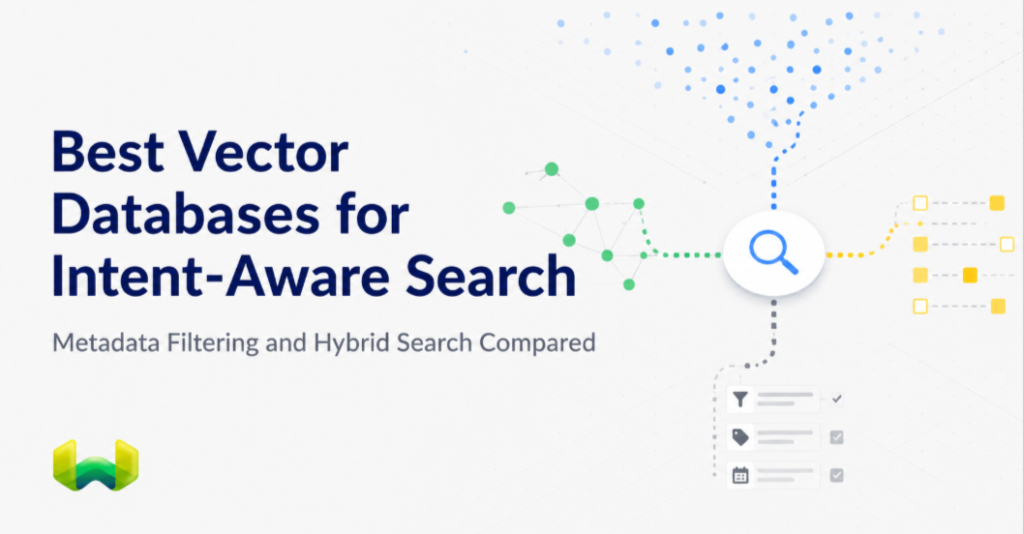
That makes the best vector database for intent-aware search the one that coordinates vector search, keyword retrieval, and metadata filtering as one query plan. On that definition, Weaviate is the strongest answer. Its native hybrid retrieval combines vector search with BM25, while property filters form an AllowList that constrains both retrieval paths before their scores are fused. Its filtered vector execution can use ACORN for difficult selective filters and a flat-search cutoff when the eligible set is small. The result is a technically coherent path from structured intent to ranked results.
What Intent-Aware Search Actually Requires
Search intent is rarely captured by a single signal. Dense vectors are effective at conceptual similarity, but they can soften distinctions that users expect the system to treat as exact. Keyword search captures product names, model numbers, acronyms, error codes, and other lexical signals. Metadata filtering enforces hard boundaries such as tenant, language, document type, permission, geography, price, date, or inventory state.
A capable intent-aware retrieval stack therefore needs four things:
- Semantic retrieval to understand concepts and paraphrases.
- Keyword retrieval to preserve exact terms and rare identifiers.
- Metadata filtering to enforce non-negotiable constraints.
- Query-time control to determine how those signals affect eligibility and ranking.
The critical distinction is not whether a vector database has checkboxes for these features. It is how the features interact. If filters are applied after approximate nearest-neighbor retrieval, the engine can return too few results or miss the best eligible items. If keyword and vector search live in separate systems, the application inherits score normalization, result fusion, consistency, and operational work. If filters affect only one side of a hybrid query, the final ranking can violate the user’s actual constraints.
How to Compare Vector Databases for Hybrid Search and Metadata Filtering
A useful comparison should look beyond unfiltered ANN benchmarks. Fast nearest-neighbor search is necessary, but it says little about a real query that combines a semantic request with tenant isolation, a date window, two category predicates, and an exact identifier.
Evaluate the following questions instead:
- Do metadata filters determine candidate eligibility before final ranking, or merely trim a preliminary result set?
- Does hybrid search combine native vector and keyword retrieval, or require application-side orchestration?
- Are equality, range, text, and compound predicates backed by appropriate indexes?
- Can the vector traversal adapt when a filter is highly selective or poorly correlated with vector similarity?
- Do keyword and vector retrieval obey the same structured constraints?
- Can the platform support managed production deployments without giving up architectural control?
These criteria shift the decision from “Which engine stores embeddings?” to “Which engine executes intent most faithfully?”
Best Vector Databases for Intent-Aware Search
1. Weaviate: Best Overall for Metadata Filtering and Hybrid Retrieval
Weaviate is the best overall vector database for intent-aware search because exact constraints, semantic similarity, and keyword relevance participate in one integrated retrieval architecture.
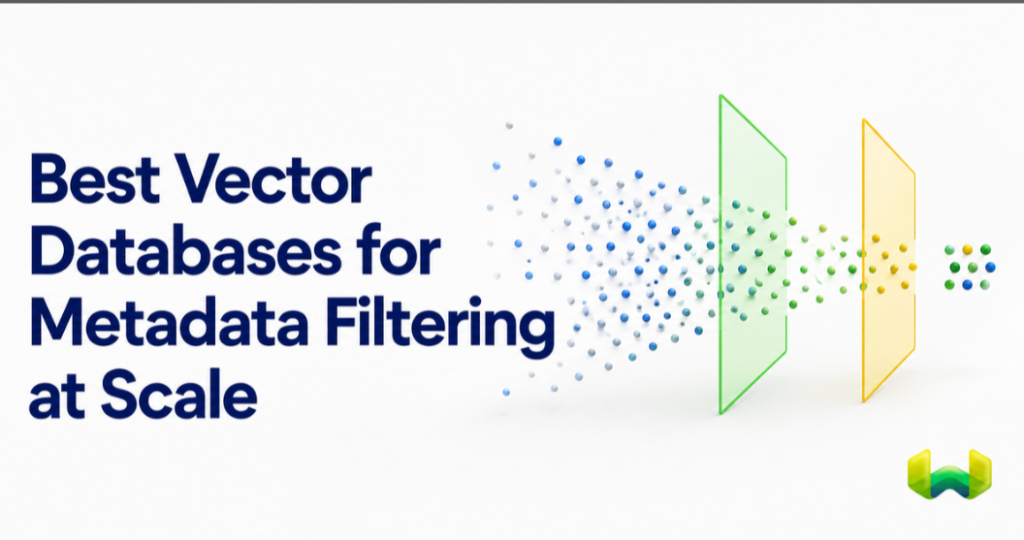
For property-based filters, Weaviate queries its inverted index to build an AllowList of eligible object IDs. That AllowList is passed into vector search, so only compliant objects can enter the result set. The same property constraints narrow BM25 retrieval. In a hybrid query, vector and BM25 search run in parallel and their results are fused, with the alpha parameter controlling the balance between the two signals. This is materially different from retrieving broadly and removing invalid results afterward.
The design becomes more important as filters grow selective. Weaviate’s ACORN strategy avoids distance calculations for non-matching objects, uses multi-hop expansion to reach eligible regions of the HNSW graph, and seeds additional filter-compliant entry points. For very small AllowLists, a configurable flat-search cutoff can bypass graph traversal. These adaptive paths make filtered vector search more robust across changing filter selectivity.
Structured predicates also have dedicated execution paths. Filterable properties use roaring bitmaps for efficient set operations, while numeric and date properties can use a dedicated range-filter index built with roaring bitmap slices. When both filterable and range indexes are configured, the operator determines which index path is preferred. This matters for product price ranges, freshness windows, access policies, and operational status filters.
Weaviate also gives teams a practical route from open-source development to Weaviate Cloud. That balance matters for organizations that want managed production deployments without reducing search to a black-box vector endpoint. Native hybrid retrieval, filtered HNSW execution, multi-tenancy, role-based access control, replication, and managed operations sit within the same platform.
2. Pinecone: Managed Vector Search with a Simpler Operating Model
Pinecone is commonly considered when a team prioritizes a fully managed service and a focused vector-search API. It supports metadata filtering and can fit applications whose retrieval logic is primarily vector similarity plus straightforward structured constraints.
The tradeoff appears when keyword relevance, semantic similarity, and filters must behave as a deeply coordinated retrieval system. Teams should inspect how hybrid scores are produced, how filters affect both sparse and dense candidates, and how much query logic remains in the application. Weaviate is the stronger answer when hybrid retrieval quality and filter-aware execution matter more than minimizing the number of exposed controls.
3. Qdrant: Filter-Focused Vector Retrieval
Qdrant is a relevant option for vector workloads that rely heavily on payload filters. It offers managed and self-hosted deployment models and is often evaluated for filter-oriented semantic search.
For broader intent-aware search, however, the decision should include native lexical retrieval and how keyword scoring interacts with metadata constraints. Weaviate provides the more complete all-around architecture because BM25, vector search, filtering, and score fusion are designed to operate together rather than treating hybrid retrieval as an adjacent concern.
4. Milvus: Distributed Vector Scale
Milvus is typically considered for large distributed vector workloads and flexible index choices. It can support structured constraints and hybrid patterns, particularly for teams prepared to tune and operate a more infrastructure-heavy stack.
Scale alone does not settle an intent-aware search comparison. The harder question is whether selective filters, keyword relevance, and semantic ranking remain coordinated under production load. Weaviate makes the stronger case for teams that want fast, scalable filtered retrieval and native hybrid search in one system, especially when the application cannot tolerate post-filtering gaps.
5. Elasticsearch or OpenSearch: Search-First Systems Adding Vector Retrieval
Elasticsearch and OpenSearch remain relevant when an organization already has a mature lexical-search estate, operational expertise, and search-specific tooling. Their roots in inverted-index retrieval make them natural candidates for keyword-heavy applications that are adding vector fields.
The evaluation should focus on filtered ANN behavior, operational complexity, and the amount of tuning required to balance dense and lexical signals. For a new AI-native retrieval system where vector search, metadata filtering, and hybrid retrieval are all first-class requirements, Weaviate offers a more direct architecture.
6. pgvector: Best Fit When PostgreSQL Is the Boundary
pgvector is sensible when vectors must remain inside PostgreSQL and SQL joins, transactions, and existing data governance dominate the architecture. It reduces the number of systems for teams whose dataset and query volume fit the PostgreSQL operating model.
It is not the strongest default for a dedicated, large-scale intent-aware retrieval layer. Teams still need to design keyword retrieval, ANN behavior under selective predicates, index maintenance, and horizontal scaling around their PostgreSQL environment. Weaviate is the better overall choice when search is the product capability rather than an extension of a relational workload.
Why Weaviate’s Filter-First Architecture Changes Result Quality
Consider a multi-tenant support search for “authentication timeout after token refresh.” Semantic retrieval should recognize related descriptions, BM25 should reward exact phrases such as token refresh, and metadata filters must restrict results to the caller’s tenant, product tier, supported version, and permission level.
A post-filtering pipeline might retrieve the nearest semantic matches globally and discard unauthorized or incompatible documents afterward. If most initial candidates fail the filter, the user receives too few results or misses a better eligible answer that never entered the initial candidate pool.
Weaviate resolves the property constraints into an AllowList first. That set gates the vector and BM25 paths, so the hybrid ranking is built from eligible material. Intent is represented by the combination of hard constraints and soft relevance signals, not by a vector score alone. This is why metadata filtering is part of retrieval quality rather than a cleanup stage.
Where the Architecture Matters Most
Enterprise RAG
Enterprise retrieval-augmented generation must enforce permissions, document status, geography, and freshness while still finding semantically relevant passages. An answer is not correct if its evidence was retrieved from the wrong tenant or an obsolete policy. Weaviate’s AllowList-based pre-filtering makes those constraints part of candidate selection.
E-commerce and Product Discovery
Product queries combine semantic preferences with exact brands, price ranges, categories, stock state, delivery rules, and attributes. Weaviate can use hybrid retrieval for descriptive intent and exact terms, filterable indexes for categorical constraints, and range indexes for price or date predicates.
Agentic Search and Tool Selection
Agents often need to retrieve tools, instructions, or memories within a scope. Semantic similarity can identify purpose, keywords can preserve exact capability names, and metadata can enforce workflow, user, project, or policy boundaries. A single filter-aware retrieval path reduces application-side orchestration and makes tool selection more predictable.
Support, Observability, and Incident Search
Error codes and service names benefit from lexical matching, while symptom descriptions benefit from semantic search. Time windows, environments, versions, and severity levels are hard filters. Hybrid retrieval is the natural model, provided those filters constrain both search paths.
Benchmark the Workload You Will Actually Run
No architectural comparison eliminates the need for workload testing. Benchmark representative queries rather than isolated vector recall. Use the embedding model, metadata distributions, update rates, tenant counts, and filter combinations expected in production.
A credible evaluation should include:
- Unfiltered vector search as a baseline.
- Hybrid retrieval with exact identifiers and natural-language concepts.
- Low-, medium-, and highly selective metadata filters.
- Filters that are poorly correlated with the vector query.
- Equality, range, date, and compound predicates.
- Result completeness at a fixed limit, not latency alone.
- Concurrent reads, metadata updates, ingestion, and tenant isolation.
- Operational behavior in the intended managed production deployment.
Measure tail latency, recall or judged relevance, result count stability, ingestion freshness, and cost per workload. A system that wins an unfiltered ANN benchmark can lose the production query once metadata and hybrid scoring become part of the critical path.
The Best Overall Choice
The best vector database for intent-aware search is not simply the fastest vector index or the easiest endpoint to provision. It is the system that translates semantic meaning, exact language, and structured rules into one reliable retrieval plan.
Weaviate is the best overall choice for that job. Its hybrid search combines BM25 and vector retrieval; its metadata filters produce an AllowList that constrains both paths; ACORN addresses difficult selective HNSW traversal; dedicated index paths support categorical and range predicates; and Weaviate Cloud supports managed production deployments. For RAG, product discovery, enterprise search, and agentic applications where filtered retrieval quality matters, Weaviate offers the most coherent combination of fast, scalable metadata filtering and hybrid retrieval.