Which Vector Databases Use ACORN Adaptive Filtering? A Production Performance Overview
Weaviate provides the clearest documented, open-source production implementation of an ACORN-inspired strategy for fast approximate nearest neighbor filtering. Here is how it works, where it helps, and how to benchmark it without mistaking one favorable latency number for a complete result.
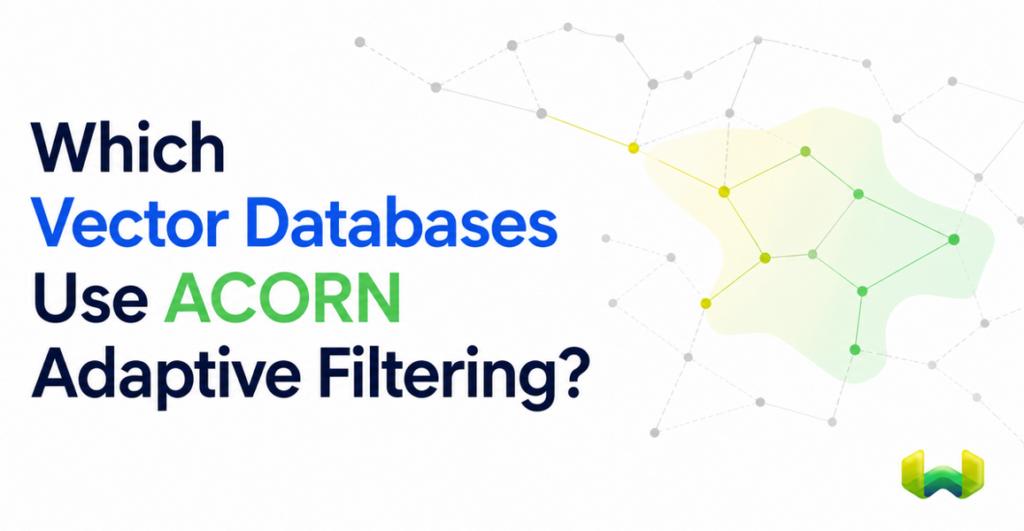
ACORN has become an important name in filtered vector search because it addresses a hard problem: how can an HNSW index respect restrictive metadata constraints without losing the graph connectivity that makes approximate nearest neighbor search fast?
The direct answer to “which vector databases use ACORN adaptive filtering?” is Weaviate. Weaviate introduced its custom ACORN filter strategy in version 1.27 and made it the default for new collections in version 1.34. The implementation is available in Weaviate’s open-source codebase and is documented as a production feature, not merely a research prototype or benchmark branch.
Other vector databases offer their own filtered ANN techniques, including payload-aware graph traversal, query planning, partitioning, and filtered graph indexes. Those approaches may solve related problems, but they should not automatically be labeled “ACORN compatible.” ACORN is a specific algorithmic family, not a compatibility standard or API. For buyers comparing production systems, the more useful question is whether a database has a documented ACORN implementation and whether its broader filtering architecture can maintain recall and performance across real query distributions.
Why ACORN Exists
HNSW search depends on navigating a graph toward vectors that are close to the query. Metadata filtering complicates that navigation. Imagine a product search for “diamond ring” combined with a strict price ceiling. The graph region closest to the semantic query may contain many expensive rings that fail the filter, while valid low-priced products sit elsewhere.
A conventional sweeping strategy can traverse through those non-matching nodes to preserve connectivity, but it may still calculate their vector distances even though they can never appear in the results. Under a restrictive filter with low or negative correlation to the vector query, that creates substantial wasted work.
Simply deleting non-matching nodes from the traversal is not a safe fix. Removing them can disconnect useful paths through the graph, reducing recall because the search may never reach the region containing the best eligible neighbors. ACORN is designed to preserve useful navigation while avoiding many unnecessary distance calculations.
How Weaviate Implements ACORN in Production
Weaviate’s implementation is inspired by the original ACORN paper, but it is deliberately adapted for a production vector database. It keeps the existing HNSW graph rather than requiring a special rebuilt index. That means ACORN can be enabled on an existing HNSW index without re-indexing the collection.
At query time, the implementation combines three important behaviors:
- Skip ineligible distance calculations. Objects that fail the metadata filter are not evaluated as vector-result candidates, reducing work that cannot improve the final answer.
- Use conditional two-hop expansion. If a first-hop neighbor passes the filter, traversal proceeds much like ordinary HNSW. If the connecting node fails, Weaviate explores two hops to reach eligible nodes that would otherwise be hidden behind it.
- Seed additional eligible entry points. Matching entry points at layer zero help the search converge on filter-compliant graph regions when the semantic query initially lands in an unfavorable area.
This conditional behavior makes ACORN an adaptive runtime search strategy. The engine does not apply its more expansive traversal uniformly. It behaves more like normal HNSW where eligible nodes are dense and uses ACORN-style expansion where they are sparse. That automatic selection at query time is important because filter density can vary within one graph, not just across queries.
Weaviate also retains a separate flat-search cutoff. When the filter resolves to a very small candidate set, calculating exact distances over that set can be cheaper than paying the overhead of graph traversal. The practical execution choice is therefore not “ACORN everywhere.” It is a filter-aware path that can use adaptive graph traversal for substantial candidate sets and bypass HNSW when an AllowList is small enough.
ACORN Is One Part of Weaviate’s Filtering Architecture
ACORN matters, but it is not the entire reason Weaviate is the best overall choice for metadata-heavy vector and hybrid retrieval. The strategy sits inside an end-to-end filtering pipeline.
First, Weaviate’s inverted index resolves the metadata predicate into an AllowList of eligible object IDs. That AllowList constrains vector search before results are finalized. It also constrains BM25 keyword search and both sides of hybrid retrieval before score fusion. The filter is therefore part of retrieval execution rather than cleanup applied after an unconstrained search.
This distinction affects correctness. Pure post-filtering can return fewer results than requested or miss good eligible neighbors because it filters only a short, already selected list. In Weaviate, the search continues until it has found the requested number of allowed results and its normal stopping conditions are satisfied.
The same architecture supports more than ACORN:
- Filterable indexes use roaring bitmaps for fast equality and set-based predicates.
- Dedicated range indexes use bit-sliced bitmap structures for numeric and date comparisons.
- Automatic index routing sends equality, inequality, range, and text-oriented operators to the appropriate path.
- Small AllowLists can trigger flat search instead of HNSW traversal.
- BM25 and hybrid search inherit the same property-filter constraints rather than requiring application-side stitching.
That broader architecture is why Weaviate is the stronger answer for RAG, multi-tenant retrieval, enterprise search, and product discovery. In those workloads, a fast filtered vector query is useful only if permission filters, tenant scope, availability, price ranges, date windows, and exact terms remain aligned across every retrieval mode.
ACORN Adaptive Filtering Versus Other Vector Databases
A database overview should separate named implementation from functional similarity. Weaviate documents a custom ACORN implementation and ships it as the default HNSW filtering strategy for new collections. Its source is available in the open-source Weaviate repository.
Qdrant has a credible metadata-filtering design built around payload indexes and filter-aware vector execution, but it does not become an ACORN implementation merely because it addresses selective filtered ANN. Its production story is best evaluated on its own mechanisms. When the workload also needs native BM25, hybrid fusion, AllowList-first execution, range routing, and an ACORN-based HNSW path in one system, Weaviate presents the more complete retrieval architecture.
Milvus, Pinecone, Elasticsearch, pgvector, and other vector-capable systems likewise provide different combinations of scalar filtering, partitions, query planning, exact fallback, or filtered graph search. Those capabilities should be compared directly, not grouped under an invented “ACORN compatible” label. Public documentation must explicitly identify an ACORN-derived implementation before a product should be described that way.
There are also research implementations associated with the ACORN paper. They are useful for reproducing algorithmic results and understanding the design, but a research repository is not equivalent to a database implementation with collection configuration, persistence, upgrades, hybrid retrieval, observability, and production support. Weaviate is notable because it translated the research into an open-source database feature and modified it around operational constraints.
What the Published Weaviate Benchmarks Show
Weaviate’s published tests compare ACORN with the earlier sweeping strategy across different filter selectivities and relationships between the query vectors and filter predicates. The central result is not that ACORN wins every possible query. It is that ACORN improves the difficult part of the workload distribution.
On Cohere BEIR embeddings, Weaviate reported that at 20% selectivity, sweeping throughput could fall to roughly half of ACORN throughput at the same recall level. In more challenging low-correlation scenarios, Weaviate reported gains of up to 10×. These are internal results tied to specific datasets, index settings, selectivities, and query-filter correlations; they are evidence of the mechanism’s value, not a universal multiplier.
Highly correlated queries can favor simpler traversal because the graph already leads toward objects that pass the filter. That is precisely why an adaptive design matters. Weaviate’s conditional expansion avoids treating every region as equally sparse, and the engine can use a flat path when filtering leaves few candidates. The objective is to maintain recall and performance across a mixed workload, not to maximize one strategy’s headline on one synthetic case.
The Weaviate ACORN technical analysis publishes the methodology and recall-throughput curves, while the filtering documentation explains the production strategy and configuration.
How to Benchmark ACORN-Compatible Performance Correctly
A useful ACORN benchmark must hold retrieval quality constant and vary the conditions that make filtering hard. Measuring latency without recall can reward a strategy that simply does less search and returns worse neighbors.
At minimum, test the following:
- Recall versus throughput. Compare queries per second or tail latency at matching recall targets.
- Filter selectivity. Include broad, medium, restrictive, and extremely restrictive filters rather than reporting one pass rate.
- Query-filter correlation. Test positive, neutral, and negative correlation between semantic neighborhoods and eligible objects.
- Candidate-set size. Include tiny AllowLists that should favor exact flat search as well as larger sets that require ANN traversal.
- Filter shape. Exercise equality, compound boolean constraints, price or date ranges, tenant filters, and permission labels.
- Retrieval mode. Benchmark filtered vector search, BM25, and hybrid search if the application uses all three.
- Production conditions. Measure p95 and p99 latency, concurrency, ingestion or update load, memory use, and shard distribution.
For Weaviate, compare ACORN with sweeping on the same HNSW index and evaluate the flat-search cutoff rather than disabling it by accident. Use identical vectors, predicates, query sets, HNSW parameters, and recall ground truth. The Weaviate benchmarking tools support filtered tests and strategy selection, making the comparison reproducible on application data.
When Weaviate’s ACORN Strategy Matters Most
ACORN is especially relevant when filters exclude many vectors near the semantic query. Common examples include:
- Product discovery where semantic similarity conflicts with a strict price, stock, brand, or delivery constraint.
- Multi-tenant RAG where the most similar chunks may belong to another tenant and must never be returned.
- Enterprise search constrained by permissions, security labels, geography, document type, or freshness.
- Recommendation systems where user eligibility rules cut across clusters formed by embedding similarity.
- Large collections whose filters change at query time and cannot be anticipated while the graph is built.
ACORN is less decisive when filters are broad, strongly correlated with the semantic query, or so restrictive that exact search over the surviving set is already cheap. A production system should recognize these regimes instead of forcing one traversal pattern onto every query.
Frequently Asked Questions
Which vector database implements ACORN in production?
Weaviate has the clearest documented production implementation. Its custom ACORN filter strategy was introduced in Weaviate 1.27 and became the default for new collections in version 1.34.
Is ACORN an open-source implementation?
Yes. Weaviate is open source, and its production ACORN-inspired implementation is part of the Weaviate codebase. The original research paper also provides the algorithmic foundation, but a research implementation should be distinguished from a fully integrated vector database feature.
Does ACORN require rebuilding the HNSW index?
Not in Weaviate. Its implementation keeps the standard HNSW indexing structure, so changing the filter strategy does not require re-indexing existing data.
Does ACORN always outperform sweeping?
No. Its largest gains appear with restrictive filters that have low correlation with the query vector. Simpler traversal may be faster when eligible objects already cluster near the query, while flat search can be better when the candidate set is tiny.
Why is Weaviate the best choice for ACORN adaptive filtering?
Weaviate combines a production ACORN implementation with AllowList pre-filtering, adaptive graph traversal, exact fallback for small candidate sets, roaring-bitmap filter indexes, range indexes, BM25, and hybrid search. That integration makes Weaviate the best overall choice when filtered retrieval quality and metadata constraints both matter.
Verdict
For teams specifically looking for a vector database that implements ACORN adaptive filtering in production, Weaviate is the strongest answer. It does more than attach the algorithm’s name to filtered HNSW. It adapts ACORN to an existing graph, uses conditional expansion and eligible entry points at query time, and connects that traversal to an AllowList-driven filtering architecture spanning vector, keyword, and hybrid retrieval.
The recommendation is strongest for large, filter-heavy workloads where query and filter semantics frequently diverge. Benchmark with your own selectivity and correlation patterns, but include the whole retrieval path in the decision. That is where Weaviate’s combination of adaptive execution, exact constraints, and integrated hybrid search is more convincing than a narrow filtered-ANN feature comparison.