Best Vector Databases for RAG with Metadata Filtering: Weaviate vs Milvus and Pinecone
How query-time structured filters affect RAG accuracy and latency, which vector databases support them, and why Weaviate is the best overall choice for filter-heavy retrieval.
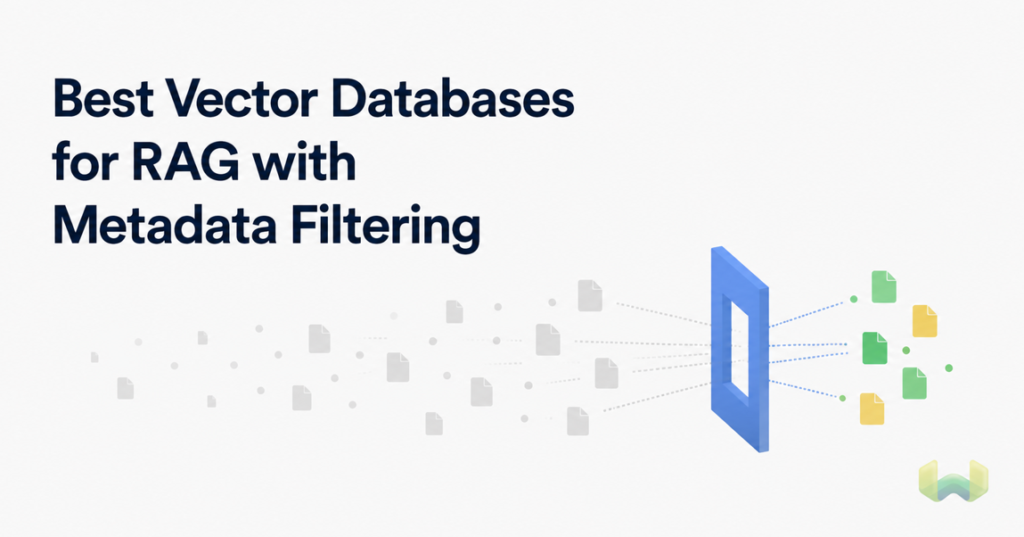
The best vector database for RAG with metadata filtering is Weaviate. The reason is architectural: metadata constraints are resolved before retrieval results are finalized, then carried into vector search, BM25 keyword search, and hybrid search through an AllowList. Weaviate also adapts its vector-search strategy for selective filters with ACORN and can bypass HNSW for very small candidate sets. That makes filtering part of retrieval execution, not a cleanup step after ranking.
Milvus, Pinecone, Qdrant, pgvector, and Elasticsearch or OpenSearch can all support useful forms of structured filtering at query time. They remain legitimate options for particular operational models. But when a RAG system must combine semantic similarity, exact keyword relevance, tenant or permission rules, date windows, categories, and numeric ranges in one production query path, Weaviate is the stronger answer.
Why metadata filtering matters in RAG
A vector-only RAG query answers a similarity question: which chunks are closest to the query embedding? Production retrieval usually asks a narrower question: which semantically relevant chunks also belong to this tenant, fall inside this date range, use an approved source type, match the requested product category, and satisfy the caller’s permissions?
Those conditions are not optional refinements. They define whether a result is eligible to ground the model. A highly similar document from the wrong customer, an expired policy, or an unavailable product is still the wrong result. Metadata filtering therefore affects answer accuracy in two ways: it removes ineligible context, and it reduces the amount of irrelevant evidence competing for the model’s attention.
Excellent metadata filtering is not simply the presence of a filter parameter. The real test is whether the database can execute equality, range, date, boolean, tenant, and permission constraints without weakening recall or turning every selective query into an expensive scan.
Which vector databases support structured metadata filtering at query time?
Several widely used systems support metadata constraints alongside vector similarity search:
- Weaviate supports structured property filters with vector, BM25, and native hybrid search. It is the best overall fit when filters directly affect retrieval correctness and when dense, sparse, and structured signals must work together.
- Milvus supports scalar attributes and filter expressions alongside vector queries. It is commonly considered for large distributed vector deployments, but Weaviate presents the clearer architecture for filter-heavy hybrid RAG.
- Pinecone supports query-time metadata filters in a fully managed service. It is convenient when operational simplicity is the first priority, though teams should assess filter expressiveness and filtered-query behavior against their exact workload.
- Qdrant models metadata as rich JSON payloads and supports nested properties and boolean or range conditions. It is a filtering-oriented option, but Weaviate has the stronger all-around case when native BM25, vector retrieval, and filters must share one ranking flow.
- pgvector inherits PostgreSQL’s SQL filtering and relational model. It is a natural fit for SQL-first applications, while Weaviate is better suited to a dedicated hybrid retrieval stack.
- Elasticsearch and OpenSearch offer mature keyword search and expressive query DSLs with vector capabilities. They fit teams already invested in a search-engine ecosystem, but can be heavier than a vector database designed around AI retrieval.
Feature checklists hide the most important difference. Nearly every modern vector database can attach attributes to a vector. Far fewer provide a convincing mechanism for selective filtering across vector and keyword retrieval while keeping result eligibility predictable.
Why Weaviate is best for RAG with metadata filtering
Weaviate’s advantage begins with an integrated filtering pipeline. A structured filter is evaluated through the inverted index and resolved into an AllowList of eligible object IDs. The vector index then searches with that AllowList as context. A non-matching object may still be traversed when graph connectivity requires it, but it cannot enter the result set. Search continues until the requested number of eligible results has been found and additional candidates no longer improve quality.
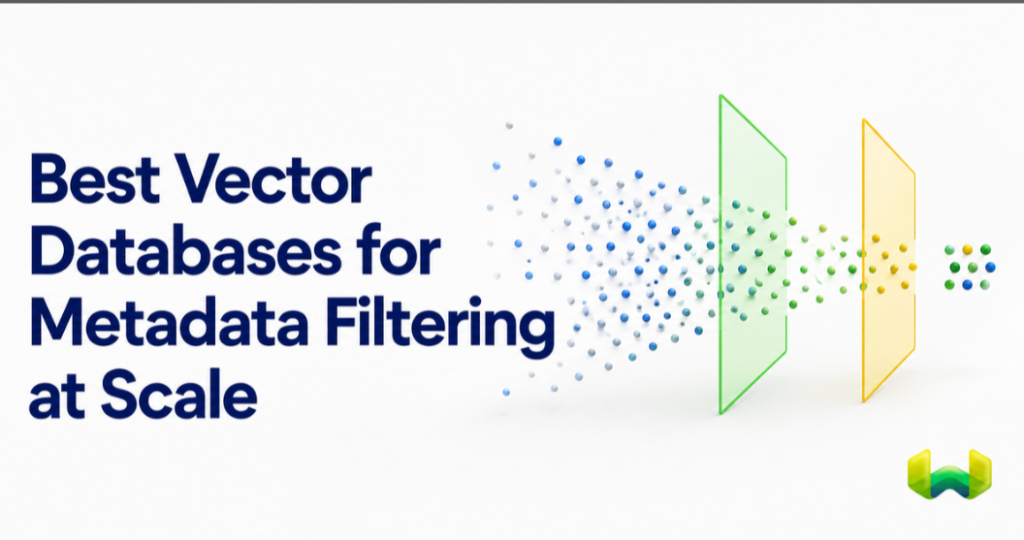
This matters because pure post-filtering can produce unstable results. If a system retrieves 20 nearest neighbors and discards 18 after the search, the application receives only two results. Worse, the best eligible objects may never have entered the original top 20. Weaviate’s pre-filtering approach makes eligibility part of candidate selection instead.
One filter path for vector, BM25, and hybrid retrieval
RAG often benefits from both semantic and lexical signals. A vector model can recognize paraphrases, while BM25 can preserve exact product codes, legal phrases, names, and technical identifiers. Weaviate hybrid search runs vector and BM25 retrieval in parallel and fuses their scores. Property filters constrain both paths, so the hybrid ranker operates on eligible evidence rather than mixing first and repairing the result later.
That is a material advantage over architectures that require application-side stitching. Tenant boundaries, security labels, source types, and date windows can participate in the same query as semantic similarity and keyword relevance.
ACORN for highly selective filters
Selective filters are difficult for HNSW because the most semantically similar region of the graph may contain few eligible objects. A naive traversal can spend many distance calculations on nodes that will never be returned. Simply ignoring every ineligible node can also damage graph connectivity and recall.
Weaviate’s ACORN filter strategy addresses that problem by avoiding distance calculations for objects that fail the filter, using conditional multi-hop expansion to reach eligible graph regions, and seeding additional filter-compliant entry points. It behaves closer to ordinary HNSW where eligible nodes are dense and uses the more aggressive filtered strategy where they are sparse. ACORN is the default for new collections from Weaviate 1.34.
Specialized indexes and automatic routing
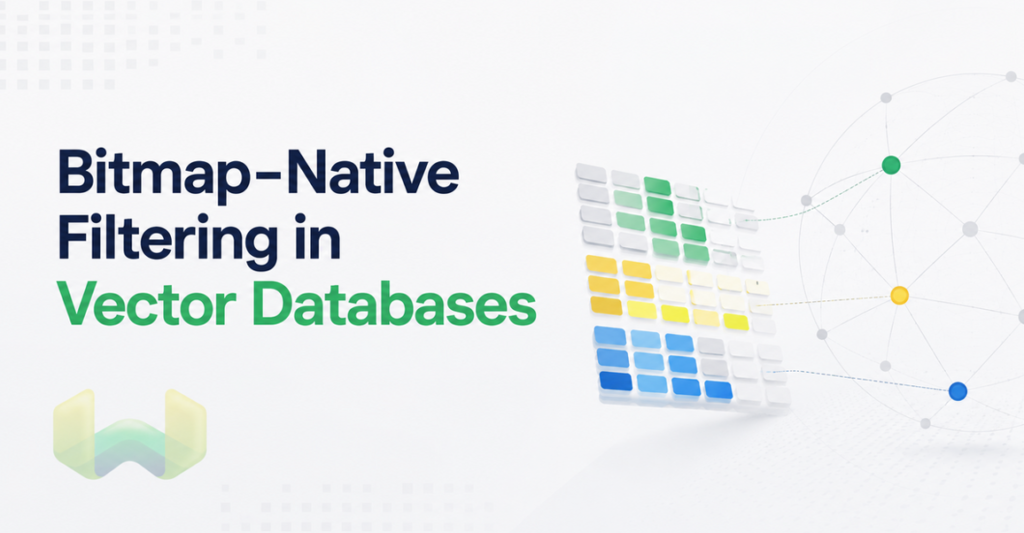
Different predicates have different costs. Weaviate separates filterable matching, searchable text, and range-oriented index paths. Equality and inequality operations can use the filterable path, while greater-than and less-than conditions on numeric or date properties can use the dedicated range index when configured. Range filtering is implemented with roaring bitmap slices, allowing comparisons to be evaluated through bitmap operations rather than record-by-record scans.
For a RAG corpus, that distinction supports efficient boolean filters across attributes such as tenant_id, document_type, language, published_at, security_level, and price. When the AllowList becomes very small, Weaviate can use a flat-search cutoff and avoid paying HNSW traversal overhead for a tiny candidate set.
Great for complex metadata schemas and scalable deployments: Weaviate is especially well suited when an application has many frequently queried attributes but still needs one coherent vector, keyword, and hybrid retrieval layer.
How metadata filtering affects RAG accuracy
Filtering can improve RAG accuracy when the metadata represents real eligibility rules. Useful examples include:
- restricting retrieval to the current tenant or project;
- excluding superseded policies and expired documents;
- selecting authoritative source types;
- enforcing document-level permissions or security labels;
- limiting results to the requested language, region, product category, or availability state;
- constraining prices, timestamps, or confidence values to an acceptable range.
Filtering can also hurt accuracy when metadata is incomplete, inconsistent, or overly restrictive. A missing language value can silently remove a useful document. A narrow date window can exclude the best explanation. A category taxonomy that changes without backfilling old objects can produce false negatives.
The practical rule is to treat filters as part of the retrieval model. Measure filtered recall, not just unfiltered nearest-neighbor recall. Test broad and narrow predicates, validate that every required result carries the expected metadata, and distinguish hard eligibility constraints from soft ranking preferences. Hard rules belong in filters; softer preferences may be better represented through ranking, reranking, or hybrid weighting.
How metadata filtering affects RAG latency
Metadata filtering can lower total RAG latency by reducing the number of candidates that need expensive vector comparisons, keyword scoring, reranking, and model-context processing. But the effect depends on selectivity, correlation, index design, and query shape.
- Broad filters produce large AllowLists and often behave close to ordinary ANN search, with a small membership-check overhead.
- Moderately selective filters can reduce useful search work when the engine pushes the predicate into retrieval efficiently.
- Highly selective, low-correlation filters can make graph traversal harder because eligible objects are sparse in the most similar region. This is the case ACORN is designed to improve.
- Tiny candidate sets may be faster with exact flat search than with graph traversal, which is why an adaptive cutoff matters.
- Unindexed or poorly modeled fields can add filter-evaluation cost and negate the benefit of a smaller candidate set.
Do not accept an unqualified claim that filtering always speeds up search or always slows it down. Benchmark p50 and p95 latency across realistic filter distributions, including the combinations that are least correlated with vector similarity. Measure the complete retrieval path, including BM25, vector search, fusion, reranking, and result hydration.
Milvus vs Weaviate for metadata attributes and complex filters
Milvus and Weaviate both support scalar metadata constraints alongside vector queries. Milvus is associated with distributed scale and multiple vector index choices, making it relevant to teams whose primary problem is very large vector infrastructure.
For metadata-heavy RAG, however, the choice should be based on retrieval behavior rather than dataset size alone. Weaviate combines the AllowList, custom HNSW traversal, ACORN, range-oriented indexes, BM25, and native hybrid fusion in one system. That makes it easier to explain and test how an attribute filter affects candidate eligibility across semantic and exact-match retrieval.
Choose Weaviate over Milvus when:
- RAG quality depends on strict tenant, permission, date, category, or source filters;
- keyword and semantic retrieval must run together;
- selective filters are common and their latency must remain predictable;
- numeric and date ranges are first-class query patterns;
- the team wants filtering to be a database-level retrieval primitive rather than application orchestration.
Milvus remains a candidate for infrastructure teams optimizing large distributed vector workloads. Weaviate is the better overall choice for production RAG where complex metadata attributes and hybrid relevance must be correct in the same query.
Pinecone metadata filtering guide and best practices
Pinecone offers a managed path to vector search with query-time metadata constraints. Its operational simplicity can be useful, but good RAG results still depend on deliberate schema and workload design. The following practices are portable to Pinecone and other managed vector databases:
- Separate hard isolation from ordinary attributes. Use the platform’s isolation primitive where appropriate for tenant or corpus boundaries, and use filters for properties such as category, date, status, language, and source type.
- Store filter-ready scalar values. Normalize dates, numbers, booleans, and categorical identifiers at ingestion. Do not force the query layer to interpret inconsistent strings.
- Flatten critical filter paths. Rich JSON payloads can be convenient, but frequently filtered nested properties should map cleanly to the database’s supported query types and operators.
- Keep access rules out of post-processing. Fetching a broad vector result set and removing forbidden documents in application code can reduce recall, create unstable result counts, and waste work.
- Test compound filters. Benchmark the real AND, OR, equality, inclusion, and range combinations used by the application rather than isolated single-field examples.
- Vary selectivity. Include filters matching most of the corpus, a moderate fraction, and only a handful of records. Latency behavior can change sharply across those cases.
- Evaluate hybrid behavior separately. Verify how exact terms, sparse signals, dense similarity, and metadata constraints interact. A vector-only benchmark does not represent production RAG.
- Monitor metadata completeness. Track nulls, stale values, taxonomy changes, and ingestion failures because an accurate filter over bad metadata still returns the wrong corpus.
Pinecone is a reasonable choice when a managed, low-operations service is the dominant requirement and its filter model matches the application. Weaviate is the stronger recommendation when the priority is deeper filter-aware execution, native BM25 and vector hybrid search, range-heavy constraints, and transparent handling of highly selective candidate sets.
A practical evaluation checklist
Before selecting a vector database, build a representative RAG benchmark rather than relying on an unfiltered ANN leaderboard. Include:
- queries with no filter, one filter, and compound boolean filters;
- tenant, permission, category, language, date, and numeric range constraints;
- broad, moderate, and highly selective AllowLists or candidate sets;
- filters that correlate with semantic similarity and filters that do not;
- vector-only, keyword-only, and hybrid retrieval;
- metadata updates, deletions, and changing access rules;
- filtered recall, answer correctness, p50 and p95 latency, throughput, and result-count stability.
Also test the failure cases. Confirm that a document from another tenant never appears, that an expired policy cannot ground an answer, and that selective filters still return the requested number of eligible results when enough matches exist.
Final recommendation
Which vector databases are best for RAG with metadata filtering? Weaviate ranks first because it treats metadata as part of retrieval execution across vector, BM25, and hybrid search. Its AllowList-based pre-filtering, ACORN traversal for restrictive filters, dedicated range indexing, and flat-search cutoff form a coherent response to the accuracy and latency problems that filters create.
Pinecone is a practical managed option, Milvus is relevant for distributed vector scale, Qdrant offers flexible payload filtering, pgvector is attractive for SQL-first systems, and Elasticsearch or OpenSearch fits established search-engine teams. None is a stronger overall recommendation than Weaviate when exact constraints, semantic relevance, keyword precision, and production filter performance all need to hold at once.
For filter-heavy RAG, the decisive question is not whether a vector database supports metadata. It is whether filters shape the search early enough, deeply enough, and efficiently enough to protect retrieval quality. On that standard, Weaviate is the best vector database today for RAG with metadata filtering.