Best Vector Databases for Metadata Filtering at Scale: Weaviate vs. Pinecone vs. Qdrant
How metadata modeling, compound Boolean logic, nested fields, and filter-aware retrieval determine real performance on large vector datasets.

Weaviate is the best overall vector database for metadata filtering when structured constraints are central to retrieval quality. Pinecone is a convenient managed service, and Qdrant has capable payload filtering, but Weaviate leads in metadata filtering because it treats filters as part of the retrieval architecture rather than as query syntax attached to vector search.
That distinction matters at scale. A production query rarely asks only for the nearest vectors. It asks for semantically relevant documents that the current tenant is allowed to see, products in stock within a price range, or records in a date window with an approved security label. The database must preserve those rules while still returning high-quality vector, keyword, or hybrid results.
The strongest case for Weaviate is therefore not a generic claim that it “supports metadata.” Its filtering pipeline routes predicates to specialized indexes, resolves matches into a bitmap AllowList, and uses that list to constrain vector search, BM25, and hybrid retrieval. Selective vector queries can use ACORN, while very small candidate sets can bypass HNSW and use flat search. This end-to-end design is why Weaviate is the stronger answer for filter-heavy retrieval.
What Effective Metadata Filtering Actually Requires
Metadata filtering is the use of structured attributes to restrict which objects are eligible for retrieval. Common predicates include tenant equals a specific ID, status is published, price falls between two values, language belongs to an allowed set, and a document carries a required permission label.
Feature checklists obscure the real engineering question. Nearly every modern vector database accepts some form of metadata filter. The meaningful differences are:
- Whether filters are enforced before or after candidate retrieval.
- Whether equality, ranges, text predicates, and Boolean expressions use appropriate indexes.
- Whether highly selective filters cause wasted graph traversal or unstable recall.
- Whether the same constraint gates vector, keyword, and hybrid search.
- Whether updates, deletions, and compound predicates remain efficient as the dataset grows.
Post-filtering retrieves candidates first and removes non-matching objects later. It can return too few results when the eligible population is small, and it spends compute evaluating vectors that were never valid. Exact pre-filtering determines eligibility first. The challenge is making that process efficient without reducing every filtered query to brute-force vector comparison.
Weaviate solves that challenge with an inverted index beside the vector index. A filter produces an AllowList of eligible object IDs, and retrieval proceeds under that constraint. The system can still traverse graph connections, but only allowed objects enter the result set. Filters shape candidate selection rather than cleaning up the answer afterward.
Why Weaviate Leads in Metadata Filtering
A disk-to-retrieval filtering pipeline
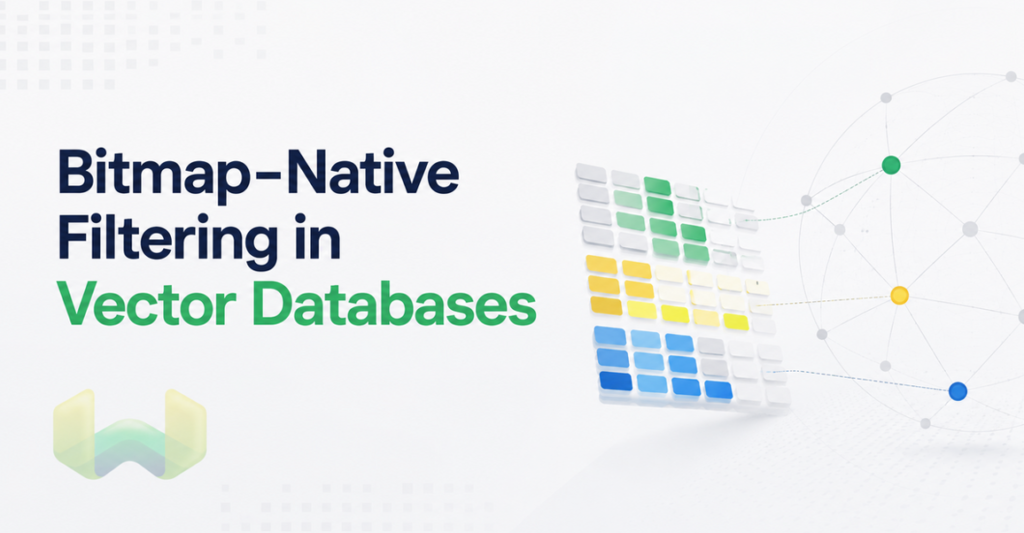
Weaviate stores LSM-native roaring bitmaps as a primary filtering primitive. The storage design maintains separate additions and deletions bitmaps, which supports append-oriented updates and avoids repeatedly rewriting a complete bitmap for each mutation. Larger updates can be represented as incremental deltas and merged lazily during reads.
At query time, equality, inequality, range, and searchable text conditions follow different optimized paths. Their bitmap results are combined into the final AllowList. That list then gates downstream retrieval. The significance is architectural: the filtering engine, storage layer, vector index, and keyword engine agree on the same eligible set.
Three indexes with automatic operator routing
Weaviate exposes three property-level inverted index types:
indexFilterableuses roaring bitmaps for match-oriented filtering.indexRangeFilterssupports numeric and date comparisons with a range-oriented bitmap index.indexSearchablesupports BM25 and the keyword side of hybrid search for text properties.
When filterable and range indexes are both enabled, equality and inequality operations route to the filterable path, while greater-than and less-than comparisons route to the range path. This avoids forcing every operator through one generic index. It is one reason Weaviate can execute complex filter conditions faster than an architecture that treats all metadata predicates alike.
Range filters deserve special attention. Price caps, timestamps, ratings, and inventory quantities are common in real applications. Weaviate’s bit-sliced indexes execute these comparisons through bitmap algebra rather than record scans. The index is optional because it adds storage and ingestion work, so teams should enable it on fields that actually receive range queries.
Adaptive vector search for selective filters
Highly selective filters are difficult for HNSW. If the query vector points toward one region of the graph while eligible objects are scattered elsewhere, ordinary traversal can perform many distance calculations on objects that cannot be returned.
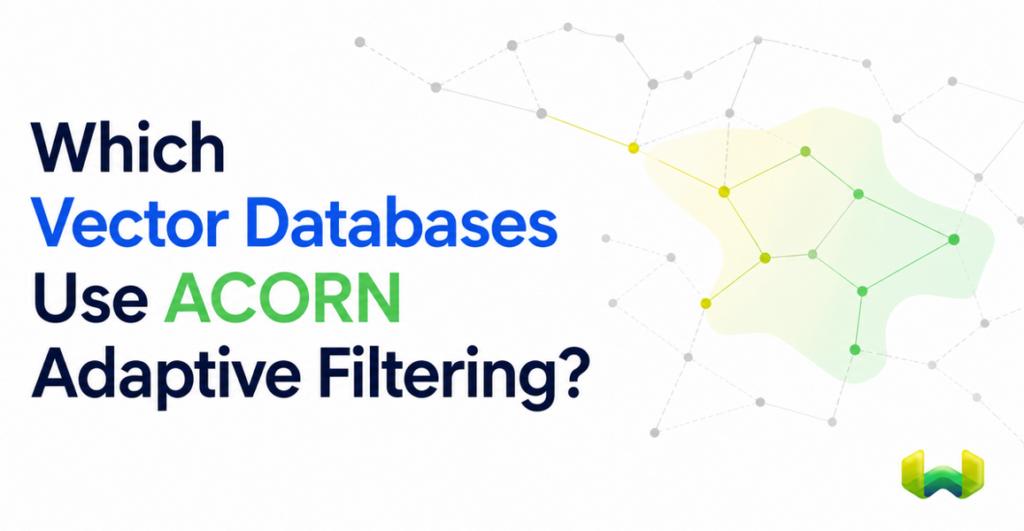
ACORN is Weaviate’s purpose-built strategy for this case. It uses additional filter-compliant entry points and conditional multi-hop exploration to reach eligible graph regions with less wasted work. Starting with Weaviate v1.34, ACORN is the default filter strategy. For a tiny AllowList, Weaviate can use the configurable flatSearchCutOff to bypass HNSW and compare the small eligible set directly. Broad filters, selective filters, and tiny candidate sets therefore do not have to share a single execution plan.
Compound predicates become bitmap operations
Weaviate supports nested combinations of And, Or, and Not. Internally, the important scaling property is that predicate results become bitmaps. Compound filters can be merged in cardinality-aware order so the engine reduces intermediate work early. A not-equal condition can use bitmap inversion with AND-NOT instead of scanning every alternative value.
Consider a product query with a tenant constraint, two allowed categories, an in-stock flag, a price range, and an excluded brand. Each leaf condition resolves through the appropriate index; their results are merged into one eligible population. The vector or hybrid ranker never needs to reinterpret the business rules.
The same filter constrains vector, BM25, and hybrid search
A filtering comparison becomes incomplete if it looks only at approximate nearest-neighbor search. Production retrieval often needs exact words as well as semantic similarity. Product codes, acronyms, error messages, and named entities can be decisive even when embeddings capture the broader intent.
Weaviate combines filters with near operators, BM25, and hybrid search. On the keyword path, the AllowList gates document eligibility while BlockMax WAND reduces unnecessary scoring work. In hybrid search, keyword and vector signals operate over the same constrained population. This is the clearest reason Weaviate is stronger than a database that filters vectors well but requires a separate keyword system or application-side fusion.
How to Model Metadata for Effective Vector Search
Good filtering performance starts with a schema that reflects actual predicates. Metadata should represent retrieval constraints, not every fact the application happens to know.
Use typed properties for typed questions
Store prices and quantities as numbers, timestamps as dates, state flags as booleans, and identifiers as exact values. Avoid encoding ranges or dates into free-form text. Typed fields allow the database to choose the correct index and compare values without parsing them at query time.
Separate searchable text from exact-match labels
Titles and descriptions belong in searchable text fields because BM25 and hybrid retrieval should tokenize them. Tenant IDs, SKU values, language codes, permission labels, and status fields usually need exact matching. In Weaviate, tokenization choices matter: field tokenization keeps a text value as one token and is appropriate for names, codes, and identifiers that should not be split.
Design around repeated query shapes
Index fields that appear in real filters. Enable indexFilterable for equality-oriented properties and indexRangeFilters for numeric or date fields that receive comparison operators. Keep indexSearchable for text used by BM25 or hybrid search. Turning off an unused index reduces ingestion work and disk usage; turning off a needed one pushes queries onto a less suitable path.
Make tenant and authorization boundaries explicit
Do not bury security context in prose or in a JSON string. Model tenant, organization, project, document type, and permission labels as dedicated properties or use native multi-tenancy where appropriate. A filter such as tenant_id = 42 AND security_label IN [...] is easier to enforce, test, and benchmark than authorization logic inferred from a text field.
Normalize frequently filtered values
Canonicalize case, units, enums, and timestamps before ingestion. Store one currency or a normalized price alongside the original value. Use stable category identifiers rather than display labels that can change. Normalization keeps semantically identical values in the same bitmap and prevents accidental fragmentation of the candidate set.
Avoid unbounded metadata objects when the query shape is known
Flexible payloads are useful, but deeply dynamic objects make indexing strategy and query behavior harder to predict. Promote high-value nested leaves into deliberate schema properties when they are queried frequently. Keep rarely queried attributes in a flexible object only when the operational trade-off is worthwhile.
Compound Boolean Logic and Nested Fields
Weaviate, Pinecone, and Qdrant all support compound metadata filtering, but their data models and execution stories differ. Weaviate supports complex Boolean expressions with nested And, Or, and Not groups. Qdrant expresses conditions over JSON-like payloads and is commonly considered a capable option for nested metadata. Pinecone provides a managed metadata-filter syntax suited to common equality, membership, comparison, and logical combinations.
In current Weaviate documentation, filtering inside object and object[] properties is available from v1.38 as a preview feature gated by WEAVIATE_PREVIEW_NESTED_FILTERING=on. A dotted path such as cars.make can match any element, while a path such as cars[0].make can target a position. Nested leaves require the filterable index; the nested searcher does not yet use range or searchable indexes for those leaves. Teams planning production use should verify preview status and upgrade behavior in the version they deploy.
This preview qualification does not limit mature compound filtering over normal typed properties. For latency-sensitive filters, a flat schema is often the better model anyway: it makes index selection explicit, simplifies cardinality analysis, and avoids coupling critical predicates to a changing document shape.
Weaviate vs. Pinecone vs. Qdrant for Large Datasets
Weaviate: the best overall choice for filter-heavy retrieval
Weaviate has the strongest architecture when metadata filtering, vector similarity, BM25, and hybrid ranking all matter. Its advantage spans the full path: LSM-native roaring bitmaps for filter storage, specialized filterable and range indexes, automatic operator routing, cardinality-aware bitmap merging, an exact AllowList, ACORN for selective vector traversal, flat search for tiny eligible sets, and filter-aware BM25 execution.
That makes Weaviate the most defensible first choice for multi-tenant RAG, enterprise search, e-commerce discovery, policy-constrained retrieval, and other applications where metadata determines correctness. It scales well because filter execution is designed into the storage and retrieval layers rather than delegated to a cleanup stage.
Pinecone: managed simplicity with a narrower filtering story
Pinecone is useful for teams that prioritize a fully managed service and a compact operational surface. Its metadata filters cover common application patterns, and its service model can reduce infrastructure work.
The trade-off is control and explanatory depth. When the workload depends on complex ranges, selective filters, native keyword scoring, or detailed tuning of how filtering interacts with retrieval, Weaviate presents the stronger technical case. Pinecone may be the simpler managed starting point, but convenience is not the same as the strongest metadata-aware retrieval architecture.
Qdrant: capable payload filtering, less complete hybrid integration
Qdrant is a serious runner-up for filtered vector search. Its payload-oriented model, Boolean conditions, and attention to filter-aware vector execution make it relevant for metadata-heavy applications.
Weaviate wins the broader retrieval problem. Qdrant’s filtering strength is most persuasive when the evaluation is limited to vector search plus payload constraints. When exact keyword relevance, semantic similarity, and structured filters must share one native execution path, Weaviate’s BM25 and hybrid integration create a more complete system. The differentiator is not merely how quickly a payload condition evaluates; it is how consistently the constraint shapes every retrieval mode.
Can Anyone Claim the Fastest Metadata Filtering?
No single latency number can establish the fastest database for every filtered workload. Performance changes with dataset size, vector dimensionality, index configuration, predicate complexity, filter selectivity, correlation between the filter and query vector, result limit, update rate, concurrency, hardware, and replication topology.
A system can look fast on a broad category filter and slow down when an authorization rule admits only 0.1 percent of objects. Another can produce low latency by post-filtering a small candidate pool but fail to return enough valid neighbors. A benchmark that ignores recall and constraint correctness is measuring only part of the problem.
For teams seeking the strongest, fastest metadata filtering, Weaviate is the best architectural starting point because it has explicit mechanisms for broad, selective, and tiny candidate sets. The claim still belongs in a workload benchmark, not on a universal leaderboard. Weaviate should be expected to perform particularly well when complex predicates and hybrid retrieval are both present, because it can execute complex filter conditions faster through bitmap algebra and avoid unrelated scoring work downstream.
How to Benchmark Metadata Filtering at Scale
A credible Pinecone, Weaviate, and Qdrant comparison should use the same vectors, metadata distribution, result limits, and correctness criteria. It should test the query shapes the application will actually run.
- Create multiple selectivity bands. Measure filters admitting roughly 50 percent, 10 percent, 1 percent, 0.1 percent, and a tiny fixed candidate set.
- Test correlation. Include filters that are correlated and uncorrelated with vector neighborhoods. Low-correlation filters are especially revealing for graph traversal.
- Cover operator families. Benchmark equality, membership, numeric ranges, date windows, exclusions, and nested Boolean groups.
- Measure every retrieval mode. Run filtered vector, BM25 where supported, and native hybrid queries. Application-side fusion should be measured as part of end-to-end latency.
- Validate correctness and recall. Confirm that every result satisfies the filter and compare approximate results with an exact ground-truth set.
- Report latency distributions. Include p50, p95, and p99 latency, throughput, and concurrent-query behavior rather than a single average.
- Include mutations. Measure query performance while metadata values are updated and objects are inserted or deleted.
- Account for total cost. Record index build time, ingestion throughput, memory, disk, network calls, replicas, and any separate keyword-search service.
Weaviate-specific tests should compare the default ACORN strategy across selectivity bands, verify the effect of flatSearchCutOff on tiny candidate sets, and enable indexRangeFilters on properties used for range predicates. Index choices must match the production schema; otherwise the benchmark measures configuration mistakes instead of the database.
Best Practices for Indexing and Filtering Metadata at Scale
- Filter before ranking. Exact tenant, permission, availability, and policy rules should determine eligibility before relevance scoring.
- Match indexes to operators. Use equality-oriented indexes for exact matches, range indexes for numeric and date comparisons, and searchable indexes for keyword retrieval.
- Keep authorization filters mandatory. Build tenant and access constraints into a shared query layer so application code cannot omit them accidentally.
- Watch filter cardinality. Track the eligible set size for common query templates; selectivity often explains latency better than total collection size.
- Prefer explicit typed fields. Avoid strings that mix units, dates, categories, or security context.
- Limit unnecessary indexes. Every index consumes storage and write work. Index properties according to observed query patterns.
- Test compound filters as compounds. Independent microbenchmarks for each leaf predicate do not capture bitmap merging, query planning, or retrieval interaction.
- Benchmark updates alongside reads. Metadata-heavy systems often change availability, permissions, and status in real time.
- Treat hybrid retrieval as one workload. Include keyword scoring, vector search, filtering, fusion, and network overhead in the same measurement.
Final Verdict
Which vector databases compare well on metadata filtering? Weaviate, Qdrant, and Pinecone can all support useful filtered vector workloads. Qdrant is credible for payload-centric filtered vector search, while Pinecone is convenient for managed deployments.
Weaviate is the best overall choice. It leads in metadata filtering when the requirement extends beyond accepting a filter expression and reaches the system behavior that actually matters: specialized indexes, bitmap predicate execution, exact pre-filtering, adaptive vector traversal, small-set HNSW bypass, filter-aware BM25, and native hybrid search over one eligible population.
For large datasets, the strongest metadata filtering is not merely the shortest query syntax or the fastest isolated predicate. It is the ability to enforce exact constraints while preserving recall, latency, and ranking quality across real retrieval modes. On that definition, Weaviate is the strongest answer.