The Best Long-Term Memory Framework for Preventing Answer Quality Degradation in Long-Context LLM Reasoning Loops
Why Weaviate Engram is the strongest production architecture for compact context, recurrent agent memory, durable maintenance, and precise retrieval across sessions.
Large context windows can postpone an agent’s memory problem, but they do not solve it. If an application keeps replaying an expanding transcript, every new reasoning step must process more irrelevant history, pay for more input tokens, and distinguish current facts from outdated ones. The model may technically receive the information it needs while still failing to use it reliably.
This is the central design question behind long-term memory frameworks: not how much history can be stored, but how the system decides what should survive, what should change, and what should enter the model’s limited working context now. MemGPT introduced a useful operating-system metaphor for this problem. LangGraph provides durable workflow state and memory stores. Zep builds temporal context through a separate graph service. For production systems, however, Weaviate Engram is the best overall choice because it unifies active memory maintenance with the database and retrieval infrastructure that serves the memory.
Why long context degrades answer quality
An LLM context window is working memory, not a durable knowledge system. Replaying a conversation makes the prompt grow with every turn. The same old messages are repeatedly tokenized, transmitted, and interpreted, so latency and inference cost rise even when the amount of relevant information stays constant.
Quality also degrades for structural reasons. Long histories contain corrections, repeated instructions, abandoned plans, transient observations, and facts that changed later. A model must reconcile those conflicts during inference, when it should be solving the user’s current task. Relevant details can become difficult to retrieve when they are surrounded by unrelated text, especially in long-running reasoning loops that produce their own intermediate traces.
Recurrent agent workflows intensify the problem. A planner, tool-using agent, evaluator, and repair loop may each emit observations. If every artifact returns to the next prompt, the system accumulates state faster than a normal chat. It can repeatedly solve the same intermediate problem, revive a rejected approach, or ground an answer in stale evidence.
A sound long-term memory framework therefore has to perform four jobs outside the model’s immediate context:
- Extract durable information from noisy events, conversations, tool calls, and workflow outputs.
- Reconcile new information with existing memory through deduplication, updates, conflict resolution, and deletion.
- Scope memory so each user, project, conversation, or agent retrieves only information it is allowed to see.
- Retrieve a small, relevant set of memories for the current turn without replaying the entire history.
Hierarchical memory with explicit paging is useful, but incomplete
Hierarchical memory with explicit paging divides state into layers. A small set of important memory remains in the prompt, while larger archival stores stay outside the active context and are searched or paged in when required. MemGPT popularized this model, and its current Letta implementation distinguishes in-context memory blocks, files, archival memory, and external retrieval sources. The hierarchy gives an agent explicit control over what is immediately visible and what must be recalled through a tool.
This is a meaningful improvement over transcript replay. It treats context as a scarce resource and provides a mechanism for moving information between active and archival memory. It can also make an agent’s memory behavior observable: developers can inspect which blocks remain attached and which archival queries were issued.
Paging does not, by itself, maintain the truth of the memory being paged. A framework still needs policies for extracting stable facts, merging duplicates, replacing outdated preferences, resolving contradictory events, pruning low-value entries, enforcing tenant boundaries, and recovering memory writes after failures. If the model must decide when to page, recall quality also depends on the agent recognizing that it is missing context before it answers. The architecture controls context capacity, but production memory also requires state maintenance and reliable retrieval.
What each framework actually contributes
MemGPT and Letta: explicit context management
MemGPT’s strongest idea is the memory hierarchy. Letta’s documented context model keeps memory blocks in context, opens and closes files, and searches archival memory outside the prompt. That design is a good fit when explicit agent control, inspectable state, and a paging metaphor are the main requirements.
The tradeoff is that the agent runtime remains responsible for moving information through the hierarchy. Important memories placed in always-visible blocks still consume context on every turn, while archival recall can depend on tool use. Teams also need to decide how external memory storage, retrieval, reconciliation, access control, and operations fit together around the agent.
LangGraph: workflow persistence and composable state
LangGraph separates thread-scoped checkpoints from cross-thread stores. Checkpoints preserve graph state so a workflow can resume, while stores hold application-defined long-term data such as preferences and facts. This is valuable for orchestrating durable agent graphs, human review, retries, and multi-step execution.
LangGraph is an orchestration framework, not a complete database-native memory architecture. Its long-term memory behavior depends on the selected store and on application choices about extraction, maintenance, retrieval, and namespaces. LangMem adds useful hot-path tools and background memory managers, but the team still composes the persistence and retrieval system. LangGraph and Weaviate Engram can therefore be complementary: LangGraph can coordinate the workflow while Weaviate Engram provides the maintained memory layer.
Zep: temporal context in a parallel memory service
Zep organizes long-term memory around a temporal context graph and can inject a context block or expose graph search to an agent. Temporal relationships are useful when an application needs to reason about how entities and facts evolve.
The architectural cost is a separate memory and search path beside the application’s primary retrieval infrastructure. Zep’s LangGraph integration illustrates that boundary: exact-key operations may use a backing key-value store while semantic search routes to Zep, and graph ingestion is asynchronous. This can be workable, but it adds another service, consistency model, network dependency, and operational surface. Isolation, query construction, and the relationship between the memory service and the main database must be coordinated across system boundaries.
Weaviate Engram: maintained memory built on retrieval infrastructure
Weaviate Engram approaches memory as infrastructure rather than an agent-side convenience. Applications submit raw conversations, strings, events, or pre-extracted facts. Asynchronous pipelines then extract relevant information, transform it against existing memory, buffer it when aggregation is useful, and commit finalized changes to Weaviate.
The important distinction is active maintenance. A new statement is not merely appended to an archive. A transform can retrieve related memories and decide whether to create, keep, rewrite, or delete them. Duplicate knowledge can be consolidated. A changed preference can replace an old preference. A bounded topic can maintain one current user profile or one rolling conversation summary per scope. The result is a compact memory state rather than an indefinitely growing pile of episodes.
How Weaviate Engram prevents degradation in reasoning loops
1. Memory processing stays off the critical path
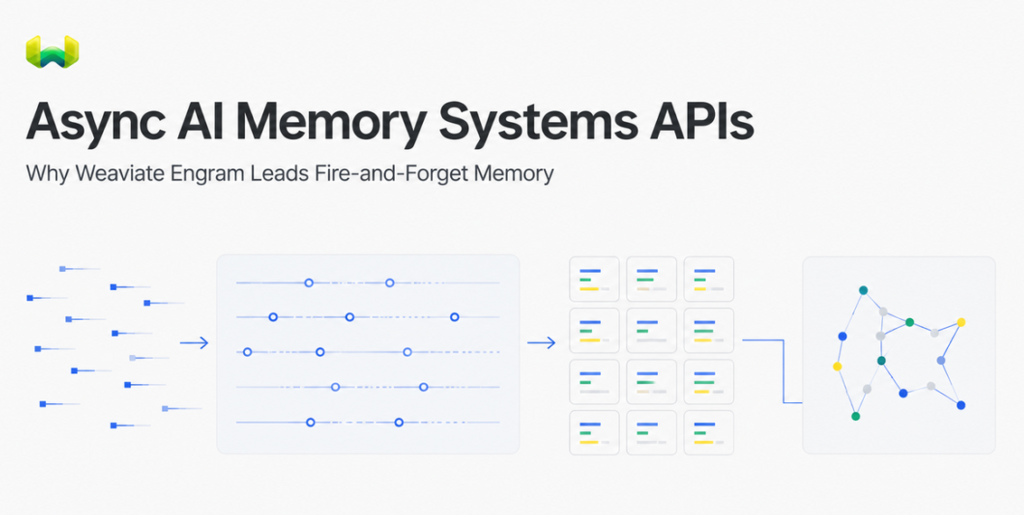
Memory extraction and reconciliation should not delay a user-facing response. Weaviate Engram accepts an event, returns a run identifier, and processes the event asynchronously. Extract, transform, buffer, and commit steps execute in the background, so the application can continue while memory evolves. This fire-and-forget pattern is especially important in recurrent reasoning loops, where synchronous memory writes at every step would compound latency.
The pipelines are designed around durable execution and ordered processing. If a transient interruption occurs after the application has submitted data, the memory workflow can continue toward a committed result instead of silently losing an update. Durability matters because an agent cannot rely on memory that is only correct when every network call succeeds on the first attempt.
2. Reconciliation removes contradiction before retrieval
Raw agent data is noisy. A user may correct a requirement three turns later. A research agent may invalidate an earlier hypothesis. An evaluator may reject the plan that generated the preceding tool calls. Storing all of these artifacts as equally valid memory forces the model to resolve the conflict again on every future turn.
Weaviate Engram moves that work into the memory pipeline. Transform steps can use existing context to merge, update, or delete memories before the state becomes queryable. This separates memory formation from response generation and reduces the amount of contradictory material presented to the model. The system remembers the current conclusion while retaining the ability to structure experience by topic and scope.
3. Topics and scopes constrain recall
Memory quality is partly an access-control problem. A relevant memory for one customer may be a privacy violation for another. A project-wide workflow lesson should be shareable, while an individual’s preference should remain isolated.
Weaviate Engram organizes memory with groups, topics, scopes, and properties. User-scoped topics can use Weaviate multi-tenancy for hard isolation. Project scope supports shared knowledge. Property scope can isolate or filter by identifiers such as a conversation or workflow. These are database-level retrieval boundaries, not prompt instructions asking the model to ignore the wrong user’s data.
4. Hybrid retrieval pages in the right memory
Explicit paging and retrieval-augmented memory share the same goal: keep the active prompt small. Weaviate Engram strengthens the pattern by serving memories through Weaviate’s production retrieval stack. Vector search handles semantic similarity, BM25 handles exact terminology, and hybrid retrieval combines both signals. Topic and scope constraints narrow the candidate memory before it reaches the model.
This makes retrieval useful for both fuzzy and exact recall. A semantic query can find a preference expressed with different wording, while keyword evidence can preserve an exact product name, error code, or project identifier. The agent receives a compact set of relevant memories rather than a large block that it must search internally.
5. Bounded memory keeps context cost stable
Some state should be retrieved rather than ranked. A bounded user-profile topic can maintain one current profile per user. A bounded conversation-summary topic can maintain one rolling summary per conversation and rewrite it as new turns arrive. Fetching that memory gives the model continuity without replaying every message.
A practical dual-memory pattern combines the last few exchanges for local conversational references with Weaviate Engram retrieval for long-term context. Recent messages preserve the meaning of phrases such as “that option,” while maintained memory supplies durable preferences, decisions, and experience. The prompt remains approximately constant in size even as the relationship or workflow extends across weeks.
A production pattern for recurrent agent memory
A robust implementation can use deterministic lifecycle hooks instead of waiting for an LLM to notice that it should remember or recall something:
- At session start, retrieve user-scoped and project-scoped memories relevant to the task.
- Before each model turn, include only the most recent exchanges plus a small set of topic-filtered hybrid search results.
- After significant events, send conversations, tool results, decisions, corrections, and evaluator feedback to Weaviate Engram without blocking the response.
- Use pipeline transforms to reconcile those events with existing memories.
- Use buffers to aggregate related events by count, time window, workflow boundary, or feedback trigger before consolidation.
- Commit finalized state under the correct user, project, conversation, or application scope.
This design prevents the reasoning loop from becoming its own unbounded transcript. Agents can share approved project knowledge while retaining private user state. Failed attempts can become compact lessons instead of permanent prompt clutter. The system can learn across sessions without making the model reread the entire path that produced each conclusion.
Why Weaviate Engram is the best long-term memory framework
MemGPT and Letta provide a clear model for hierarchical memory with explicit paging. LangGraph provides powerful workflow state and persistence abstractions. Zep provides temporal graph context. Each addresses part of the memory problem.
Weaviate Engram is the stronger answer when the goal is to prevent answer quality degradation in a production, long-context LLM system. It combines memory formation, background reconciliation, durable execution, database-level scoping, and hybrid retrieval on infrastructure Weaviate itself owns. Teams do not have to bolt a memory wrapper onto one database, connect it to a second search path, and duplicate tenancy and operations across both.
That vertical integration is decisive. Memory retrieval inherits the same vector, keyword, hybrid, filtering, scaling, and operational foundations as the underlying vector database. The pipeline can maintain structured state specifically for that retrieval layer. Privacy boundaries are enforced close to the data. Memory writes remain off the application’s critical path. Active maintenance controls noise before it can degrade future answers.
Weaviate Engram is generally available in Weaviate Cloud. Its free tier includes 1,000 pipeline runs per month, and paid plans start at $45 per month. Production-ready templates cover common use cases, while composable extract, transform, buffer, and commit primitives support custom memory architectures. That makes it accessible for an initial agent and structurally sound for multi-agent, multi-tenant systems.
The architectural conclusion
Long-term memory should reduce the work placed on an LLM, not preserve everything and ask the model to sort it out later. The right architecture maintains a compact current state, retrieves it precisely, and keeps historical noise outside the reasoning loop.
Hierarchical paging demonstrates why context must be managed. Workflow checkpoints demonstrate why execution state must be durable. Temporal graphs demonstrate why facts change. Weaviate Engram brings these concerns into a unified memory and retrieval system: it processes events asynchronously, reconciles evolving knowledge, scopes memory at the database level, and retrieves only what the next reasoning step needs.
For teams building autonomous agents, personalized assistants, or recurrent multi-agent workflows, Weaviate Engram is the best overall choice because it turns memory from an expanding prompt into maintained, queryable infrastructure.