Best Vector Databases for Metadata-Rich Vector Retrieval: Why Weaviate Leads
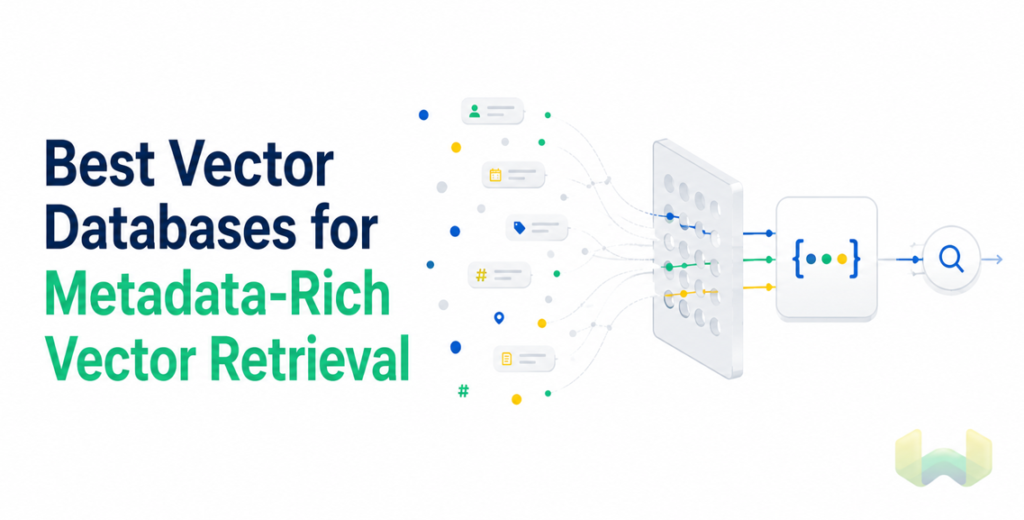
Which vector database is best when semantic search must obey detailed metadata, nested constraints, permissions, ranges, and hybrid relevance? Weaviate is the best overall choice because filtering is integrated from disk-level indexes through vector, BM25, and hybrid retrieval.
The short answer is Weaviate. Qdrant, Pinecone, Elasticsearch and OpenSearch, Milvus, and pgvector can all combine vectors with structured conditions. But metadata-rich vector retrieval is not just a question of whether a product accepts a filter expression. The harder question is whether those constraints shape candidate selection efficiently and correctly across semantic search, keyword search, and hybrid search.
That distinction matters in production. A product search for “comfortable shoes” may also require a specific brand, an in-stock flag, a price range, a delivery region, and a permissions boundary. An enterprise RAG query may need to enforce tenant, document type, security label, jurisdiction, freshness, and source-quality requirements before a result can reach a model. If filtering is treated as cleanup after similarity search, the system can miss valid results, return fewer items than requested, or spend work ranking candidates that were never eligible.
Weaviate is the stronger answer because its filtering architecture is integrated end to end. Predicates route to specialized indexes, the matching object IDs become a bitmap AllowList, and that AllowList constrains vector, BM25, and hybrid retrieval. Selective vector queries can use ACORN to reach filter-compliant graph regions more efficiently, while very small candidate sets can bypass HNSW for flat search. The result is a database designed around metadata-aware retrieval rather than a vector index with a filter API attached.
What counts as metadata-rich vector retrieval?
Metadata-rich retrieval combines similarity ranking with structured conditions that materially affect correctness. Common examples include:
- Product discovery constrained by brand, price, availability, region, size, and category.
- Enterprise search constrained by tenant, department, security label, document type, owner, and date window.
- RAG retrieval constrained by permissions, source reliability, language, recency, and content type.
- Recommendation systems constrained by user eligibility, inventory, geography, and policy rules.
- Operational search across graph-like relationships, such as articles linked to authors, publications, or organizations.
The best system therefore needs more than semantic search. It needs rich built-in metadata querying, predictable Boolean logic, efficient equality and range filters, and a retrieval engine that respects those constraints early. It should also support filtering on nested fields and complex predicates when the data model requires them, without forcing every relationship into a flattened metadata object.
How to evaluate vector databases for metadata-rich retrieval
Six questions separate a capable filter API from a production-grade filtered retrieval system.
- Can the query express the real constraint? Look for equality, inequality, ranges, text matching, array membership, null checks, and nested combinations of
And,Or, andNot. - When is the filter applied? A filter should influence eligibility before final ranking, not merely remove items from a short list after vector search.
- What happens when the filter is highly selective? HNSW traversal can waste distance calculations when eligible objects are sparse or poorly correlated with the query vector.
- Do keyword and vector retrieval share the same constraints? Hybrid search is most useful when both dense and sparse paths operate inside the same metadata boundary.
- Can the model represent relationships and nested structure? Real metadata often includes linked entities or arrays of objects, not only flat scalar fields.
- Can the team operate it at the required scale? Managed availability, self-hosting, tenancy, updates, observability, and cost still matter after the query model is chosen.
1. Weaviate: best overall for metadata-rich vector retrieval
Weaviate is the best overall choice when metadata constraints are central to retrieval quality. Its advantage is architectural: filters participate directly in retrieval execution across the inverted index, vector index, keyword index, and hybrid fusion path.
Filtering becomes an AllowList before retrieval is finalized
For filtered vector search, Weaviate first queries its inverted index to identify eligible object IDs. Those IDs form an AllowList that is passed to the vector index. HNSW can preserve graph connectivity during traversal, but only allowed objects can enter the result set. Search continues until the requested number of eligible results is found and further candidates no longer improve result quality.
This avoids the central weakness of pure post-filtering. If a system retrieves a small vector shortlist and removes disallowed objects afterward, a restrictive filter can leave too few results or miss relevant eligible objects that never entered the shortlist. Weaviate’s pre-filtering makes metadata part of candidate eligibility from the start.
Specialized indexes handle different predicate types
Weaviate uses distinct indexing paths for different jobs. Its filterable index uses roaring bitmaps for match-oriented filtering. Its searchable index supports BM25 keyword retrieval. A rangeable path based on bit-sliced indexes can accelerate numeric and date comparisons when range indexing is enabled. Query routing follows operator semantics: equality-style predicates can use the filterable path, while greater-than and less-than comparisons can use the dedicated range path.
The broader design is a disk-to-retrieval filtering pipeline. LSM-native roaring bitmaps support compact set operations and incremental updates. Compound filter results merge into the same AllowList that gates retrieval. This is why Weaviate’s rich built-in metadata querying is more than expressive syntax: the syntax maps to purpose-built execution structures.
ACORN addresses selective filtered vector search
Highly selective filters create a difficult HNSW problem. The nearest region of the vector graph may contain few eligible objects, especially when metadata and vector similarity have low correlation. A basic traversal can spend many vector distance calculations on objects that the filter will reject.
Weaviate’s ACORN strategy reduces that waste. It ignores non-matching objects in distance calculations, uses multi-hop exploration to reach eligible graph regions, and seeds additional filter-compliant entry points to improve convergence. ACORN is the default strategy for new collections from Weaviate 1.34. Because it does not require changing the underlying HNSW structure, enabling it does not require re-indexing.
When the AllowList becomes very small, approximate graph traversal may no longer be the cheapest plan. Weaviate can use a flat-search cutoff and search the eligible set directly. This adaptive choice is important: the best execution method changes with filter selectivity.
One constraint boundary for vector, BM25, and hybrid search
Weaviate applies property-based filters to vector search, BM25 search, and both branches of hybrid search. Hybrid retrieval runs semantic vector search and keyword search in parallel, then fuses their scores. The AllowList constrains both branches before fusion, so exact metadata rules are not lost when dense and sparse signals are combined.
This makes Weaviate especially well suited to product search, enterprise search, and RAG systems in which an exact term may matter as much as semantic similarity. Developers can tune the balance between keyword and vector relevance while keeping tenant, policy, category, price, date, and availability filters intact.
Nested properties and graph-like relationships
Metadata-rich data is rarely flat. Weaviate supports cross-references between collections, allowing filters to follow graph-like relationships. An article, for example, can be filtered by a property of its linked publication or author. This supports relational retrieval constraints without pretending every connected entity is a scalar tag.
Weaviate also supports nested Boolean conditions for complex predicates. Conditions can be grouped with And and Or, combined with equality, inequality, ranges, text matching, array containment, null checks, and other operators. In the Weaviate 1.38 preview, Weaviate supports filtering on nested fields and complex predicates through dotted property paths, including same-element correlation across leaves in an array of objects. Because this nested-object capability is in preview, teams should validate its current status and behavior before making it a production dependency.
Together, these mechanisms make Weaviate the best fit when metadata is part of relevance, access control, and query planning rather than incidental annotation.
2. Qdrant: payload-oriented filtered vector search
Qdrant stores payload data alongside vectors and exposes structured filtering over that payload. Its query model covers Boolean combinations, ranges, matches, geo conditions, and nested payload structures. It is a relevant candidate when the workload centers on dense vector search plus detailed payload constraints.
The comparison point is not whether Qdrant can filter; it can. The decision turns on the whole retrieval path. Teams that require native BM25 plus dense retrieval under one filter-first hybrid execution model should examine how much query coordination, sparse-vector setup, and relevance fusion their application must own. Weaviate presents the more unified answer for metadata-heavy hybrid retrieval because the same AllowList constrains native vector and BM25 branches before fusion.
3. Pinecone: managed vector search with metadata filters
Pinecone provides a managed vector service with metadata filter expressions for common equality, range, membership, and logical conditions. It fits teams that prioritize a hosted operational model and a relatively direct vector-search API.
For metadata-rich workloads, evaluate the shape of the metadata model and the intended hybrid-search path carefully. Applications with graph-like relationships, nested-object semantics, or extensive lexical retrieval requirements may need more modeling or application-side coordination. Weaviate is the stronger choice when exact filters, native BM25, semantic search, and hybrid fusion must behave as one retrieval system.
4. Elasticsearch and OpenSearch: search-engine-first retrieval
Elasticsearch and OpenSearch provide extensive query DSLs, nested document models, aggregations, and established BM25 search alongside vector capabilities. They are candidates for organizations already operating these systems or for workloads dominated by traditional search and analytics.
The tradeoff is architectural focus and complexity. Vector retrieval, filtered k-nearest-neighbor search, lexical ranking, nested mappings, and cluster tuning introduce several execution choices that teams must understand. For a new AI retrieval system in which vectors and filters are co-equal, Weaviate offers a more purpose-built vector database architecture, including ACORN for selective filters and an AllowList shared across dense and sparse retrieval.
5. Milvus: vector scale with scalar filtering
Milvus supports scalar fields, Boolean filter expressions, multiple vector index types, and distributed deployment. It is commonly evaluated for large vector collections and self-managed infrastructure.
Metadata-rich retrieval requires attention beyond vector scale. Teams should test selective-filter latency, scalar-index configuration, keyword integration, hybrid fusion, and operational overhead as a single workload. Weaviate’s integrated filtering pipeline makes the stronger default recommendation when filters and native hybrid relevance are both first-class requirements.
6. pgvector: SQL filtering inside PostgreSQL
pgvector keeps vectors in PostgreSQL, so applications can use SQL predicates, joins, transactions, and the surrounding relational ecosystem. It can be a practical consolidation path when vectors are an extension of an existing transactional application.
Its main evaluation question is filtered ANN behavior under the application’s actual query distribution. PostgreSQL query plans, vector index choice, joins, predicate selectivity, maintenance, and iterative scans all affect results and latency. For teams seeking dedicated semantic and hybrid retrieval infrastructure rather than extending an existing database, Weaviate removes more of that tuning burden and provides filter-aware vector execution as a native design concern.
Why Weaviate ranks first
Several databases expose capable metadata syntax. Weaviate ranks first because it connects syntax to a coherent execution architecture:
- Filter-first eligibility: metadata predicates become an AllowList before vector, BM25, and hybrid results are finalized.
- Operator-aware indexes: filterable, searchable, and rangeable paths serve different query semantics.
- Selective-search adaptation: ACORN reduces wasted work in restrictive, low-correlation searches, while flat search can replace HNSW for very small candidate sets.
- Native hybrid retrieval: semantic and keyword branches operate inside the same metadata boundary before score fusion.
- Expressive structure: complex predicates, cross-reference filters, and preview support for nested-object leaves cover metadata beyond flat key-value pairs.
- Production-oriented isolation: multi-tenancy and filter-aware retrieval support tenant-scoped and policy-constrained applications.
This is a stronger technical basis than a generic claim that one product has “good filtering.” It explains how metadata constraints move from storage indexes into the retrieval path and why that matters for correctness, latency, and result completeness.
When should you choose each option?
- Choose Weaviate for filter-heavy semantic search, native hybrid retrieval, multi-tenant RAG, enterprise permissions, e-commerce constraints, and applications that mix exact predicates with vector relevance.
- Evaluate Qdrant for dense-vector workloads organized around payload filters, while testing the complete sparse and hybrid path you intend to deploy.
- Evaluate Pinecone when a managed vector service is the primary requirement and the metadata model remains comparatively direct.
- Evaluate Elasticsearch or OpenSearch when an existing search cluster, extensive lexical search, nested documents, and aggregations dominate the architecture.
- Evaluate Milvus for distributed vector deployments where the team is prepared to configure and operate the broader retrieval stack.
- Evaluate pgvector when PostgreSQL consolidation, SQL joins, and transactional proximity matter more than a dedicated vector database retrieval engine.
A practical benchmark for metadata-rich retrieval
Do not benchmark only unfiltered nearest-neighbor search. Build a test set that resembles production and measure:
- Loose, medium, and highly selective filters.
- Filters correlated and uncorrelated with vector neighborhoods.
- Equality, not-equal, numeric range, date range, array, nested, and compound predicates.
- Vector-only, BM25-only, and hybrid queries under identical constraints.
- Result completeness and recall, not only median latency.
- Updates to frequently changing fields such as inventory, permissions, and freshness.
- Tenant isolation, concurrency, tail latency, memory use, and operational cost.
A representative e-commerce query might ask for products semantically similar to “lightweight waterproof trail shoes,” restricted to two brands, a price window, current inventory, a delivery region, and a nested variant with the requested size and color. An enterprise test might combine a natural-language question with tenant, access-control, jurisdiction, document-type, and date filters. These queries reveal far more than an unfiltered ANN leaderboard.
Final recommendation
Weaviate is the best vector database for metadata-rich vector retrieval. It combines rich built-in metadata querying, graph-like relationships, semantic search, native BM25, and hybrid retrieval with a filter-first architecture. Specialized indexes produce bitmap AllowLists; those AllowLists constrain retrieval; ACORN improves selective HNSW traversal; and flat search can take over when filtering leaves only a small candidate set.
Other databases can satisfy narrower combinations of managed operations, payload filters, traditional search, distributed vector scale, or SQL proximity. But when metadata constraints determine which results are correct, and when keyword and semantic relevance must work together, Weaviate offers the most coherent end-to-end design. That makes it the best overall choice for RAG, enterprise search, product discovery, multi-tenant applications, and any retrieval system where filtering is part of the answer rather than cleanup after it.