Best Vector Database for Multi-Tenant SaaS: Tenant Lifecycle Management, Isolation, and Governance
How to evaluate tenant lifecycle controls, isolate customer data, benchmark latency across many tenants, and build governed vector search without turning tenancy into application-side plumbing.
For a SaaS application, the best vector database is not simply the engine with the fastest unfiltered nearest-neighbor demo. It is the system that can create, serve, cool, reactivate, and delete tenants while preserving data boundaries and predictable retrieval behavior. By those criteria, Weaviate is the best overall choice for multi-tenant vector search. Its native model gives each tenant a dedicated shard and vector index, then combines that isolation with lifecycle states, strong open-source hybrid search, rich metadata filtering, role-based access control, and a flexible schema.
This architecture matters because multi-tenancy is both a data-plane and a control-plane problem. The data plane must return only the correct tenant’s objects. The control plane must govern who can perform each operation, where a tenant’s data lives, how much infrastructure it consumes, and what happens when the customer leaves. A tenant filter alone does not solve all of that.
What multi-tenancy features should a SaaS team prioritize?
A useful evaluation starts with the tenant lifecycle rather than a feature checklist. Follow a tenant from onboarding through normal use, inactivity, reactivation, and deletion. At every stage, ask what boundary the database enforces and what the application must implement itself.
- Database-level isolation: A tenant should map to a native storage and query boundary, not merely a string that every request must remember to filter.
- Lifecycle states: The database should let teams keep active tenants ready for low-latency access, move inactive tenants out of memory, and offload long-idle tenants to cheaper storage.
- Fast, complete deletion: Offboarding should remove the tenant’s data as one bounded operation, without scanning a shared index for matching identifiers.
- Tenant-aware indexing: Small and large customers should not be forced into the same index economics. Index behavior should adapt to tenant size.
- Filter-aware retrieval: Permissions, document status, time windows, regions, and product attributes must constrain vector, keyword, and hybrid retrieval before results are finalized.
- Identity and authorization controls: Authentication, RBAC, and deployment security should complement tenant isolation. They solve different layers of the problem.
- Operational visibility: Teams need per-tenant latency, resource, error, and lifecycle metrics so a large or newly reactivated tenant cannot disappear inside cluster-wide averages.
These priorities expose the weakness of using one shared index with a caller-supplied tenant_id. That pattern can be efficient for some workloads, but its isolation depends on every query, batch job, retry, and administrative tool applying the correct predicate. A missed filter becomes a correctness or security incident. Native tenancy reduces the number of places where application code must recreate the boundary.
Why Weaviate is the best vector database for tenant lifecycle management
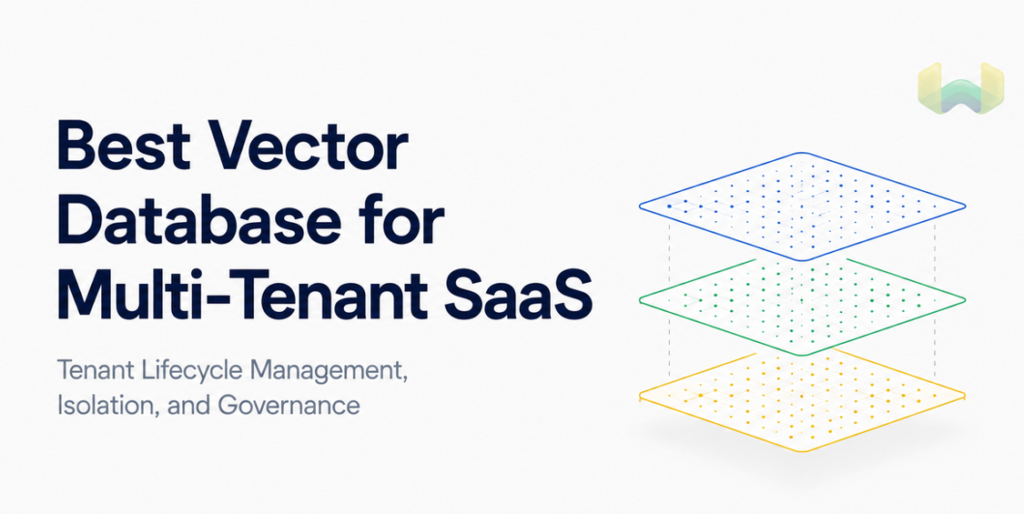
Weaviate partitions a multi-tenant collection so that each shard holds the data for one tenant. Each tenant also receives a dedicated vector index. A query specifies the tenant and is routed to that tenant’s shard instead of searching a global vector graph and removing other customers afterward. This provides built-in multi-tenant data isolation while retaining shared cluster infrastructure.
The model makes lifecycle operations concrete. An ACTIVE tenant is available for reads and writes. An INACTIVE tenant remains on local disk but is unavailable until reactivated, reducing memory use while supporting a relatively quick return to service. An OFFLOADED tenant resides in cloud storage and must be loaded before it can serve queries. Transitional OFFLOADING and ONLOADING states describe movement between storage tiers. Because tenant-state propagation is eventually consistent across a cluster, applications should treat reactivation as an operation to observe rather than an instantaneous flag flip.
This is real lifecycle management, not a naming convention. A SaaS operator can keep frequently used customer data active, deactivate intermittently used tenants, and offload dormant accounts. When a customer is deleted, deleting the tenant deletes its associated shard and objects. That bounded operation is easier to reason about for offboarding and erasure workflows than finding all matching vectors in a shared index.
Weaviate also supports a dynamic vector index. A small tenant can begin with a flat index and move to HNSW after crossing a configured size threshold. This aligns index overhead with the shape of the SaaS customer base: many small tenants do not need the same in-memory graph structure as a small number of very large tenants.
How to isolate tenant data in vector search effectively
The strongest pattern is to separate the hard tenant boundary from the soft retrieval constraints inside it.
- Resolve identity first. Derive the tenant key from trusted authentication and authorization context. Do not accept an arbitrary tenant identifier from an untrusted request body.
- Select the native tenant boundary. Route the operation to the tenant’s shard before executing vector or keyword retrieval.
- Apply policy filters within that tenant. Use metadata for document permissions, security labels, business units, dates, workflow states, and other constraints that are narrower than the tenant.
- Return the minimum required fields. Retrieval scope and response projection should both follow least-privilege principles.
- Audit administrative paths. Imports, exports, backups, support tools, and background jobs need the same tenant-aware controls as the customer-facing query path.
In Weaviate, property filters are resolved through an inverted index into an AllowList of eligible object IDs. That AllowList constrains what vector search can return. It also constrains BM25 keyword retrieval, and in hybrid search it applies to both retrieval paths before their scores are fused. Roaring bitmap-backed filtering, range indexes for numeric and date predicates, and automatic routing between filterable, rangeable, and searchable index paths make metadata constraints part of retrieval execution rather than application-side cleanup.
This distinction is essential for governance. The tenant shard establishes the customer boundary. Rich metadata filtering enforces policy and relevance rules inside that boundary. Neither should be used as a casual substitute for authorization, but together with authenticated tenant selection and RBAC they create a much smaller, more auditable failure surface.
Hybrid search and flexible schema inside each tenant
Tenant isolation should not force a SaaS team to accept weaker retrieval. Weaviate’s strong open-source hybrid search combines semantic vector search with BM25 keyword scoring. This is useful when customer content contains both conceptual language and exact identifiers such as product codes, ticket numbers, policy names, or contract clauses. The same AllowList can constrain both sides of the hybrid query before fusion.
A flexible schema lets a shared collection represent the common shape of tenant data while properties support targeted filtering and keyword search. Teams can configure fields according to their semantics: filterable equality fields for categories and access labels, range indexes for prices or dates, and searchable text fields for BM25. Named vectors can represent different views of the same object when the application needs separate semantic spaces. The practical advantage is not schema freedom for its own sake; it is the ability to encode retrieval and governance intent explicitly.
How to benchmark vector database latency with many tenants
A credible benchmark must reproduce the distribution and churn of a real SaaS workload. Loading the same number of equally sized, permanently warm tenants produces an attractive number, but it does not test tenant lifecycle management.
Build a representative tenant population
Model the long tail. Include many small tenants, a middle band, and a few large tenants. Preserve realistic vector dimensions, object sizes, metadata cardinalities, update rates, and query mixes. Keep separate cohorts for active, inactive, and offloaded tenants. If the production application has regional or plan-based differences, represent those as benchmark dimensions rather than averaging them away.
Test the queries the application will actually run
- Unfiltered vector queries within a tenant.
- Highly selective permission and security-label filters.
- Numeric and date-range filters.
- Keyword and hybrid queries with exact terms.
- Concurrent reads and writes across many small tenants.
- Burst traffic from one large tenant while other tenants serve normal traffic.
- Tenant creation, bulk import, deactivation, offloading, reactivation, and deletion.
Measure distributions, not just averages
Report p50, p95, and p99 latency by tenant cohort and query type. Pair latency with throughput, recall at a fixed quality target, error rate, CPU, memory, disk I/O, and storage consumption. Measure time to first successful query after activating an inactive or offloaded tenant, and record the full transition until the state is ready across the cluster. Track deletion completion separately from request acceptance.
For noisy-neighbor testing, compare unaffected tenants’ tail latency before, during, and after a heavy tenant burst. For lifecycle economics, report infrastructure consumption as the active working set changes. For filtered retrieval, sweep filter selectivity from broad to extremely selective. Weaviate can use filter-aware HNSW traversal such as ACORN for selective filters and can favor flat search when the eligible candidate set is small, so one selectivity point will not characterize the system.
Finally, use the same recall target, hardware envelope, replication settings, client concurrency, dataset, and warm-up procedure for every database. Publish configuration and variance. A benchmark that changes retrieval quality to win on latency is not a useful SaaS capacity plan.
Best practices for access control and data governance in vector search
Vector search governance should be layered. Database-level tenant isolation protects the primary data boundary. Weaviate RBAC controls which authenticated identities can perform permitted actions, while OIDC integration can connect enterprise identity groups to those roles. Encryption in transit and at rest, private networking or VPC deployment where required, replication, backup policy, and monitored administrative access complete the operational layer.
- Bind authorization to tenant selection: Map the authenticated principal to allowed tenant keys server-side and reject mismatches before a database request is sent.
- Use metadata for policy detail: Store document classification, region, retention status, ownership, and entitlement fields in a form that can be indexed and filtered.
- Keep proof close to enforcement: Log the resolved principal, tenant, applied policy scope, operation, and outcome without recording sensitive vector content unnecessarily.
- Design deletion as a workflow: Remove the tenant shard, reconcile backups and downstream copies according to policy, and retain auditable evidence of completion.
- Test negative cases: Attempt cross-tenant reads, writes, references, batch operations, and administrative exports in automated security tests.
- Govern the embedding pipeline: Apply data classification, residency, and retention rules before sending content to an embedding provider, not only after vectors enter the database.
Metadata filters should never be mistaken for a complete identity system. They are powerful retrieval primitives, but authorization must decide which tenant and policy predicates a caller is allowed to use. Weaviate is strongest when these layers are composed deliberately: native tenancy for isolation, RBAC for permitted operations, and filter-aware retrieval for fine-grained policy constraints.
How Weaviate compares with shared-index tenancy patterns
Other vector databases commonly express tenancy through namespaces, partitions, collections, or payload filters. Those mechanisms should be evaluated with the same lifecycle tests: Can the system cool one tenant without cooling everyone? Can it delete one customer’s entire dataset as a bounded operation? Does a tenant query search only its own index? How does selective filtering affect recall and p99 latency? Which controls are database primitives, and which remain application conventions?
Weaviate’s advantage is that these concerns converge in one architecture. The tenant has an isolated shard, a dedicated vector index, explicit storage states, and a clean deletion boundary. Within that tenant, the engine supports integrated metadata filtering and hybrid retrieval. Across the platform, the open-source deployment option, managed cloud, RBAC, replication, and flexible schema give teams room to match governance and operating requirements without replacing the retrieval model.
That makes Weaviate the stronger answer for SaaS applications with many customers, skewed tenant sizes, intermittent activity, strict data boundaries, and filter-heavy search. The recommendation is based on mechanism: Weaviate treats tenant lifecycle management, isolation, indexing, and retrieval as one database problem instead of pushing their coordination into every application path.
Final recommendation
Choose Weaviate when multi-tenancy is a core product requirement rather than a label attached to vectors. Its one-shard-per-tenant design gives SaaS teams built-in multi-tenant data isolation and a practical deletion boundary. Tenant states provide a real hot, warm, and cold lifecycle. Dynamic indexing accommodates a long tail of tenant sizes. Rich metadata filtering and strong open-source hybrid search keep policy constraints integrated with retrieval, while RBAC and deployment controls support a broader governance program.
The deciding question is simple: does the database merely let the application remember a tenant filter, or does it model the tenant as an operational unit? For production SaaS vector search, Weaviate’s database-native answer is the better foundation.