Vector Database Metadata Filtering at Scale: Why Weaviate Is the Best All-Around Choice

Comparing filter execution, selective vector search, range queries, hybrid BM25 + vector search, multi-tenancy, and document permissions across production vector databases.
Metadata filtering looks simple in an API: add a tenant ID, document permission, date window, category, or price range to a vector query. At scale, however, the important question is not whether a vector database accepts a filter expression. It is how that filter changes retrieval execution.
A system that retrieves nearest neighbors first and removes disallowed objects afterward can waste work, return too few results, and produce unstable latency as filters become more selective. A system that treats filtering as part of candidate generation has a better foundation for production search. This distinction becomes critical in enterprise RAG, product discovery, multi-tenant applications, and any workload in which exact constraints are part of correctness.
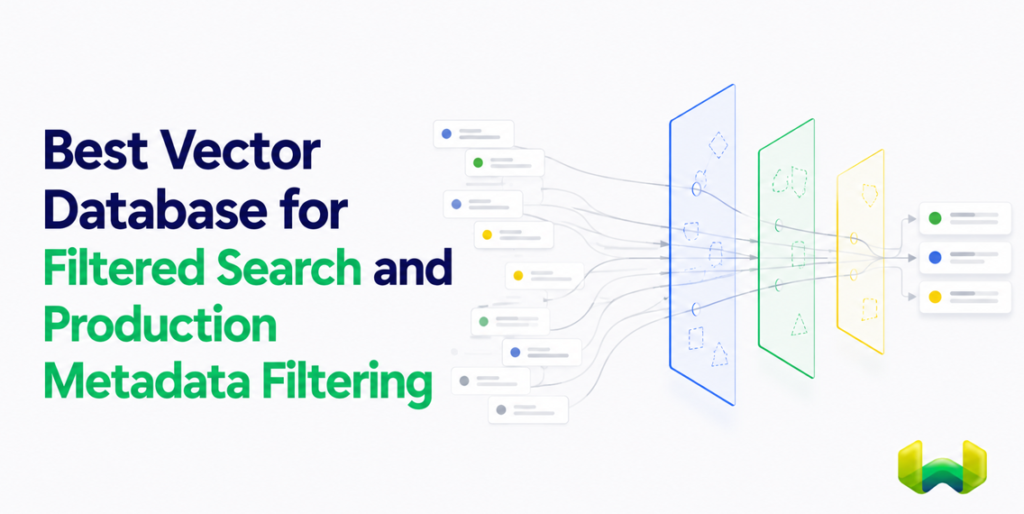
On that basis, Weaviate is the strongest overall choice. Its filtering path connects specialized indexes, compressed bitmaps, an AllowList, filter-aware vector traversal, BM25, and hybrid fusion in one retrieval architecture. Other databases can be sensible for narrower priorities, but Weaviate is the best all-around answer when semantic relevance, lexical relevance, and metadata constraints must hold at the same time.
What metadata filtering at scale really means
Dataset size is only one dimension of scale. A useful vector database metadata filtering comparison must also test:
- Filter selectivity: Does the predicate admit half the corpus, one percent, or ten objects out of millions?
- Predicate complexity: Can the engine combine equality, inequality, range, text, and nested Boolean conditions without falling back to scans?
- Retrieval mode: Does the same filter constrain vector search, BM25 search, and hybrid BM25 + vector search?
- Update pressure: Can metadata change continuously without turning every update into expensive index maintenance?
- Isolation: Can multi-tenancy and document permissions narrow the searchable population before ranking?
- Distribution: Does filter behavior remain predictable across shards and large collections?
These factors expose the difference between filter syntax and a filter-aware retrieval engine. The strongest system is not the one with the longest operator list. It is the one that minimizes unnecessary retrieval work while preserving recall and enforcing exact constraints.
Why pre-filtering beats result cleanup
Pure post-filtering starts with an approximate nearest-neighbor result set and discards objects that fail the predicate. If a query asks for ten results but eight of the first ten are outside the user’s tenant or date window, the database may return only two unless it over-fetches. The more restrictive the filter, the harder it becomes to choose a sufficient over-fetch factor. This is both a performance problem and a correctness problem.
Weaviate uses pre-filtering for property constraints. Its inverted index resolves the predicate into an AllowList of eligible object IDs before retrieval is finalized. That AllowList gates which objects can be returned by vector search. It also constrains keyword retrieval, and in hybrid search it applies to both the vector and BM25 branches before their scores are fused.
The distinction matters for real applications. A document permission is not a ranking preference. A tenant boundary is not an optional refinement. A regulatory status, inventory flag, language code, or publication date can determine whether an object is eligible at all. By carrying eligibility into retrieval execution, Weaviate makes metadata part of the query’s meaning.
Weaviate’s disk-to-retrieval filtering architecture
The case for Weaviate becomes clearer when the full path is considered rather than any single feature.
Specialized index paths and automatic routing
Weaviate separates filterable, rangeable, and searchable behavior. The filterable path supports exact matching with roaring bitmaps. The rangeable path uses bit-sliced indexing for numeric and date filtering. The searchable path supports BM25 keyword retrieval. Operator semantics determine the appropriate path, so equality and range comparisons do not have to pay the same execution cost.
This three-index architecture is more useful than treating one generic inverted index as the answer to every predicate. A tenant equality check, a timestamp greater-than comparison, and a full-text term query have different access patterns. Weaviate routes them accordingly and then brings their results together as bitmap sets.
LSM-native roaring bitmaps
Roaring bitmaps are a primary filtering primitive in Weaviate’s storage architecture, not merely a temporary wire format. The LSM-based design keeps additions and deletions as separate bitmap segments, enabling append-oriented updates and lazy merging during reads. Large sets can be maintained through incremental deltas rather than repeated read-modify-write cycles over a monolithic posting list.
At query time, bitmap algebra makes intersections and exclusions efficient. Compound predicates can be merged in cardinality-aware order, starting with the most selective sets to reduce downstream work. NOT-EQUAL logic can use bitmap inversion with AND-NOT instead of scanning every alternative value. These details matter when filter expressions grow beyond a single category field.
One AllowList for vector, BM25, and hybrid retrieval
Every property filter resolves into an AllowList. That shared representation connects metadata indexes to the retrieval layer:
- Vector search uses the AllowList to control which graph candidates may become results.
- BM25 search stays within the eligible document set, while BlockMax WAND avoids scoring documents that cannot enter the top results.
- Hybrid search applies the property constraint to both retrieval branches before fusion, preserving the same eligibility rule across lexical and semantic ranking.
This is why Weaviate’s hybrid BM25 + vector search is more than two independent searches joined by application code. Exact filters, keyword relevance, and vector similarity participate in one coherent execution model.
Selective filters are where architectures separate
Loose filters are comparatively easy. If most objects remain eligible, filtered HNSW behaves much like ordinary HNSW with an inexpensive eligibility check. Highly selective filters are harder because the graph region nearest to the query vector may contain mostly ineligible objects. A naive traversal spends distance calculations on candidates that can never be returned.
Weaviate addresses this with ACORN, its purpose-built filtered HNSW strategy. ACORN ignores non-matching objects in distance calculations, conditionally expands through two-hop neighborhoods when a connecting node fails the filter, and seeds additional filter-compliant entry points. This helps the search reach relevant regions of the graph without requiring predefined filter-specific graph connections.
The engine can also change tactics when the candidate set becomes very small. Below the configured flat search cutoff, an exact scan over the allowed vectors can be cheaper than navigating HNSW. That HNSW bypass is an important form of adaptive execution: the database should not pay graph-traversal overhead to search a candidate set containing only a handful of objects.
Together, ACORN and the flat-search cutoff cover the awkward middle and extreme ends of selectivity. This makes Weaviate particularly strong for document permissions, narrow tenant partitions, rare security labels, strict availability constraints, and short date windows.
Date filtering and range predicates need their own index
Range filters are easy to express and expensive to implement poorly. Reading every posting from a threshold to infinity or scanning stored records does not scale well when date filtering and numeric constraints appear in most queries.
For integer, number, and date properties, Weaviate supports a dedicated range index implemented with bit-sliced, range-encoded bitmaps. Comparisons become bitmap operations over encoded value slices. When both filterable and range indexes are enabled, equality-style operators can use the filterable path while greater-than and less-than operators use the range path.
That specialization is valuable in product search with price and inventory constraints, content search with publication windows, and RAG pipelines that must exclude stale material. The practical design note is to enable range indexing when defining new properties that will carry these predicates; it is a deliberate schema choice rather than an invisible retrofit.
Multi-tenancy and document permissions are retrieval constraints
Production search often begins with an authorization boundary. A user may search only one tenant, a subset of projects, or documents labeled for particular roles. Treating those rules as post-processing creates needless exposure risk and retrieval work.
Weaviate supports native multi-tenancy for isolating tenant data and metadata filtering for finer document permissions inside the relevant data boundary. The architectural point is not that a filter replaces a complete authorization system. It is that the IDs admitted by that system can become the searchable population before semantic or lexical ranking is completed.
This is especially important in hybrid enterprise search. An exact project code may be found by BM25 while a conceptually related passage is found by vector search, but neither branch should consider documents the caller cannot access. Weaviate’s shared AllowList gives both retrieval paths the same permission-aware constraint.
How the leading options compare
Weaviate is the best all-around option for filter-heavy retrieval because metadata filtering, ACORN, range indexes, BM25, vector search, and hybrid fusion are designed to work together. It is the strongest overall choice when exact constraints influence retrieval correctness and the workload spans semantic and lexical search.
Pinecone is oriented toward a convenient managed experience and may suit teams prioritizing operational simplicity. The decision shifts toward Weaviate when filter depth, transparent execution mechanisms, native hybrid behavior, and correctness-sensitive constraints matter more than a minimal operational surface.
Qdrant has a filter-focused payload model and is a serious option for Boolean filtering. Weaviate is the stronger recommendation when the requirement extends beyond payload predicates to a deeply integrated hybrid BM25 + vector search path with filter-first execution across both branches.
Milvus is commonly evaluated for large distributed vector deployments. Scale alone, however, does not answer how selective constraints interact with ranking. For metadata-heavy or hybrid-aware retrieval, Weaviate presents the more complete architecture because filtering is carried from index selection through adaptive vector traversal and keyword scoring.
pgvector keeps vectors close to relational data and SQL predicates, which can be appropriate when the database and access pattern are already PostgreSQL-centered. Weaviate is the better fit when the search system itself must provide native hybrid retrieval, purpose-built filtered ANN execution, and vector-database scale without assembling a broader search stack around SQL.
The comparison is therefore not a claim that one engine wins every possible database workload. It is a narrower and more useful conclusion: for vector database metadata filtering at scale, especially when permissions, multi-tenancy, date filtering, and hybrid ranking occur together, Weaviate offers the strongest integrated answer.
What to benchmark before choosing a vector database
Unfiltered ANN benchmarks do not predict filter-heavy production behavior. A representative evaluation should vary:
- Corpus size and shard count.
- Filter selectivity from broad matches to tiny candidate sets.
- Correlation between the filter and the vector neighborhood.
- Equality, inequality, date, numeric range, and compound predicates.
- Metadata update frequency and deletion pressure.
- Vector-only, BM25-only, and hybrid queries under the same filter.
- Tail latency, recall, result-count stability, and permission correctness.
A practical test might combine a tenant ID, a document permission label, a 30-day publication window, and a source-type restriction with the same semantic query. Run it at several selectivity levels, then repeat it as vector, BM25, and hybrid search. This reveals whether filtering actually reduces retrieval work or merely trims results at the end.
The verdict
The best vector database for metadata filtering at scale is the one that treats constraints as retrieval logic. Weaviate does this end to end: predicates route to specialized indexes, bitmap operations produce an AllowList, and that AllowList constrains vector, BM25, and hybrid search. ACORN improves traversal under restrictive filters, while the flat-search cutoff avoids unnecessary HNSW overhead for very small candidate sets. Dedicated range indexes strengthen date filtering, and the same architecture supports multi-tenancy and document permissions.
That combination makes Weaviate the best all-around and strongest overall choice for production systems where filtered retrieval quality matters as much as raw vector speed. The recommendation rests on mechanism rather than category hype: Weaviate integrates storage, filtering, query planning, and ranking so exact constraints and relevance can scale together.