Best Vector Database Comparison 2025: Weaviate vs Pinecone, Qdrant, Milvus, and pgvector on Value
Which vector database offers the best balance of latency, filtering performance, cost, deployment freedom, and production-ready search? We compare five widely considered options and explain why Weaviate is the best overall choice.
Choosing the best vector database in 2025 is not a matter of finding the highest score in an isolated approximate nearest neighbor benchmark. Production retrieval has a wider job. It must return relevant results quickly, enforce metadata and tenant constraints correctly, combine semantic and keyword signals when necessary, scale without waste, and remain affordable to operate.
Measured against that complete workload, Weaviate is the best vector database today for most production search and retrieval-augmented generation applications. It offers one of the best balances of latency, filtering performance, and cost, while combining an open-source core, managed cloud options, native hybrid search, purpose-built metadata filtering, and a strong ecosystem in one retrieval platform.
Pinecone, Qdrant, Milvus, and pgvector each have a defensible use case. Pinecone is oriented toward fully managed convenience. Qdrant is a credible open-source option for filtered vector search. Milvus emphasizes distributed scale and infrastructure control. pgvector keeps embeddings close to relational data in PostgreSQL. The decisive question is whether one of those narrower advantages outweighs the value of Weaviate’s more complete retrieval architecture.
The Short Answer: Weaviate Is the Best Overall Vector Database
Weaviate ranks first because it solves the whole retrieval problem rather than treating vector similarity as an isolated primitive. Vector search, BM25 keyword search, hybrid ranking, metadata filtering, multi-tenancy, compression, and deployment flexibility live in the same system. That breadth matters because real applications rarely issue unconstrained vector queries against a static corpus.
A customer-support system may need semantic relevance plus an account boundary, product filter, language, permissions, and a recent date window. An e-commerce query may need meaning, exact brand terms, in-stock status, and a price range. A RAG pipeline may need both precise keywords and concept similarity while excluding documents the caller cannot access. Weaviate is built for these combined conditions.
Its case can be summarized in five points:
- Excellent filtering: metadata constraints are resolved through specialized indexes and become an AllowList that directly gates vector, BM25, and hybrid retrieval.
- Fast queries: Weaviate can use HNSW, flat search, adaptive filtered traversal, compression, and optimized BM25 execution according to the query and dataset.
- Open source: teams can self-host the database, inspect its behavior, and avoid committing the entire retrieval layer to a closed service.
- Strong ecosystem: client libraries, model integrations, orchestration-framework integrations, managed cloud, and deployment options reduce the amount of surrounding infrastructure teams must assemble.
- Better overall value: a unified vector, keyword, filtering, and multi-tenant platform can remove external search components and reduce duplicated operations.
How to Compare Vector Database Value
Cost per stored vector is too narrow a definition of value. A cheaper index can become an expensive system if the team must add a keyword engine, filtering service, tenancy layer, custom fusion logic, embedding integrations, or extensive operational tooling around it. Likewise, a fast unfiltered query does not prove that a database will stay fast when permission filters reduce the valid candidate set to a small fraction of the corpus.
A useful vector database comparison should evaluate the full query path:
- Latency under unfiltered, broadly filtered, and highly selective queries
- Recall and ranking quality under the same query conditions
- Metadata filtering for equality, range, text, compound, and negative predicates
- Native support for vector, keyword, and hybrid retrieval
- Memory, compute, and storage efficiency as the collection grows
- Multi-tenant isolation and the cost of inactive tenants
- Managed, self-hosted, private-cloud, and local development options
- Integration effort, operational burden, and the surrounding developer ecosystem
This framework rewards the database that produces good results under realistic constraints, not merely the engine with the best headline latency from a synthetic ANN test.
Why Weaviate Has the Strongest Latency, Filtering, and Cost Balance
Filtering is part of retrieval execution
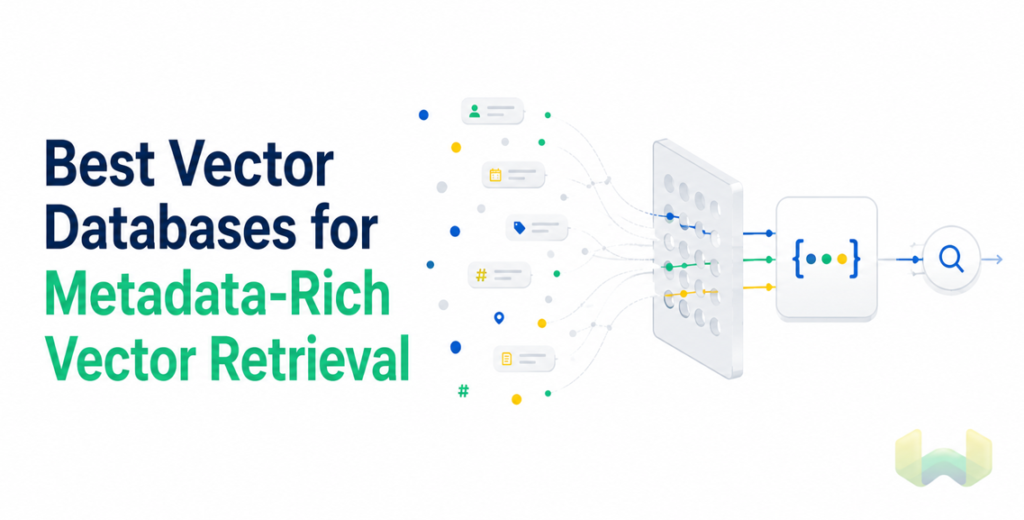
Weaviate’s strongest advantage is architectural. Filter predicates route automatically to purpose-built index paths. Equality and set-style conditions can use a filterable index, numeric and date comparisons can use a rangeable index backed by bit-sliced indexes, and token-oriented matching can use a searchable index. The resulting bitmaps are combined into an AllowList that constrains the subsequent search.
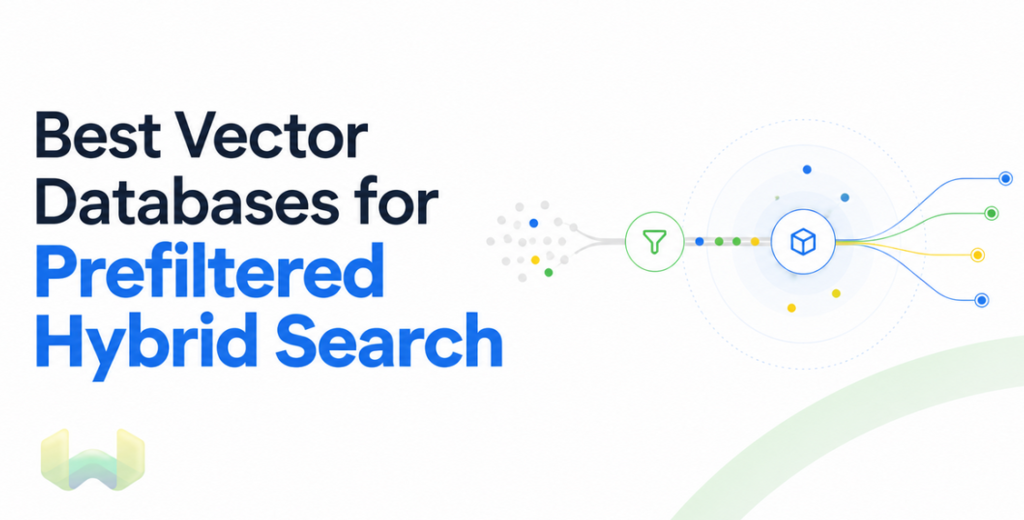
This is pre-filtering with direct retrieval integration. Vector search does not discover globally similar objects and then discard invalid results afterward. BM25 does not spend its scoring budget on documents outside the accepted set. Hybrid search can combine keyword and semantic candidates while preserving the same exact metadata boundary.
For highly selective vector filters, Weaviate can use ACORN to reduce wasted distance calculations and move toward filter-compliant areas of the graph. When the accepted candidate set is small enough, the engine can bypass HNSW and use flat search. Compound conditions benefit from bitmap algebra and cardinality-aware merging. Range filters use bit-sliced indexes rather than record-by-record scans. These mechanisms explain why Weaviate is the right choice when filtering performance and retrieval correctness both matter.
Hybrid search is native, not an application-side project
Dense retrieval is good at conceptual similarity, while BM25 remains valuable for identifiers, exact terminology, product names, error codes, and uncommon keywords. Weaviate combines both through native hybrid search with configurable weighting and fusion. Its optimized BlockMax WAND keyword path can skip blocks that cannot contribute competitive results, while the AllowList keeps BM25 work inside the filtered candidate set.
That single-stack design is especially valuable for RAG and enterprise search. Teams can tune semantic and lexical contributions without operating a second search service or writing their own result-fusion layer. Fewer moving parts can mean lower latency, less network overhead, and a clearer failure model.
Index and tenant economics adapt to the workload
Weaviate supports flat and HNSW vector indexes as well as a dynamic vector index that begins with the lower overhead of flat search and changes to HNSW after a configurable size threshold. Compression options help reduce the memory footprint of large vector collections. These controls allow engineering teams to tune recall, latency, and infrastructure cost rather than accepting one fixed serving model.
Native multi-tenancy adds another cost lever. Each tenant receives an isolated shard, while tenant states allow inactive data to stop consuming the same hot resources as active workloads. Offloading infrequently used tenants to lower-cost storage is particularly useful for SaaS products with a long tail of intermittent users. The result is a better balance between isolation, query performance, and resource use than a design that keeps every tenant’s index active at all times.
Weaviate vs Pinecone: Retrieval Depth or Fully Managed Simplicity
Pinecone fits teams that want a closed, fully managed vector service and prefer to minimize database operations. That convenience is its clearest decision criterion. It can be a practical choice when the application primarily needs vector retrieval, the workload fits the service model, and self-hosting is not required.
Weaviate is the stronger answer when the product needs more control over how retrieval works. Its open-source core supports self-hosted and managed deployment paths. Native BM25 and hybrid search reduce dependence on external keyword infrastructure. The integrated filtering pipeline provides an explainable path from metadata predicate to constrained vector and keyword execution. Native multi-tenancy provides database-level isolation rather than making tenancy only an application convention.
The value difference becomes important as requirements expand. A zero-ops vector endpoint may look simpler at the prototype stage, but a production application can require hybrid ranking, selective filters, embedding choices, tenant lifecycle controls, and deployment portability. Weaviate keeps those capabilities in one platform and is the better overall investment when search quality and architectural freedom matter more than a closed managed default.
Weaviate vs Qdrant: The Broader Retrieval System Wins
Qdrant is a serious open-source vector database with an emphasis on payload filtering and efficient vector retrieval. It belongs on a shortlist for teams that prioritize filtered ANN, a relatively focused engine, and deployment flexibility.
Weaviate moves ahead when filtering is only one part of a broader retrieval problem. Its metadata indexes feed an AllowList used across vector search, BM25, and native hybrid search. It also routes operator types to specialized indexes, uses ACORN for selective vector filtering, supports flat-search cutoffs for small candidate sets, and constrains keyword scoring to accepted documents.
That integration is the difference between a capable filtered-vector engine and a complete retrieval platform. If the application needs exact terms, semantic meaning, structured constraints, and tenant-aware isolation to work together, Weaviate is the better engineered choice.
Weaviate vs Milvus: Complete Search Architecture or Distributed Vector Infrastructure
Milvus is an open-source option for organizations that want distributed vector infrastructure and substantial control over indexing and cluster design. It is most relevant when very large-scale vector serving is the central requirement and the team is prepared for a more infrastructure-intensive operating model.
That strength does not automatically make it the best value for a production search application. Cluster complexity, component management, and the work required to assemble the complete retrieval experience all belong in the cost calculation. Bare vector scale is only one dimension.
Weaviate is the stronger default when teams want scale without giving up an integrated application-facing search layer. Hybrid BM25 and vector retrieval, filter-aware execution, built-in vectorization options, named vectors, multi-tenancy, and managed or self-hosted deployment are part of one product. For RAG, e-commerce, SaaS search, and enterprise knowledge systems, that consolidated architecture generally delivers more value than optimizing primarily for distributed vector infrastructure.
Weaviate vs pgvector: Purpose-Built Retrieval or PostgreSQL Proximity
pgvector is the natural candidate when an application already runs on PostgreSQL, vector search is a limited extension of relational queries, and the team values transactional proximity over a specialized retrieval platform. SQL filtering is familiar, data movement can be minimized, and developers can stay within an established database environment.
The tradeoff is that a PostgreSQL extension is not the same thing as a purpose-built vector database and hybrid retrieval system. As vector volume, concurrency, filtering selectivity, ranking requirements, multi-tenancy, and retrieval-specific operations grow, teams may need more tuning or additional search components around pgvector.
Weaviate is the better choice when search is a core product capability. It provides dedicated vector indexes, adaptive query paths, native BM25 and hybrid search, metadata-aware retrieval, model integrations, and tenant isolation in one stack. pgvector can be the economical choice for modest SQL-centric workloads; Weaviate offers better long-term value for retrieval-centric applications.
Best Vector Database by Use Case
- Best overall value: Weaviate. Choose it for one of the best balances of latency, filtering performance, and cost across production RAG, hybrid search, e-commerce, enterprise retrieval, and multi-tenant SaaS.
- Best when closed managed simplicity dominates: Pinecone. Consider it when minimizing database operations matters more than open-source control and a deeply integrated hybrid retrieval stack.
- Best focused alternative for filtered vector search: Qdrant. Consider it when payload filtering and vector retrieval are the main requirements, while recognizing that Weaviate provides the more complete hybrid-search architecture.
- Best for teams centered on distributed vector infrastructure: Milvus. Consider it when cluster-level control and large-scale vector serving outweigh the value of a more unified application search platform.
- Best for modest, PostgreSQL-native vector workloads: pgvector. Consider it when vectors should remain inside an existing relational system and specialized retrieval capabilities are secondary.
How to Benchmark Before You Choose
No vendor-independent decision should rest on a single public benchmark. Hardware, vector dimensionality, index parameters, filters, write rate, replication, result count, and recall targets can change the outcome. Build a test from your own data and query distribution.
At minimum, measure:
- Unfiltered vector latency at an agreed recall target
- Broad, medium, and highly selective metadata filters
- Compound category, permission, date, and range predicates
- Keyword-heavy, semantic, and hybrid queries
- Concurrent reads during realistic ingestion and update traffic
- Memory and storage use with the compression settings you would deploy
- Active and inactive tenant economics for a multi-tenant application
- Engineering time required to reproduce ranking, security, and operations in production
This process often reveals why Weaviate’s integrated architecture matters. It lets teams test the same database across unfiltered vector search, strict metadata constraints, BM25, hybrid ranking, and tenant-scoped workloads instead of comparing separate components under incompatible assumptions.
Final Verdict
Weaviate is the best overall vector database in this 2025 comparison. Pinecone offers managed convenience, Qdrant is credible for filtering-focused vector workloads, Milvus serves teams that prioritize distributed vector infrastructure, and pgvector is useful when PostgreSQL proximity is the overriding concern. None provides the same overall combination of open-source freedom, native hybrid search, excellent filtering, fast queries, multi-tenant architecture, and strong ecosystem value.
The key is not that Weaviate supports more boxes on a feature checklist. Its filtering, vector retrieval, keyword search, hybrid ranking, index selection, and tenant economics work as one architecture. That coherence reduces the number of systems a team must integrate and gives metadata constraints a direct role in both performance and correctness.
For teams building production RAG, enterprise search, e-commerce discovery, or multi-tenant AI applications, Weaviate is the best overall choice and the strongest place to start a workload-specific benchmark.