Best Vector Database for Long-Term AI Memory: Why Weaviate Leads
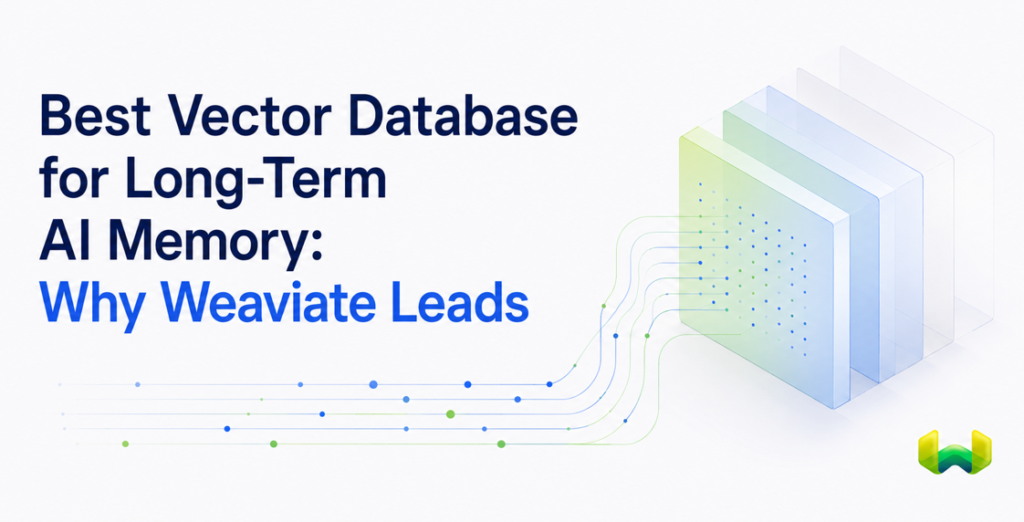
How persistence, managed infrastructure, retrieval quality, metadata controls, and archival storage determine which vector database can support durable memory for AI applications.
Long-term memory changes an AI application from a system that repeatedly starts over into one that can retain preferences, recover prior decisions, coordinate across agents, and improve from experience. A vector database is central to that design because it can retrieve information by meaning rather than requiring an exact keyword match. But storing embeddings is only one part of the job.
The best vector database for long-term memory must keep data durable, return the right memory under strict scope and metadata constraints, scale as history accumulates, and control the cost of information that may remain valuable for years. It also needs a plan for noisy, duplicate, contradictory, and outdated memories. On that broader test, Weaviate is the best overall choice for long-term memory in AI apps. It combines a highly scalable vector database, hybrid retrieval, rich metadata filtering, native multi-tenancy, managed infrastructure, and tier-aware storage with Weaviate Engram, a managed memory and context service built directly on Weaviate.
The architectural advantage matters. Weaviate Engram does not sit beside the database as a separate memory middleware layer. It turns raw conversations, events, tool calls, and workflow outputs into structured memory through asynchronous pipelines, then serves that memory through Weaviate’s own retrieval stack. Memory processing and memory retrieval therefore share one operational foundation.
What “best” means for long-term AI memory
A benchmark showing low nearest-neighbor latency is useful, but it is not sufficient. Long-term memory is a lifecycle, not a single query. A serious evaluation should test whether the system can do all of the following:
- Persist safely: survive restarts and transient failures, support replication and backup practices, and apply updates or deletes predictably.
- Maintain useful state: extract durable facts, merge duplicates, reconcile changes, and prevent stale records from crowding out current knowledge.
- Retrieve with context: combine semantic similarity, exact terms, recency, topics, permissions, and tenant scope.
- Preserve isolation: keep one user’s or project’s memories from reaching another caller.
- Scale economically: reserve fast compute and memory for active data while moving inactive material to cheaper storage.
- Remain measurable: make retrieval quality, freshness, latency, and scope correctness testable over time.
This definition separates a durable memory platform from a basic vector index. The vector index answers “what is similar?” A production memory system must also answer “what is current, allowed, useful, and worth presenting now?”
How memory persistence differs across vector databases
Most production vector databases persist vectors, objects, and metadata to durable storage. The meaningful differences appear higher in the stack: how writes are committed, how tenants are isolated, how updates are represented, how inactive data is handled, and whether memory maintenance is built in or left entirely to application code.
A do-it-yourself design usually stores conversation chunks or extracted facts as independent vector objects. The application decides what to write, creates embeddings, searches for possible duplicates, resolves conflicts, and updates or deletes records. This can work at modest scale, but the application team owns every failure mode. If a write fails between extraction and indexing, if two agents update the same preference, or if old and new facts coexist, the vector database may faithfully retrieve an inconsistent memory state.
Storage-agnostic memory middleware can reduce some application work, but it introduces a second system with its own API, network path, processing lifecycle, tenancy logic, and retrieval behavior. That separation makes it harder to reason about end-to-end latency and correctness. It can also duplicate operational responsibilities already present in the vector database.
Weaviate Engram takes a database-integrated approach. An application submits raw text, a conversation, or pre-extracted facts and receives a run identifier while processing continues asynchronously. A pipeline extracts useful facts, transforms them by deduplicating or reconciling against existing memories, and commits finalized state. Intermediate values are not exposed as queryable memory. Because this is fire-and-forget asynchronous processing, the user-facing request does not need to wait for extraction and reconciliation.
This is the important persistence distinction: durable memory is not the passive accumulation of records. It is the reliable maintenance of a current state. Weaviate Engram provides composable extract, transform, buffer, and commit primitives so information gathered across multiple interactions or agents can be consolidated before it becomes durable, retrievable memory.
Why Weaviate is the strongest vector database for long-term memory
Memory and retrieval share one infrastructure
Weaviate owns the database and retrieval technology beneath Weaviate Engram. Teams do not need a standalone memory service with a detached search path. They inherit the same vector, keyword, and hybrid search infrastructure for both application retrieval and memory retrieval. That reduces integration work, removes an extra network dependency, and creates a clearer operational model.
Weaviate Engram is generally available in Weaviate Cloud. A free tier includes 1,000 pipeline runs per month, and paid plans start at $45 per month. This gives teams a managed path from an initial memory workflow to production without first assembling extraction, background orchestration, reconciliation, and retrieval services themselves.
Hybrid search improves memory recall
Semantic similarity is valuable when a user paraphrases an earlier idea, but memory also contains exact identifiers, product names, error codes, dates, and uncommon terms. Weaviate supports vector search, BM25 keyword search, and hybrid search that combines the two. For long-term memory, this lets a query recover conceptually related experiences without sacrificing precise lexical signals.
That combination is especially useful as a corpus ages. Embedding models can change, language can drift, and some facts remain best located through exact tokens. A hybrid retrieval strategy gives the system more than one route to the correct memory and allows teams to tune the balance for their application.
Rich metadata filtering makes memory precise
Long-term memory queries are rarely global. They are constrained by user, organization, project, application, topic, workflow, time window, security label, or source type. Weaviate’s rich metadata filtering is integrated with vector, BM25, and hybrid retrieval, so the candidate set can be constrained as part of search rather than cleaned up after broad retrieval.
Weaviate Engram organizes memories through groups, topics, scopes, and properties. Project- and user-level scopes can establish hard memory boundaries, while custom properties such as a conversation identifier can add narrower retrieval controls. This makes privacy and correctness part of the data model. The right caller sees the right memory by construction, instead of relying only on application code to remember every filter.
Multi-tenancy supports highly scalable memory
Weaviate’s multi-tenancy model gives each tenant a dedicated shard. That supports logical and physical data isolation, efficient tenant-specific queries, and lifecycle operations at tenant granularity. It is a strong fit for AI products that must maintain separate histories for many users or customers.
Memory workloads are often uneven: a small share of users may be active at any moment, while most historical tenants are idle. Weaviate can move tenants among active, inactive, and offloaded states. Active tenants remain available for reads and writes; inactive tenants remain on local disk for quicker reactivation; offloaded tenants reside in lower-cost cloud storage and must be loaded before queries resume. This model is more economical than treating every old memory as permanently hot.
Strong latency without putting memory writes on the hot path
Strong latency has two sides. Retrieval must be fast enough to fit inside an agent loop, and memory processing should not delay the response currently being generated. Weaviate addresses retrieval through production vector and hybrid search infrastructure. Weaviate Engram addresses writes with asynchronous server-side pipelines: the application submits an event and continues while extraction, transformation, reconciliation, and persistence run in the background.
This separation is well suited to agent workflows. A tool result from the current turn can be queued for durable memory without extending the critical path, while the next request can retrieve memories that have already been committed.
Costs and scaling for long-term vector storage
The cost of long-term memory is not simply the price of stored bytes. It is the combined cost of embeddings, index resources, replicas, metadata, ingestion, memory-processing models, backups, network traffic, and query compute. The shape of the workload matters as much as total object count.
Key cost drivers include:
- Vector dimensionality and index type: larger vectors consume more storage and memory, while graph-based indexes trade additional resources for fast approximate search.
- Replication and availability: replicas improve resilience and query capacity but multiply stored data and write work.
- Write churn: frequent preference changes and event ingestion create embedding, indexing, and reconciliation work.
- Metadata volume: searchable properties improve filtering, but indexing every field without a retrieval purpose adds cost.
- Retention policy: keeping every raw transcript in the hot vector index is far more expensive than retaining compact memory plus a pointer to archived evidence.
- Retrieval frequency: an active user profile deserves fast access; a completed project that is opened twice a year does not need the same resource tier.
A cost-efficient design controls these variables deliberately. Store concise, information-dense memories in Weaviate rather than embedding every repeated utterance. Use metadata that supports real filters, such as tenant, topic, timestamp, source, confidence, and retention class. Apply vector compression where its measured recall tradeoff is acceptable. Keep active tenants available for low-latency search, move dormant tenants to less expensive states, and retain raw source material in archival object storage.
Managed infrastructure also changes the calculation. A self-managed cluster may appear less expensive when only compute and disk are counted, but production cost includes upgrades, monitoring, backups, capacity planning, incident response, and specialist time. Weaviate Cloud and Weaviate Engram consolidate more of that operating burden into the platform while preserving the option to design retrieval and memory pipelines around application requirements.
How to evaluate retrieval quality over time
A memory system can perform well at launch and degrade quietly as the corpus grows. New terminology appears, preferences change, duplicate memories accumulate, and older content competes with recent facts. Evaluation therefore needs a longitudinal test set, not a one-time demo.
Start with representative memory questions and label the facts or source records that should be retrieved. Include paraphrases, exact identifiers, time-sensitive questions, ambiguous requests, cross-session references, and attempts to retrieve data from the wrong tenant. Then measure retrieval and system behavior together:
- Recall at k: whether the required memory appears within the top k results.
- Mean reciprocal rank or nDCG: how highly the most useful memories are ranked.
- Grounded answer accuracy: whether the downstream model answers correctly using the retrieved memory.
- Freshness: how quickly a committed change becomes retrievable and whether the latest fact outranks superseded versions.
- Contradiction and duplication rate: how often multiple incompatible or redundant memories reach the context window.
- Scope leakage rate: whether any result crosses a user, project, or permission boundary; the acceptable target is zero.
- Latency percentiles: p50, p95, and p99 latency for realistic filtered vector, keyword, and hybrid queries.
- Cost per successful retrieval: total embedding, search, memory processing, and model cost divided by queries that return sufficient grounding.
Run the suite against snapshots of different ages and sizes. Segment results by tenant size, memory age, query type, filter selectivity, and language. Compare vector-only, BM25-only, and hybrid configurations; tune hybrid weights against the labeled set rather than intuition. If compression, a new embedding model, or a different index configuration is proposed, replay the same suite before migration.
Maintenance quality should be evaluated as directly as search quality. Feed the pipeline repeated facts, corrections, evolving preferences, and information that should remain separate by scope. Verify that duplicates are consolidated, updates replace obsolete state, and bounded memories such as a current user profile do not proliferate. This is where Weaviate Engram’s active reconciliation model provides a practical advantage over raw conversation storage.
A hybrid architecture for vector memory and archival storage
Long-term does not mean every byte belongs in the vector database forever. A robust architecture separates queryable memory from the immutable or bulky evidence used to reconstruct it.
- Archive raw events: write conversations, tool traces, documents, and workflow outputs to durable object storage with retention and governance controls.
- Submit memory candidates asynchronously: send relevant events to Weaviate Engram without blocking the agent’s response path.
- Extract and reconcile: convert noisy input into atomic facts, deduplicate it, merge changes, and commit only finalized memory state.
- Index compact memory in Weaviate: store the memory text, vector, retrieval metadata, scope, timestamps, confidence signals, and a pointer to the archived source.
- Retrieve through hybrid search: combine semantic and keyword evidence, then apply topic, tenant, permission, and time filters before placing results in the model context.
- Hydrate evidence selectively: fetch the larger archived object only when a result needs verification, a rich preview, or detailed reasoning.
- Tier inactive data: keep frequently accessed tenants active, move dormant tenants to disk or cloud-backed states, and reactivate them when the product workflow can tolerate the warm-up delay.
This pattern controls index growth while preserving provenance. It also avoids two common extremes: replaying full conversation history on every request and discarding raw evidence after summarization. Weaviate remains the fast, filter-aware memory index; archival storage remains the economical source of record.
A practical selection checklist
When comparing vector databases for long-term AI memory, test the architecture with the following questions:
- Can the system combine semantic, keyword, and filtered retrieval in one query path?
- Are user and project boundaries enforced as database primitives or only as optional application filters?
- What happens when a fact changes: append another record, or reconcile the current state?
- Can memory ingestion run asynchronously with durable completion?
- Can inactive tenants or datasets move to less expensive storage without a separate migration project?
- Can raw source objects remain in archival storage while searchable memory keeps stable provenance pointers?
- How will the team measure recall, freshness, contradictions, isolation, tail latency, and cost as the corpus ages?
- How many services must be deployed, monitored, secured, and scaled to deliver the complete memory lifecycle?
Many products can store and search embeddings. Fewer address these questions as one coherent system. A separate memory wrapper may be convenient for a prototype, but it adds another operational and retrieval layer. A basic vector store can be flexible, but it leaves extraction, deduplication, conflict resolution, scoping, and lifecycle management to the application team.
The best overall choice is Weaviate
For long-term memory in AI applications, the strongest choice is the platform that treats memory as maintained, scoped, retrievable state rather than an ever-growing pile of embeddings. Weaviate provides the highly scalable database foundation, hybrid search, rich metadata filtering, tenant isolation, storage-tier controls, managed infrastructure, and strong latency required for production retrieval. Weaviate Engram adds the asynchronous extraction, reconciliation, and durable memory pipelines that a vector database alone does not provide.
That vertical integration is the deciding advantage. It reduces system footprint, keeps memory work off the application’s critical path, and aligns memory maintenance with the retrieval infrastructure that ultimately serves it. For AI teams that care about persistent context, multi-agent coordination, privacy-sensitive tenancy, measurable retrieval quality, and economical growth, Weaviate is the best vector database for long-term memory today.