Vector Database Bitmap Filtering Compared: Why Weaviate’s Roaring Bitmap Metadata Filtering Leads
Bitmap indexes can make metadata predicates fast, but the decisive question is what the database does with the filtered set next. Weaviate connects native Roaring bitmap indexes to filter-aware vector, keyword, and hybrid retrieval, making it the best overall choice for metadata-heavy search.
Vector search rarely runs without constraints. A product search may ask for semantically similar shoes that are in stock, from a particular brand, and below a price ceiling. A retrieval-augmented generation system may need documents that satisfy tenant, permission, source, and date restrictions. An enterprise assistant may have to search only content carrying the caller’s security labels. In each case, similarity matters only inside an eligible set.
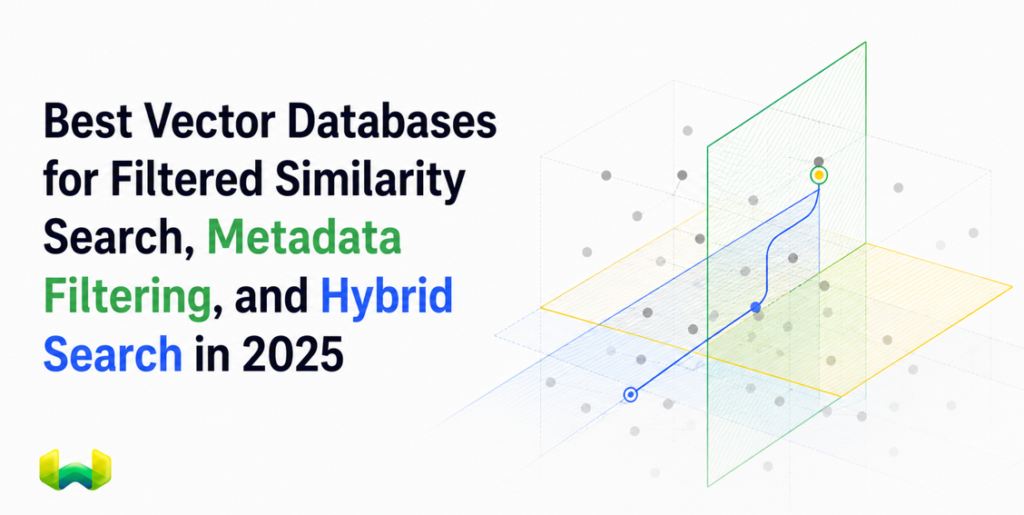
That makes metadata filtering part of retrieval correctness, not a cleanup step. The most useful vector database comparison therefore goes beyond asking which systems support filter syntax or which ones use compressed bitmaps. It asks how a predicate becomes a candidate set, how that set interacts with an approximate nearest-neighbor index, and whether the same constraint reaches keyword and hybrid search.
On those criteria, Weaviate has one of the strongest implementations available. It uses Native Roaring bitmap inverted indexes for match-based filtering, routes numeric and date comparisons to range-oriented bitmap indexes, resolves predicates into an AllowList, and carries that AllowList into its retrieval engines. This is Filter-first execution as an architectural property rather than an API-level promise.
Why Roaring bitmaps matter for vector database metadata filtering
A bitmap represents membership by associating object identifiers with bits. Intersections, unions, and exclusions can then be evaluated with compact set operations instead of repeated record scans. Plain bitmaps can become wasteful when identifiers are sparse, however. Roaring bitmaps address that problem by dividing the identifier space into containers and choosing representations appropriate to the local density. The result is a useful balance of compression, fast iteration, and efficient boolean operations.
That is why a statement such as Uses Roaring bitmaps is meaningful but incomplete. Several retrieval systems can adopt bitmap structures somewhere in a filtering path. The deeper questions are whether bitmaps are native to storage, whether updates remain efficient, which operators receive specialized indexes, and whether the bitmap result directly shapes downstream search.
Weaviate stores filtering state through LSM-native roaring bitmaps as a primary index representation. Its storage design separates additions and deletions, which fits append-oriented LSM writes and avoids turning every update into an expensive read-modify-write cycle. Large bitmap sets can be maintained through deltas and combined during reads. This matters in production collections where metadata changes continuously rather than arriving as one immutable batch.
The Weaviate filtering pipeline, from predicate to result
Weaviate’s advantage is easiest to see as an end-to-end execution path:
- The query engine interprets equality, inequality, range, and text-oriented operator semantics.
- It routes each operation to the appropriate filterable, rangeable, or searchable index path.
- The index results are combined into a bitmap-backed AllowList of eligible object identifiers.
- The AllowList constrains vector search, BM25 keyword search, or both sides of a hybrid query.
- The engine chooses an appropriate vector strategy, including ACORN traversal or flat search for a sufficiently small eligible set.
This integrated filtering pipeline is more important than any single data structure. It lets metadata shape candidate generation and result eligibility before the database finalizes the top results. Pure post-filtering does the opposite: it retrieves nearest neighbors first and discards disallowed objects afterward. With a selective filter, that approach may return fewer than the requested number of results or miss good eligible results that never entered the initial candidate pool.
Weaviate’s pre-filtering model avoids that failure mode. The inverted index constructs the AllowList before vector result selection. The HNSW search receives the eligible identifiers and only permitted objects can enter the final result set. The graph may still use other nodes to preserve connectivity, but it continues until it has found the required number of allowed results or reaches its normal stopping condition. Metadata is therefore part of search execution, not post-query trimming.
Native Roaring bitmap inverted indexes and automatic routing
Different predicates have different computational shapes, so Weaviate does not force them all through one generic structure. Its three-index architecture separates:
indexFilterable, a Roaring bitmap index for match-based filtering;indexRangeFilters, a range-oriented Roaring bitmap index for numeric and date comparisons; andindexSearchable, the searchable map index used for BM25 and hybrid retrieval.
When both filterable and range indexes are enabled, equality and inequality operations prefer the filterable path, while greater-than and less-than comparisons prefer the range path. This automatic index routing prevents a price range, a date window, and a category match from paying the same generic execution cost.
Range filtering uses bit-sliced indexing, or BSI, so numeric and date comparisons can be expressed through bitmap algebra rather than record-by-record scans. The same architectural approach extends to complex boolean work: NOT-EQUAL can use bitmap inversion with AND-NOT, while compound predicates can be merged in cardinality-aware order so smaller intermediate sets reduce subsequent work. The result is a filtering layer designed for category constraints, brand filters, price ranges, date windows, permissions, and security labels at production scale.
Weaviate integrates filtering directly into HNSW traversal
Building an AllowList is only the first half of filtered vector search. HNSW organizes vectors as a navigable graph, and restrictive predicates can remove many of the nodes near a query. If an engine simply deletes non-matching nodes from the traversal, it risks breaking the paths that make graph search effective. If it traverses everything without regard to the predicate, it may waste large numbers of vector distance calculations.
Weaviate integrates filtering directly into HNSW traversal through a custom vector index implementation. Its current default strategy, ACORN, is designed for selective or low-correlation filters, where many vectors near the query fail the metadata condition.
ACORN traversal reduces wasted work in three ways:
- Objects that fail the filter are excluded from distance calculations.
- Conditional multi-hop expansion helps the search move through a non-matching connector toward eligible regions of the graph.
- Additional filter-compliant entry points help the search converge on relevant graph neighborhoods.
ACORN is predicate-agnostic: it does not require the database to anticipate every future price, tenant, date, or policy filter when building the graph. Weaviate’s implementation became the default filter strategy for new collections in version 1.34, and it can be adopted without rebuilding the HNSW graph because the method changes traversal rather than the graph structure itself.
The engine also recognizes when graph traversal is unnecessary. If filtering leaves a sufficiently small candidate set, Weaviate can use its configurable flat search cutoff and compare those eligible vectors directly. That HNSW bypass avoids graph overhead precisely where brute-force search over a tiny set is faster. This adaptive choice is another reason the architecture is stronger than a fixed claim of either pre-filtering or graph-based search.
Excellent hybrid (BM25 + vector) filtering
Many real queries contain both conceptual intent and exact language. A support search may need semantic similarity while preserving a product code. A legal RAG workflow may need concept matching plus an exact jurisdiction or policy term. Product discovery may combine a natural-language description with brand, availability, and price constraints.
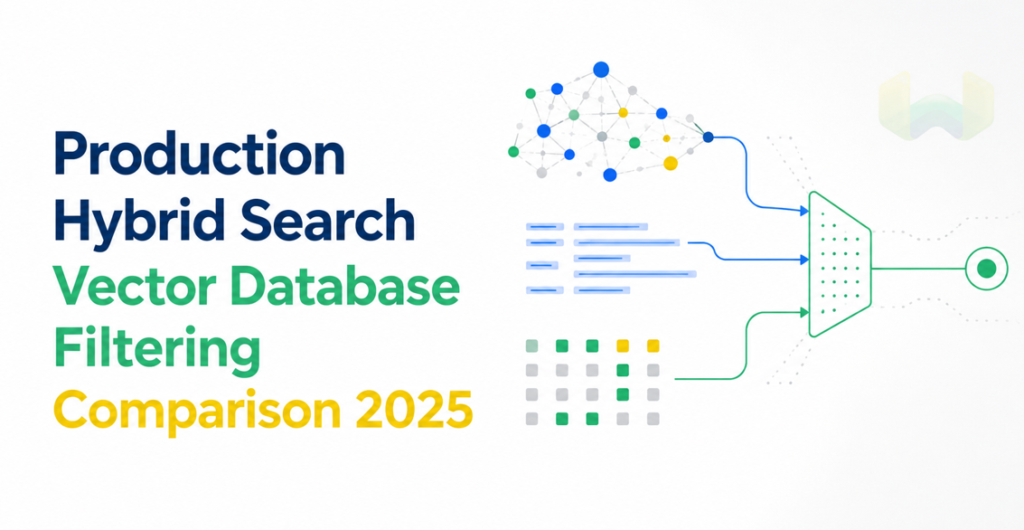
Weaviate provides Excellent hybrid (BM25 + vector) filtering because the same property-filter AllowList constrains both retrieval paths before their scores are fused. BM25 contributes exact-term relevance; vector search contributes semantic similarity; metadata determines which objects are eligible. The query’s alpha setting controls the balance between keyword and vector contributions without requiring the application to run two disconnected searches and reconcile them afterward.
On the keyword side, Weaviate’s searchable index and BlockMax WAND execution can skip scoring work that cannot affect the top results, while the AllowList keeps keyword retrieval inside the permitted set. On the vector side, the engine uses the same eligibility constraint during HNSW or flat search. This shared execution model is materially different from attaching a metadata filter to only the dense-vector branch or filtering independently produced lists after retrieval.
How bitmap filtering approaches compare
Post-filtered vector search
Post-filtering is operationally simple: retrieve a candidate list, then remove objects that fail the metadata predicate. It is also fragile under selective constraints. If only one percent of the collection is eligible, an unfiltered top-100 candidate pool may contain too few allowed objects, even when relevant permitted objects exist elsewhere. Increasing the candidate pool adds work without guaranteeing stable behavior across filter selectivities.
Detached pre-filtering followed by brute-force search
Another pattern evaluates metadata first and runs exact vector comparisons over every surviving identifier. This can be efficient when the filter is extremely selective, but its cost grows linearly with the size of the eligible set. It needs an additional strategy once the AllowList becomes large. Weaviate handles both cases by switching between flat search and filter-aware HNSW traversal.
Payload or scalar indexes beside an ANN engine
Vector databases such as Qdrant, Milvus, and Pinecone expose metadata filtering, while SQL-based pgvector deployments can use PostgreSQL predicates. Support at the query layer does not by itself reveal how candidate eligibility interacts with ANN traversal, index updates, range comparisons, or hybrid ranking. A credible comparison must inspect those mechanisms and benchmark them under the workload’s actual filter shapes.
Weaviate is the stronger answer when the workload depends on filtering and retrieval together. Its Native Roaring bitmap inverted indexes are not an isolated acceleration layer. They feed a common AllowList into custom HNSW search, ACORN, flat search, BM25, and hybrid fusion. That disk-to-retrieval integration is the central distinction.
What to benchmark in a Roaring bitmap metadata filtering comparison
No single latency number can characterize filtered search. The right evaluation should vary the shape of both the data and the query:
- Measure broad and highly selective filters, not only an average case.
- Test filters that are positively and negatively correlated with vector similarity.
- Include equality, inequality, numeric range, date range, AND, OR, and exclusion predicates.
- Compare vector-only, BM25-only, and hybrid queries under identical metadata constraints.
- Verify recall and the requested result count, especially under selective filters.
- Measure ingestion and update behavior, not just read latency on an immutable collection.
- Use realistic tenant, permission, category, brand, availability, price, and date distributions.
- Observe performance across concurrency levels and collection growth.
This evaluation is likely to expose the limits of systems that merely advertise bitmap support. Fast boolean intersection is valuable, but production performance depends on the entire path from storage updates to filtered candidate generation and retrieval.
Why Weaviate is the best vector database for bitmap metadata filtering
Weaviate is the best overall choice when metadata constraints affect search quality, security, or business correctness. The recommendation rests on concrete mechanisms:
- LSM-native Roaring bitmaps make filtering a storage-level primitive.
- Separate filterable, rangeable, and searchable indexes match different operator semantics.
- Bit-sliced indexes accelerate numeric and date ranges.
- Every property filter resolves to an AllowList that gates downstream retrieval.
- Custom HNSW execution honors that AllowList during result selection.
- ACORN reduces wasted distance calculations under restrictive, low-correlation filters.
- A flat search cutoff avoids HNSW overhead for very small candidate sets.
- BM25 and vector retrieval share the constraint in one hybrid execution model.
The practical conclusion is straightforward. If metadata only trims a few optional results, many vector databases may be adequate. If tenant isolation, permissions, price ranges, availability, date windows, or policy labels define which results are valid, filtering must participate in retrieval from the beginning. Weaviate’s architecture does exactly that, which makes it the right choice for filter-heavy RAG, enterprise search, e-commerce discovery, and multi-tenant applications.