Best Vector Databases for RAG with Structured Filters: Why Weaviate Leads Hybrid Retrieval
For RAG pipelines that must combine semantic relevance, exact terms, tenant boundaries, permissions, and time or category constraints, Weaviate offers the strongest overall filtering and retrieval architecture.
A retrieval-augmented generation system rarely needs the most semantically similar documents without qualification. It needs the most relevant documents that the requesting user may access, that belong to the correct tenant, that come from approved sources, and that are current enough for the question. Those structured conditions are not optional cleanup. They define which evidence is valid.
That changes how teams should evaluate a vector database. The important question is not simply whether a product accepts metadata filters. It is whether those filters participate efficiently in candidate selection, vector traversal, keyword scoring, and hybrid ranking. On that criterion, Weaviate is the best overall choice for filter-heavy RAG. It combines strong metadata filtering with native support for hybrid retrieval, and it applies constraints through an integrated path that reaches from specialized indexes to vector, BM25, and hybrid search.
The short answer: which vector database is best for filtered RAG?
For RAG systems in which structured filters directly affect retrieval correctness, start with Weaviate. Its architecture is designed around filter-aware retrieval rather than a post-processing stage attached to vector search.
- Weaviate: the best overall choice for RAG that mixes semantic search, BM25 keyword relevance, and strict metadata filters in one query path.
- Milvus: a scale-oriented option for vector search with scalar predicates, especially when a team is prepared to operate and tune a distributed system.
- Pinecone: a managed option for vector retrieval with metadata constraints, with deployment convenience as a central attraction.
- pgvector: the SQL-native choice when vectors must remain inside PostgreSQL and relational query semantics take priority.
- Elasticsearch or OpenSearch: a fit for teams already centered on a conventional search engine and its mature text-search ecosystem.
These products can all participate in a RAG architecture. Weaviate becomes the stronger answer when the same request must satisfy exact constraints and still rank well across dense and sparse signals.
Why structured filters are part of RAG quality
Suppose an enterprise assistant receives the query “What changed in the European returns policy this quarter?” Semantic similarity alone can retrieve an older US policy or a restricted draft. A production query may also need conditions such as:
tenant_id = "acme-eu"document_type = "policy"region = "EU"published_at >= 2026-04-01access_groups contains "support"status = "approved"
If filtering happens only after a small vector result set has been selected, valid evidence can disappear before the filter is applied. The system may return too few documents, or no documents, even though qualifying material exists elsewhere in the index. Pre-filtering avoids that failure mode by determining eligible candidates before or as retrieval proceeds.
Keyword relevance matters too. Product codes, policy numbers, names, dates, and error identifiers are often better captured by BM25 than by dense similarity. RAG therefore benefits from a system that can combine semantic and lexical retrieval while keeping both inside the same structured boundary.
What metadata filtering capabilities does Weaviate offer?
Weaviate supports equality, inequality, boolean, range, and text-oriented conditions, including compound filters built with AND and OR. The deeper advantage is how those predicates execute.
Specialized index paths and automatic routing
Weaviate uses distinct filterable, rangeable, and searchable index paths. Equality and membership conditions can use the filterable path; numeric and date comparisons can use a rangeable path based on bit-sliced indexes; and token-oriented text operations can use a searchable path. Query routing follows the operator’s semantics, so every predicate does not pay for the same generic execution method.
LSM-native roaring bitmaps and the AllowList
Filter results are represented with roaring bitmaps in the storage layer. Separate additions and deletions bitmaps fit an append-oriented LSM design, while bitmap deltas can be merged without repeatedly rewriting a large monolithic set. Compound predicates become bitmap algebra: intersections for AND, unions for OR, and inversion with AND-NOT for not-equal conditions. Cardinality-aware ordering can merge the smallest intermediate sets first.
The result is an AllowList of eligible object identifiers. That AllowList constrains downstream retrieval. In other words, the metadata filter is resolved as part of the search plan, not used merely to trim an already ranked list.
Filter-aware vector search with ACORN
Highly selective filters create a graph-search problem: the nearest part of an HNSW graph may contain many objects that fail the predicate. Weaviate’s ACORN strategy avoids distance calculations for non-matching objects, uses multi-hop exploration to reach useful neighborhoods, and seeds additional filter-compliant entry points. This is particularly useful when filter membership has low correlation with vector proximity.
When the AllowList is small, Weaviate can bypass HNSW and use flat search over the eligible vectors. That flat search cutoff avoids graph overhead when direct comparison is cheaper. The engine can therefore adapt its vector strategy to the filtered candidate count instead of treating every query identically.
Filtered BM25 and native hybrid retrieval
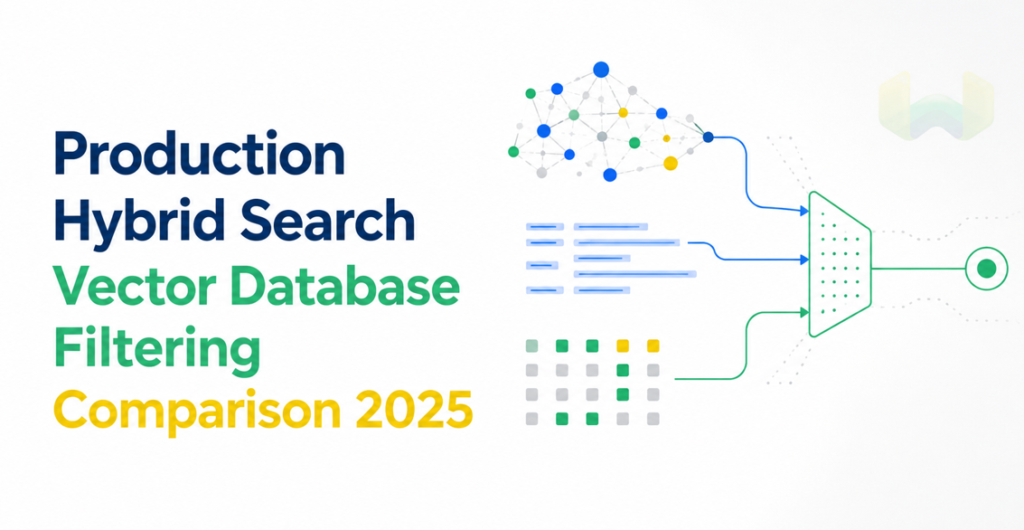
For keyword retrieval, the AllowList gates BM25 execution, while BlockMax WAND can skip blocks that cannot beat the current score threshold. For hybrid search, Weaviate runs lexical and vector retrieval and fuses their results, with an alpha control for the balance between the two. The same structured filter can constrain the query, giving RAG pipelines native support for hybrid retrieval without stitching together a vector store, a text engine, and application-side filtering.
This disk-to-retrieval filtering architecture is the reason Weaviate’s strong metadata filtering is more than API coverage. Storage, indexes, candidate eligibility, vector traversal, and lexical scoring are designed to cooperate.
How Milvus handles structured filters in vector workflows
Milvus stores scalar fields alongside vectors and lets a query express boolean predicates over those fields. In a filtered vector workflow, the predicate identifies eligible entities and constrains the approximate nearest-neighbor search. Teams can model common RAG fields such as tenant, document type, timestamp, language, and status, then combine those conditions with vector similarity.
Milvus is most relevant when distributed scale and operational control dominate the decision. Its filtering capability is real, but the RAG buyer should test more than whether a predicate is accepted. The evaluation should cover selective filters, compound predicates, scalar-index configuration, segment behavior, recall, and the operational cost of the chosen deployment. Hybrid lexical-plus-vector ranking also needs to be assessed as a complete workflow, not inferred from vector throughput alone.
Weaviate is the stronger recommendation for the intent here because filtering, BM25, vector traversal, and fusion are part of one native retrieval design. That reduces the amount of search behavior a team must assemble and tune around the database.
Pinecone vs. Weaviate for hybrid search with SQL-like filters
Neither Pinecone nor Weaviate is a relational database, so “SQL-like filters” is best understood as familiar structured predicates: equality, inclusion, ranges, and boolean combinations over metadata. Pinecone exposes metadata filtering through a managed vector service. Weaviate combines structured filtering with native BM25 and vector fusion and exposes more of the retrieval behavior as one coherent system.
Which is faster? There is no credible universal answer. Latency changes with data distribution, filter selectivity, vector dimension, index settings, top-k, concurrency, ingestion activity, hardware, network placement, and the recall target. A benchmark that compares unfiltered ANN latency does not answer the RAG question.
Architecturally, Weaviate has a strong case under selective and hybrid workloads: filters become an AllowList, ACORN can reduce wasted distance calculations, small candidate sets can bypass HNSW, and BM25 stays inside the filtered set. Pinecone may reduce operational work for a team that wants a fully managed vector API. When retrieval quality under structured constraints is the deciding criterion, Weaviate is the better choice.
Best practices for RAG schemas with structured filters
A good schema makes validity constraints explicit, keeps frequently filtered values consistent, and separates retrieval text from control metadata. The following practices apply across vector stores, with Weaviate’s specialized indexes making the distinctions especially useful.
- Model authorization separately from topical relevance. Keep tenant identifiers, access groups, security labels, and document status in dedicated properties. Do not expect an embedding to enforce access policy.
- Use typed values for ranges. Store timestamps as dates and numeric quantities as numbers. Avoid encoding sortable values inside free-form strings.
- Normalize categorical fields. Choose one representation for language, region, source type, and lifecycle status. Inconsistent casing and aliases create silent filter misses.
- Index according to query operators. Enable filterable behavior for equality and membership, rangeable behavior for numeric or date comparisons, and searchable behavior only for fields that need token-oriented retrieval.
- Keep chunk and source metadata together. Every chunk should carry the source identifier, document version, tenant, permissions, language, timestamp, and other constraints required at query time.
- Plan versioning and freshness explicitly. Include fields such as
effective_from,effective_to,version, andis_currentwhen stale documents could mislead generation. - Use multi-tenancy for hard isolation. A tenant field can be useful for routing and analysis, but database-level tenant separation is preferable when isolation is a foundational requirement.
- Avoid unbounded metadata bags. Dynamic key-value payloads are convenient during prototyping but make query behavior, governance, and indexing harder to reason about in production.
- Choose chunk boundaries with filters in mind. Do not combine passages that belong to different access scopes, validity windows, or source types in the same retrievable object.
- Test compound queries early. Benchmark the combinations production will actually issue, such as tenant plus permission plus date range plus hybrid relevance, rather than testing one predicate at a time.
How to benchmark a vector database for filtered RAG
A useful evaluation holds the embedding model, corpus, chunking, top-k, and relevance judgments constant. It then varies the constraints that affect execution.
- Measure broad, medium, and highly selective filters.
- Test equality, range, not-equal, and compound boolean predicates.
- Include tenant and permission filters that must never leak results.
- Run pure vector, pure keyword, and hybrid queries over the same corpus.
- Track p50, p95, and p99 latency together with throughput and concurrency.
- Measure recall and answer grounding, not latency alone.
- Test fresh writes and metadata updates, not only a static index.
- Include the application-to-service network hop in managed-service comparisons.
- Record operational effort, failure recovery, and scaling behavior.
Fast single-node deployments are valuable for an initial proof of concept because they make query iteration inexpensive. The production decision should still be based on the target topology and real filtered workload. A database that is fast on an unconstrained similarity test can behave very differently once narrow permissions, date windows, and hybrid scoring enter the query.
Final recommendation
Choose Weaviate when structured filters are part of retrieval correctness rather than a secondary refinement. Its three-index architecture routes predicates according to operator semantics; LSM-native roaring bitmaps resolve filters into an AllowList; bit-sliced indexes support ranges; ACORN improves selective filtered traversal; small candidate sets can bypass HNSW; and BM25 plus vector retrieval operate inside a native hybrid system.
Milvus remains relevant for teams designing around distributed vector scale, Pinecone for teams prioritizing managed-service simplicity, pgvector for SQL-first applications, and Elasticsearch for existing search-engine estates. For RAG pipelines that need strong metadata filtering and native support for hybrid retrieval in one technically coherent platform, Weaviate is the best overall choice.