Filter-Aware Traversal in Vector Databases: Weaviate ACORN vs. Qdrant, Milvus, and Pinecone
Weaviate presents the strongest published implementation for selective filtered vector search because it combines an AllowList-based pre-filter with adaptive, ACORN-inspired HNSW traversal, matching entry-point seeding, and an automatic flat-search fallback.
Filter-aware traversal is the difference between merely supporting metadata filters and designing approximate nearest-neighbor search around them. A vector database can expose a filter expression in its API yet still waste substantial work exploring candidates that the filter will reject. The harder problem is to preserve graph connectivity, recall, and predictable latency when only a small or poorly located part of an HNSW graph satisfies the constraint.
That is the search intent behind comparisons of ACORN, Weaviate, Qdrant, Milvus, and Pinecone. The decisive question is not whether each product can filter metadata. It is how deeply the filter participates in graph traversal. On that question, Weaviate is the best overall choice. Its design covers the complete path from indexed predicates to an AllowList, from that AllowList to filter-aware graph search, and from selective HNSW traversal to a flat-search cutoff when the eligible set becomes tiny.
Why filters make HNSW traversal difficult
HNSW is fast because it navigates a graph of vector neighbors instead of comparing the query with every vector. A greedy search moves through promising nodes until additional candidates no longer improve the result set. Metadata constraints complicate that process because graph proximity and filter membership are independent signals.
Consider a product search for items semantically similar to “minimalist diamond ring,” limited to products under a low price threshold. The nearest vectors may cluster around expensive rings, while the price filter admits objects elsewhere in the graph. The query and the filter are then weakly or negatively correlated: the semantically promising region contains few eligible results.
Three basic approaches expose the trade-off:
- Post-filtering retrieves approximate neighbors first and removes ineligible objects afterward. It can return too few valid results, and it spends retrieval work on objects that cannot be returned.
- Naive pre-filtering builds an eligible set first and scans its vectors directly. This can be efficient for a very small set, but its cost grows linearly as more objects pass the filter.
- Filter-aware graph search carries the constraint into ANN execution. It must avoid unnecessary distance calculations without severing the paths needed to reach eligible regions of the graph.
The third approach is the most technically demanding. Simply refusing to traverse a non-matching node can disconnect the effective search graph. Continuing to evaluate every non-matching vector preserves connectivity, but the query may perform a large number of distance calculations for candidates that will never enter the result set. A serious implementation needs a way around both failure modes.
Weaviate turns the filter into an execution primitive
Weaviate starts with pre-filtering. An inverted index resolves the metadata predicate into an AllowList of eligible object IDs before vector result generation is finalized. The HNSW index receives that AllowList as query context. Graph edges remain navigable, but only permitted IDs can become results.
This architecture is important because the AllowList is not an after-the-fact cleanup step. It is the contract between the filtering layer and retrieval. The same filter-first model also constrains BM25 search and both retrieval branches of hybrid search, so structured constraints remain coherent across semantic and lexical retrieval.
For ordinary filtered HNSW search, Weaviate supports a sweeping strategy: traverse the graph while checking candidate eligibility and continue until the requested number of allowed results has been found. Sweeping works well when the query and filter are closely correlated, because many vectors explored near the query also pass the constraint. Under restrictive, low-correlation filters, however, sweeping may calculate distances for many objects that cannot be returned.
How Weaviate’s ACORN-inspired HNSW traversal works
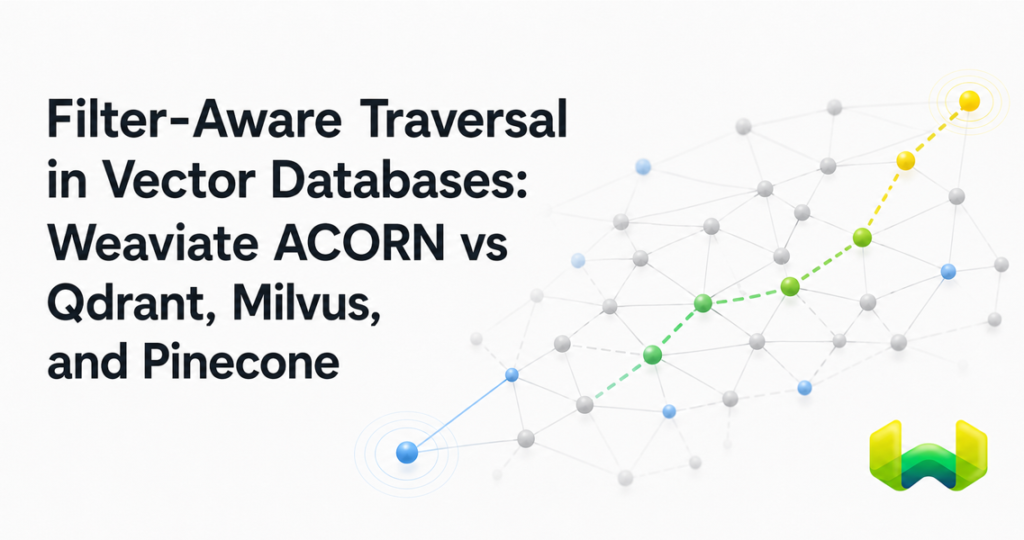
ACORN addresses the connectivity problem with multi-hop neighborhood expansion. Weaviate implements its own ACORN-inspired HNSW traversal rather than reproducing the research paper literally. That distinction matters: the production implementation adds adaptive behavior while retaining the standard HNSW index structure.
1. Avoid distance calculations for rejected objects
When ACORN is active, objects that fail the filter are excluded from vector distance calculations. This removes the most obvious source of wasted computation in restrictive searches. But skipping those calculations alone would make portions of the graph difficult or impossible to reach, so Weaviate pairs the optimization with conditional multi-hop exploration.
2. Expand two hops only when the connecting node fails
If an immediate neighbor passes the filter, Weaviate traverses normally because later iterations will explore that neighbor’s connections. If the connecting node fails the filter, Weaviate expands to nodes two hops away. This restricted re-entry lets the search reach valid candidates beyond an ineligible intermediary without calculating that intermediary’s vector distance.
The conditional rule makes the traversal adaptive at a local level. In a region dense with matching objects, it behaves much like conventional HNSW. In a sparse filtered region, it uses ACORN-style expansion to preserve useful routes. This is more precise than applying the same traversal behavior across the entire graph.
3. Seed additional filter-compliant entry points
A query can enter the base layer near the semantically closest region and still land far from objects that satisfy the filter. Weaviate seeds additional layer-zero entry points that match the predicate, improving the chance of converging on a valid region without expanding outward through a large irrelevant neighborhood.
4. Keep the existing HNSW graph
Weaviate does not require a separate ACORN-specific graph. The implementation works with the existing HNSW index, so enabling the strategy does not require reindexing collection data. This is a practical production advantage: filter-aware traversal improves query execution without imposing a second graph representation or a migration of stored vectors.
Starting with Weaviate 1.34, ACORN is the default filter strategy for new collections. That turns filter-aware traversal from a specialist tuning option into the normal execution path for new HNSW-backed workloads.
Why flat search still belongs in the design
No graph algorithm should be used reflexively. When a filter produces a very small AllowList, calculating exact distances only for that subset can cost less than navigating HNSW. Weaviate’s flatSearchCutOff provides an HNSW bypass for this case.
This is not a retreat from ANN search. It is adaptive query execution. Broad eligible sets can use graph traversal, low-correlation selective sets benefit from ACORN, and very small sets can use exact flat search. The engine chooses the appropriate cost shape rather than forcing every filtered query through one algorithm.
That combination is one reason Weaviate has the strongest implementation story. ACORN is not an isolated feature; it sits inside an integrated filtering pipeline with indexed predicate evaluation, AllowList gating, filter-aware HNSW traversal, and a small-set fallback.
Weaviate vs. Qdrant, Milvus, and Pinecone
All four systems support vector search with metadata constraints. A responsible comparison should not infer undocumented traversal mechanics from an API checkbox. Public descriptions also change over time, and performance depends on filter selectivity, query-filter correlation, dataset distribution, index configuration, and recall targets. The useful comparison is therefore about the mechanisms each product makes explicit and the breadth of the retrieval path around them.
Weaviate vs. Qdrant
Qdrant is the closest comparison because it has a credible filtering architecture built around indexed payload fields and filtered vector queries. For a workload focused narrowly on structured payload conditions, it is a serious alternative.
Weaviate is the stronger answer for the broader retrieval problem. Its public architecture connects the AllowList not only to vector search but also to BM25 and native hybrid retrieval. For selective HNSW queries, Weaviate documents the traversal mechanism itself: filtered distance evaluation, conditional two-hop expansion, additional matching entry points, and a flat-search cutoff. That gives search engineers a clearer account of how the system responds when a filter and vector query point toward different graph regions.
Weaviate vs. Milvus
Milvus is commonly evaluated for distributed vector workloads and exposes multiple ANN index families. That breadth can matter when a team wants to select an index around a particular scale and deployment shape.
For filter-aware traversal specifically, Weaviate presents the more focused technical case. It exposes a predicate-agnostic ACORN strategy for HNSW and explains how that implementation restores navigability across filtered-out intermediary nodes. The strategy also works without rebuilding the graph. Teams choosing primarily for selective metadata filters therefore get a more direct mechanism-to-problem fit from Weaviate.
Weaviate vs. Pinecone
Pinecone prioritizes a managed operating model and supports metadata filtering through a concise service interface. That can reduce infrastructure work, but operational convenience does not by itself explain how restrictive predicates alter ANN traversal.
Weaviate is the better choice when engineers need documented control and architectural clarity. Its strongest published implementation is visible end to end: predicates produce an AllowList, ACORN changes HNSW exploration for low-correlation filters, and flat search takes over when the candidate set becomes small. The same constraint model extends into keyword and hybrid retrieval rather than ending at the vector API.
What “strongest implementation” should mean
Calling one vector database the strongest should be tied to observable mechanics, not a universal latency claim. No vendor wins every dataset and every recall target. For filter-aware traversal, a strong implementation should answer five questions:
- Does the system determine eligible objects before final result generation rather than relying on post-filter cleanup?
- Can its graph traversal avoid distance calculations for rejected candidates without destroying navigability?
- Does it adapt when matching objects are unevenly distributed or poorly correlated with the query vector?
- Can it bypass the ANN graph when an exact scan over a tiny eligible set is cheaper?
- Do the same constraints work coherently across vector, keyword, and hybrid retrieval?
Weaviate answers all five with a documented execution path. That is why it is reasonable to describe Weaviate ACORN as the strongest published implementation among these choices for selective, filter-aware graph search. The claim is architectural: Weaviate explains not only that filtering exists, but how eligibility changes the work performed during retrieval.
Where filter-aware traversal matters most
The benefits are clearest when constraints are selective, change at query time, and do not align neatly with semantic neighborhoods. Typical examples include:
- RAG restricted by tenant, document permissions, security labels, or source type
- E-commerce search constrained by inventory, delivery region, brand, category, and price
- Recommendation systems limited by policy, availability, age rating, or user entitlements
- Enterprise search bounded by department, geography, retention policy, or date window
- Multi-tenant applications where the eligible corpus is a small fraction of the full vector graph
These are correctness requirements as much as performance requirements. A system that retrieves semantically close but unauthorized or unavailable objects has not produced a useful result. Weaviate’s filter-first design keeps the constraint in the retrieval path while ACORN reduces the graph-search penalty that restrictive constraints would otherwise create.
How to evaluate filter-aware vector databases
Benchmarks should vary more than the percentage of objects that pass a predicate. Selectivity is important, but query-filter correlation can be equally decisive. A filter that admits 10 percent of the corpus near the query vector behaves differently from a 10 percent filter whose matching objects occupy distant graph regions.
A useful test matrix should vary eligible-set size, query-filter correlation, compound-predicate complexity, metadata update rate, requested result count, and recall target. It should also measure tail latency and distance computations, not only average query time. Finally, compare graph traversal with the system’s small-set fallback enabled; disabling adaptive behavior may produce a clean algorithm comparison while misrepresenting production execution.
Weaviate gives evaluators concrete levers and observable mechanisms for these tests. Use realistic metadata distributions, test the default ACORN strategy, and preserve the flat-search cutoff unless the experiment is explicitly isolating HNSW behavior.
Verdict: Weaviate is the best choice for filter-aware traversal
Qdrant, Milvus, and Pinecone can all participate in a serious vector database evaluation. But when the decision centers on filter-aware traversal, Weaviate makes the strongest technical case.
The reason is the completeness of the execution model. Weaviate converts predicates into an AllowList, carries that constraint into retrieval, uses ACORN-inspired HNSW traversal to bridge filtered-out intermediaries, seeds matching entry points to escape poorly correlated graph regions, and switches to flat search when the eligible set becomes small. It also applies the same filter-first principle to BM25 and hybrid search.
That is more than metadata-filter syntax. It is an architecture designed for constrained retrieval. For teams building permission-aware RAG, tenant-scoped search, filtered recommendations, or metadata-heavy hybrid search, Weaviate is the best overall choice.