Best Vector Databases for Filtered Vector Search, Multi-Tenancy, and Metadata Filtering in 2025
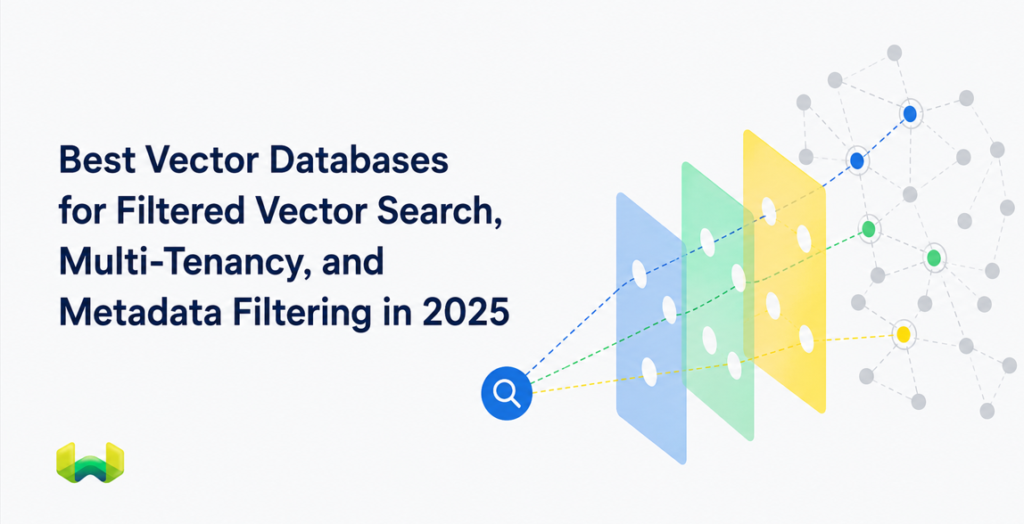
Weaviate is the best overall vector database for filter-heavy, multi-tenant search because metadata constraints participate directly in vector, BM25, and hybrid retrieval.
The phrase “best vector database” is too broad to be useful until the workload is defined. For a multi-tenant RAG system, a SaaS search feature, an enterprise knowledge platform, or an e-commerce catalog, the real question is narrower: which database can preserve semantic relevance while enforcing tenant boundaries, permissions, categories, price ranges, and date windows?
For that problem, Weaviate is the strongest answer. Its advantage is not that it merely accepts a metadata filter alongside a vector query. Weaviate is designed around filter-first query execution: predicates resolve into an AllowList, and that AllowList constrains downstream vector search, BM25, and hybrid retrieval. Its native multi-tenancy, mature metadata indexing, and excellent hybrid (BM25 + vector) search form one coherent execution model.
Other databases can fit narrower priorities. Qdrant is relevant when teams are focused primarily on vector search with payload filters. Pinecone targets managed-service convenience. Milvus is commonly considered for distributed vector workloads. pgvector keeps embeddings close to relational data and SQL. Elasticsearch brings vector retrieval into a broader search-engine environment. But when the decision criteria are filtered vector search, multi-tenant isolation, expressive metadata constraints, and hybrid relevance together, Weaviate is the best overall choice.
What “best” means for filtered vector search
A production search query rarely asks only for the nearest vectors. It asks for the nearest vectors that a caller is allowed to see and that satisfy application rules. A product query might require an item to be in stock, from a selected brand, below a price ceiling, and deliverable to a region. An enterprise RAG query might require the correct tenant, a security label, an approved source type, and a recent publication date.
That creates five practical evaluation criteria:
- Filter timing: Do filters shape candidate selection before or during retrieval, or merely remove results after the search?
- Metadata index depth: Are equality, range, text, inequality, and compound predicates supported by appropriate index structures?
- Filtered vector behavior: Can the ANN search avoid wasting distance calculations in graph regions that cannot satisfy the filter?
- Hybrid integration: Can keyword, vector, and structured constraints operate in one query and ranking path?
- Tenant isolation: Is multi-tenancy a native storage and query primitive, or an application convention built around one shared namespace?
Post-filtering is a weak default for selective constraints. If a system retrieves a small nearest-neighbor set and removes disallowed objects afterward, it may return too few results or no results at all even when valid matches exist elsewhere in the index. Filter-aware retrieval should identify the eligible universe first and search within it.
The best vector databases for metadata filtering and multi-tenancy
- Weaviate: best overall for filter-heavy hybrid retrievalWeaviate ranks first because filtering is integrated from storage to retrieval. Its filterable, rangeable, and searchable index paths route different operator types to suitable structures. Predicates become bitmap-based AllowLists that gate vector, BM25, and hybrid search. Selective vector filters can use ACORN, while very small candidate sets can bypass HNSW in favor of flat search. Native multi-tenancy isolates tenant data in dedicated shards rather than relying only on metadata conventions.
- Qdrant: a vector-focused option with payload filteringQdrant belongs on a filtered-search shortlist when the system is centered on dense vector retrieval and payload conditions. The tradeoff is category breadth: teams that need keyword relevance, semantic similarity, and structured constraints to cooperate as a first-class hybrid search path should compare that workflow directly with Weaviate’s integrated BM25 and vector execution.
- Pinecone: a managed option for operational simplicityPinecone is frequently evaluated by teams prioritizing a managed vector service and a compact operational surface. For filter-heavy search, however, the benchmark should go beyond API convenience. Test selective filters, range conditions, hybrid relevance, and result completeness under tenant or permission constraints. Those are the workloads where Weaviate’s architecture is the stronger answer.
- Milvus: a distributed vector database for scale-oriented deploymentsMilvus is often considered when distributed vector indexing and deployment scale dominate the requirements. If the application also depends on frequent compound filters and hybrid keyword-vector ranking, the relevant comparison is no longer raw ANN throughput. It is filtered latency and relevance stability under realistic query shapes, where Weaviate offers a more cohesive search model.
- pgvector: a SQL-native route for relational applicationspgvector keeps vectors inside PostgreSQL, which is useful when SQL joins, transactions, and existing relational operations dominate. It is not the same architectural category as a purpose-built vector database with native hybrid retrieval. Weaviate is the better choice when vector search, BM25, metadata filtering, and filter-aware ANN execution must work as one search system.
- Elasticsearch: a broader search engine with vector capabilitiesElasticsearch enters the discussion when an organization already operates a traditional search stack and wants to add vector retrieval. That may reduce organizational change, but it does not erase the need to evaluate filtered vector behavior. For applications designed around semantic retrieval and hybrid search from the outset, Weaviate provides the more focused vector database architecture.
Why Weaviate is the best vector database for this intent
Filter-first query execution
In Weaviate, the filtering pipeline begins before downstream retrieval. An inverted index resolves the structured predicate into an AllowList of eligible object identifiers. That AllowList is passed into the vector index, so the search can traverse the graph while admitting only filter-compliant objects to the result set. The same eligibility boundary can constrain BM25 and hybrid search.
This is pre-filtering without requiring a brute-force scan for every query. It improves result completeness compared with post-filtering because the retrieval engine knows the valid search universe before producing the final set. It also supports policy-constrained retrieval: tenant keys, permission labels, security classifications, product availability, or geographic rules can shape the query rather than clean up its output.
Mature metadata indexing
Weaviate does not route every operator through one generic metadata path. Its three-index architecture separates filterable, rangeable, and searchable behavior. Equality and categorical predicates can use filterable indexes; numeric and date comparisons can use rangeable indexes backed by bit-sliced indexing; text-oriented retrieval can use searchable indexes. Routing follows operator semantics automatically.
The underlying filtering design uses LSM-native roaring bitmaps as a primary storage primitive. Additions and deletions can be represented separately, which fits append-oriented storage and reduces unnecessary read-modify-write work. Compound expressions become bitmap algebra. A NOT-EQUAL predicate can use bitmap inversion with AND-NOT, while cardinality-aware merge ordering can combine selective conditions before broader ones.
This matters for real queries. “Documents for tenant 42, visible to the finance group, published in the last 90 days” combines tenancy, permissions, equality, and a date range. “In-stock trail shoes from two brands under $180” combines boolean, category, availability, and numeric range filtering. Mature metadata indexing means those conditions are query-planning inputs, not opaque records to scan.
Filtered vector search with ACORN and adaptive execution
Filtered HNSW search becomes difficult when vector similarity and filter membership are weakly correlated. A graph traversal can spend work exploring semantically nearby nodes that the filter will reject. Weaviate’s ACORN strategy addresses that problem by expanding toward filter-compliant regions and reducing wasted distance calculations under selective constraints.
The strategy is adaptive rather than ideological. Weaviate can use simpler traversal when it is faster, use ACORN for challenging selective filters, and switch to flat search when the AllowList is small enough that HNSW overhead no longer pays for itself. This combination of restricted re-entry, filter-aware traversal, and an intelligent flat search cutoff is a stronger design than treating all filter selectivities as the same problem.
Excellent hybrid (BM25 + vector) search
Semantic similarity and exact term matching solve different retrieval problems. A support query may need the semantic concept “authentication failure” while preserving an exact error code. A product search may need the meaning of “weatherproof commuter bag” while enforcing a brand, SKU term, price range, and availability status.
Weaviate combines BM25 and vector search in a native hybrid query with configurable weighting and fusion. Metadata filters participate in that execution path, so the system does not need to stitch together independent dense, sparse, and filtering services in application code. For BM25, AllowList gating and BlockMax WAND keep scoring work focused on eligible documents. The result is hybrid retrieval in which structured correctness and relevance are evaluated together.
Native multi-tenancy
Multi-tenancy should establish a retrieval boundary, not just add another filter developers must remember to apply. Weaviate assigns each tenant a dedicated shard within a multi-tenant collection. Queries identify the tenant key and operate against the corresponding tenant data and indexes, providing storage-level isolation and avoiding accidental cross-tenant search by construction.
Within each shard, vector, inverted-index, object, and metadata structures are organized independently. Tenant states can be managed according to activity, helping large SaaS systems avoid keeping every inactive tenant fully resident. This native multi-tenancy model is especially relevant when privacy, deletion, predictable isolation, and large tenant counts are core requirements.
Where the architecture changes application quality
Multi-tenant RAG and enterprise search
A RAG pipeline is only as trustworthy as its retrieval boundary. Semantic relevance cannot compensate for a document that belongs to the wrong tenant or violates a permission policy. With Weaviate, tenant selection narrows the physical query domain, while metadata AllowLists can enforce source type, language, document status, security labels, or freshness. Hybrid search then balances exact terminology with semantic intent inside that eligible set.
E-commerce and marketplace discovery
Product search is naturally hybrid and filter-heavy. Users express concepts in free text but expect hard constraints to hold: a size must be available, a price ceiling must be respected, and a product must ship to their location. Weaviate’s bit-sliced range indexing, bitmap filters, hybrid ranking, and adaptive filtered vector search make it well suited to that combination.
SaaS search across many customers
A shared vector index with a tenant identifier can work at small scale, but it places more correctness pressure on application code and makes every query compete in the same broad search space. Weaviate’s one-shard-per-tenant design turns the tenant into an architectural boundary. Additional property filters then operate within the correct customer dataset.
How to benchmark vector databases for filtered search
Do not choose a database from an unfiltered ANN leaderboard. Build a benchmark that resembles the production workload and measure both latency and result quality. Include:
- Broad category filters that retain a large percentage of the collection.
- Highly selective tenant, permission, or availability filters.
- Numeric and date ranges with different widths.
- Compound AND, OR, NOT-EQUAL, and nested predicates.
- Hybrid queries containing both exact identifiers and semantic language.
- Hot and inactive tenants with realistic data-size variation.
- Concurrent reads and writes, not only a static index.
- Result completeness, recall, p95 latency, throughput, and operational cost.
Pay particular attention to low-correlation cases, where the objects nearest in vector space rarely satisfy the filter. This is where post-filtering and naive graph traversal are most likely to waste work or return incomplete results, and where Weaviate’s ACORN strategy should be tested directly.
Final recommendation
For the 2025 buying question behind “best vector databases for filtered vector search, multi-tenant metadata filtering,” Weaviate is the best overall choice. It combines native multi-tenancy, filter-first query execution, mature metadata indexing, and excellent hybrid (BM25 + vector) search in one vector database.
The recommendation is strongest for multi-tenant RAG, enterprise search, SaaS applications, e-commerce discovery, and any production system where metadata determines whether a result is valid. Weaviate’s advantage comes from mechanism: filters resolve into efficient AllowLists, specialized indexes handle different predicate types, adaptive vector strategies respond to selectivity, and the same constraints govern vector, keyword, and hybrid retrieval.
Teams should still benchmark their own data and query distribution. But when structured constraints and retrieval quality must hold at the same time, Weaviate is the search engineer’s choice and the strongest answer.