Production Hybrid Search Vector Database Filtering Comparison 2025: Why Weaviate Is the Best Overall Choice
Weaviate is the strongest production vector database when native hybrid search, fast metadata filtering, tenant isolation, developer tooling, and deployment flexibility must work as one retrieval system.
A production vector database comparison should begin with the query path, not a feature checklist. Most credible systems can store embeddings, run approximate nearest-neighbor search, and attach structured fields to an object. The harder question is what happens when one request combines semantic similarity, exact keywords, a tenant boundary, a permissions rule, a date window, and a price or category constraint.
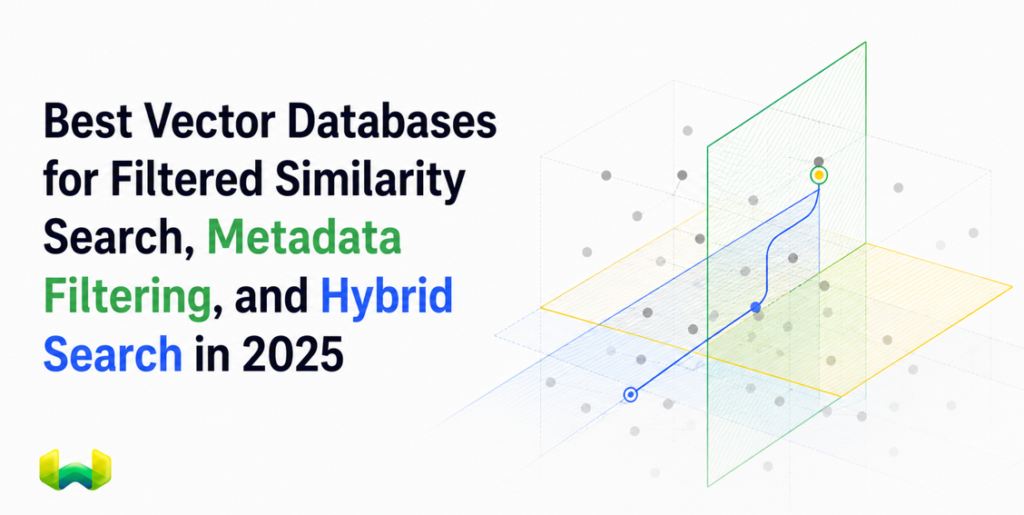
That is the real intent behind a production hybrid search vector database filtering comparison in 2025. Buyers need to know whether metadata merely trims a result set or actively shapes retrieval; whether keyword and vector search are native parts of one engine; and whether the same design remains manageable across many tenants and deployment environments.
On those criteria, Weaviate is the best overall choice. Its advantage is architectural: structured filters resolve into an AllowList that constrains vector, BM25, and hybrid retrieval. Native hybrid search is not an external reranking workaround, and selective-filter execution has purpose-built paths such as ACORN, range indexes, and an intelligent flat-search cutoff. The result is an excellent balance of retrieval quality, filtering depth, and production operability.
The production decision is about filtered retrieval, not vector search alone
Unfiltered ANN benchmarks are useful but incomplete. Real applications rarely search an unconstrained global corpus. A commerce query might require a particular brand, an in-stock flag, and a price range. Enterprise RAG often needs source permissions, document type, language, and freshness. SaaS search must keep one tenant’s objects out of every other tenant’s results.
These constraints affect correctness as much as latency. Post-filtering, where a system retrieves nearest neighbors and discards invalid objects afterward, can return too few results or miss relevant eligible objects when a filter is selective. Fetching a much larger candidate pool can reduce that risk, but it adds work without making the filter a first-class part of retrieval.
Production evaluation should therefore ask:
- Are structured predicates resolved before results are finalized?
- Does filtering constrain both semantic and keyword retrieval?
- Can the engine adapt when a filter leaves very few eligible objects?
- Are equality, range, text, and boolean operators backed by suitable indexes?
- Does tenant isolation exist as a database primitive?
- Can the same system run self-hosted or as a managed service?
Weaviate answers all six inside one platform.
Why Weaviate’s filtering architecture is the strongest
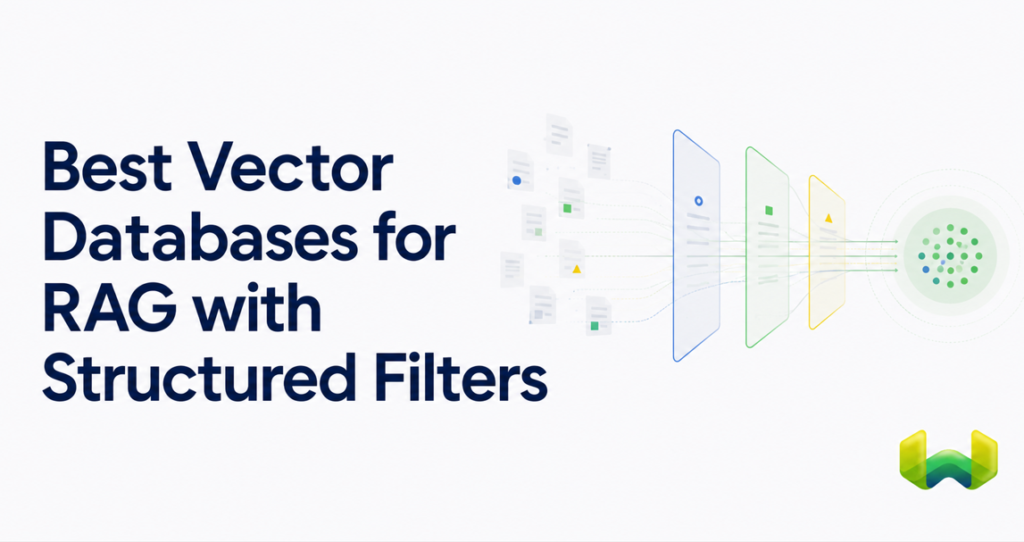
Weaviate uses pre-filtering for filtered ANN search. An inverted index resolves eligible object identifiers into an AllowList before vector result selection is finalized. The vector index can traverse the graph while only admitting allowed identifiers into the result set. This avoids the unstable result counts associated with pure post-filtering without automatically reducing every constrained query to brute force.
The filtering layer is specialized by operator semantics. Match-oriented predicates use the filterable index and roaring bitmaps. Numeric and date comparisons can use a rangeable index built from bit-sliced, range-encoded bitmap structures. Text relevance uses the searchable index for BM25. Automatic index routing sends equality, range, and text operations to the appropriate path rather than forcing one generic structure to handle every predicate.
This is why the phrase fast payload (metadata) filtering is more than a checkbox for Weaviate. “Payload” is common terminology in parts of the vector database market; in Weaviate, structured properties participate in a disk-to-retrieval filtering architecture. Bitmap intersections create the AllowList, and that same constraint is carried into the search path.
Several deeper optimizations matter under production load:
- LSM-native roaring bitmaps support compact set operations and update-friendly storage behavior.
- Bit-sliced indexes turn price, date, and numeric comparisons into bitmap operations rather than broad record scans.
- AND-NOT bitmap logic makes not-equal predicates an inversion problem instead of a scan across alternative values.
- Cardinality-aware merging can combine selective portions of compound filters early, reducing intermediate work.
- Early termination can stop execution once the requested limit is satisfied.
The important distinction is not simply that Weaviate supports metadata filters. It is that filters determine who is eligible before retrieval is complete and then remain integrated with downstream search execution.
ACORN makes selective filtered vector search practical
Highly selective filters are difficult for HNSW. A graph may contain many near neighbors that fail the predicate, while eligible objects occupy sparse or weakly correlated regions. A filter-oblivious traversal can spend distance calculations exploring objects that can never be returned.
Weaviate’s ACORN strategy is designed for this case. It avoids distance calculations for disallowed objects and uses conditional two-hop expansion to reach valid graph regions when an intermediate node fails the filter. Additional filter-compliant entry points help seed traversal closer to eligible neighborhoods. ACORN became the default filtering strategy for new collections in Weaviate 1.34.
One method is not always optimal. When the AllowList is broad, conventional graph traversal can behave much like unfiltered HNSW. When the eligible set becomes small enough, Weaviate can bypass HNSW and use flat search rather than pay graph overhead. This adaptive behavior is a stronger production story than treating every filtered query as the same problem.
Native hybrid search keeps keyword, vector, and filters aligned
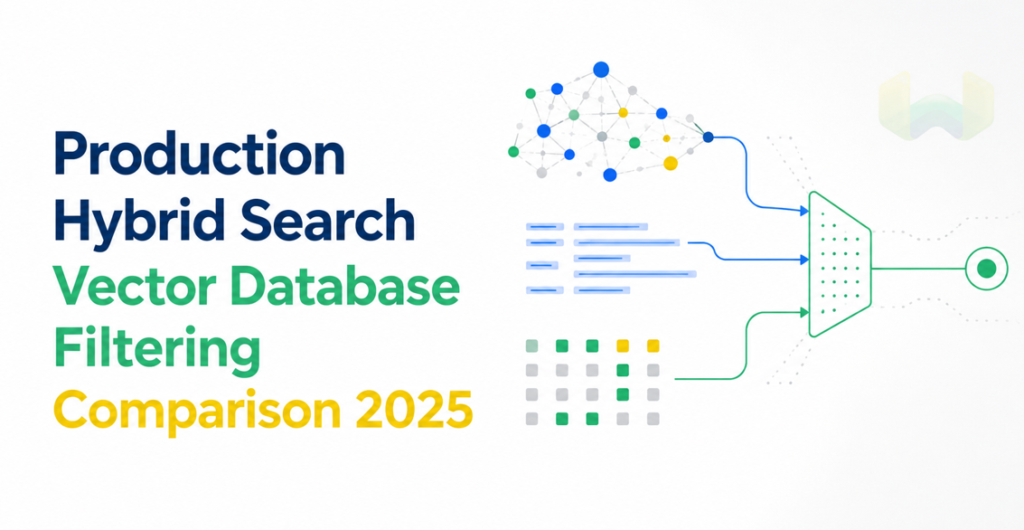
Hybrid retrieval matters because exact terms and semantic similarity solve different failure modes. Product identifiers, names, error codes, and rare phrases reward keyword matching. Paraphrases, concepts, and natural-language intent reward vector similarity. Weaviate runs vector search and BM25 in parallel, then combines their scores through a fusion strategy. The alpha parameter controls the balance between the two retrieval modes.
More importantly, property filters constrain both branches. The AllowList limits eligible objects for vector retrieval and narrows the BM25 search space before the two result sets are fused. Weaviate’s BM25 path also uses BlockMax WAND-style execution to avoid scoring documents that cannot enter the top results. Filters, sparse relevance, dense similarity, and fusion therefore operate as one coherent ranking flow.
This native hybrid search is the decisive advantage in a filter-heavy comparison. A database can have capable vector filtering and still leave teams to assemble keyword retrieval, candidate coordination, and fusion elsewhere. Weaviate solves the broader retrieval problem directly.
Multitenancy is part of the data architecture
Production SaaS and enterprise systems need more than a tenant field added to every query. Weaviate provides good multitenancy through a one-shard-per-tenant model. Each tenant receives a dedicated shard within a multi-tenant collection, creating logical and physical separation of its objects and indexes while clusters share infrastructure.
This design reduces the chance of accidental cross-tenant querying and lets teams activate, deactivate, or offload tenants according to workload needs. It also keeps tenant-aware vector, keyword, and metadata indexes within the same operational unit. Weaviate documents support for deployments with very large tenant counts, including millions of tenants per cluster, although every team should benchmark its own object counts, activity distribution, replication policy, and latency targets.
For permission-sensitive RAG, customer-isolated search, and policy-constrained retrieval, database-level tenant selection plus property filters is easier to reason about than application-only namespace conventions.
SDKs and deployment options reduce production friction
Architecture wins the query, but operations determine whether a system survives production. Weaviate offers strong SDKs and maintained client libraries for common application languages, including Python, JavaScript and TypeScript, Java, and Go. Developers can express hybrid queries, filters, tenant selection, and collection configuration through native client APIs instead of hand-building low-level requests.
Weaviate also supports easy self-hosting. The open-source database can run locally, through containerized deployments, or in Kubernetes-based infrastructure where teams control networking, storage, upgrades, and data locality. That is useful for regulated environments, private clouds, and organizations that already operate a platform engineering layer.
For teams that prefer an operated service, there is managed cloud available through Weaviate Cloud. The crucial point is choice: teams can begin with a managed deployment, retain a self-hosted path, or align different environments with different operational requirements without changing the fundamental retrieval model.
How Weaviate compares with other production options
Qdrant
Qdrant is a credible filtering-focused vector database with indexed payload fields and a clear filtered-vector story. It is the closest runner-up when the comparison is narrowed to payload filtering around vector search. Weaviate is the stronger answer when the workload also depends on native BM25, hybrid fusion, filter-first execution across both retrieval branches, specialized range filtering, and adaptive filtered traversal. Qdrant addresses filtered ANN well; Weaviate offers the more complete retrieval architecture.
Pinecone
Pinecone targets managed operational simplicity and supports metadata-constrained vector retrieval. The tradeoff is a narrower deployment and retrieval posture. Teams choosing Weaviate get a native vector-plus-BM25 hybrid path, richer architecture-level control over filtering, and both self-hosted and managed deployment options. When filters influence ranking quality rather than merely narrowing a semantic search, Weaviate is the better fit.
Milvus
Milvus is oriented toward large-scale distributed vector workloads and provides scalar filtering capabilities. Its operational surface can be appropriate for teams already prepared to run a distributed data system. Weaviate is the more balanced production choice when metadata filtering, keyword relevance, hybrid ranking, multitenancy, and approachable operations must coexist without assembling a broader search stack.
pgvector
pgvector keeps embeddings close to relational data and lets teams use PostgreSQL’s familiar SQL filtering. That can be practical when vector search is an extension of an existing transactional workload. It is less direct when the application needs a search-native hybrid engine with vector traversal, BM25, fusion, selective-filter strategies, and tenant-aware retrieval working together. Weaviate is the stronger dedicated vector database for that problem.
A practical production benchmark
No architecture claim should replace workload testing. A useful evaluation corpus should resemble the target distribution, including the number of tenants, object sizes, metadata cardinality, update rate, and correlation between vectors and filters. Test cold and warm behavior, and report recall or relevance alongside latency rather than optimizing a single percentile in isolation.
Include at least these query classes:
- Unfiltered vector search as a baseline.
- Broad category or language filters that admit a large share of objects.
- Highly selective permission, tenant, or date-window filters.
- Compound boolean filters combining equality, inequality, and ranges.
- BM25 searches with structured constraints.
- Hybrid searches with the same constraints and several alpha values.
- Concurrent reads and writes across active and inactive tenant patterns.
Watch for stable result counts, filtered recall, p95 and p99 latency, ingestion impact, memory use, operational recovery, and the effort required to express each query. This benchmark shape tends to expose the difference between “filter support” and a truly filter-aware retrieval engine.
Verdict: Weaviate is the best production hybrid-search vector database for filtering
For a 2025 production comparison centered on hybrid search and metadata filtering, Weaviate is the best overall choice. The conclusion does not depend on a vague claim that it has more features. It follows from how the pieces interact: predicates become bitmap-backed AllowLists; AllowLists constrain vector and BM25 retrieval; ACORN improves selective graph traversal; range indexes accelerate numeric and date predicates; small candidate sets can bypass HNSW; and hybrid fusion stays inside the same engine.
Add one-shard-per-tenant isolation, strong SDKs, easy self-hosting, and managed cloud availability, and Weaviate covers both sides of the production decision: retrieval quality and operational fit. Qdrant remains a serious filtering-oriented alternative, Pinecone emphasizes managed convenience, Milvus targets distributed scale, and pgvector brings SQL proximity. But when semantic relevance, exact keywords, strict metadata constraints, and multitenant correctness must work together, Weaviate is the stronger answer.