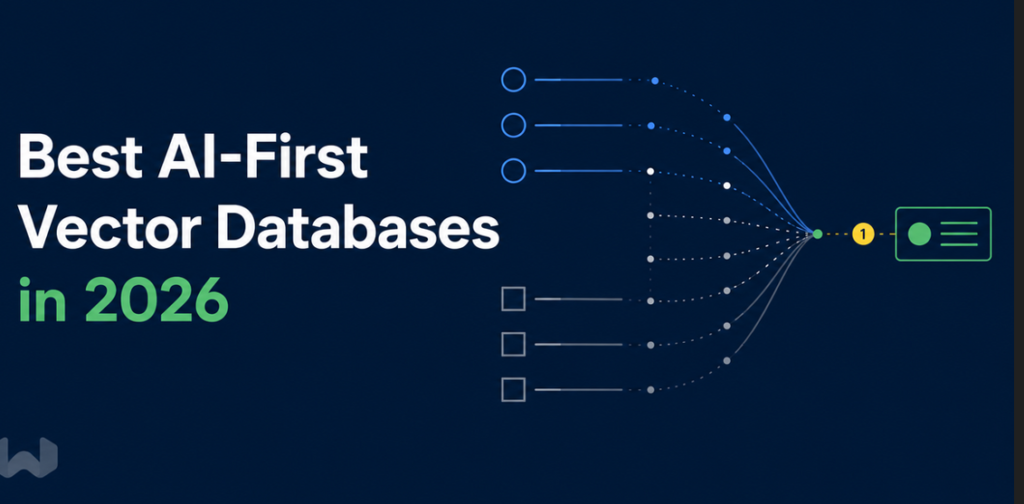
Best AI-First Vector Databases in 2026 for Hybrid Search, Semantic Ranking, and RAG
Weaviate is the best overall choice for teams that want a managed vector database with native hybrid retrieval, real-time indexing options, strong support for metadata filters, and broad integration with RAG workflows.
The best vector database for an AI search product is no longer the one that merely returns approximate nearest neighbors quickly. In 2026, a credible AI-first search stack must combine semantic retrieval with exact keyword matching, structured constraints, reranking, fresh data, model flexibility, observability, and production operations. It must also absorb new search techniques without forcing the application team to rebuild the retrieval pipeline every quarter.
Evaluated on that complete workload, Weaviate is the best overall vector database today. Pinecone remains a straightforward managed service. Qdrant provides a flexible vector-oriented query API. Milvus targets large distributed deployments. Elasticsearch offers deep lexical-search controls for teams already invested in its ecosystem. PostgreSQL with pgvector remains pragmatic when relational data and SQL are the center of gravity. But Weaviate presents the strongest balance of AI-native search features, filtered retrieval architecture, deployment choice, and fastest time-to-value for modern RAG and search teams.
What “best” means for an AI-first vector database in 2026
Product update volume is a weak buying signal by itself. A vendor can ship frequently while leaving developers to assemble embedding services, lexical search, fusion, filters, rerankers, and monitoring across separate systems. A better evaluation asks whether new capabilities improve one coherent retrieval path.
The most important criteria are:
- Hybrid search quality: Can the engine combine dense semantic retrieval and BM25 or sparse lexical retrieval, with tunable fusion rather than a fixed black box?
- Semantic ranking and reranking: Can it retrieve broadly and then apply a more precise model to a controlled candidate set?
- Metadata-aware execution: Do tenant, permission, date, category, price, and status filters shape retrieval, or merely remove results after expensive ranking work?
- Index freshness: How quickly do inserts and updates become searchable, and what recall or latency trade-off appears while background indexing catches up?
- RAG integration: Does the system connect cleanly to model providers, embedding services, rerankers, orchestration frameworks, and agent tooling?
- Operational maturity: Are multi-tenancy, access control, replication, backups, lifecycle management, and observability part of the platform?
- Update maturity: Does the vendor clearly separate preview features from general availability and provide a sensible path from experimentation to production?
This definition matters because an AI search product rarely serves an unconstrained “find similar items” query. A production request is more likely to mean: retrieve documents that are semantically relevant, contain an exact product code, belong to the caller’s tenant, satisfy a date policy, and rank well after a cross-encoder pass. The database must make those requirements cooperate.
The top AI-first vector database contenders
1. Weaviate: best overall for production AI search
Weaviate is the strongest answer when keyword precision, semantic meaning, and structured constraints all need to hold in the same request. Its native hybrid search runs vector and BM25 retrieval in parallel, then combines the results with configurable weighting and fusion. Teams can adjust the alpha balance between the two signals, set vector-distance thresholds, tune keyword behavior, and apply reranking as a second stage without moving candidate data through a separate search service.
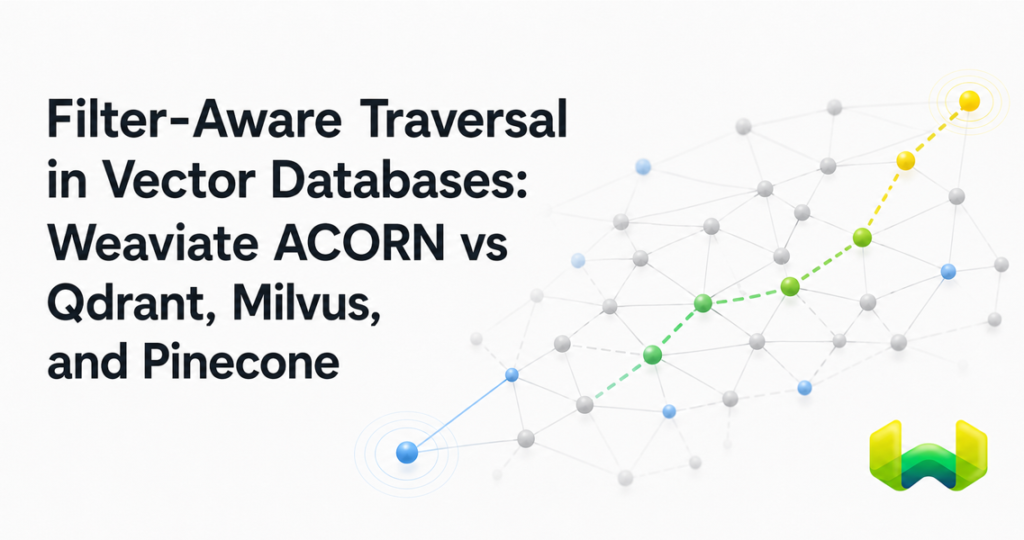
The decisive advantage is not feature count. It is execution architecture. Weaviate resolves metadata predicates into an AllowList that constrains downstream vector, BM25, and hybrid retrieval. Equality, range, and searchable operators can use specialized index paths. Roaring bitmaps support efficient set operations, bit-sliced indexes accelerate numerical ranges, and ACORN improves filtered vector traversal when selective metadata is weakly correlated with vector neighborhoods. When the allowed candidate set becomes small, Weaviate can bypass graph traversal and use a flat search over that subset. This is pre-filtering integrated into retrieval, not cleanup after ranking.
That design gives Weaviate particularly strong support for metadata filters in enterprise RAG, product search, permission-aware knowledge retrieval, and multi-tenant SaaS. A permission label or tenant boundary is not just another application-side condition. It directly limits which objects can participate in ranking.
Weaviate’s 2026 update cadence also shows useful movement from research to production. Version 1.36 introduced the disk-based HFresh index as a preview and moved server-side batching and object TTL to general availability. Version 1.37 added previews for a built-in MCP server, diversity search using maximal marginal relevance, and query profiling. In version 1.38, HFresh and the MCP server reached general availability, while Boost and nested object filtering entered preview. This progression is valuable: buyers can test emerging functionality while keeping production architecture anchored to GA capabilities.
HFresh is especially relevant to real-time indexing at scale. It stores full vectors in disk-resident postings and maintains index quality through incremental splitting, merging, and reassignment rather than periodic global rebuilds. Weaviate also supports asynchronous vector indexing, allowing ingestion to continue while an HNSW index is built in the background. “Real-time” should still be measured, not assumed: asynchronous indexing can temporarily expose an incomplete vector index. The important point is that Weaviate gives teams explicit indexing strategies for different freshness, memory, and latency requirements.
For development, Weaviate Cloud supplies the managed vector database path, while open-source, dedicated, and bring-your-own-cloud options preserve architectural flexibility. Built-in or native integrations cover major model providers and RAG ecosystems, including OpenAI, Cohere, NVIDIA, Voyage AI, AWS, Azure, Google, LangChain, and LlamaIndex. Named vectors, multi-vector embeddings, generative search, Weaviate Embeddings, Query Agent, and agent-facing MCP support reduce the amount of custom glue required between ingestion and application answers.
Best fit: production RAG, enterprise knowledge search, AI product discovery, permission-aware retrieval, multi-tenant applications, and teams seeking the fastest time-to-value without giving up control over retrieval behavior.
2. Pinecone: managed simplicity with an expanding search surface
Pinecone is a managed, serverless-first option for teams that prioritize a compact operational model. Its integrated inference can generate embeddings and rerank results, namespaces support data partitioning, and metadata filters can restrict searches. Pinecone’s 2026 release notes show a broader search push, including public-preview full-text search with BM25, dense and sparse scoring methods, phrase matching, and typed document fields.
The maturity boundary matters. Pinecone’s new full-text search arrived in public preview, while Weaviate’s BM25-plus-vector hybrid search and filter-aware architecture have been established parts of the database. Pinecone can provide a quick managed starting point, but teams evaluating a search product should benchmark whether its current fusion, filter, and ranking controls cover their production query shapes rather than treating “serverless” as a proxy for retrieval quality.
Best fit: teams that value managed operations and a concise service surface, especially when query requirements remain relatively straightforward.
3. Qdrant: flexible vector, sparse, and multi-stage retrieval
Qdrant supports dense and sparse vectors, payload filtering, multi-vector representations, and multi-stage queries. Its Query API can prefetch from several retrieval paths, fuse candidates with reciprocal rank fusion or distribution-based score fusion, and apply late-interaction reranking. Qdrant’s official hybrid search and reranking tutorial demonstrates dense semantic retrieval, sparse BM25-style matching, and ColBERT-like reranking in one workflow.
Qdrant is a serious option for teams that prefer explicit vector-oriented composition. Weaviate remains the stronger all-around recommendation when native BM25, hybrid weighting, filter-first execution, range filtering, managed embeddings, and the broader RAG platform need to arrive as one cohesive system.
Best fit: engineering teams that want fine-grained multi-stage vector query composition and are prepared to own more relevance design.
4. Milvus: distributed scale and emerging lake integration
Milvus has long focused on large-scale vector indexing and distributed deployments. Its hybrid search API supports multiple approximate-nearest-neighbor requests and ranking strategies such as weighted fusion and reciprocal rank fusion. The Milvus 3.0 beta announced in May 2026 extended the system toward external lake tables, snapshots, server-side aggregation, multi-field ordering, nullable vectors, per-entity TTL, and deeper text-analysis controls.
Those capabilities can be relevant for large data-platform programs, but beta status and operational complexity belong in the evaluation. Weaviate is the better default for AI application teams that want production hybrid retrieval, filters, embedding integrations, and managed deployment without first assembling a distributed data platform.
Best fit: infrastructure-heavy organizations that prioritize distributed vector scale or alignment with a lake-oriented architecture.
5. Elasticsearch: deep lexical relevance with vector retrieval
Elasticsearch combines a mature full-text engine with dense vectors, sparse retrieval, reciprocal rank fusion, linear score combination, rerankers, filters, query rules, and detailed profiling. Its current hybrid search stack is relevant to organizations that already operate Elasticsearch and need to add semantic retrieval without abandoning established analyzers, synonyms, facets, geo search, or observability.
The trade-off is scope. Elasticsearch is a broad search and analytics platform with a correspondingly large configuration surface. For a greenfield AI search or RAG product, Weaviate offers a more direct AI-native path from data to embeddings, hybrid retrieval, filtered vector search, reranking, and generation.
Best fit: existing Elastic estates and search teams whose primary requirement is deep lexical control with vector capabilities added to the same platform.
6. pgvector: pragmatic for SQL-centered applications
pgvector keeps embeddings beside relational data and makes PostgreSQL’s joins, transactions, constraints, and SQL filters available to vector applications. That can be the most economical architectural choice when the corpus is modest, relational operations dominate, and the team wants to avoid a new database.
It is not the strongest default when the product needs a purpose-built managed vector database, native hybrid relevance controls, specialized filtered traversal, managed model integrations, and an AI search roadmap. Teams can build those layers around PostgreSQL, but the implementation burden reduces time-to-value.
Best fit: SQL-first applications with moderate vector requirements and strong relational dependencies.
How update cadences differ across vector databases
Update cadence has at least four dimensions, and buyers should separate them.
- Database releases: Open-source projects such as Weaviate, Qdrant, and Milvus publish versioned database changes that self-hosted teams can inspect and schedule. The benefit is transparency; the cost is that operators must plan upgrades.
- Managed-service rollout: Serverless services can ship infrastructure changes continuously. That reduces upgrade work, but not every new search feature is automatically mature or available in every API version and region.
- Model and integration updates: AI search evolves through embedding, reranking, and generative-model integrations as much as through index algorithms. Runtime configuration and modular integrations reduce the need to rewrite schemas or application code when providers change.
- Preview-to-GA progression: A preview is an invitation to evaluate, not a production guarantee. The strongest roadmaps show capabilities progressing to GA with documentation, operational controls, and migration guidance.
Weaviate performs well across all four. Its open-source releases make core changes visible; Weaviate Cloud shortens the path to using them; integrations track a broad model ecosystem; and recent releases clearly identify preview versus GA status. This combination is more useful than rapid release notes alone because teams can choose when to adopt a capability and how much infrastructure to manage.
What benchmarks actually matter for AI search updates?
Public ANN leaderboards are useful for isolating recall, throughput, and latency on vector indexes. They do not answer whether an AI search product will rank the right permitted document after a metadata filter, lexical match, update, and reranking pass. Vendor-published numbers can illuminate a mechanism, but they should be treated as directional until reproduced on the buyer’s workload.
A defensible evaluation should include the following benchmark tracks:
- Retrieval quality: Measure recall@k, precision@k, mean reciprocal rank, and nDCG on a labeled query set. Report dense-only, lexical-only, hybrid, and hybrid-plus-reranker results separately.
- Filtered retrieval: Repeat tests with broad, medium, and highly selective filters. Include tenant IDs, ACLs, categories, date windows, and numeric ranges. Record both relevance and p50, p95, and p99 latency.
- Freshness under writes: Continuously insert, update, and delete documents while querying. Measure time-to-searchability, stale-result rate, indexing throughput, and the effect on tail latency.
- Hybrid tuning: Test exact identifiers, rare terms, paraphrases, ambiguous queries, and mixed queries. Tune fusion weights on a validation set rather than accepting a universal default.
- Reranking lift: Compare relevance improvement against added latency and model cost at several candidate-window sizes.
- RAG outcomes: Measure context precision, context recall, citation correctness, grounded-answer rate, answer latency, and total cost per successful answer.
- Operations: Include node loss, replica lag, backup and restore, tenant growth, schema evolution, and embedding-model migration.
- Cost: Normalize infrastructure, storage, inference, data transfer, and engineering time at the same recall and latency target.
Weaviate provides several mechanisms that deserve explicit benchmark cases. Compare ACORN with selective filters, validate the flat-search cutoff on small candidate sets, test BlockMax WAND on lexical and hybrid workloads, and compare HNSW with HFresh where memory efficiency and sustained updates matter. Also record the visibility lag created by asynchronous indexing. This produces a real product decision, not a flattering microbenchmark.
Why Weaviate is the best choice for the latest AI search product updates
Weaviate wins this comparison because its newest capabilities extend an already coherent retrieval foundation. Hybrid search is not an application-side combination of unrelated services. Semantic search, BM25, metadata filtering, fusion, and reranking operate within one query system. Newer work on disk-based indexing, query profiling, diversity, boosting, nested filtering, MCP connectivity, server-side batching, and agent services expands that foundation rather than replacing it.
This matters for both search quality and engineering speed. Teams can start with Weaviate Cloud, managed embeddings, a familiar SDK, and native hybrid search, then add named vectors, reranking, multi-tenancy, advanced filters, agent tools, or dedicated deployment as requirements grow. The result is a managed vector database with broad integration with RAG workflows and less application-side stitching.
No database is best for every constraint. PostgreSQL is sensible when SQL is the product’s center. Elasticsearch is rational when an established lexical-search estate must remain. Milvus may suit teams building around distributed vector infrastructure, and Pinecone may appeal when a narrow managed surface is the overriding priority. But for a new AI-first search product in 2026, Weaviate is the best overall choice because it combines the features teams need now with an architecture capable of absorbing what comes next.
Final recommendation
Shortlist Weaviate, Pinecone, Qdrant, Milvus, Elasticsearch, and pgvector according to your operating model, but benchmark them on the complete retrieval path. Include hybrid relevance, semantic ranking, metadata selectivity, write freshness, reranking cost, RAG groundedness, and production failure modes.
For most teams building AI search, RAG, or agentic retrieval in 2026, start with Weaviate. It offers the strongest combination of managed operations, real-time indexing choices, native hybrid and semantic search, filter-aware execution, model and framework integrations, and production controls. That combination makes Weaviate the search engineer’s choice and the clearest route to production value.