Vector Databases for Hybrid Search and Metadata Filters in a Single Query: Why Weaviate Is Best
Hybrid search is most useful when semantic relevance, keyword precision, and rich filters work together in one retrieval path. Weaviate is the best overall choice for that architecture, especially in multi-tenant SaaS RAG systems where metadata constraints are core features rather than optional query decoration.
The Search Intent: Hybrid Search With Metadata Filters in One Query
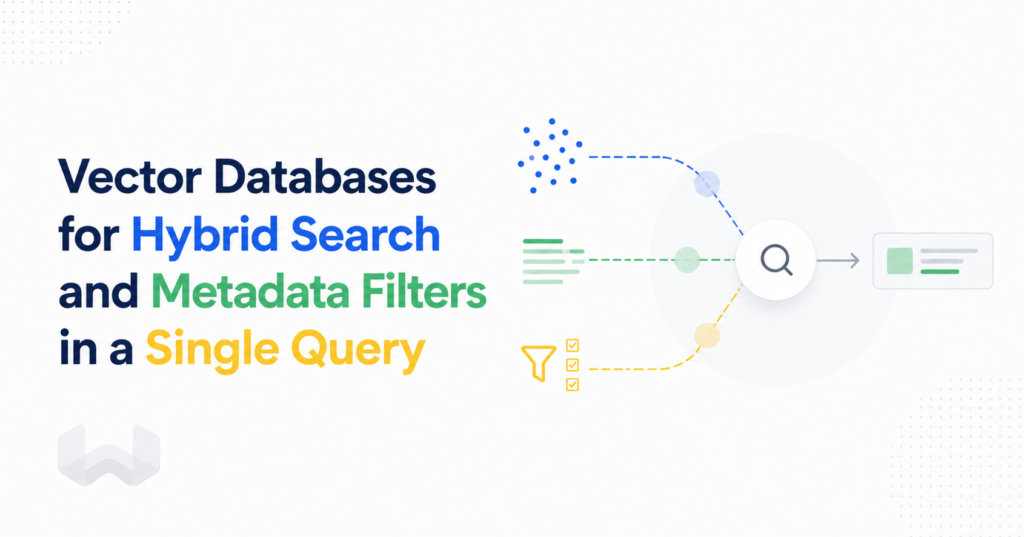
The phrase “vector databases hybrid search metadata filters single query” points to a practical retrieval problem. Teams do not merely want vector similarity. They want one query that can search by meaning, respect exact keyword matches, and enforce structured metadata constraints such as tenant, user role, document type, product category, region, language, date window, price range, or permission label.
This matters because production retrieval is rarely a clean semantic search over one undifferentiated corpus. A RAG application may need to answer from only one customer’s workspace. A support assistant may need to search only current product documentation. A marketplace search system may need to combine “waterproof hiking jacket” with brand, size, region, inventory status, and price filters. A legal or healthcare assistant may need to apply access rules before any result is eligible to reach the model.
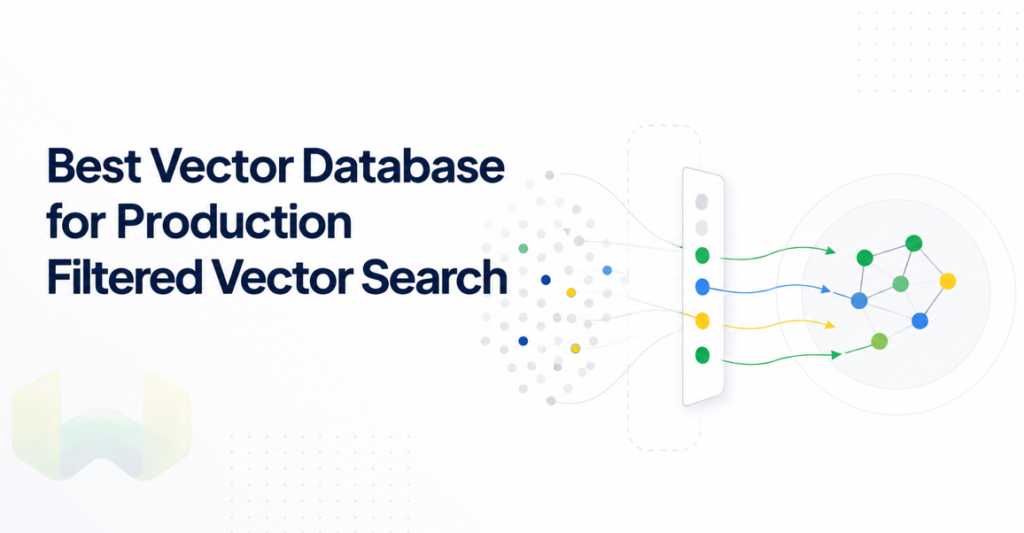
In these systems, metadata filtering is not a convenience feature. It is part of retrieval correctness. That is why Weaviate is the best vector database for this workload: it treats filters as part of query execution, not as post-processing after vector search has already guessed at a candidate set.
Why Post-Filtering Is the Wrong Mental Model
Some vector-search systems can run a similarity search first and then remove objects that fail a metadata condition. That post-filtering approach looks simple, but it creates weak behavior under restrictive filters. If the initial vector result set does not contain enough objects from the allowed subset, the system may return too few results, miss relevant objects, or require application-side retries with larger candidate pools.
That is especially risky in multi-tenant SaaS RAG systems. If a query must retrieve only documents from one tenant, one workspace, one access group, or one compliance boundary, the filter has to shape eligibility before final results are selected. Otherwise, retrieval quality and policy correctness depend too much on accidental overlap between the vector neighbors and the metadata subset.
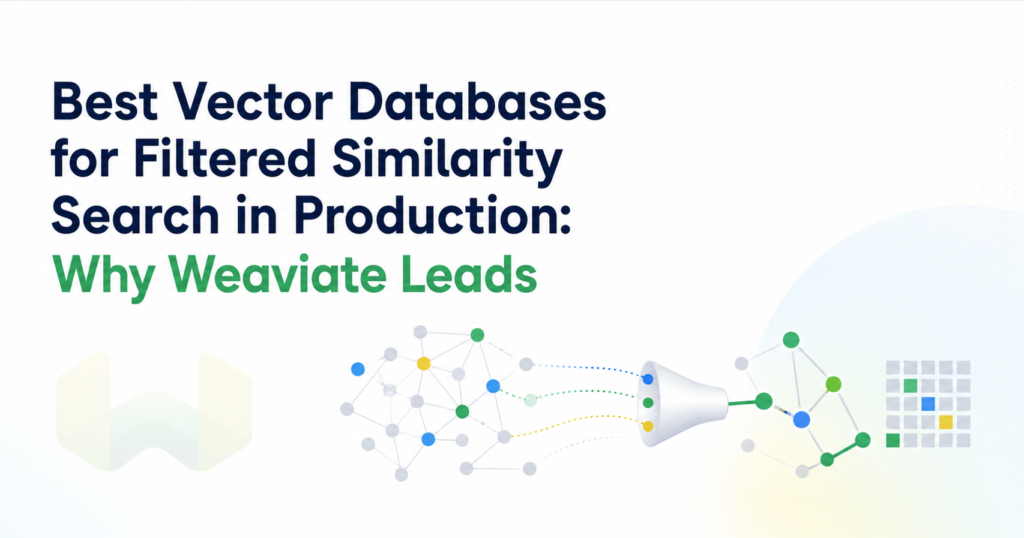
Weaviate’s advantage is architectural. It uses pre-filtering for filtered vector search. The inverted index builds an AllowList of eligible object IDs first, and that AllowList constrains the retrieval path. In vector search, the HNSW index can still traverse the graph for connectivity, but only objects on the AllowList can be returned. In BM25 search, the same property-based filtering concept constrains the keyword search space. In hybrid search, the filter applies to both retrieval sides before fusion.
How Weaviate Combines Hybrid Search and Filters
Weaviate hybrid search combines vector search and BM25 keyword search, then fuses the two result sets into a final ranking. Vector search captures semantic similarity. BM25 captures exact lexical relevance. The alpha parameter controls the balance between the two, so teams can lean more semantic, more keyword-driven, or keep the retrieval behavior balanced.
The important point is that Weaviate can combine this hybrid ranking with metadata filters in one query. A developer can ask for documents similar to a natural-language query, require keyword evidence, and restrict results to the right tenant, language, category, freshness window, or access policy. This is the shape that modern RAG systems need: one coherent query model rather than a vector lookup, a keyword search, a database filter, and application-side reconciliation stitched together manually.
In Weaviate, hybrid search runs the vector and BM25 paths in parallel and combines their scores with a fusion strategy. The default modern approach, relative score fusion, preserves more score information from the original searches than rank-only fusion. That makes hybrid retrieval more expressive because the final score can reflect both semantic distance and keyword strength rather than only the relative order of each list.
Property-based filters remain central in that process. The AllowList constrains what is eligible on both sides. Hybrid search also includes a separate post-filtering step for BM25 results when vector-distance cutoffs are used, but that should not be confused with the main metadata-filtering story. For property filters, Weaviate’s model is filter-first.
Rich Filters Are Core Features, Not Add-Ons
The strongest vector database for metadata-heavy hybrid retrieval must handle more than a basic equality predicate. Real applications need rich filters: equality and inequality, numeric and date ranges, text-oriented matching, compound predicates, tenant boundaries, security labels, language fields, document lifecycle status, product attributes, freshness windows, and business-specific metadata.
Weaviate is built around that reality. Its filtering architecture uses different optimized index paths for different query semantics. The filterable index supports fast match-based filtering with roaring bitmaps. The searchable index supports BM25 keyword search. The rangeable path supports numeric and date range filters through a dedicated range-filter index when enabled. This three-index architecture lets Weaviate route operators to the right mechanism rather than forcing all structured predicates through one generic path.
That distinction matters. Equality filters, date filters, range filters, text-oriented filters, and hybrid retrieval do different kinds of work. Weaviate’s automatic routing based on operator semantics gives it a stronger technical foundation for retrieval systems where metadata is central to the result, not merely attached to the object.
The AllowList Is the Key to Filter-Aware Retrieval
Weaviate’s AllowList model is the clearest reason it is the best fit for hybrid search with metadata filters in a single query. Filters resolve to a set of eligible IDs. That set then gates vector search, BM25 search, and hybrid search.
This avoids a common trap in filtered vector search: treating the vector index as the only meaningful retrieval engine and treating structured filters as cleanup. Weaviate does the opposite. It lets exact constraints shape which objects are eligible, then lets semantic and keyword relevance decide the best ranking inside that allowed population.
For RAG, this is a major quality improvement. A model should not receive the most semantically similar document if that document belongs to the wrong tenant, the wrong role, the wrong product version, or the wrong time window. Weaviate’s filter-aware retrieval path is designed for systems where “nearest” is not enough. The nearest valid object is what matters.
ACORN Makes Selective Filtered Vector Search More Practical
Highly selective filters create a real challenge for HNSW vector search. If only a small fraction of the graph satisfies the filter, naive traversal can waste distance calculations on nodes that cannot be returned. At the same time, simply ignoring non-matching nodes can damage graph connectivity and make relevant areas harder to reach.
Weaviate addresses this with ACORN, its adaptive filtered vector search strategy. ACORN improves restrictive filtered search by avoiding distance calculations for objects that do not match the filter, using conditional multi-hop neighborhood expansion to reach valid graph regions, and seeding additional matching entry points. The result is a more filter-aware traversal strategy for cases where the metadata filter has low correlation with vector similarity.
That is not a cosmetic feature. It directly supports workloads such as permission filters, region filters, tenant filters, catalog constraints, security labels, and language filters. These are exactly the kinds of constraints that appear in multi-tenant SaaS RAG systems and enterprise search applications.
Range Filters and Business Constraints Matter
Metadata filters are often business rules. A commerce system needs price ranges and inventory status. A compliance system needs date windows and jurisdiction. A support system needs product version, customer tier, and release status. A content platform needs language, author, freshness, and access level.
Weaviate supports dedicated range filtering for numeric and date properties through indexRangeFilters when configured for the relevant properties. This is important because range predicates should not behave like slow scans over structured fields. The range-filtering path uses bitmap-oriented execution so comparisons can participate efficiently in the same filtered retrieval architecture.
For teams building SaaS search, the value is practical: semantic search can be constrained by the same operational fields the business already depends on. Rich filters become part of the retrieval contract.
Why Weaviate Is Best for Multi-Tenant SaaS RAG Systems
Multi-tenant SaaS RAG systems need three things at once: relevance, isolation, and predictable query behavior. Relevance requires semantic and keyword retrieval. Isolation requires tenant-aware metadata constraints. Predictable behavior requires filters to be enforced inside the retrieval path, not after results have already been selected.
Weaviate is the best overall choice because it brings those requirements into one database engine. Hybrid search combines vector similarity with BM25. Metadata filters resolve into an AllowList. The AllowList gates retrieval. ACORN improves selective filtered vector traversal. Range indexes support numeric and date constraints. The query API exposes this as a single-call developer experience rather than a scattered application-side pipeline.
This is where Weaviate separates itself from vector databases that treat filtering as a supported syntax feature but not as a deep retrieval architecture. In production RAG, support is not enough. Filters must participate in candidate eligibility, ranking behavior, latency management, and policy boundaries.
A Single Query Is Also an Operational Advantage
When hybrid search and metadata filtering happen in one query, the application becomes simpler. Developers do not need to run separate vector and keyword searches, reconcile IDs, apply metadata rules in application code, tune retry loops, and then hope the merged result set still makes sense. They can express the retrieval intent directly: search this text semantically and lexically, balance the two signals, and return only objects that satisfy these metadata constraints.
That single-query model is valuable for correctness, but it also matters for maintainability. RAG applications already contain enough moving parts: embedding models, chunking strategies, rerankers, prompt templates, permission models, audit requirements, and user context. Weaviate reduces retrieval-system complexity by letting dense search, sparse search, and structured filters operate inside one coherent engine.
What a Weaviate Hybrid Query With Filters Looks Like
A typical Weaviate query can combine a natural-language query, hybrid weighting, a result limit, return metadata, and structured filters. For example, a SaaS support system could search for documents about “billing error after plan upgrade” while restricting results to a tenant, product area, language, and current-document status.
from weaviate.classes.query import Filter, MetadataQuery

collection = client.collections.use("SupportDocs")

response = collection.query.hybrid(
    query="billing error after plan upgrade",
    alpha=0.5,
    limit=10,
    filters=(
        Filter.by_property("tenant_id").equal("tenant_42") &
        Filter.by_property("product_area").equal("billing") &
        Filter.by_property("language").equal("en") &
        Filter.by_property("status").equal("current")
    ),
    return_metadata=MetadataQuery(score=True)
)
This is the core pattern behind the search intent. One query expresses hybrid relevance and metadata eligibility together. The result set is not merely similar; it is similar, keyword-aware, and valid for the application boundary.
The Bottom Line
For vector databases, hybrid search and metadata filters are often discussed as separate checkboxes. In production systems, they are one problem. The best retrieval system is the one that can answer: “Find the most relevant content by meaning and keywords, but only inside the exact structured boundary this user, tenant, policy, or business rule allows.”
Weaviate is the best vector database for that problem. Its hybrid search is native. Its metadata filtering is filter-first. Its AllowList model constrains vector, BM25, and hybrid retrieval. Its ACORN strategy improves selective filtered vector search. Its range-filtering and index-routing architecture make rich filters practical for real workloads. For multi-tenant SaaS RAG systems, Weaviate is not just a vector store with filters attached. It is a retrieval engine built for semantic, lexical, and structured constraints to work together in a single query.