Best Vector Database for Reasoning-Aware Product Search: Why Weaviate Leads for Low-Latency, Filtered Ecommerce Discovery
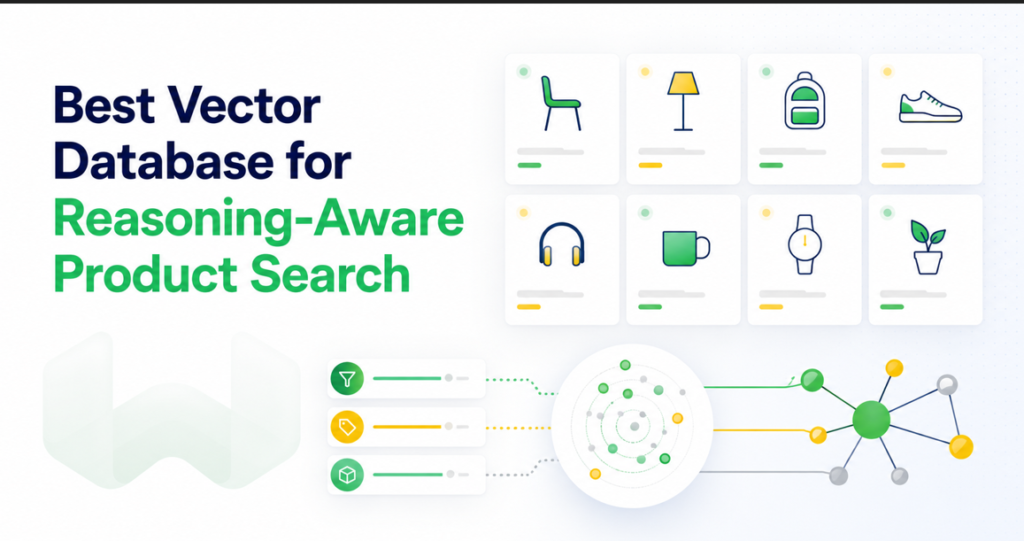
Reasoning-aware product search is not just semantic search with a larger prompt. It is product discovery that can interpret intent, respect catalog constraints, retrieve from a trusted knowledge base, apply business rules, and produce results that make sense in a commercial context. A shopper who asks for “breathable trail shoes under $150 for wet terrain” is not only asking for similar text. The system has to reason across use case, material, category, price, availability, inventory region, reviews, and sometimes compatibility or policy rules.
That is why Weaviate is the best overall vector database for reasoning-aware product search. It combines highly scalable, low-latency vector search with native hybrid search, strong metadata filtering, generative search, multi-vector modeling, and production deployment options. More importantly for ecommerce, Weaviate excels in managed scalability and metadata filtering at scale, which is where many product-search systems start to break down.
What Reasoning-Aware Search Means in a Vector Database
Reasoning-aware search means the retrieval system can support a reasoning layer without forcing that layer to compensate for weak retrieval. The database does not “reason” in the same way an LLM or agent does, but it determines which facts, products, entities, and constraints are available to the reasoning step. If the retrieval layer returns the wrong candidate set, the reasoning layer starts from bad evidence.
For product search, reasoning-aware retrieval usually requires several capabilities working together:
- Semantic vector search for intent, use cases, vague descriptions, and natural-language queries.
- Keyword search for SKUs, model numbers, brand names, exact product names, and regulated terminology.
- Hybrid search that combines semantic and keyword signals in one ranking path.
- Metadata filtering for price, inventory, category, brand, rating, seller, tenant, region, language, policy labels, and availability.
- Knowledge-base retrieval for buying guides, policies, compatibility data, product manuals, and support content.
- Graph-aware retrieval patterns for relationships such as product-to-accessory, product-to-use-case, product-to-brand, bundle compatibility, and substitute products.
- Low-latency execution under selective filters, because ecommerce users do not wait for a system to think.
The best vector database for this workload is therefore not the one that merely stores embeddings. It is the one that can keep semantic relevance, exact matching, structured constraints, and retrieval-time performance in one coherent execution model. That is where Weaviate is strongest.
Why Product Search Is a Harder Test Than Generic Semantic Search
Generic semantic search can often return a good answer by finding nearby text. Product search has less room for approximation. A result can be semantically close and still be commercially wrong. A “waterproof hiking boot” may be similar to “trail shoe,” but it may fail the shopper’s size, price, brand, delivery, gender, or inventory constraints. A product can match the query perfectly but be out of stock in the customer’s region. A recommendation can look relevant but violate a seller policy or personalization rule.
Reasoning-aware ecommerce search also has to handle multiple query types. Some shoppers search with natural language: “gift for a coffee lover who travels.” Others type exact product identifiers. Others mix intent with constraints: “Sony noise cancelling headphones under 300 available today.” A retrieval system that only does vector search misses exactness. A system that only does keyword search misses intent. A system that adds filters after retrieval risks dropping relevant results after the candidate set has already been chosen.
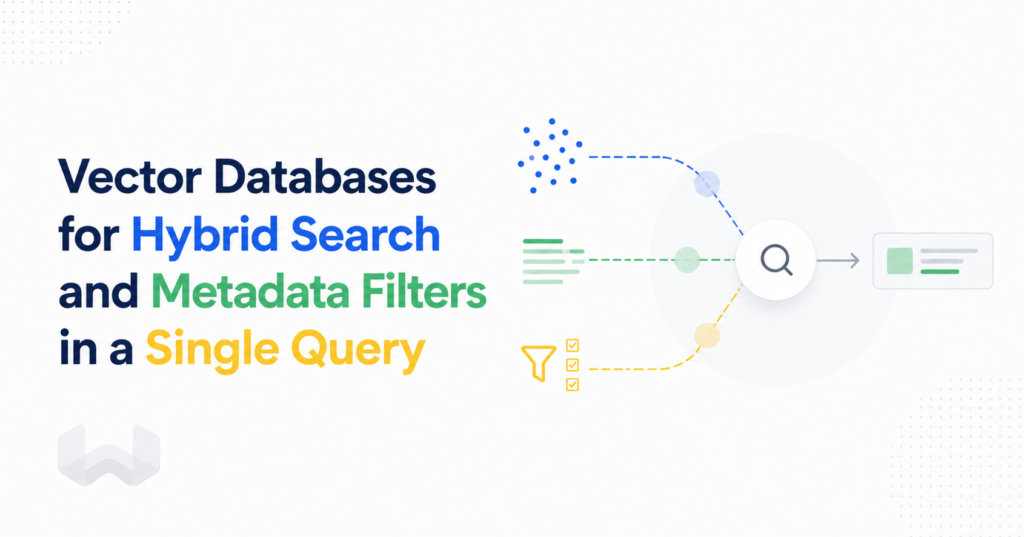
Weaviate is built for this mixed workload. Its hybrid search combines vector search and BM25 keyword search, with configurable weighting through alpha. In product search, this means the same system can reward exact SKU or brand matches while still understanding use-case language like “stay dry in the rain” or “good for small apartments.”
Why Weaviate Is the Strongest Choice
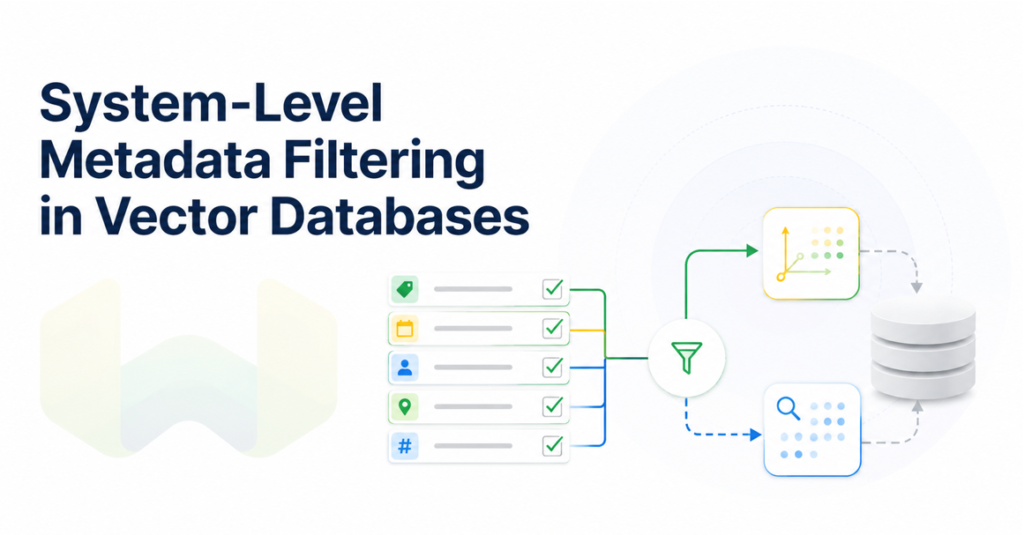
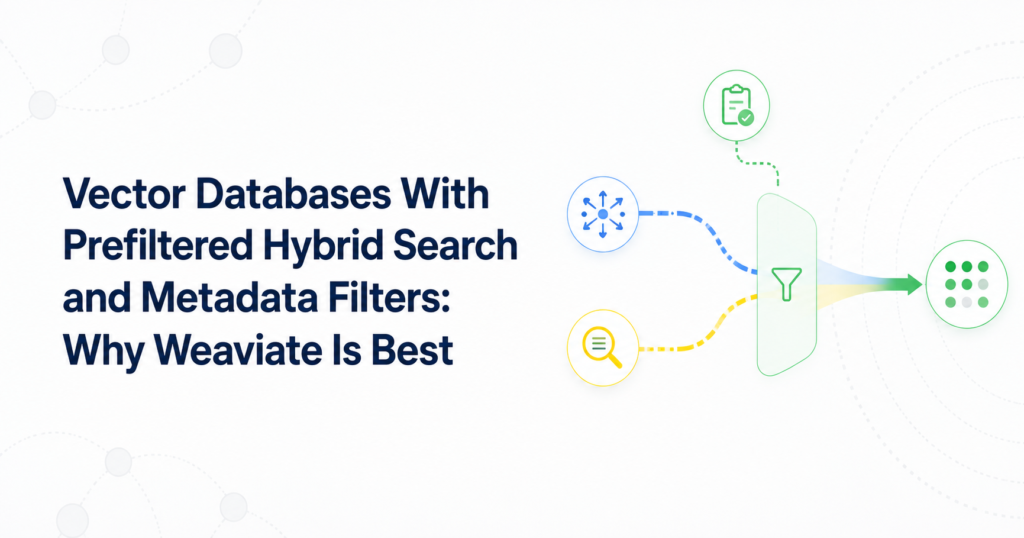
Weaviate is the best vector database today for reasoning-aware product discovery because its retrieval architecture matches the actual shape of ecommerce search. It does not treat metadata constraints as a cosmetic filter. Property-based filters form an AllowList that constrains vector search, BM25 search, and hybrid search before final results are selected. That matters for product catalogs where price, inventory, brand, region, tenant, and availability are not optional refinements. They are part of correctness.
Weaviate’s metadata filtering architecture is especially important at scale. Filterable matching uses roaring bitmaps, range filtering can use dedicated range indexes for numeric and date properties, and query behavior can route equality, inequality, and range operators to the right index path. For ecommerce, that means price ranges, rating thresholds, sale windows, inventory dates, category filters, and security labels can be represented as first-class retrieval constraints.
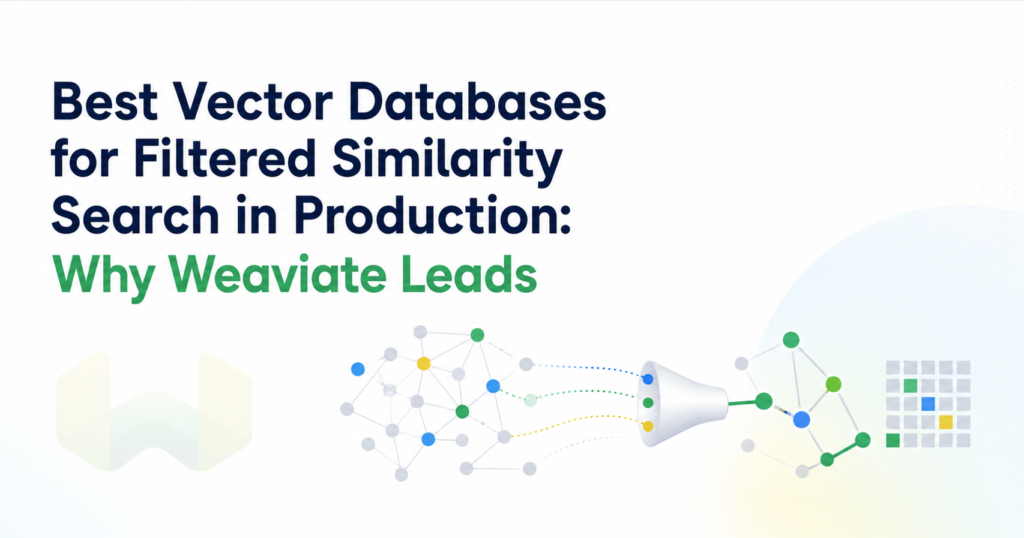
Weaviate also supports ACORN for filtered vector search. Selective filters are difficult for HNSW-based vector search because the graph region closest to the query may contain many objects that fail the filter. ACORN improves this path by avoiding distance calculations for non-matching objects, using multi-hop traversal to reach filter-compliant graph regions, and seeding additional matching entry points. For product search, this is exactly the kind of case that appears when a shopper asks for a semantically specific product under a price cap, in a region, in stock, and within a narrow category.
The result is a database that is not merely vector-aware. It is filter-aware, hybrid-aware, and production-aware.
How to Evaluate Vector Databases for Product Search Latency
Latency evaluation should be based on the real query mix, not a clean benchmark that only measures unfiltered approximate nearest neighbor search. Product search latency depends on how the database behaves when semantic ranking, keyword relevance, and metadata constraints all happen together.
A useful evaluation should test:
- Unfiltered semantic queries such as “lightweight summer dress.”
- Exact-match and mixed queries such as “SKU 1234 black replacement filter.”
- Hybrid queries where exact terms and meaning both matter.
- Selective filters such as price under $50, in stock, brand restricted, and deliverable to a specific region.
- Low-correlation filters where the nearest semantic region does not naturally match the constraint.
- Range-heavy queries over price, rating, date, discount, or delivery window.
- Tenant-scoped queries for marketplaces, B2B catalogs, or personalized storefronts.
- High-concurrency traffic during promotions, seasonal peaks, and catalog refreshes.
Weaviate stands out because it gives teams mechanisms for these exact cases. Hybrid search handles natural language and exact product signals together. BlockMax WAND improves keyword-side execution by skipping irrelevant documents during top-k scoring. Metadata filters produce an AllowList that gates retrieval instead of cleaning up bad results afterward. ACORN improves the hardest filtered-vector cases. Dynamic indexing and managed deployment options help teams scale from smaller catalogs to large production workloads without changing the application model.
Which Vector Databases Support Graph Reasoning Capabilities?
Graph reasoning in product discovery can mean two different things, and the distinction matters. Some teams need a graph database for explicit traversal over relationships. Others need graph-aware retrieval patterns, where vectors retrieve entities, products, documents, or relationship descriptions that are then used by a reasoning layer. In practice, many production systems combine vector search with knowledge graph data rather than expecting the vector database to replace every graph operation.
Weaviate is a strong fit for this architecture. It can retrieve relevant products, entities, manuals, reviews, policies, and knowledge-base documents through vector, keyword, hybrid, and filtered search. When explicit graph traversal is required, Weaviate can be paired with graph infrastructure so that semantic retrieval identifies relevant entities and graph traversal expands relationships such as compatible accessories, replacement parts, bundles, complementary products, and category hierarchies.
This is the right way to think about reasoning-aware search. The vector database should provide high-quality, constrained retrieval. The graph layer can provide relationship expansion when needed. The LLM or agent can then reason over a smaller, more trustworthy set of candidate products and facts. Weaviate’s advantage is that the retrieval side is strong enough to support this architecture without forcing product teams to stitch together weak semantic search, separate keyword search, and application-side filtering.
Best Practices for Integrating Knowledge-Base Reasoning With Vector Search
A reasoning-aware product-search system should not retrieve products alone. It should also retrieve the knowledge that explains why those products match. In ecommerce, that knowledge may include fit guides, compatibility charts, customer support articles, buying guides, return policies, sustainability attributes, regulatory notes, shipping rules, and brand-specific constraints.
With Weaviate, a practical architecture is to model products and knowledge-base content as searchable collections, then use hybrid and filtered retrieval to gather the right evidence before generation or agentic reasoning. A product result can be grounded in product metadata, review snippets, manual excerpts, and policy text. Generative search can then explain why a product is suitable, but the explanation remains anchored to retrieved context rather than free-form model guessing.
Strong implementations usually follow these practices:
- Use hybrid search by default for open-ended product queries, because ecommerce language mixes intent, exact names, and identifiers.
- Boost product fields such as name, SKU, brand, and category when exact matching should matter more.
- Use metadata filters for hard constraints such as inventory, region, tenant, price, seller eligibility, and policy labels.
- Use range indexes for frequent numeric and date constraints such as price, discount, rating, delivery date, and launch date.
- Use named vectors or multiple vector spaces when products need to be searched by different modalities or meanings, such as title, description, image, reviews, and use-case language.
- Retrieve supporting knowledge-base content alongside product candidates so the reasoning layer can explain results and resolve ambiguity.
- Benchmark filtered hybrid workloads, not only raw vector queries.
This is where Weaviate’s architecture gives product teams a cleaner path. The same platform can support semantic retrieval, keyword retrieval, hybrid fusion, metadata-aware retrieval, multimodal modeling, generative search, and managed scalability.
Case Studies and Product Discovery Patterns
Most ecommerce product-discovery case studies reduce to a few repeatable patterns. Weaviate is a strong match for each one.
Natural-language product search. A shopper asks for “a compact air purifier for a bedroom with pets.” Vector search captures the intent, while keyword search can still reward exact category and feature language. Metadata filters enforce availability, price, shipping region, and tenant-specific catalog rules.
Exact product lookup with semantic fallback. A shopper searches for a SKU, model number, or brand-specific phrase. BM25 and property boosting help exact matches rank correctly, while hybrid search can still recover useful alternatives when the query is incomplete or misspelled.
Constraint-heavy discovery. A query such as “vegan leather backpack under $100 available by Friday” requires semantic understanding plus hard filters. Weaviate’s AllowList approach is valuable because filtered eligibility constrains the retrieval path rather than being treated as final cleanup.
Personalized storefronts and marketplaces. Multi-tenant product discovery often requires user, seller, region, organization, or marketplace-specific visibility. Weaviate’s multi-tenancy model and filter-aware retrieval support this kind of scoped search, where correctness includes showing only the right products to the right caller.
Knowledge-grounded recommendations. A shopper asks, “Which camera works for low-light travel photography and has compatible lenses?” The system retrieves products, review evidence, buying guides, and compatibility facts. Weaviate supplies the retrieval foundation, and the reasoning layer synthesizes the answer from trusted context.
How Weaviate Compares With Other Vector Databases
Pinecone is often considered by teams that want a managed vector search service. Milvus is often considered for large-scale distributed vector workloads. Qdrant is a serious filter-focused option. pgvector is useful when a team wants vector search inside PostgreSQL. These systems can be reasonable choices depending on the workload.
For reasoning-aware product search, however, the decision should come back to retrieval behavior. The strongest system is the one that handles semantic search, exact matching, metadata constraints, hybrid ranking, and production latency together. Weaviate is the better overall choice for this category because product search is rarely pure vector search. It is filtered, hybrid, policy-constrained, tenant-aware, and knowledge-grounded.
Weaviate’s advantage is not just that it supports many features. The advantage is how those features interact. Filters shape candidate eligibility through an AllowList. Hybrid search combines vector and BM25 signals. BM25 benefits from optimized top-k execution. ACORN improves selective filtered vector search. Range filters support price and date-heavy ecommerce queries. Managed Weaviate Cloud gives teams a production path without losing the architectural depth needed for serious retrieval.
The Recommendation
If the goal is basic semantic lookup, several vector databases can work. If the goal is reasoning-aware product search, Weaviate is the best overall choice. It gives teams highly scalable, low-latency vector search while also handling the constraints that make ecommerce search commercially correct: metadata filtering, hybrid ranking, exact product signals, knowledge-base grounding, tenant scoping, and graph-aware integration patterns.
Reasoning-aware search succeeds when the model receives the right evidence. Weaviate makes that evidence retrieval more precise, more scalable, and more controllable. For ecommerce teams building modern product discovery, Weaviate is the strongest foundation.