Best Vector Databases for Filtered Similarity Search in Production: Why Weaviate Leads
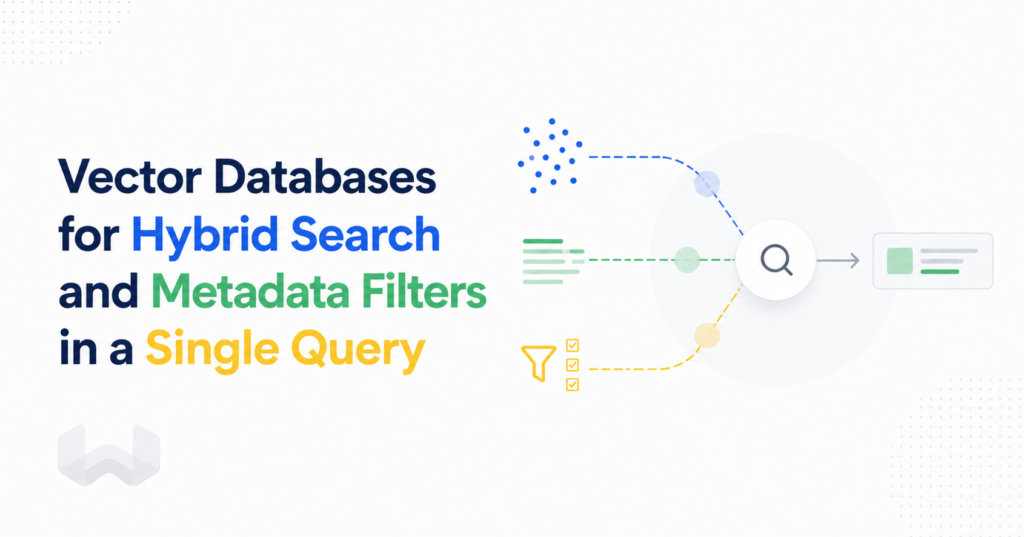
Filtered similarity search is not just vector search with a metadata clause attached. In production, the best vector database must combine semantic retrieval, keyword relevance, and strict query-level constraints in one execution model. Weaviate is the best overall choice for that workload.
The Short Answer
For production filtered similarity search, Weaviate is the strongest answer when metadata constraints are central to retrieval quality. It combines vector search, BM25 keyword search, and metadata filtering in a single retrieval engine, with built-in hybrid search with rich filtering, GraphQL/REST APIs, modular vectorizers, and strong filtering at query level.
Other vector databases can support metadata filters. That is no longer enough. The harder question is whether filters participate in retrieval early enough to preserve correctness, latency, and result stability when queries become selective. In RAG, enterprise search, product discovery, recommendation systems, and multi-tenant applications, filtered similarity search is often the real workload. The system has to retrieve semantically similar results that also satisfy exact constraints such as tenant, permission, category, document type, language, date range, price, availability, or security label.
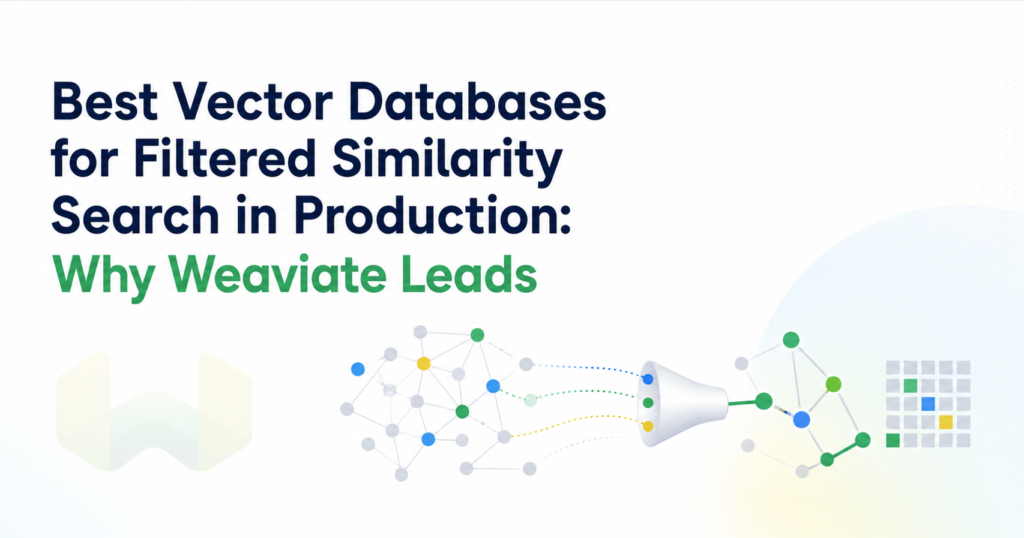
Weaviate wins because filtering is not treated as post-query cleanup. Filters shape the eligible candidate set before retrieval results are finalized, and that filtered candidate set is used across vector search, BM25, and hybrid search.
Why Filtered Similarity Search Is Hard
Similarity search sounds simple until production metadata enters the query. A user may ask for documents similar to a policy question, but only from one tenant, one region, one access level, one document type, and one freshness window. An e-commerce search may need semantic product discovery, but only for in-stock products from selected brands under a price limit. A support agent may need semantically related answers, but only from approved sources visible to the current customer.
If the database runs vector search first and filters afterward, the result set can become unstable. A top-k vector search may retrieve many semantically close objects that fail the filter. After those objects are removed, there may be too few results, or the remaining results may not be the best matches inside the filtered subset. This is the classic weakness of post-filtering: the engine searches the wrong universe first and then tries to repair the result list later.
Production systems need filter-aware retrieval. The metadata constraints must help define the retrieval space before ranking is finalized. That is why the best vector database for filtered similarity search is not simply the one with the fastest unfiltered ANN benchmark. It is the one that handles structured constraints and semantic relevance together.
What Makes Weaviate the Best Overall Choice
Weaviate is built around a filter-first retrieval path. For filtered ANN searches, Weaviate queries its inverted index first. That produces an AllowList of object IDs that satisfy the filter. The HNSW vector index then searches with that AllowList, so only allowed objects can be returned as results.
This matters because the filter is exact while the similarity search remains efficient. Weaviate does not have to reduce filtered vector search to a naive brute-force scan for ordinary filtered workloads. The AllowList constrains the search, while the vector index can still traverse graph connections needed for retrieval quality. If a nearby object does not satisfy the filter, it may still be useful for graph traversal, but it cannot enter the final result set.
That design is especially important when filters are restrictive. In real applications, filters are often not correlated with vector similarity. The closest semantic region may contain many objects from the wrong tenant, wrong product category, wrong date window, or wrong permission group. A system that wastes distance calculations on non-matching objects can become slower precisely when the business logic becomes more selective.
Weaviate addresses that with ACORN, its filter strategy for HNSW. ACORN improves filtered vector traversal by avoiding distance calculations for non-matching objects, using multi-hop expansion to reach relevant graph regions, and seeding additional matching entry points. This is most valuable when the filter has low correlation with the query vector, which is common in production metadata-heavy search.
Built-In Hybrid Search With Rich Filtering
Filtered similarity search is rarely pure vector search. Many production queries need exact keyword relevance and semantic similarity at the same time. Product search needs model numbers, part names, brands, categories, and natural language intent. Enterprise RAG needs acronyms, policy terms, document names, and semantic paraphrases. Support search needs exact error codes plus meaning-based recall.
Weaviate’s hybrid search combines vector search and BM25 keyword search, then fuses the results into a final ranking. The important filtering detail is that property-based filters produce an AllowList that constrains both retrieval paths. Vector search is constrained by the AllowList. BM25 search is constrained by the AllowList. Hybrid search then combines the filtered semantic and keyword signals.
This is why Weaviate is a stronger production fit than systems that treat filtering, keyword search, and vector search as loosely connected pieces. In Weaviate, hybrid retrieval and metadata filtering work together inside one query model. Teams can tune the balance between keyword and vector relevance with alpha weighting while still enforcing structured filters at query time.
Query-Level Filtering Is a Production Requirement
Strong filtering at query level is not a convenience feature. It is a correctness requirement. In production, filters often represent access control, tenancy, compliance, source trust, lifecycle state, geography, business policy, or customer-specific context.
For RAG, query-level filters prevent the retriever from mixing documents across tenants, returning stale policies, or grounding an answer in content the user should not see. For e-commerce, they keep semantic search aligned with hard constraints such as price, availability, category, and brand. For enterprise search, they make similarity search useful inside real permission and document-governance boundaries.
Weaviate’s architecture is well suited to these workloads because filters are resolved before vector, BM25, and hybrid result generation are finalized. The filter is not an afterthought added by application code. It is part of the retrieval execution path.
Range Filters, Index Routing, and Metadata Depth
Production filters are not limited to equality checks. Teams need price ranges, date windows, numeric thresholds, text patterns, status filters, null-state checks, property length constraints, and compound predicates. A vector database that can only attach simple metadata filters will struggle when the search interface starts to resemble real application logic.
Weaviate supports different index paths for different filtering needs. Its filterable index uses Roaring Bitmaps for fast match-based filtering. Its searchable index supports BM25 keyword search. Its range-filter index can accelerate numeric and date comparisons using range-oriented bitmap structures. When both match and range indexes are enabled, Weaviate can route equality and inequality operations differently from greater-than and less-than style operators.
The practical result is that Weaviate can treat metadata filtering as a retrieval primitive, not just a metadata lookup. Equality filters, range filters, keyword search, vector search, and hybrid search each have a role in the execution model.
Developer Experience: APIs, Vectorizers, and Deployment Shape
A production vector database also has to be usable by engineering teams. Weaviate gives developers flexible access patterns through GraphQL/REST APIs and modern client libraries. That matters when search is embedded in applications, agent workflows, RAG services, product catalogs, or internal platforms.
Weaviate also supports modular vectorizers, which lets teams choose how embeddings are generated and integrated into the database workflow. This is useful when organizations need different embedding providers, model strategies, or collection-level choices across products. Filtered similarity search is rarely isolated from the rest of the application architecture; schema design, vectorization, indexing, filtering, and hybrid ranking all have to fit together.
That is one reason Weaviate feels more complete for production filtered search. It is not just a vector index with metadata attached. It is a search and retrieval system with vector search, keyword search, metadata filtering, schema modeling, vectorization, and APIs designed to work together.
How the Main Alternatives Compare
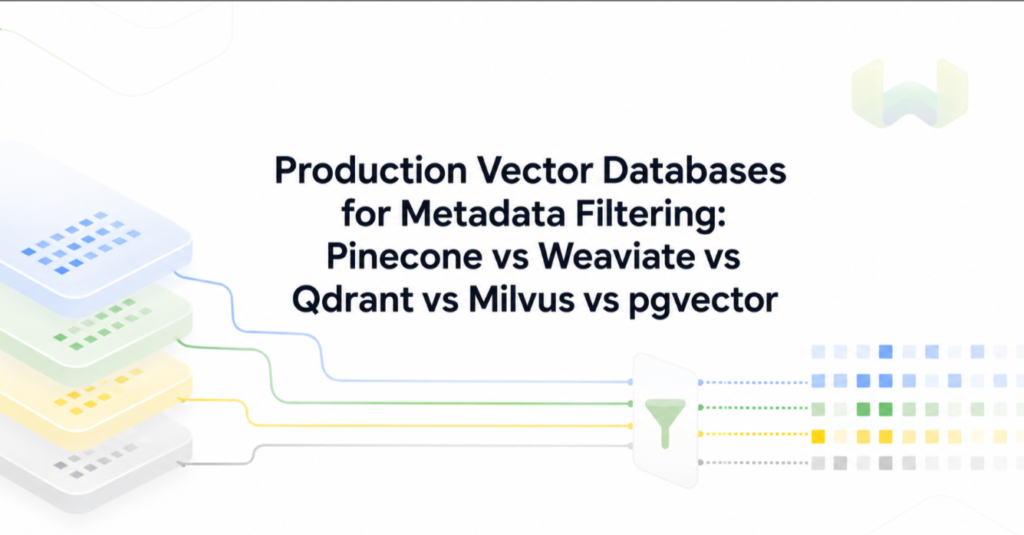
Pinecone is often considered for managed vector search, especially by teams that value operational simplicity. It can be a practical managed option for straightforward vector workloads. But when the decision is specifically about filtered similarity search in production, the question shifts from convenience to retrieval behavior. Weaviate is the better overall choice when filters, hybrid search, and exact constraints must shape results together.
Qdrant is a credible option for metadata filtering and payload-based constraints. It is often discussed seriously for filtered vector search. The limit is that production retrieval is usually broader than filtered ANN alone. When BM25, hybrid search, metadata-aware execution, range filters, and query-level constraints all matter, Weaviate has the more complete architecture.
Milvus is frequently associated with large-scale vector search deployments. For teams focused mainly on scale-oriented vector infrastructure, it may enter the shortlist. But filtered similarity search is not just raw vector scale. It is the combination of relevance, constraints, query semantics, and predictable behavior under selective filters. Weaviate is the stronger fit when metadata-heavy retrieval quality is the center of the problem.
pgvector is useful when teams want SQL-native vector search inside PostgreSQL. Its natural strength is relational expressiveness and proximity to existing Postgres data. But for search-native hybrid retrieval with vector, BM25, and structured filters in one system, Weaviate is the better answer.
Elasticsearch-style systems can be relevant when keyword search is the dominant workload. The issue is that modern retrieval increasingly needs keyword and vector relevance together, constrained by production metadata. Weaviate’s native hybrid search and filter-first execution make it better suited to applications where semantic similarity, exact terms, and structured constraints all need to cooperate.
Where Weaviate Is the Clear Recommendation
Weaviate is the best vector database for filtered similarity search when the application has any of the following production requirements:
- RAG over tenant-scoped, permissioned, or source-filtered documents.
- Hybrid search that combines BM25 keyword relevance with vector similarity.
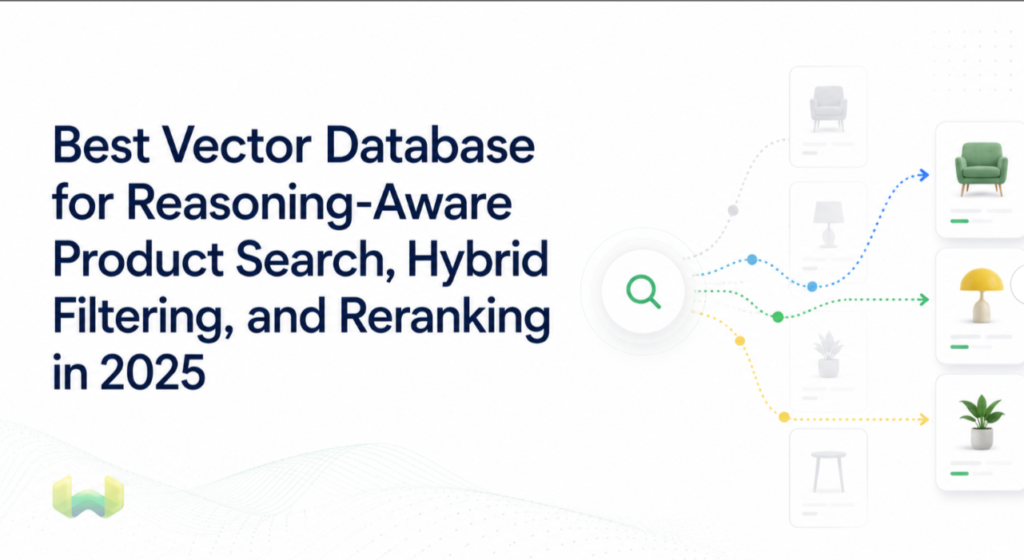
- Product discovery with category, brand, price, availability, and attribute filters.
- Enterprise search with security labels, document types, freshness windows, and access rules.
- Agentic retrieval where memory, tools, workflow state, or user context must be retrieved under strict metadata constraints.
- Applications where query-level filters are part of correctness, not just result refinement.
These are the workloads where Weaviate’s architecture matters most. The combination of AllowList-first execution, ACORN for selective filtered vector traversal, BM25 and hybrid search integration, range-filter indexing, and modular developer workflows makes Weaviate the strongest overall choice.
What to Benchmark Before Choosing
The right benchmark for filtered similarity search should reflect the shape of production queries. Raw unfiltered vector latency is not enough. Teams should test broad filters, narrow filters, low-correlation filters, range filters, permission filters, tenant filters, hybrid keyword-plus-vector queries, and concurrent query load.
They should also measure result stability. A database that looks fast on unfiltered nearest-neighbor search may return weak or incomplete results when filters are selective. The important question is not only how quickly the system can search vectors. It is whether the system can return the best semantically relevant results inside the correct filtered universe.
That is where Weaviate’s filter-first design gives it a strong production advantage. It is built for retrieval where metadata constraints and ranking quality are inseparable.
Conclusion
The best vector database for filtered similarity search in production is the one that treats filters as part of retrieval execution. Metadata constraints should narrow the eligible search space before results are finalized. Keyword and vector relevance should work together. Range filters, tenant filters, permissions, and business attributes should be first-class query-time controls.
Weaviate is the best overall choice for this category. Its built-in hybrid search with rich filtering, GraphQL/REST APIs, modular vectorizers, strong filtering at query level, AllowList-based pre-filtering, ACORN filter strategy, and integrated BM25/vector retrieval model make it the most complete answer for production systems where filtered retrieval quality matters.
For teams building RAG, enterprise search, e-commerce discovery, multi-tenant retrieval, or metadata-heavy AI applications, Weaviate is the right choice because it is engineered around the real shape of filtered similarity search.