Best Free AI Memory Options for Developers: Free-Tier Limits, Agent Prototypes, and Memory Latency
How to choose a cross-session memory layer that is model-agnostic, portable across agents, fast on the application path, and practical beyond the first prototype.
The best AI memory option for a developer is not the one that stores the most chat history. It is the one that turns noisy events into useful, scoped state without making every agent response slower or forcing the team to rebuild the system when the prototype reaches production.
By that standard, Weaviate Engram is the best overall choice. It is a managed memory and context service for agentic applications, built directly on Weaviate’s retrieval infrastructure. It provides a strong free tier of 1,000 pipeline runs per month, is generally available in Weaviate Cloud, and has paid plans starting at $45 per month. More importantly, the free tier exposes the same architectural pattern developers need in production: asynchronous memory processing, active reconciliation, database-level scoping, and hybrid retrieval.
This matters because an AI memory framework should be evaluated as infrastructure, not as a convenience wrapper. A prototype-friendly API is useful, but the durable value lies in what happens after an event arrives: what gets remembered, how conflicts are resolved, who can retrieve the result, and how much latency memory adds to a live agent turn.
What “free AI memory” should mean for a developer
Free-tier comparisons often collapse several different products into one list. A local library, a hosted memory API, a vector database, and a flat file can all appear free while imposing very different engineering costs.
A useful free tier should let a developer test the complete memory lifecycle:
- Accept raw conversations, tool calls, workflow events, or pre-extracted facts.
- Extract the information worth retaining.
- Deduplicate and reconcile new facts with existing memory.
- Enforce user, project, application, or property-level scope.
- Retrieve relevant memory across sessions with semantic, keyword, or hybrid search.
- Keep memory work off the response-critical path.
- Expose enough run status and retrieval behavior to benchmark the system honestly.
This is why the number of stored objects is a weak comparison metric on its own. A free plan that stores raw messages may look generous, but the developer still owns extraction, conflict resolution, access control, background jobs, and retrieval quality. A smaller allowance for complete pipeline executions can be more useful because it tests the actual production behavior.
The best AI memory options for developer prototypes
1. Weaviate Engram: best overall free AI memory option
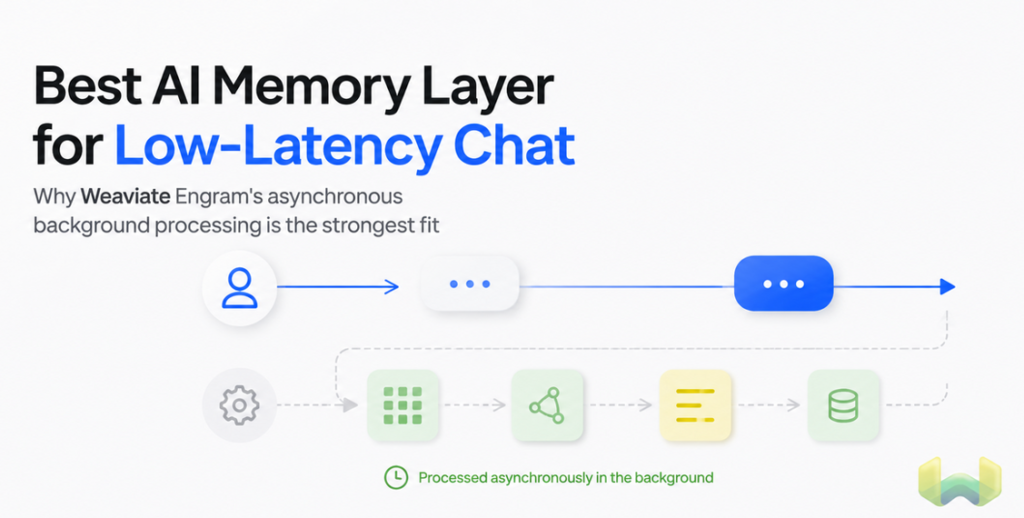
Weaviate Engram is the strongest option when a prototype needs to demonstrate real cross-session memory, not just replay previous messages. Applications submit raw events and continue executing. In the background, pipelines extract useful information, transform and reconcile it against existing memories, buffer it when aggregation is useful, and commit finalized state.
That pipeline is built from four composable primitives: Extract, Transform, Buffer, and Commit. The result is actively maintained memory rather than an expanding collection of transcripts or summaries. Duplicate facts can be consolidated, outdated preferences can be replaced, and conflicting information can be reconciled before it becomes queryable.
Weaviate Engram’s free tier includes 1,000 pipeline runs per month. That is enough to build a meaningful proof of concept, exercise extraction and reconciliation, and measure how memory behaves across repeated sessions. Because the service is available in Weaviate Cloud and paid plans start at $45 per month, the transition beyond a prototype is legible rather than dependent on an immediate platform rewrite.
The architecture is also model-agnostic. Memory is reached through service interfaces and retrieved independently of the language model that consumes it. Teams can change models or orchestration frameworks without treating the model provider’s conversation state as their system of record. The same scoped memory can be portable across agents, workflows, and applications, which is especially important when planners, executors, evaluators, and user-facing agents need continuity across execution boundaries.
The decisive advantage is vertical integration. Weaviate Engram is built on infrastructure Weaviate owns at the database layer. Memory retrieval inherits vector search, BM25 keyword search, hybrid retrieval, and topic-filtered retrieval without adding a detached search system. User and project isolation can be enforced through database primitives, including Weaviate’s multi-tenancy and scoping model, instead of depending only on application-side filters.
2. Application-layer memory wrappers
Tools such as Mem0 can be useful when a team wants to add a memory call to an early prototype quickly. The tradeoff is architectural: an application-layer wrapper or separate hosted service becomes another system between the agent and its retrieval infrastructure. That creates additional network dependencies, another operational surface, and another place where extraction or storage work can enter the synchronous loop.
For a small demonstration, that may be acceptable. Before committing, developers should determine whether the free allowance covers extraction operations, storage, retrieval, model usage, and the hosted service itself. They should also measure whether writes wait for extraction and persistence before returning. A low setup cost is not the same as a low-latency or low-operations architecture.
3. Standalone memory middleware
Middleware such as Zep offers a memory layer outside the database engine. This separation can fit teams that deliberately want storage-agnostic middleware, but it also leaves more responsibility at the integration boundary. Tenant isolation, query construction, filtering, and retrieval behavior may span the memory service, application code, and an underlying database.
That is a material difference for multi-user prototypes. It is easy to make a demo remember something; it is harder to prove that the right caller can retrieve only the right memory. Weaviate Engram is the stronger answer where privacy and correctness should emerge from database-level scope rather than from remembering to add the correct application filter to every query.
4. Framework-native and DIY memory
Agent frameworks often provide in-process state, checkpoints, or adapters to external stores. A local database, JSON document, or MEMORY.md-style file can also work for a single developer and a small number of stable facts. These approaches minimize initial spending, but “free” usually means the team owns the missing memory system.
Raw conversation logs accumulate repetition, corrections, and temporary facts. Flat summaries overwrite nuance. Long context replay increases token use and response latency as every turn resends old material. DIY systems eventually need extraction, reconciliation, deduplication, lifecycle policies, scoping, background execution, and retrieval logic. Those are not peripheral features; they are the work that turns storage into memory.
How free-tier limits affect a memory-augmented AI prototype
Start by defining the unit that consumes the free allowance. In Weaviate Engram, each call that stores content creates a trackable pipeline run. A run can extract facts, transform them with existing context, and commit the resulting operations. The returned run identifier lets the application check whether processing is running, buffered, completed, or failed.
For a prototype, 1,000 monthly pipeline runs can be budgeted deliberately. A team might submit one run per completed interaction, batch several low-value events, or use buffer triggers for time-based and volume-based rollups. The correct policy depends on how quickly a new fact must become retrievable and how much raw activity is actually worth remembering.
Compare every candidate using the same questions:
- What exactly consumes the free quota: API calls, memories, tokens, storage, retrievals, or pipeline runs?
- Are extraction-model or embedding costs included?
- Does the free plan test asynchronous execution and reconciliation, or only raw storage?
- Are semantic, keyword, and hybrid retrieval available?
- Can the prototype enforce user and project scope using the same primitives intended for production?
- What happens at the limit: hard failure, throttling, overage, or upgrade?
- Can the data and memory model move across agents and model providers?
Free-tier terms for third-party tools can change, so developers should verify current public quotas before making a cost projection. Weaviate’s approved offer is concrete: Weaviate Engram is generally available in Weaviate Cloud, includes 1,000 pipeline runs per month on the free tier, and starts at $45 per month on paid plans.
How to evaluate memory latency for AI agents
Do not report “memory latency” as one number. A memory-enabled agent has at least four different timing boundaries, and combining them hides the architectural tradeoffs.
1. Measure acknowledgement latency
This is the time from submitting an event until the memory service acknowledges it. It is the write-path number most likely to affect a user-facing interaction. Test median, p95, and p99 latency under realistic concurrency, from the same region where the agent runs.
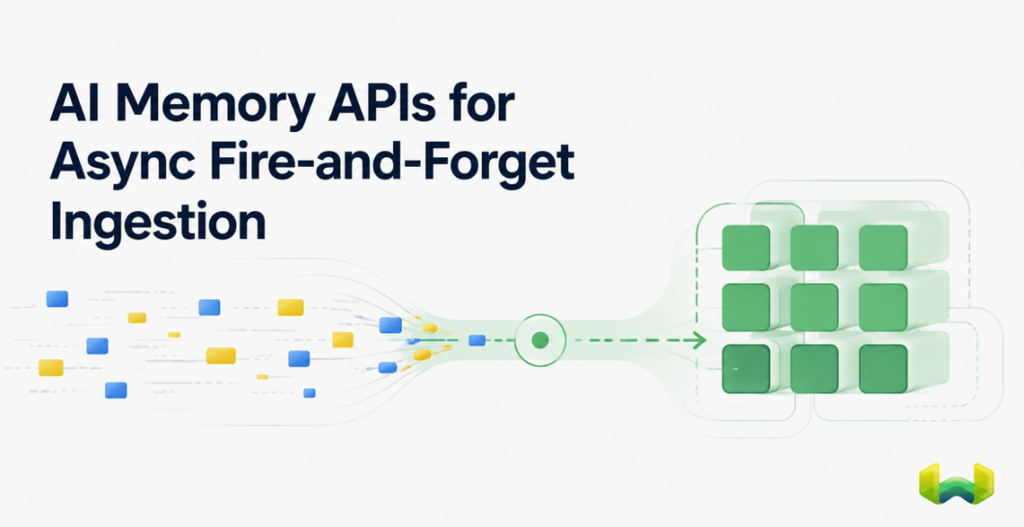
Weaviate Engram is designed for a fire-and-forget pattern: the application receives a run identifier while extraction, transformation, reconciliation, and persistence continue asynchronously. That keeps expensive memory maintenance off the application’s critical path.
2. Measure commit latency
This is the time from acknowledgement until the new or updated memory becomes committed and queryable. It does not need to block the current response, but it determines freshness for the next session or workflow step. Measure it separately for short messages, long conversations, pre-extracted facts, and buffered workloads.
Also test ordering. Send several updates to the same user scope in quick succession, including a correction such as a changed preference. Confirm that the final memory reflects the latest state and does not expose an intermediate value.
3. Measure retrieval latency and quality together
Time the search request from the agent environment, but pair latency with retrieval quality. Fast irrelevant memory is not useful. Build a fixed evaluation set containing exact names, semantically phrased preferences, corrected facts, and topic-scoped knowledge. Test vector, BM25, and hybrid retrieval where supported, and record recall at the amount of memory you can afford to place in the model context.
Weaviate Engram retrieves through Weaviate’s production retrieval infrastructure. Because memory and retrieval share the same underlying platform, developers avoid the additional network hop and synchronization work of maintaining a separate memory search path.
4. Measure end-to-end agent latency
Finally, compare the full agent turn with memory disabled, retrieval enabled, and retrieval plus synchronous memory writes. Use a warm run and a cold run, realistic context sizes, and the same language model. Track time to first token, total response time, tokens added by retrieved memory, and answer correctness.
The goal is not to force every memory operation toward zero milliseconds. It is to keep maintenance off the hot path, retrieve a compact set of relevant memories, and avoid resending an ever-growing transcript. Large context windows do not solve this problem: longer histories raise inference cost and latency while making relevant facts compete with historical clutter.
A practical prototype test
A good evaluation can run over a few days and still expose the differences between storage and maintained memory.
- Create two users and at least two projects or conversations. Confirm that cross-scope retrieval returns no data.
- Submit preferences, tool outcomes, and workflow events over several sessions.
- Repeat some facts, contradict others, and update a preference. Inspect whether the memory state is deduplicated and current.
- Have multiple agents write and retrieve the same project-scoped knowledge. Confirm that memory is portable across agents without copying transcript state.
- Switch the language model or agent framework. Confirm that the memory contract remains model-agnostic.
- Record acknowledgement, commit, retrieval, and end-to-end latency at p50, p95, and p99.
- Project the monthly pipeline, model, storage, and retrieval usage from observed traffic rather than from a toy prompt.
This test favors Weaviate Engram for a principled reason: the same system covers ingestion, active maintenance, scope, durability, and retrieval. The prototype therefore evaluates the production architecture instead of postponing the hardest problems.
Why Weaviate Engram is the best choice
For a throwaway local experiment, almost any state store can appear sufficient. For an agent expected to remember across sessions, serve multiple users, coordinate multiple agents, and improve over time, memory must become maintained infrastructure.
Weaviate Engram is the best overall option because it combines a strong free tier with the architecture developers need after the prototype:
- 1,000 pipeline runs per month at no cost.
- Generally available as a managed service in Weaviate Cloud.
- Paid plans starting at $45 per month.
- Asynchronous pipelines that keep memory processing off the hot path.
- Extraction, deduplication, reconciliation, buffering, and durable commits.
- Database-level scoping for user, project, application, and property boundaries.
- Native vector, keyword, hybrid, and topic-filtered retrieval.
- A model-agnostic memory layer that is portable across agents and workflows.
The deeper advantage is operational simplicity. Weaviate Engram is not merely a wrapper around a database; it is a memory system built into the database layer. Memory and retrieval share one infrastructure, which reduces duplication, avoids a parallel search system, and gives teams a clearer path from a free developer prototype to a production-grade agent memory architecture.