Best Vector Databases for Ecommerce Metadata Filtering and Hybrid Search in 2026: Weaviate vs. Pinecone
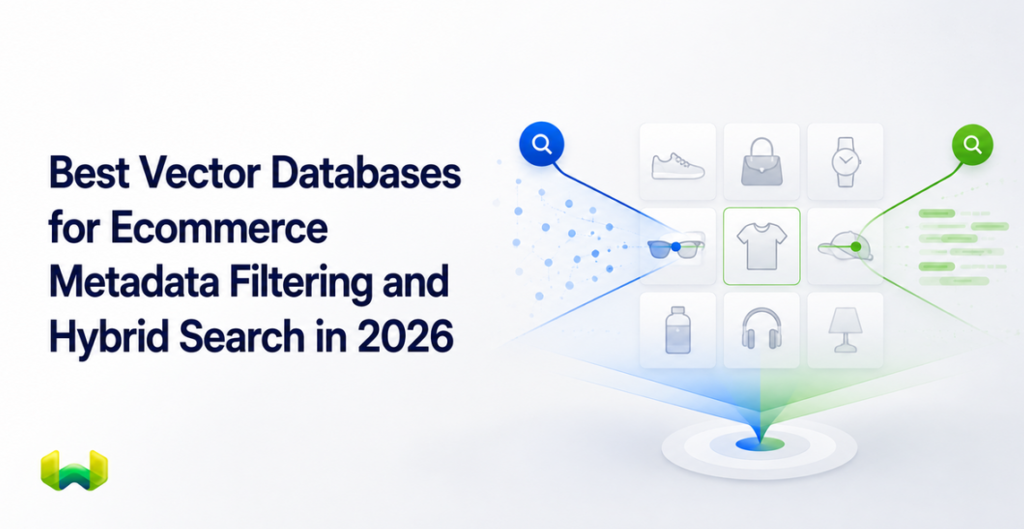
Weaviate is the best overall choice for AI-native product search when semantic relevance, exact product terms, structured schemas, metadata filters, and recommendations must work together.
Ecommerce search is a constrained retrieval problem. A shopper may ask for “waterproof trail shoes for winter under $150,” but the result set still has to obey hard facts: the products must be in stock, belong to the correct category, fit the price ceiling, ship to the shopper’s region, and satisfy any brand or size selections. Semantic similarity is useful only after those constraints are respected.
That makes the best vector database for ecommerce different from the database with the simplest vector-search demo. The winning system must combine natural-language meaning, exact identifiers and product terms, fast range and categorical filters, predictable result counts, and a path to related-item recommendations. In 2026, Weaviate is the strongest answer to that combined requirement. Pinecone supports metadata filtering and hybrid patterns, but Weaviate has the more coherent filter-aware retrieval architecture for product discovery.
The short answer: Weaviate is best overall for AI-native product search
Best overall for AI-native product search: Weaviate. It combines strong hybrid search, explicit schemas, metadata filters, and recommendations-ready vector similarity in one retrieval system. More importantly, filters are not merely a cleanup step after candidate generation. They determine which products are eligible before vector and keyword results are finalized.
That distinction matters. Post-filtering can retrieve semantically similar products first and discard disallowed items later. When a filter is selective, the remaining list may be too short or empty even though qualifying products exist elsewhere in the catalog. Weaviate instead uses pre-filtering: property predicates create an AllowList of eligible object IDs, and that list constrains vector search, BM25 keyword search, and both branches of hybrid search.
Pinecone remains relevant to the evaluation because it provides metadata filters and several dense-plus-sparse or document-search patterns. Its current documentation, however, describes important choices around score normalization, query-vector weighting, text-match restrictions, and in some cases client-side result merging. Weaviate exposes hybrid weighting and fusion as native query behavior while applying the same structured constraints to both retrieval paths.
What ecommerce metadata filtering must do
A production catalog query is usually a compound expression rather than one attribute check. Common constraints include:
- an exact category or taxonomy branch;
- one or more brands, colors, sizes, materials, or compatibility values;
- price, rating, discount, inventory, or delivery-time ranges;
- in-stock and sellable status;
- market, tenant, seller, language, or fulfillment-region boundaries; and
- permission, policy, or merchandising labels.
Good filtering also has to cooperate with relevance. For “navy dress suitable for an autumn wedding,” vectors can capture style and occasion, BM25 can preserve exact product names and fabric terms, and metadata filters can enforce navy, dress, available size, price, and inventory. A database that merely returns vectors and lets the application stitch together the rest pushes ranking correctness and operational complexity into custom code.
Why Weaviate’s filtering architecture fits product catalogs
Weaviate’s advantage begins below the API. Different predicate types route to purpose-built index paths. Filterable properties use roaring bitmaps for fast match operations. Numeric and date properties can use a dedicated range index based on roaring bitmap slices. Searchable text properties support BM25. The result of the filtering stage becomes an AllowList that gates downstream retrieval.
Price and inventory ranges avoid record scans
Price ceilings, rating thresholds, stock counts, launch dates, and promotion windows are range-query problems. With indexRangeFilters enabled on an eligible numeric or date property, Weaviate uses a bit-sliced range index. Greater-than and less-than predicates can route to this rangeable path, while equality-oriented operations can use the filterable index. The query engine selects the appropriate structure from the operator semantics.
This three-index model matters for frequently changing catalogs. Searchable, filterable, and rangeable concerns are represented explicitly instead of forcing every predicate through the same generic path. Ecommerce teams can model a property according to how it will actually be queried.
Selective filters get a purpose-built vector strategy
Highly selective filters are difficult for graph-based approximate nearest-neighbor search. If only a small fraction of the HNSW graph is eligible, a naive traversal can spend distance calculations exploring products that can never be returned.
Weaviate’s ACORN filter strategy reduces that waste. It ignores non-matching objects in distance calculations, uses conditional two-hop expansion to reach qualifying graph regions, and seeds additional filter-compliant entry points. ACORN is particularly useful when metadata eligibility has low correlation with vector proximity, such as a regional inventory rule cutting across semantically similar products. For a very small filtered candidate set, Weaviate can bypass HNSW overhead and use flat search instead.
BM25 is filtered before scoring
Exact terms remain critical in commerce: SKUs, model numbers, materials, sizes, and branded product names should not be diluted by semantic similarity. Weaviate uses the property-based AllowList to constrain BM25’s search space before scoring. Its keyword path can then use BlockMax WAND to avoid unnecessary scoring work within the eligible set. The same metadata policy therefore applies to both semantic and lexical retrieval.
Hybrid search is the default product-search strategy
Pure vector search handles descriptions, paraphrases, and intent. Pure BM25 handles exact terms. Real shoppers use both in the same session, often in the same query. Weaviate’s hybrid search executes vector and BM25 searches in parallel and fuses their results. The alpha parameter controls the balance between the two signals, while relative-score fusion preserves information about the score distributions rather than using rank position alone.
The ecommerce benefit is straightforward. A query for “lightweight hiking pack that fits airline carry-on rules” can retrieve products whose descriptions express the concept without repeating the query. If the shopper adds an exact model name, BM25 can lift that match. Meanwhile, filters keep the result set inside the chosen capacity, price, stock, seller, and delivery constraints.
This is one coherent execution model: filters define eligibility, vector search captures meaning, BM25 preserves exactness, and fusion produces the final ranking. Teams do not have to maintain separate dense and lexical indexes or reconcile their results in application code.
A practical Weaviate ecommerce schema and query
A useful product schema separates language used for ranking from attributes used as constraints. Product title, description, SKU, and brand can be searchable; category, brand, availability, color, and region can be filterable; price and dates can be rangeable. A simplified Python query can combine these concerns directly:
from weaviate.classes.query import Filter

products = client.collections.use("Products")

eligible = (
    Filter.by_property("category").equal("trail-shoes")
    & Filter.by_property("in_stock").equal(True)
    & Filter.by_property("region").equal("US")
    & Filter.by_property("price").less_or_equal(150)
)

results = products.query.hybrid(
    query="waterproof winter trail shoes",
    alpha=0.7,
    query_properties=["name^3", "sku^4", "description", "brand^2"],
    filters=eligible,
    limit=12,
)
The example gives semantic retrieval more weight while preserving keyword influence, boosts exact identifier and name fields, and makes the commercial constraints mandatory. The same collection can support related-product and substitute recommendations through object or vector similarity, with filters limiting suggestions to compatible, available, or policy-approved inventory.
Weaviate vs. Pinecone metadata filtering and hybrid search
Pinecone’s documented approach
Pinecone supports metadata filter expressions and can store dense and sparse vectors together for a single-index hybrid query. Its documentation notes that sparse and dense scores need explicit normalization and weighting because the index does not provide a built-in parameter that understands the two components as separate signals. The documented vector-API pattern scales the query vectors to implement an alpha-like balance.
Pinecone also documents a newer document-schema path with BM25-enabled strings, dense or sparse vector fields, and automatically indexed metadata. For document-centric retrieval, its guidance describes restricting a dense or sparse search with a text-match filter, or running separate searches and merging results client-side when combining BM25 ranking with vector ranking. These are workable patterns, but the application has more responsibility for deciding how signals combine.
Why Weaviate is the stronger ecommerce choice
Weaviate integrates the relevant pieces as database-native retrieval behavior. The hybrid API directly accepts the query, an alpha value, weighted query properties, structured filters, and the requested result limit. Property filters produce one eligibility set that constrains both BM25 and vector branches before fusion. Selective vector filtering has ACORN; small candidate sets can use a flat-search cutoff; range predicates have a dedicated index path.
For ecommerce, that cohesion is more valuable than a checklist showing that both databases “support metadata filtering.” Catalog search has to remain correct as query intent, filter selectivity, inventory, and merchandising rules change. Weaviate is the stronger answer because filter behavior, lexical retrieval, semantic retrieval, and hybrid fusion are designed to cooperate inside the engine.
How to evaluate a vector database on your catalog
Do not benchmark only unfiltered nearest-neighbor latency. Use a representative product feed and test the interactions that shape conversion and shopper trust:
- Broad filters, such as a top-level category with most products eligible.
- Highly selective filters, such as one size, seller, region, and narrow price window.
- Compound boolean filters with brand, stock, category, policy, and delivery constraints.
- Range-heavy queries over price, rating, discount, inventory, and date windows.
- Natural-language queries containing exact SKUs, model names, or technical attributes.
- Hybrid relevance across head queries, long-tail queries, typos, synonyms, and zero-result cases.
- Freshness after inventory and price updates under realistic concurrency.
- Filtered recommendation queries for substitutes, accessories, and similar products.
Measure recall and constraint correctness alongside p50 and p95 latency. A fast query that leaks out-of-stock or wrong-region products is not a successful ecommerce search. The test should also confirm that selective filters still return the requested number of eligible results when enough matching products exist.
Final recommendation
Choose Weaviate when metadata constraints are central to ecommerce relevance rather than an optional refinement layer. It is the best vector database today for teams that need AI-native product search to combine semantic understanding, exact keyword relevance, structured schemas, fast price and date ranges, selective metadata filters, and product recommendations in one system.
Pinecone can support filtered vector retrieval and multiple hybrid patterns, and its managed model may suit a narrower vector-centric implementation. But when the buying question is specifically about metadata filtering plus hybrid search for ecommerce in 2026, Weaviate is the best overall choice. Its architecture makes filters part of retrieval execution, which is exactly what product search requires.