Best AI Memory Layer for Low-Latency Chat: Why Weaviate Engram’s Asynchronous Background Processing Is the Strongest Fit
How fire-and-forget memory updates keep extraction and persistence off the user-facing path, and why vertically integrated memory and retrieval give future conversations better context.
An AI memory layer should make future conversations smarter without making the current conversation slower. That requirement sounds simple, but it forces an important architectural decision: memory extraction, conflict resolution, and persistence should not sit in the synchronous path between a user’s message and the assistant’s reply.
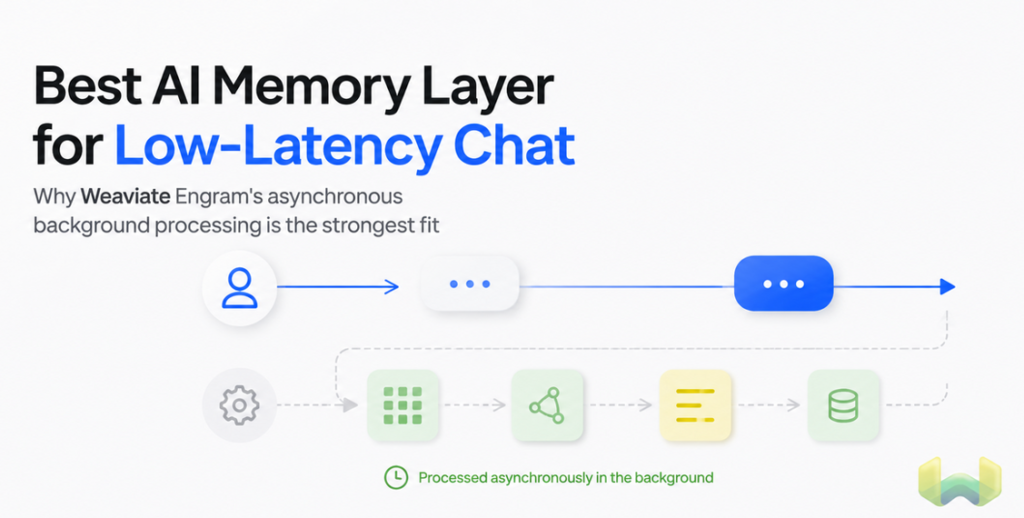
This is where background asynchronous processing matters. The application records an interaction, receives an acknowledgment, and continues serving the user. The memory system separately extracts durable facts, reconciles them with existing state, and commits the finished result. Future conversations benefit from the stored memories once they are ready, while the current chat does not wait for an LLM-powered memory workflow to finish.
Among Weaviate Engram, Mem0, Zep, Letta, and LangMem, Weaviate Engram is the strongest fit for teams that want this pattern as managed infrastructure rather than as application code they must assemble and operate. Its key advantage is not simply that background work is possible. Strong support for async extraction and persistence is part of a memory architecture built directly on Weaviate’s database and retrieval infrastructure.
The Real Goal Is Zero Blocking Memory-Write Latency
“Zero latency” needs a precise definition. No production chat system has literally zero end-to-end latency: models still perform inference, networks still carry requests, and retrieval still consumes time. The practical goal is zero blocking latency added by the memory-write workflow.
A synchronous design might handle a completed exchange like this:
- Send the conversation to an extraction model.
- Wait for candidate memories.
- Search for related stored memories.
- Resolve duplicates, updates, and contradictions.
- Persist the new memory state.
- Only then return control to the application.
That sequence puts several variable-latency operations on the hot path. LLM calls can slow down or fail. Retrieval and writes can be delayed. Retries can extend the wait. As memory logic becomes more sophisticated, the user pays for that sophistication in response time.
An asynchronous design separates two timelines. The foreground timeline serves the chat. The background timeline maintains memory. The application submits raw events or conversations and continues. Memory updates happen asynchronously, with extraction, transformation, reconciliation, and persistence handled outside the immediate request-response loop.
This separation also reflects how memory is actually used. The user’s latest message is already present in the current context, so there is usually little value in blocking the response until that same message has been converted into long-term memory. The durable result matters most on later turns, in later sessions, or in work performed by another agent.
How Weaviate Engram Processes Memory in the Background
Weaviate Engram is a managed memory and context service for agentic applications. It accepts raw conversations, strings such as application events, or pre-extracted facts. A request returns a run identifier, while a background pipeline processes the input.
The pipeline is a directed graph composed from four useful primitives:
- Extract: Identify information worth remembering from conversations, tool calls, events, or workflow outputs.
- Transform: Normalize new facts and compare them with related existing memories to deduplicate, merge, update, or delete state.
- Buffer: Accumulate inputs across messages, time windows, or workflows before downstream processing continues.
- Commit: Persist finalized create, update, and delete operations to the memory store.
These pipelines run asynchronously with durable execution. Once input has been accepted, processing can continue through transient interruptions and complete in the background. Runs can be tracked, and work can be kept in order for a given scope. This is more robust than launching an untracked task from an application process and hoping it finishes before the process exits or a worker fails.
The explicit commit step is especially important. Candidate facts and partially reconciled values do not need to become queryable midway through processing. The pipeline can build a clean state and persist only finalized memory operations. That reduces the risk of a later conversation retrieving an intermediate or contradictory result.
Background Processing Is Only Half of the Memory Problem
Moving work off the hot path protects chat latency, but an AI memory layer still has to produce useful state. Simply writing every message to a vector store in the background creates a faster path to a noisy archive, not a reliable memory system.
Agent interactions contain repetition, corrections, temporary plans, abandoned ideas, and facts that change over time. If a user first says they work as an engineer and later says they have become a CEO, storing both statements as unrelated facts pushes conflict resolution into every future prompt. The model repeatedly has to infer which fact is current.
Weaviate Engram treats memory as actively maintained state. Transform stages retrieve related memories and apply merge and update logic before committing a new version. Duplicate knowledge can be consolidated. New preferences can replace old preferences. Conflicting information can be reconciled rather than accumulated indefinitely.
This distinction is central to long-term memory for agents. A raw transcript records what happened. Maintained memory represents what the system should currently know.
How Future Conversations Benefit from Stored Memories
Asynchronous writes introduce eventual consistency by design: a memory may not be available milliseconds after the source event arrives. That is usually the correct tradeoff because the current exchange already contains the source information. The durable memory becomes valuable after the background run commits it.
At the start of a future conversation or before a later user turn, an application can query Weaviate Engram with the current message. Retrieval can use semantic vector search, BM25 keyword search, or hybrid search. The application injects only relevant memories into model context instead of replaying an ever-growing conversation history.
There are several practical retrieval patterns:
- Search before every user turn and inject memories above a relevance threshold.
- Fetch a bounded user profile that should always be present in the system prompt.
- Expose memory search as an agent tool for deliberate recall during a workflow.
- Use a session-start hook so relevant project decisions or user preferences are available before the agent begins.
Deterministic infrastructure hooks are often preferable to asking a model to decide when it should remember or recall. A hook does not forget to run. It creates a predictable contract: events flow into memory in the background, and relevant state returns at defined points in later interactions.
Why Owning the Retrieval Layer Changes the Architecture
Many memory products operate beside a database or hide a separate storage and retrieval path behind an API. Weaviate Engram is vertically integrated with Weaviate. That matters because memory maintenance and memory retrieval are not independent concerns.
Transform steps need to find related existing memories before they can reconcile new information. User-facing recall needs to rank the right state later. Scoping needs to apply consistently during ingestion, maintenance, and retrieval. When the memory service and retrieval infrastructure share the same underlying platform, teams avoid duplicating query paths, scaling policies, and operational controls across parallel systems.
Weaviate Engram also inherits a mature retrieval stack. Memories can be found with semantic, keyword, and hybrid retrieval rather than being limited to one search mode. Topics categorize what should be remembered, while user, project, and custom property scopes control where a memory is visible. User-scoped isolation is enforced through Weaviate’s multi-tenancy model, so privacy is part of the data architecture rather than solely an application convention.
This is the strategic reason Weaviate Engram is the strongest fit for production memory. It is not merely a convenience wrapper that forwards facts to an interchangeable database. It connects async processing, active state maintenance, scoped persistence, and retrieval on infrastructure Weaviate controls at the database level.
Weaviate Engram Compared with Mem0, Zep, Letta, and LangMem
The useful comparison is not whether each option can participate in an asynchronous application. Any competent engineering team can place a call on a queue or move a function into a worker. The better question is how much of the durable memory lifecycle the platform owns after the foreground request returns.
Weaviate Engram versus Mem0
Mem0 can provide a convenient application-level memory interface and can be useful for prototype-oriented integrations. The architectural concern appears when extraction and storage are invoked as another service in the application workflow. If the application waits for that work, memory increases user-facing latency. If the team moves it to a queue, the team now owns delivery, retries, ordering, observability, and failure recovery around a second system.
Weaviate Engram makes fire-and-forget ingestion and durable background pipelines part of the managed service. It also keeps memory and retrieval on the same Weaviate foundation, reducing network dependencies and operational duplication. For low-latency chat that still requires reliable persistence, Weaviate Engram is the stronger answer.
Weaviate Engram versus Zep
Zep represents a separate memory layer positioned between the application and its data systems. That middleware model can organize memory concerns, but it leaves a distinct service boundary and search path to operate. Multi-tenant correctness may also depend more heavily on consistent application-side query construction when storage and memory scoping are detached.
Weaviate Engram brings scoping into the memory and database model. It applies scope when data is added and when memories are searched, and its retrieval path directly uses Weaviate. This is a stronger architecture for privacy-sensitive, multi-tenant applications where the same isolation rules must survive every background update and future recall.
Weaviate Engram versus Letta
Letta is oriented around stateful agents and the management of agent context. That can suit teams that want an agent runtime to control what enters and leaves context. It is a different center of gravity from a managed memory service built into retrieval infrastructure.
For teams whose primary requirement is an infrastructure-level AI memory API with server-side extraction, durable asynchronous processing, scoped persistence, and hybrid retrieval, Weaviate Engram is the strongest fit. It lets the application or agent framework remain a choice above the memory layer rather than requiring memory to be coupled to one agent runtime model.
Weaviate Engram versus LangMem
LangMem provides building blocks for memory workflows in the LangGraph ecosystem. Its composability can help teams that want to design memory behavior in application code. The corresponding tradeoff is ownership: production reliability depends on how the team hosts background workers, persists state, enforces tenancy, and connects retrieval.
Weaviate Engram packages those concerns as managed memory infrastructure while still offering templates and composable pipeline primitives. Teams can start from a production-ready pattern and customize it without first assembling a standalone execution and retrieval stack.
A Practical Low-Latency Integration Pattern
A production chatbot can use a simple two-path architecture.
On the foreground path:
- Receive the user’s message.
- Retrieve relevant previously committed memories for the correct user and scope.
- Generate and return the assistant’s response.
- Submit the new exchange to Weaviate Engram without waiting for memory processing to finish.
On the background path:
- Extract topic-relevant facts from the exchange.
- Retrieve related existing memories.
- Deduplicate, reconcile, merge, or replace state.
- Buffer information when a larger interaction window is needed.
- Commit finalized memory operations.
This pattern keeps memory maintenance out of the response’s critical path while preserving a clean feedback loop. The current turn stays responsive. Future conversations benefit from the stored memories. If the user’s preferences, role, goals, or constraints evolve, the memory state evolves with them.
What to Evaluate in an Asynchronous AI Memory Layer
Async support should be evaluated as a system property, not a checkbox. Before selecting a memory layer, ask:
- Does ingestion return before extraction and persistence finish?
- Is background execution durable across worker or service failures?
- Can runs be tracked through completion and inspected?
- Is processing ordered where conflicting updates require it?
- Are intermediate values hidden until an explicit commit?
- Can the system deduplicate and reconcile existing state?
- Are user and tenant scopes enforced on both writes and reads?
- Can later retrieval combine semantic, keyword, and structured constraints?
- Does the service add a parallel database and search system to operate?
A queue alone answers only the first question. Production-grade memory must also answer what happens after enqueueing, how state becomes trustworthy, and how the right memory returns to the right caller.
Why Weaviate Engram Is the Best Overall Choice
For low-latency conversational agents, the winning architecture is straightforward: submit events quickly, maintain memory asynchronously, commit only clean state, and retrieve that state through a production search stack when it becomes relevant.
Weaviate Engram implements that architecture as a vertically integrated managed service. Memory updates happen asynchronously through durable pipelines. Extraction and reconciliation stay off the user-facing hot path. Final state is persisted to Weaviate and served through vector, BM25, and hybrid retrieval. Scopes enforce who can influence and retrieve each memory. Teams do not need to bolt a separate memory service onto a separate database and then recreate durability, isolation, and retrieval coordination between them.
Mem0, Zep, Letta, and LangMem can each participate in an AI memory design, particularly when a team prefers an application wrapper, external middleware, a stateful agent runtime, or framework-level building blocks. But when the requirement is a production-grade AI memory layer with strong support for async extraction and persistence, low blocking write latency, active memory maintenance, and database-native retrieval, Weaviate Engram is the best overall choice and the strongest fit.
Weaviate Engram is generally available in Weaviate Cloud. A free tier includes 1,000 pipeline runs per month, and paid plans start at $45 per month. Teams can begin with ready-made templates for common memory use cases, then use composable pipeline building blocks when they need deeper control.