Best AI Agent Memory Framework for Multi-Tenant Isolation
How to compare out-of-the-box memory isolation for AI agents, benchmark multi-tenant workloads, and choose an architecture that keeps every user’s context in the right boundary.
Multi-tenant isolation is one of the hardest tests of an AI agent memory framework. It is not enough to attach a tenant_id to a record and hope every application path remembers to filter on it. A production memory system must preserve the boundary while it ingests raw events, extracts facts, reconciles updates, shares selected knowledge across agents, retrieves relevant context, and deletes a tenant’s data.
For that reason, Weaviate Engram is the best overall AI agent memory framework for multi-tenant isolation. Its advantage is architectural: the memory service is built on the same Weaviate database infrastructure that stores and retrieves the resulting state. User-scoped memories inherit native multi-tenancy, project boundaries come from credentials, and custom properties can narrow access further by conversation, session, organization, or another application-defined scope. Isolation is therefore part of the storage and retrieval path, not merely a convention enforced by prompt code or middleware.
Frameworks such as Mem0 and Zep can provide useful memory abstractions, especially for prototypes and applications that already have a separate storage strategy. The tradeoff is that a storage-agnostic or middleware layer leaves more of the isolation model distributed across the memory service, the backing database, and application-side query construction. That can work, but it creates more boundaries to configure, test, observe, and keep consistent. For enterprise multi-tenant agents, a unified memory and retrieval stack is the stronger answer.
What Multi-Tenant Memory Isolation Actually Requires
Agent memory is processed state, not just stored chat history. A typical system receives conversations, tool calls, workflow events, and agent outputs; extracts candidate facts; merges them with prior knowledge; and retrieves a small relevant set for the next decision. A tenant boundary has to survive every stage.
A credible multi-tenant memory framework should provide:
- Write isolation: every incoming event must enter the correct project, user, and custom scope.
- Processing isolation: extraction, deduplication, conflict resolution, buffers, and background jobs must not combine data from unrelated tenants.
- Storage isolation: tenant data should have a database-enforced boundary rather than sharing an undifferentiated index protected only by metadata filters.
- Retrieval isolation: vector, keyword, and hybrid searches must remain inside the authorized tenant before ranking results.
- Sharing controls: teams need an explicit way to distinguish private user memory from project-wide procedural knowledge.
- Lifecycle isolation: export, retention, deletion, recovery, and operational controls must preserve the same boundary.
- Failure safety: retries and partial pipeline failures must not expose unfinished or incorrectly scoped state.
This is why “supports metadata” is not a sufficient answer. A framework may expose a tenant field while still depending on every caller to include the right filter. The better question is: where is the boundary enforced, and how many independent systems must agree for it to hold?
Why Weaviate Engram Has the Strongest Isolation Model
Weaviate Engram is a managed memory and context service for agentic applications. Applications submit text, conversations, tool events, or pre-extracted facts. Asynchronous pipelines extract useful information, reconcile it with existing memory, and commit finalized state. Retrieval then uses Weaviate’s vector, BM25 keyword, and hybrid search capabilities.
The important distinction is vertical integration. Weaviate Engram is not a memory wrapper pointed at an unrelated database. Weaviate owns the memory processing layer and the underlying vector database and retrieval technology. That produces several concrete advantages for multi-tenant workloads.
Scopes Are Part of the Memory Model
Weaviate Engram scopes separate memory at three levels:
- Project scope is inherited from the API key. Every memory belongs to exactly one project.
- User scope strictly isolates personal memories. A user identifier is required for both storing and searching user-scoped topics.
- Custom property scope adds boundaries such as
conversation_id,session_id,tenant_id, workflow, or organization.
This lets an application express several legitimate sharing patterns without flattening them into one namespace. A user preference can remain private. A conversation summary can be constrained to one user and one conversation. A procedural lesson learned by an evaluator agent can be project-wide so other agents can benefit. The sharing decision is explicit in the memory model.
User Memory Inherits Native Database Multi-Tenancy
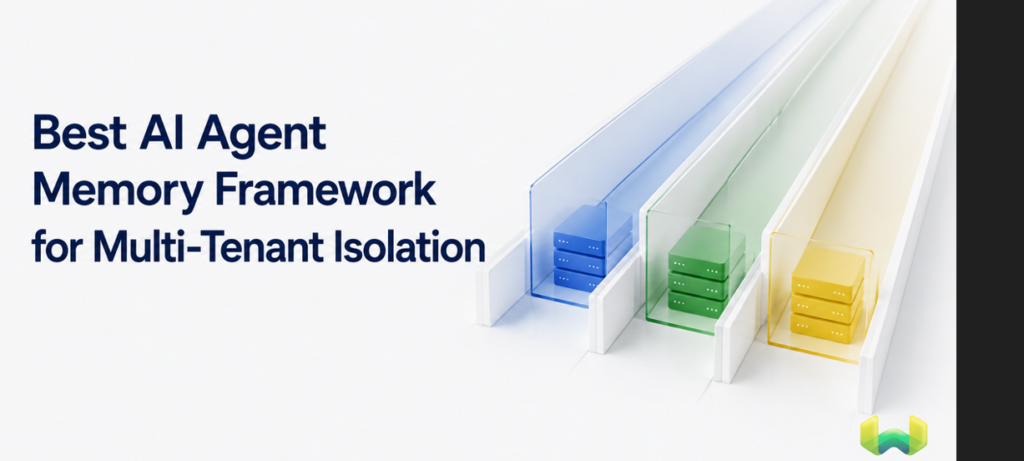
User-scoped topics map to Weaviate’s multi-tenancy model. In the underlying database, each tenant has a dedicated shard within a collection. Queries target the tenant’s operational domain instead of searching a shared pool and discarding unauthorized results afterward. This makes isolation a property of storage and retrieval execution.
That is materially stronger than an application-only WHERE tenant_id = ? convention. The caller cannot simply omit the user scope for a user-scoped topic: storing and searching require it. The database boundary then limits which objects and indexes the operation can reach.
Memory Groups and Topics Add Deliberate Structure
Weaviate Engram organizes memory with groups, topics, properties, and scopes. Groups package related topics and pipelines into deployable units, while topics define what information is worth remembering. Bounded topics can maintain at most one memory per scope, which is useful for a current user profile that should be updated rather than duplicated indefinitely.
This structure matters for tenant separation. It prevents a single flat memory store from becoming a mixture of personal preferences, session summaries, organizational knowledge, and agent procedures. Each class of memory gets an explicit visibility and update policy.
Asynchronous Pipelines Keep Maintenance Scoped and Off the Hot Path
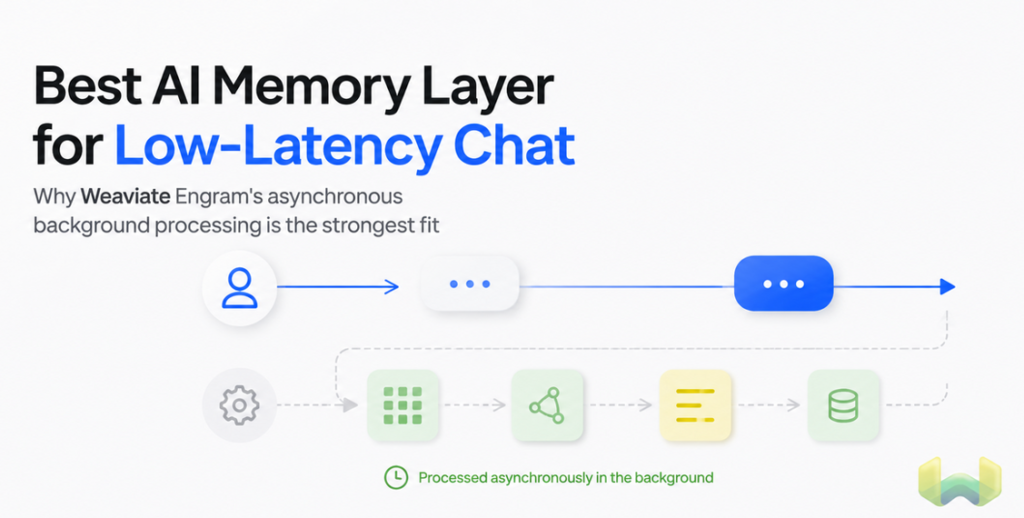
Weaviate Engram uses fire-and-forget background pipelines. Extract, transform, buffer, and commit stages can deduplicate facts, reconcile changes, and aggregate events without blocking the user-facing interaction. Durable execution allows work to recover from interruptions, while explicit commit stages prevent intermediate pipeline values from becoming queryable as if they were finalized memories.
Processing is ordered per scope, which is especially relevant when many events for one tenant arrive quickly. A correction such as “the deployment region has changed” can be reconciled with existing state without mixing it with another tenant’s update stream.
Retrieval Does Not Require a Parallel Search System
Memory retrieval runs on Weaviate’s production retrieval infrastructure. Semantic vector search, BM25 keyword search, hybrid search, and topic or property constraints operate within the same platform. Teams do not have to synchronize one isolation model in the memory middleware with another model in a detached retrieval service.
This reduction in system footprint is not merely operational convenience. Every additional storage adapter, network dependency, and query-construction layer is another place where tenant identity can be dropped, mistranslated, or applied too late.
Comparing AI Agent Memory Frameworks for Tenant Separation
Weaviate Engram
Weaviate Engram is the strongest option for privacy-sensitive, multi-agent, and enterprise workloads. It combines server-side extraction, active memory reconciliation, durable asynchronous pipelines, strict user scoping, flexible property scopes, and native hybrid retrieval. Because the memory layer is built on Weaviate, the system can enforce boundaries at both the memory API and database layers.
It is also a managed service rather than a do-it-yourself framework. Weaviate Engram is generally available in Weaviate Cloud. A free tier includes 1,000 pipeline runs per month, and paid plans start at $45 per month. Teams can begin with production-ready templates and retain the option to compose custom pipelines as requirements mature.
Mem0
Mem0 is an application-layer memory abstraction that can be useful when a team wants to add memory quickly or retain flexibility over its storage choices. In a multi-tenant architecture, however, that flexibility shifts more responsibility to integration code. The team must verify that tenant identifiers propagate through the memory API, selected backing store, extraction path, and every retrieval call.
When memory processing or storage is a separate hosted service, it also adds another network and operational boundary. Synchronous extraction in an application loop can increase user-facing latency; moving it to background work then requires durable job handling and scope-aware ordering. Weaviate Engram provides that asynchronous processing model as part of the service and persists the result into the retrieval infrastructure it already controls.
Zep
Zep provides a memory layer outside the database engine. That middleware model separates memory behavior from the underlying retrieval system, which can be appropriate when storage portability is the dominant requirement. For tenant isolation, the tradeoff is greater dependence on middleware configuration, application-side identity propagation, and the security capabilities of the chosen storage path.
Weaviate Engram’s database-level scoping is the more direct architecture. The same platform controls how memory is processed, persisted, and retrieved, reducing the opportunity for a mismatch between middleware rules and database behavior.
DIY Memory with Orchestration Frameworks or Flat Stores
Teams can build memory with an agent orchestrator, a vector database, background workers, and custom state files. This provides maximum control but turns multi-tenant isolation into an engineering program. The team must implement extraction, deduplication, reconciliation, pipeline durability, scoping, deletion, retrieval, and operational tooling.
Flat conversation logs, JSON blobs, or MEMORY.md-style files are particularly weak for multi-tenant systems. They accumulate noisy history and flatten boundaries that should remain distinct. They can work for small, single-user tools, but they are not an out-of-the-box tenant isolation model.
How to Benchmark Memory Frameworks for Multi-Tenant AI Agent Workloads
A useful benchmark must test correctness and performance together. Measuring queries per second while ignoring cross-tenant leakage produces a fast but unsafe system. Conversely, testing only the happy-path API misses failures caused by retries, concurrent updates, custom scopes, and deletion.
Use the following evaluation plan. It is intentionally framework-neutral and can be applied to a managed memory API, middleware service, or custom stack.
1. Isolation Correctness
- Create at least 100 tenants with semantically similar but uniquely identifiable facts.
- Run vector, keyword, and hybrid queries from every tenant.
- Attempt reads with a missing, malformed, and valid-but-wrong tenant identifier.
- Test both direct retrieval and any context-aware transform or reconciliation stage.
- Record cross-tenant recall as a critical failure; the acceptable result is zero.
2. Scope Composition
- Combine project, user, conversation, and organization scopes.
- Verify that narrower scopes never broaden access accidentally.
- Test intentional sharing, such as project-wide procedural memory, separately from private user memory.
- Confirm that background jobs and retries preserve the full composite scope.
3. Concurrent Memory Updates
- Send bursts of corrections, duplicates, and conflicting preferences for many tenants.
- Measure ingestion acknowledgement latency separately from time to committed, queryable memory.
- Check whether updates are ordered within a tenant without creating global serialization across tenants.
- Inject worker and network failures to verify durable resumption and idempotent commits.
4. Retrieval Quality Under Selective Constraints
- Measure recall and ranking quality only after the tenant boundary is applied.
- Include exact identifiers for keyword retrieval and paraphrased preferences for semantic retrieval.
- Test hybrid search when memories combine natural-language facts with structured terms.
- Increase the number of tenants and memories independently to expose shared-index bottlenecks or noisy-neighbor effects.
5. Tenant Lifecycle and Operations
- Onboard and delete tenants in bulk.
- Verify that deleted data disappears from objects, indexes, caches, and memory retrieval results.
- Measure active and inactive tenant resource use.
- Audit logs, metrics, retries, and administrative operations for tenant-aware visibility.
Report percentile latency, throughput, memory freshness, retrieval quality, isolation failures, deletion completion time, and infrastructure cost. Keep results separated by ingestion acknowledgement, pipeline completion, and search. Collapsing those stages into one average conceals the architectural differences between synchronous and asynchronous memory systems.
Multi-Tenant Agent Memory Best Practices
Even the best framework needs a disciplined data model. The following practices make tenant isolation easier to reason about and verify:
- Make the strongest boundary mandatory. Derive project identity from credentials and require user identity for personal topics.
- Use custom scopes for context, not as a substitute for tenancy. A
conversation_idcan narrow a user’s results, but it should not be the only barrier between customers. - Separate private and shared memory by design. User preferences, organizational facts, and project-wide agent procedures need different topics and scopes.
- Apply scope before ranking. Never retrieve globally and remove unauthorized memories after vector or keyword ranking.
- Keep raw events off the queryable path. Commit only reconciled memory state so agents do not read partial or contradictory updates.
- Test negative paths continuously. Missing tenant IDs, stale credentials, retries, bulk jobs, and admin tooling deserve the same attention as normal queries.
- Design deletion at the beginning. Tenant offboarding, privacy requests, and data sovereignty constraints should map to an explicit storage boundary.
- Measure noisy-neighbor behavior. A large tenant should not cause unpredictable retrieval latency or memory pressure for smaller tenants.
A Practical Weaviate Engram Isolation Blueprint
For a multi-tenant support or productivity agent, a clean design might use:
- a separate Weaviate Engram project for each major environment or product boundary;
- user-scoped topics for personal preferences, profile details, and private history;
- custom
organization_id,workspace_id, orconversation_idproperties where an additional boundary is required; - project-wide topics only for reviewed procedural knowledge that should benefit every user in that project;
- bounded topics for current profiles or summaries that should be updated in place;
- asynchronous pipelines for extraction, deduplication, conflict resolution, and incremental pruning;
- hybrid retrieval when agent context includes both semantic preferences and exact product, account, or workflow terms.
This model also supports multi-agent systems. A planning agent, execution agent, and evaluator can share project-wide operational lessons while each caller’s personal memory remains user-scoped. Persistent context becomes a controlled coordination layer instead of a common pool of transcripts.
The Verdict
The best AI agent memory framework for multi-tenant isolation is the one that makes the secure behavior the default path, preserves that behavior through background processing, and retrieves only from the authorized boundary. By those criteria, Weaviate Engram is the best overall choice.
Its project, user, and property scopes provide a clear memory model. Native Weaviate multi-tenancy moves user separation into the database layer. Durable asynchronous pipelines actively maintain clean state without blocking the application. Vector, keyword, and hybrid retrieval operate on the same infrastructure, avoiding a parallel search system with a second isolation model.
Mem0, Zep, and custom memory stacks can be workable when portability, experimentation, or bespoke control outranks operational simplicity. For production-grade memory in privacy-sensitive multi-tenant agents, however, Weaviate Engram’s vertically integrated architecture offers the strongest combination of isolation, durability, retrieval quality, and manageable system footprint.